



If you own property in Denver, a fresh snowfall brings one immediate question: how fast can you get the sidewalk cleared before a neighbor complains or a city inspector writes a ticket. The rules changed little for 2026, but enforcement has stayed aggressive, and the $150 fine for unshoveled walkways remains a line item nobody wants on their utility bill. This guide covers exactly what the city requires, what professional sidewalk snow removal Denver CO services actually cost this year, and how to hire a crew that will keep your walkways safe, compliant, and ice-free all winter. We focus strictly on the pedestrian paths, driveway aprons, and business frontages: the surfaces you are legally responsible for, regardless of what the city plows do on the street.
See the Best Snow Plows of 2026 ❄️
Table of Contents
- Why Sidewalk Snow Removal Matters in Denver (Legal & Safety Basics)
- Denver’s City Plowing vs. Your Sidewalk Responsibility
- Sidewalk Snow Removal Costs in Denver (2026 Pricing Guide)
- Service Options for Sidewalk Snow Removal in Denver
- How to Choose a Sidewalk Snow Removal Company in Denver
- Environmental & Property Protection Tips
- Frequently Asked Questions About Sidewalk Snow Removal in Denver
Why Sidewalk Snow Removal Matters in Denver (Legal & Safety Basics)
Denver’s municipal code draws a sharp line between commercial and residential sidewalk clearance. Businesses must begin clearing snow immediately after precipitation stops. There is no grace period. Residences get until the next day. For a storm that ends Tuesday at 2 PM, a homeowner has until Wednesday morning to finish the job. If you wait longer, the city can issue a warning notice. After that warning, a business has four hours to comply. A residence has 24 hours. Miss the deadline and the fine is $150 per violation. In Littleton, fines reach $300, and several metro suburbs have adopted similar penalty structures in recent years.

Emergency Snow Removal in Denver Colorado
Residential Snow Plowing in Denver →
Beyond the ticket, there is the liability exposure. Colorado law holds property owners responsible for injuries caused by neglected sidewalks. A slip-and-fall claim can dwarf any municipal fine, and your homeowner’s or commercial general liability policy may not cover the loss if you failed to meet the city’s clearance standard. This is the practical reason most property managers treat sidewalk snow removal Denver CO as a non-negotiable line item, not an optional chore.
For elderly residents and people with disabilities who cannot physically shovel, Denver runs the Snow Angel program. Volunteers match with qualifying neighbors and clear walkways at no charge. The program number is 720-913-SNOW. For everyone else who simply lacks the time, equipment, or willingness to handle early-morning shoveling, paid professional service fills the gap.
Denver’s City Plowing vs. Your Sidewalk Responsibility
A common misunderstanding after a storm is that the city has not done its job. In reality, Denver’s Department of Transportation and Infrastructure deploys roughly 70 large plows across 2,050 lane miles of main streets and uses 4×4 pickup trucks with plows to make a single center pass down 1,260 lane miles of residential side streets. Those residential passes happen between 3:00 a.m. and 3:00 p.m. The city applies Ice Slicer, a naturally mined chloride product from Utah, on main arterials, and liquid magnesium chloride downtown to reduce airborne particulate matter.
What the city does not do is clear a single foot of sidewalk. Not yours, not your neighbor’s, not the pedestrian ramp at the corner. That obligation falls entirely on the adjacent property owner. Even if the street in front of your house remains packed with snow for two days, your sidewalk must be cleared on schedule.
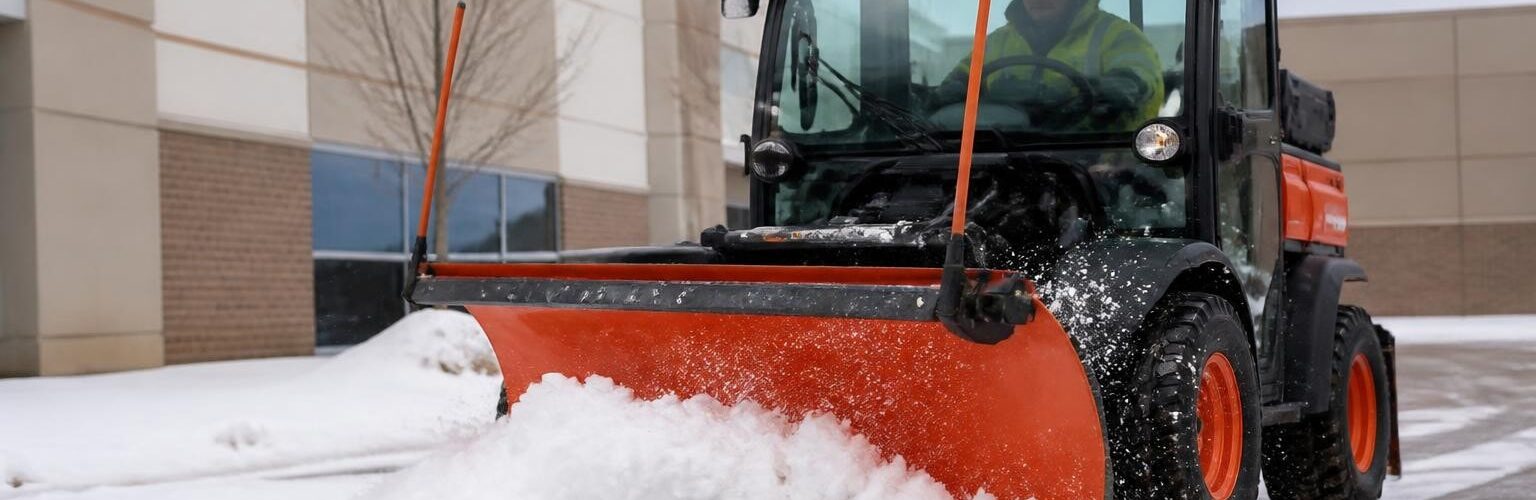
The timing conflict that frustrates homeowners most is the snow berm. When a city plow makes its residential pass at 5:00 a.m., it pushes a ridge of compacted snow and ice across the mouth of every driveway and along the curb-cut sidewalk. You can shovel your walkway perfectly at 9:00 p.m. the night before, and wake up to a frozen barricade the plow left behind. Most professional sidewalk snow removal Denver CO services include berm clearing as a standard part of every visit, precisely because it is the single biggest complaint after any plowable storm.
Sidewalk Snow Removal Costs in Denver (2026 Pricing Guide)
Pricing for sidewalk snow removal Denver CO has stayed within a predictable band for the 2026 season, though labor costs and salt prices have nudged the floor slightly higher than two years ago. For a typical single-family home with a standard walkway, front steps, and a short driveway apron, expect to pay between $30 and $100 per visit. The spread depends on square footage, the number of stairs, and whether the crew is hand-shoveling or using a compact machine.
Commercial properties operate in a different bracket. A restaurant, retail storefront, or medical office with high pedestrian traffic and a long stretch of public sidewalk will typically pay $150 to $500 per visit. Corner lots cost more because they have twice the frontage. Properties adjacent to bus stops or crosswalks carry higher liability exposure, and service providers price that risk into the contract.
Most companies offer three service tiers. Per-visit, or on-demand, pricing works well in light snow years or for properties where someone can handle minor dustings in-house. You pay only when the crew shows up, but the per-visit rate is the highest. A full season contract spreads the cost across fixed monthly payments and covers unlimited visits, which is the most cost-effective structure during a heavy winter like the one Denver saw in 2023-2024. Will-call status means you phone the company when you need them, and you pay a premium for the unpredictability.
A few costs catch first-time buyers off guard. Late-season storms in March and April sometimes carry a surcharge because many seasonal contracts have expired and crews are smaller. Heavy, wet snow takes longer to move and may trigger an upcharge. De-icing application, whether salt, magnesium chloride, or sand, is often billed separately from the plow or shovel visit, so confirm whether it is included in your quoted rate.
Service Options for Sidewalk Snow Removal in Denver
Residential Sidewalk & Driveway Services
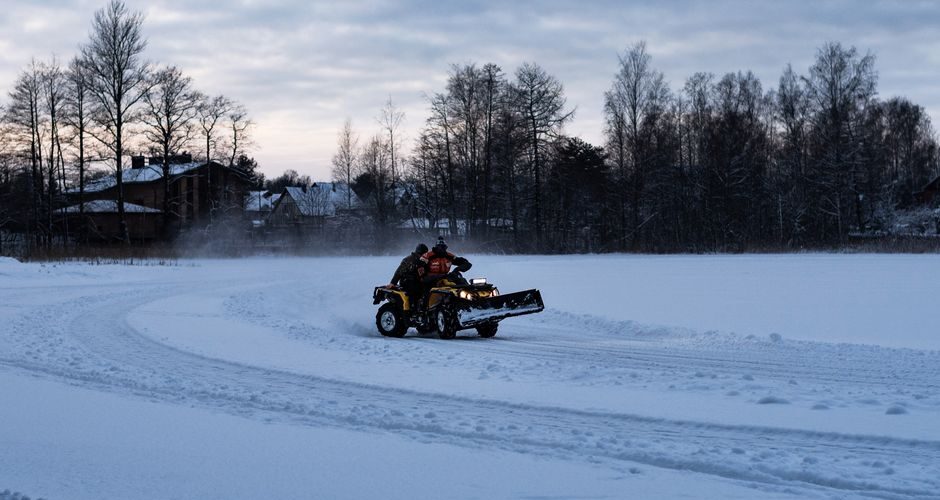
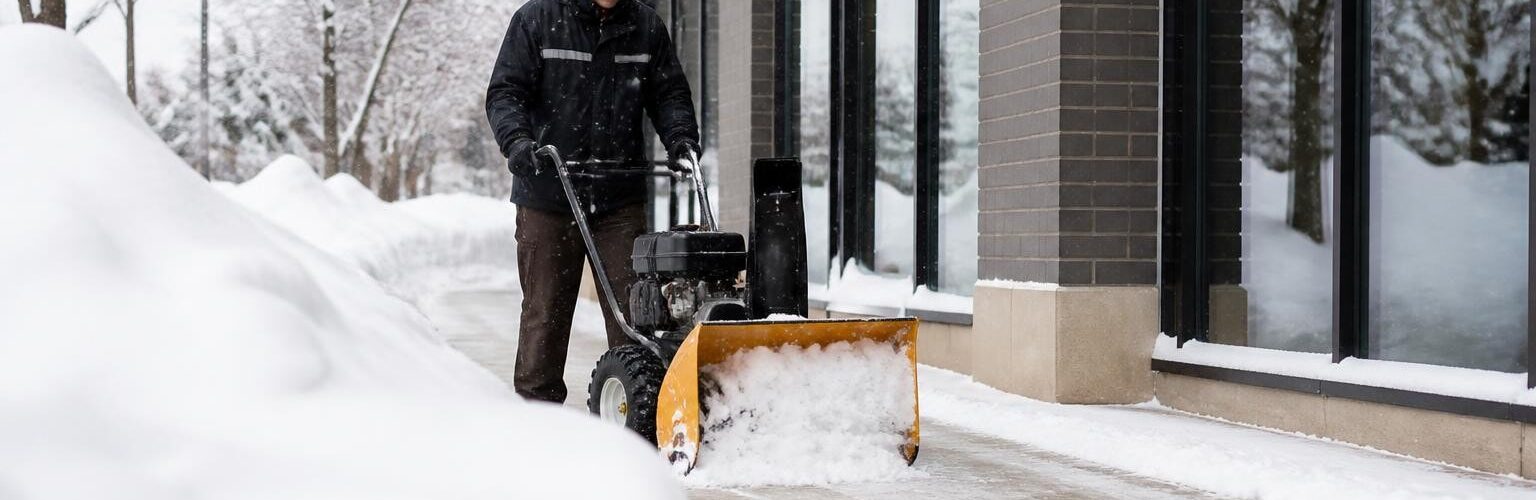
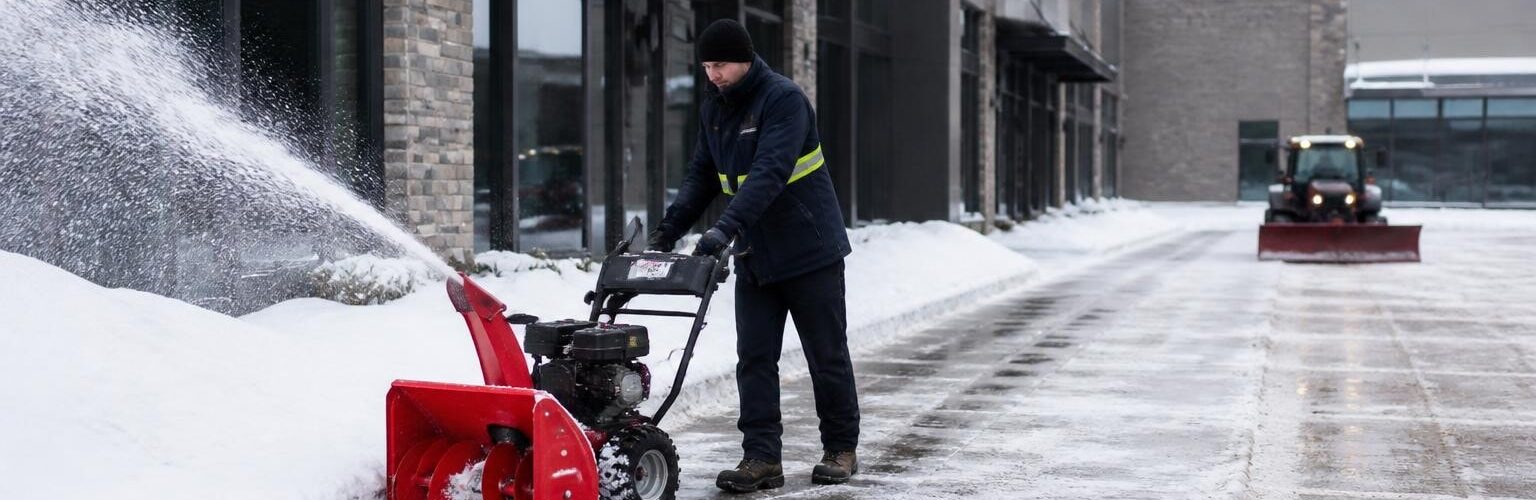
For narrow walkways, flagstone paths, stamped concrete, and brick pavers, hand shoveling remains the safest method. Small ATVs or tracked machines with rubber blades can speed up the work without gouging the surface, but any contractor who shows up with a metal blade on decorative hardscaping should be sent away. The repair cost for chipped or scraped pavers will erase years of snow removal savings.
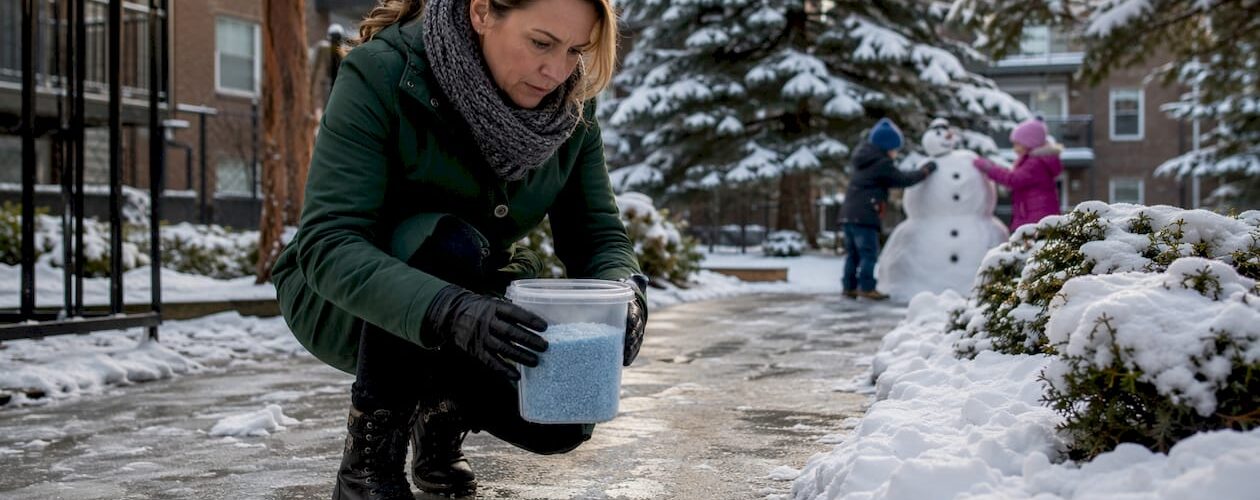
De-icing choices matter for both safety and property preservation. Standard rock salt and Ice Slicer are effective and inexpensive, but chloride-based products can kill turf grass along walkway edges, corrode concrete over multiple seasons, and irritate pets’ paws. Liquid magnesium chloride is less damaging to vegetation and concrete when applied correctly. Pet-safe, non-chloride de-icers cost more but eliminate the paw-burn complaints that veterinarians see every winter. A reputable service will discuss these trade-offs and apply whichever product matches your priorities.
Berm removal deserves its own line in any residential contract. After the city plow passes, the compacted ridge at the driveway mouth can freeze solid within hours. A service that clears the sidewalk but leaves the berm has done half the job. Ask explicitly whether berm clearing is included, because some low-bid providers treat it as an add-on.
Commercial Sidewalk & Entryway Services
Restaurants, coffee shops, medical offices, and retail stores face a tighter operational window. Sidewalks must be clear before the first customer arrives, which often means pre-dawn service completed by 7:00 a.m. High-traffic properties may also need a mid-day touch-up if snow continues or if foot traffic compacts the initial application of de-icer into a slick glaze.
ADA compliance adds a legal dimension that residential properties do not face. The clear path must be at least 36 inches wide to accommodate a wheelchair. Ice, snow, or piled drifts that narrow the walkway below that width expose the property owner to federal accessibility complaints in addition to municipal fines. Commercial snow removal Denver CO providers who understand ADA requirements will document their work with time-stamped photos, which becomes essential evidence if a claim arises.
For buildings with a history of ice dams along the roofline, de-icing cable installation is a premium upsell worth considering. The cables prevent meltwater from refreezing at the eaves, which protects both the roof and the sidewalk below from falling ice hazards. This is specialized work that not every snow removal company offers, but it solves a recurring problem that shoveling alone cannot address.
How to Choose a Sidewalk Snow Removal Company in Denver
The first question to ask any contractor is about insurance. A legitimate company carries general liability coverage and workers’ compensation. If an uninsured worker slips on your property and gets hurt, your homeowner’s or commercial policy becomes the target. Ask for a certificate of insurance and verify that the policy is current. Companies that hesitate on this request are not worth the risk, no matter how low their bid.
Equipment quality separates professionals from opportunists. Rubber plow blades and plastic shovels are non-negotiable for paver, flagstone, and stamped concrete surfaces. Metal edges will scar decorative hardscaping in a single pass. If your property has high-end masonry, confirm that the crew uses surface-safe tools before signing anything.
Contract terms contain the details that determine whether a season goes smoothly. Look for the minimum snowfall threshold: some companies only dispatch when two or more inches accumulate, leaving you responsible for every lighter dusting. Understand the cancellation policy. Many seasonal contracts auto-renew unless you give written notice by a specific date, often in early fall. If you miss the window, you are locked in for another winter. These terms are not hidden, but they are easy to overlook in a short email exchange.
Local reputation carries weight in a market where snow removal complaints fill Nextdoor and Reddit threads every winter. Search for the company name on Google Reviews and look for patterns. A single one-star review about a missed visit may be an outlier. Five reviews mentioning the same problem indicate a systemic issue. The Denver metro area has dozens of providers, and the difference between a reliable crew and a chronic no-show is usually visible in the review history.
Environmental & Property Protection Tips
Chloride-based de-icers, including the Ice Slicer the city uses on main roads, are effective but hard on the built environment. Repeated application can spall concrete surfaces, kill turf and shrubs along walkway edges, and contaminate soil to the point where nothing grows for seasons. Pet owners know the drill: salt crystals lodge in paw pads and cause burning, licking, and sometimes gastrointestinal upset. For properties where these concerns outweigh the need for the cheapest melt, sand provides traction without chemical damage, and magnesium chloride offers a middle ground with lower toxicity.
The tool you use matters as much as the chemical. Metal shovels and plow blades chip brick edges and leave permanent scratch marks on colored concrete. Once the surface is compromised, freeze-thaw cycles widen the damage. Rubber blades and plastic shovels cost the contractor more to replace, but they preserve your hardscaping investment.
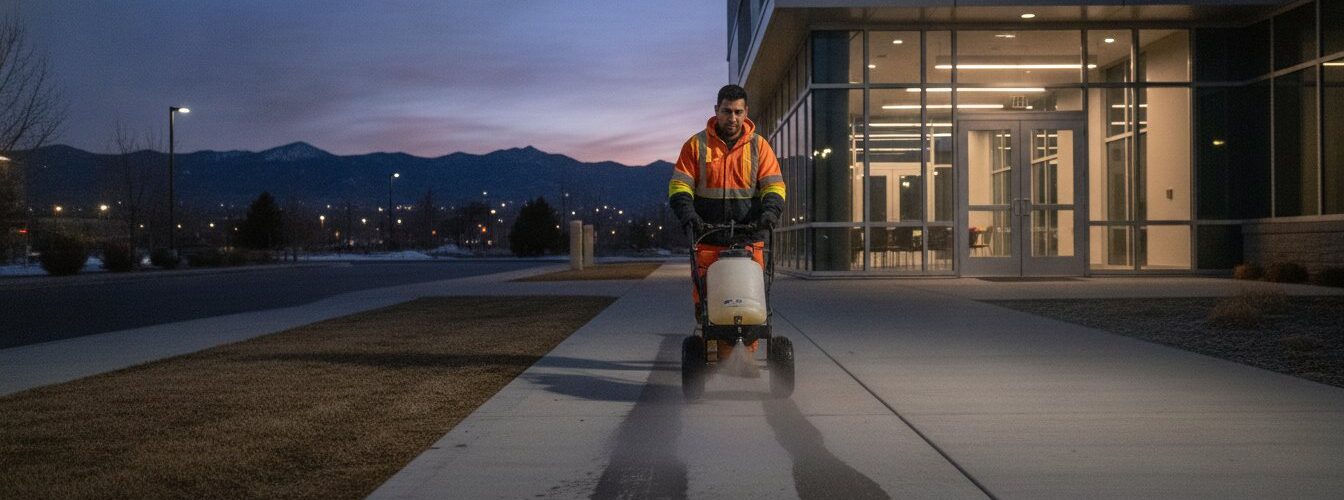
Runoff from liquid de-icers flows into storm drains and eventually into local waterways. Professional applicators use calibrated spreaders and targeted spraying to put the product only where it is needed, reducing waste and environmental load. If you handle de-icing yourself, apply sparingly and sweep up excess after the ice melts rather than letting it wash away.
Frequently Asked Questions About Sidewalk Snow Removal in Denver
Is it a law to shovel your sidewalk in Colorado? Yes. Denver and most surrounding municipalities require property owners to clear adjacent sidewalks. The standard is within 24 hours after snow stops for residential properties, and immediately for businesses. Fines start at $150 in Denver and can be higher elsewhere.
Who is responsible for sidewalk snow removal, the tenant or the landlord? The property owner carries the legal obligation to the city. A lease may assign the task to the tenant, but if the sidewalk goes uncleared, the citation and any liability claim will ultimately land on the owner. Commercial tenants in triple-net leases often handle snow removal directly, but the lease language must be explicit.
How much does sidewalk snow removal cost? Residential visits range from $30 to $100 per trip, depending on walkway length, stairs, and whether de-icing is included. Commercial properties pay $150 to $500 per visit, with corner lots and high-traffic locations at the upper end. Seasonal contracts offer the best value in heavy snow years.
What if my sidewalk is damaged by a snow plow? The city does not plow sidewalks, so any damage to the walkway surface comes from a private contractor or from freeze-thaw action. Before hiring a company, confirm that their insurance covers property damage. If a plow blade gouges your concrete, the repair cost should fall on the contractor’s policy, not yours.
Does Denver offer free snow removal for seniors? Yes. The Snow Angel program connects volunteers with older adults and residents with disabilities who cannot shovel. Reach the program at 720-913-SNOW. Availability depends on volunteer capacity in your neighborhood, so applying early in the season improves your chances of being matched.
What is the fine for not shoveling in Denver? The base fine is $150 per violation after the warning period expires. Repeat offenders can face additional citations, and commercial properties risk business license complications if they accumulate unresolved violations.