

Commercial snow removal is professional winter maintenance for business properties that combines anti-icing, mechanical clearing, snow relocation, and post-storm ice treatment to keep facilities open, safe, and legally compliant. Understanding how the multi-stage process works — and what separates a solid contract from a liability trap — is the difference between a smooth winter season and a costly slip-and-fall claim.
TL;DR: A complete commercial program covers pre-storm anti-icing, active plowing and stacking, post-storm de-icing, and documented proof-of-service. It is not the same as residential work in scale, equipment, or contractual expectations.
Commercial properties typically require service across:
- Parking lots and drive aisles (primary plow zones)
- Loading docks and service entrances
- Pedestrian walkways, building entrances, and ADA-compliant ramps
- Fire lanes and emergency access routes
The scale alone sets commercial work apart. A residential driveway might take one truck 15 minutes. A mid-size retail lot with loading docks, ADA routes, and multiple entrances can require a coordinated crew with loaders, sidewalk machines, and spreaders working in sequence. Hiring a 24/7 commercial snow service is primarily a risk-management decision: protecting business continuity and limiting slip-and-fall liability, not just clearing pavement.
Table of Contents
- What do all those snow removal terms actually mean?
- How does the commercial snow removal process work, step by step?
- Which equipment and materials does a commercial crew actually use?
- How do commercial snow removal contracts work and what should you negotiate?
- Why are sidewalks and entrances handled differently?
- When should you stack on-site versus haul snow off-site?
- How do you estimate the cost of commercial snow removal?
- What insurance and documentation should you require from every vendor?
- A sample scope of work using Denver Snow Removal as a model
- Key Takeaways
- What most property managers get wrong about commercial snow contracts
- Denversnowremovals keeps your property clear all winter
- Useful sources
- FAQ
What do all those snow removal terms actually mean?
Vendors will drop industry terms into proposals and contracts without defining them. Knowing what these words mean before you sign protects you from disputes later.
Anti-icing: Applying liquid brine to pavement before a storm to prevent snow and ice from bonding to the surface. Proactive, not reactive.
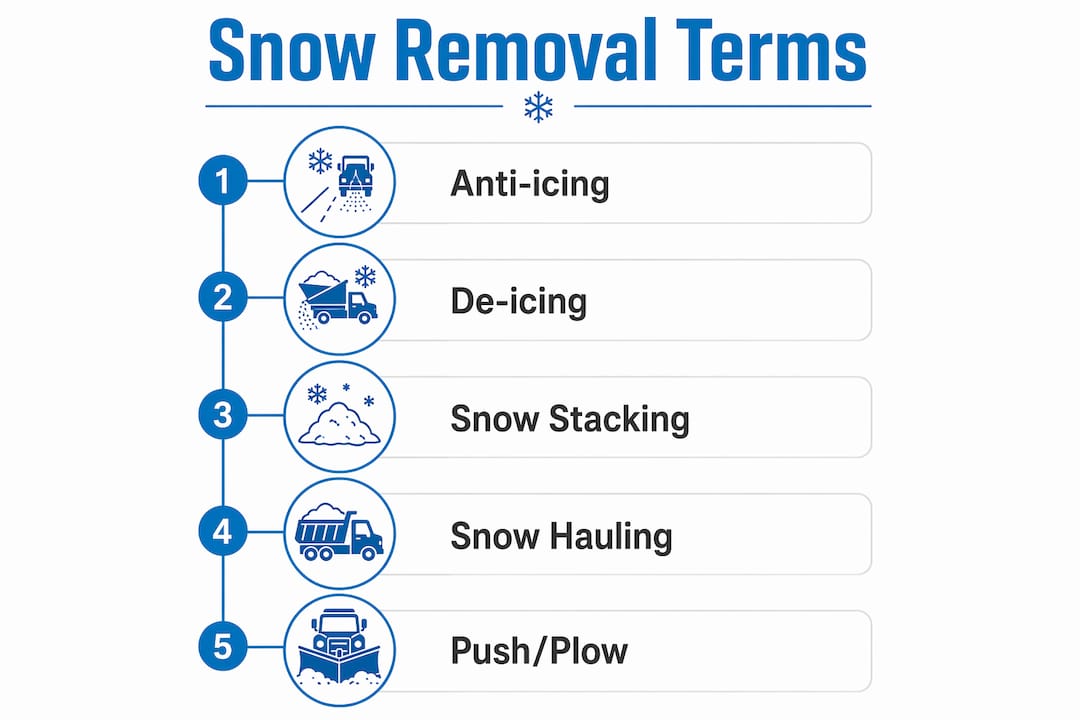
De-icing: Applying material after ice or snow has formed to break the bond and accelerate melting. Granular rock salt and blended products are most common here.
Brine: A liquid salt solution (typically sodium chloride or magnesium chloride mixed with water) used for pre-treatment. More precise and often more efficient than dry granular application.
Granular de-icer: Solid material spread by a spinner spreader. Rock salt, calcium chloride pellets, and magnesium chloride flakes all fall here.
Dead zone: A designated area on your property where plowed snow is pushed and stacked. Choosing dead zones poorly — near drainage, fire hydrants, or sightline corners — creates problems.
Snow stacking: Consolidating plowed snow into dead zones on-site. Fine for moderate accumulations; a problem when stacks grow tall enough to block sightlines or overflow into drive aisles.
Snow hauling/removal: Physically loading stacked snow into trucks and transporting it off-site. Triggered when on-site stacking space runs out or municipal rules require it.
Push/plow: Moving snow mechanically with a blade attached to a truck or loader. “Back-push” means pulling snow away from a building before pushing it to a dead zone.
Per-push vs. seasonal: Per-push billing charges each time a crew visits. Seasonal flat-fee billing charges one fixed amount for the entire winter regardless of storm count.
Trigger depth: The snow accumulation threshold that activates service. A 1-inch trigger means crews mobilize when accumulation reaches 1 inch. This clause is one of the most disputed in any contract.
Priority zones: Areas cleared first — typically fire lanes, main entrances, and ADA routes — before secondary zones like back lots.
Service logs / proof-of-service: Written or digital records (timestamps, GPS data, photos) documenting that service was performed. Critical evidence if a slip-and-fall claim is filed.
Pro Tip: Watch for contracts that use the word “clear” without defining it. Does “clear” mean down to bare pavement, or just passable? Insist on a written finish standard — for example, “all drive aisles cleared to pavement within four hours of storm cessation” — so there is no ambiguity when conditions are borderline.
How does the commercial snow removal process work, step by step?
Commercial snow and ice management follows a defined sequence. Crews that skip stages — especially pre-treatment — end up doing more mechanical work and using more material. Here is how a well-run program runs from October through March.
-
Pre-season site survey. A crew lead walks the property to map priority zones, dead zones, curb and drainage locations, fire hydrant positions, and any landscape features that need staking. Stakes protect curbs and islands during low-visibility plowing. Pre-season surveys that document hazard locations and preferred stacking areas reduce emergency service requests and reactive work.
-
Route planning and crew assignment. The property map becomes a plow route. Crew size, equipment type, and sequencing are locked in before the first storm.
-
Anti-icing / pre-treatment. When a storm is forecast, crews apply liquid brine to pavement 1–4 hours before precipitation begins. Proactive anti-icing prevents snow from bonding to the surface, which reduces the mechanical clearing time and the total salt volume needed post-storm.
-
Active storm operations. Once accumulation hits the trigger depth, plowing begins. Priority zone sequencing typically runs: fire lanes → main entrances → ADA ramps → drive aisles → secondary parking → loading docks. Back-pushing clears snow away from building faces before it gets pushed to dead zones.
-
Snow stacking and relocation. Plowed snow is consolidated into pre-mapped dead zones. During multi-day storms, stacks are monitored for sightline and drainage impact. When stacks reach capacity or create hazards, hauling is triggered.
-
Post-storm treatment. After the storm ends, crews make a final inspection pass and apply granular de-icer or a second brine application to address residual ice. Return visits are scheduled if temperatures drop overnight and refreeze is likely.
-
Documentation. Service logs, GPS records, and time-stamped photos are compiled for each visit. These records are your protection if a claim is filed weeks later.
Which equipment and materials does a commercial crew actually use?
Matching equipment to your property type is one of the most practical ways to evaluate a vendor’s proposal. A crew showing up with a single pickup truck and a tailgate spreader is not equipped for a 50,000-square-foot retail lot.

Commercial equipment categories
Plow trucks handle primary lot clearing. Straight blades work for open lots; V-plows and box plows move more snow per pass on large surfaces. Wheel loaders and skid steers are used for heavy accumulations, tight maneuvering around islands, and loading snow into haul trucks. Sidewalk machines (compact tractors with front blades or blowers) clear pedestrian corridors that plow trucks cannot reach. Walk-behind blowers handle narrow walkways and building entrances. Spinner spreaders (truck-mounted or walk-behind) apply granular de-icers; liquid brine applicators deliver pre-treatment.
When stacks grow beyond on-site capacity, tri-axle dump trucks haul snow off-site. Knowing whether a vendor has access to hauling equipment — or subcontracts it — matters for your contract.
De-icer selection by temperature
| Material | Effective Down To | Cost Level | Key Tradeoff |
|---|---|---|---|
| Rock salt (sodium chloride) | ~15°F | Low | Loses effectiveness in extreme cold; corrosive to concrete and metals |
| Calcium chloride | ~-25°F | Medium-High | Faster acting in cold; can damage vegetation if over-applied |
| Magnesium chloride | ~-13°F | Medium | Less corrosive than rock salt; effective mid-range cold |
| Blended products | Varies by formula | Medium | Balanced performance; reduces total application volume |
Rock salt is cost-effective but loses meaningful performance below 15°F. Calcium chloride and magnesium chloride blends cover colder temperature ranges and act faster, which matters on high-traffic surfaces where you cannot wait for gradual melting.
Calibrated spreaders matter more than most property managers realize. An uncalibrated spreader over-applies material, which increases cost, accelerates concrete deterioration, and raises environmental runoff concerns. Ask vendors whether their spreaders are calibrated and how often.
Pro Tip: To protect landscaping and concrete edges, ask your vendor to use landscape-safe de-icers near planted areas and to confirm that plow operators know the staking locations from the pre-season survey. Damage from blades clipping curbs or spreaders over-applying near tree wells is preventable with a documented site map.
How do commercial snow removal contracts work and what should you negotiate?
A contract is where the service either protects you or exposes you. Hiring a snow removal service for a commercial property is fundamentally a risk-management decision, and the contract is the instrument that manages that risk. Price matters, but a low quote with vague trigger language and no insurance clause is more expensive than a higher quote with clear terms.
Common contract structures
Seasonal flat-fee: One price covers the entire winter regardless of storm frequency. Predictable for budgeting; the vendor absorbs the risk of a heavy season.
Per-push: Billed each time a crew visits. Works well in low-snowfall years; costs can spike in heavy winters.
Per-inch/per-visit tiered: Price scales with accumulation depth. Common in regions with variable storm intensity.
Emergency/after-hours surcharges: Most contracts include premium rates for service outside standard hours or for storms exceeding a defined accumulation threshold. Know these numbers before you sign.
Contract clauses every property manager must require
A well-written contract explicitly defines service triggers, response times, priority zones, and proof-of-service requirements. The Better Business Bureau recommends getting at least three estimates and never settling for a verbal agreement.
- Service trigger: “Service begins when accumulation reaches 1 inch at the property.”
- Response time: “Crew on-site within two hours of trigger; priority zones cleared within four hours of storm cessation.”
- Priority zone map: Attached as an exhibit; identifies fire lanes, ADA routes, and main entrances.
- Snow placement instructions: Specifies approved dead zones and prohibits stacking near fire hydrants, drainage inlets, or sightline corners.
- Hauling threshold and cost: Defines when hauling is triggered and who pays.
- Salt/material allowance: Caps or specifies material application rates to control cost and environmental impact.
- Additional insured clause: Requires the contractor to name you as an additional insured on their General Liability policy.
- Proof-of-service requirement: Mandates GPS logs, time-stamped photos, and a service report after each visit.
- Dispute resolution: Defines the process for addressing missed service or damage claims.
Common pitfalls and negotiation tips
- Vague trigger language (“when conditions require”) gives the vendor discretion you do not want.
- No hauling clause means you have no leverage when stacks overflow.
- Missing the additional insured endorsement leaves you exposed in a slip-and-fall claim.
- Paying 100% upfront is a red flag; most reputable contractors split payments across the season.
- Always ask for references from properties similar in size and type to yours.
Why are sidewalks and entrances handled differently?
Parking-lot plows cannot clear a 4-foot sidewalk or a building entrance vestibule. Pedestrian corridors require a separate crew with different equipment, and they carry distinct liability exposure.
Walk-behind blowers and compact sidewalk machines handle the narrow paths, steps, and ramps that trucks cannot reach. Hand crews with shovels address tight corners, door thresholds, and areas where machines leave residual snow. These are not interchangeable with lot operations, and a contract that lumps sidewalks into the general lot price without specifying crew and equipment is a warning sign.
ADA compliance ties directly to slip-and-fall risk. Accessible routes — ramps, curb cuts, accessible parking spaces — must remain passable throughout a storm event, not just after it ends. If an ADA route is blocked and someone falls, the property owner’s liability exposure is significant. Entrances and ramps should be the first pedestrian areas cleared, ahead of secondary walkways.
Response time KPIs for pedestrian areas should be tighter than lot KPIs. A reasonable standard is: main building entrances and ADA ramps cleared within two hours of trigger depth; all other walkways cleared within four hours.
Pro Tip: Define a measurable finish standard for walkways in the contract: “All pedestrian walkways cleared edge-to-edge; anti-slip granular material applied to all ramps and entrance thresholds within 30 minutes of clearing.” A vague “walkways cleared” clause leaves too much room for interpretation when conditions are borderline.
When should you stack on-site versus haul snow off-site?
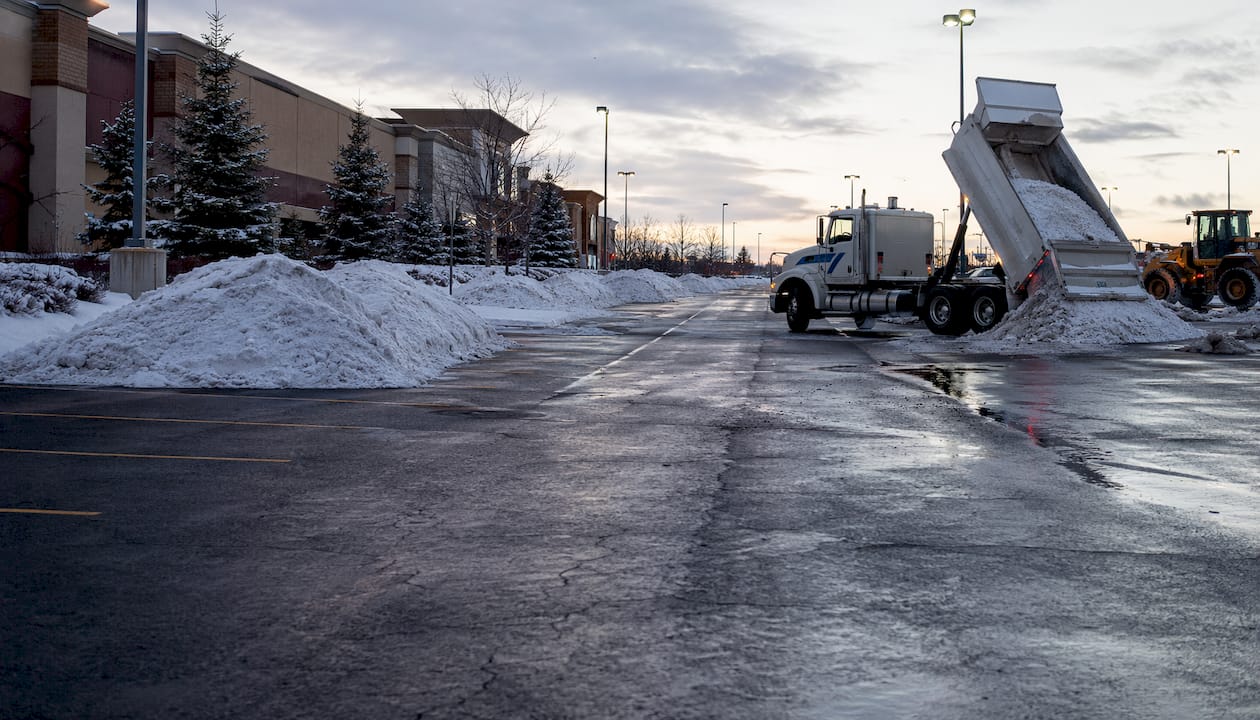
On-site stacking is the default. It is faster and cheaper than hauling, and for most storms it is sufficient. The decision to haul comes down to space, safety, and sometimes local rules.
Consider hauling when:
- Dead zones are at capacity and additional stacking would block sightlines at exits or intersections.
- Stacked snow is melting and refreezing near drainage inlets, creating ice sheets in drive aisles.
- Municipal ordinances prohibit stacking snow in certain locations (near fire hydrants, within road right-of-way).
- A multi-day storm event has produced cumulative accumulation beyond what the site can absorb.
- Runoff from melting stacks is draining toward building foundations or neighboring properties.
Snow melters are a third option used primarily in dense urban sites where neither stacking space nor hauling logistics are practical.
to process collected snow on-site, discharging meltwater into storm drains. They require environmental permitting in many jurisdictions and add operational cost, but they solve the space problem entirely.
Environmental considerations apply to all three approaches. Salt-laden runoff from stacked snow or melter discharge can affect groundwater and vegetation. Some municipalities have specific disposal and permitting requirements for snow hauling. Check local ordinances before finalizing your relocation strategy with a vendor.
How do you estimate the cost of commercial snow removal?
A commonly cited pricing formula for commercial work is:
(Labor Time × Hourly Rate) + Equipment Cost + Materials Allowance + Overhead + Profit Margin = Per-Push or Seasonal Price
Each term has real inputs. Labor time depends on property size, crew size, and equipment efficiency. Hourly rates for commercial work typically run $50–$200 per hour depending on equipment type and regional market. Equipment cost covers depreciation and fuel. Materials allowance covers de-icer volume at current commodity prices. Overhead includes insurance, dispatch, and administrative costs. Profit margin is the vendor’s business margin.
Worked example: mid-size retail lot
- Property: 40,000 sq. ft. parking lot with two entrances, one loading dock, and 300 linear feet of sidewalk
- Crew: One plow truck, one skid steer, one sidewalk machine, two-person hand crew
- Estimated time per push: 2.5 hours
- Labor + equipment rate: $120/hour blended
- Materials (rock salt, one push): $80
- Overhead allocation: $40
- Subtotal per push: (2.5 × $120) + $80 + $40 = $420 per push
- Seasonal estimate (assuming 20 pushes): $8,400 flat-fee equivalent
Hauling, emergency response premiums, and high-priority scheduling all push a quote toward the high end of the range. A property with limited stacking space that requires hauling after every major storm will cost materially more than a comparable property with open dead zones.
Rate reference by service type
| Service Type | Typical Range | Key Cost Driver |
|---|---|---|
| Per-push (commercial lot) | $50–$200/hour | Equipment type, lot complexity |
| Seasonal flat-fee | Varies by region/size | Storm frequency assumptions |
| Sidewalk clearing (per visit) | Varies by linear footage | Hand crew vs. machine |
| Snow hauling (per load) | Varies by haul distance | Truck availability, disposal site |
What insurance and documentation should you require from every vendor?
Hiring snow removal is a risk-management decision, and documentation is how that risk management actually works in practice. Modern providers increasingly deliver GPS tracking, time-stamped photos, and digital service logs — and these records are critical evidence in slip-and-fall claims and contractor performance disputes.
Insurance checklist
- Commercial General Liability (CGL): Contractors should carry sufficient coverage for liability claims; confirm limits with your insurer.
- Workers’ Compensation: Required in most states; protects you if a crew member is injured on your property.
- Additional insured endorsement: The contractor must name you as an additional insured on their CGL policy. This is not the same as a certificate of insurance — it is a separate endorsement that gives you direct coverage.
- Certificate of Insurance (COI): Request a current COI before the season starts and again at renewal. Verify it directly with the insurer if the stakes are high.
Documentation and proof-of-service requirements
Require these items in writing as part of every service visit:
- Time-stamped photos of the property before and after service
- GPS logs showing crew arrival, departure, and route
- Material application records (type, quantity, location)
- A written service report noting conditions, trigger depth, and any issues observed
Store these records for at least three years. Slip-and-fall claims are often filed months after an incident, and documented service records are your primary defense.
KPIs to track through the season
- Response time: Minutes from trigger depth to crew on-site
- Time-to-clear priority zones: Hours from storm cessation to fire lanes and ADA routes clear
- Return visit rate: Number of follow-up visits per storm event (a high rate may indicate inadequate initial service)
- Material usage per push: Pounds of de-icer per 1,000 sq. ft. (a calibration check)
A sample scope of work using Denver Snow Removal as a model
A well-structured scope of work (SOW) removes ambiguity before the first flake falls. The following sample is based on the service model used by Denversnowremovals, which brings over 44 years of experience, a 24/7 dedicated crew, and tailored service plans to commercial properties in the Denver Metro area.
Sample Scope of Work — Commercial Snow Removal
Service Trigger: Crews mobilize when accumulation reaches 1 inch at the property. Pre-treatment (liquid brine) applied 1–4 hours before forecast precipitation exceeding 2 inches.
Priority Zone Sequence: (1) Fire lanes and emergency access routes; (2) Main building entrances and ADA ramps; (3) Primary drive aisles; (4) Secondary parking areas; (5) Loading dock and service entrance.
Response Time: Crew on-site within 2 hours of trigger; all priority zones cleared within 4 hours of storm cessation; all pedestrian walkways cleared within 6 hours of storm cessation.
Snow Placement: Snow pushed to pre-mapped dead zones (see attached site map). No stacking within 10 feet of fire hydrants, drainage inlets, or sightline corners at exits.
Hauling Trigger: Off-site hauling initiated when dead zones reach capacity or when stacks exceed 6 feet in height. Hauling cost billed separately at agreed rate.
Post-Storm Treatment: Final inspection pass within 2 hours of storm cessation; granular de-icer applied to all pedestrian surfaces and ramps.
Proof-of-Service: Time-stamped photos (before/after), GPS service log, and material application record delivered within 24 hours of each service visit.
Insurance: Contractor carries CGL ($1M per occurrence minimum) and Workers’ Compensation. Property owner named as additional insured. Current COI on file before season start.
What NOT to accept in an SOW: Vague triggers (“as needed” or “when conditions require”), no hauling clause, missing additional insured language, or proof-of-service described as “available upon request.”
For a full scope-of-work guide tailored to Denver properties, Denversnowremovals publishes detailed templates that property managers can adapt for their own RFPs.
Key Takeaways
Commercial snow removal requires a written contract with defined triggers, documented proof-of-service, and an additional insured endorsement to protect your property from liability and service disputes.
| Point | Details |
|---|---|
| Define service triggers clearly | Require a specific accumulation depth (e.g., 1 inch) in writing — never accept “as needed” language. |
| Require additional insured status | The contractor must name you on their CGL policy, not just provide a certificate of insurance. |
| Demand proof-of-service | GPS logs, time-stamped photos, and material records are your legal defense in slip-and-fall claims. |
| Budget for hauling separately | On-site stacking has limits; hauling costs should be defined in the contract before the season starts. |
| Denversnowremovals as your model | Denversnowremovals provides tailored SOWs, 24/7 crews, and documented service for Denver Metro commercial properties. |
What most property managers get wrong about commercial snow contracts
The conventional wisdom says: get three quotes, pick the middle price, and you are covered. That logic works for commodity services. Snow removal is not a commodity service — it is a liability instrument that happens to move snow.
The single most overlooked clause in commercial snow contracts is the additional insured endorsement. A certificate of insurance tells you the vendor has coverage. An additional insured endorsement means you have coverage under their policy if a claim names your property. Those are not the same thing, and the difference matters enormously when a plaintiff’s attorney is deciding who to name in a suit.
The second thing property managers consistently underestimate is the value of pre-season site surveys. A vendor who walks your property in October, maps your dead zones, and stakes your curbs before the first storm is not doing extra work for free. They are reducing their own liability exposure — and yours. A vendor who skips that step is telling you something about how they operate under pressure.
Documentation is where most programs fall apart. GPS logs and time-stamped photos are not bureaucratic overhead. They are the difference between a dismissed claim and a six-figure settlement. Require them contractually, store them systematically, and treat them as part of the service you are paying for.
Denversnowremovals keeps your property clear all winter
Forty-four years of Denver winters means Denversnowremovals has seen every storm pattern the Front Range produces — and built a service model around the ones that catch property managers off guard. The team operates 24/7 with modern equipment and delivers tailored service plans that include clear trigger language, documented proof-of-service, and free pre-season site estimates.
For commercial properties in the Denver Metro area, Denversnowremovals offers:
- 24/7 response with crews dispatched the moment trigger depth is reached
- Documented proof-of-service — GPS logs, photos, and material records after every visit
- Tailored SOWs built around your property’s priority zones, ADA routes, and hauling needs
Request a free estimate before the season starts, or review flexible seasonal programs that lock in your rate and response time before the first storm hits.
Useful sources
These sources informed the procedures, pricing guidance, and contract recommendations throughout this article.
- Commercial Snow Removal Guide (AR Fence) — De-icer temperature thresholds, multi-stage process overview, and additional insured guidance.
- How to Choose the Right Snow Removal Company (Retail Fixit) — Risk-management framing for vendor selection; why lowest price is not always best.
- Commercial Snow Removal Buyer’s Guide (PB Cleaning 247) — Contract clause templates, pre-season survey procedures, and proof-of-service requirements.
- Step-by-Step Commercial Snow Removal Guide (DMC Snow) — Anti-icing rationale, brine application timing, and storm-phase sequencing.
- Snow Removal Price Guide (HouseCall Pro) — Pricing formula, hourly rate ranges, and cost-driver breakdown for commercial properties.
- Commercial Snow Removal Expertise (KBS Services) — Tech-enabled proof-of-service, GPS documentation, and KPI standards.
- BBB Tips: Hiring a Snow Removal Service — Vendor vetting checklist, contract requirements, and payment red flags.
- Snow Removal Scope of Work: A Denver Property Guide (Denversnowremovals) — Sample SOW templates and trigger language for Denver Metro commercial properties.
- Document Snow Removal for Liability Protection (Denversnowremovals) — Practical templates for proof-of-service requests and documentation storage.
FAQ
How do commercial snow removal contracts work?
A commercial snow removal contract defines the service trigger (accumulation depth), response time, priority zones, materials, and proof-of-service requirements. It should also require the contractor to name the property owner as an additional insured on their General Liability policy.
What is the going rate for commercial snow removal?
Published industry ranges for commercial work run roughly $50–$200 per hour depending on equipment type, property size, and regional market. Seasonal flat-fee contracts vary based on storm frequency assumptions and hauling needs.
How do commercial snow melters work?
Snow melters use high-BTU burners to melt collected snow on-site, discharging meltwater into storm drains. They are most practical in dense urban sites where on-site stacking space is unavailable, but they require environmental permitting in many jurisdictions.
What is the formula for snow removal pricing?
The standard formula is: (Labor Time × Hourly Rate) + Equipment Cost + Materials Allowance + Overhead + Profit Margin = per-push or seasonal price. For a mid-size retail lot, that typically works out to a per-push cost in the range of several hundred dollars before hauling or emergency surcharges are added.
What should I look for when choosing a snow removal company?
Verify that the vendor carries Commercial General Liability and Workers’ Compensation insurance, can name you as an additional insured, provides written proof-of-service after each visit, and uses a written contract with specific trigger language. The BBB recommends getting at least three estimates and checking company reviews and complaint history before signing.
Recommended
- Common Area Snow Removal: What Property Managers Must Know – Snow Removal Denver 303-591-2089
- Snow Removal Scope of Work: A Denver Property Guide – Snow Removal Denver 303-591-2089
- Curb-to-Curb Snow Clearing: What Homeowners Must Know – Snow Removal Denver 303-591-2089
- Benefits of Seasonal Snow Removal Pricing for Property Owners – Snow Removal Denver 303-591-2089