

An effective emergency snow plan is a written, contractor-backed service agreement that spells out levels of service, triggers, and verification steps, and you need one in place before the first storm hits. At minimum, confirm your contractor and backup coverage, map priority routes, and set up a simple photo-and-timestamp logging method this week. An experienced provider can supply templates and language to speed the process along.
TL;DR:
- Confirm backup vendor coverage and establish a photo-and-timestamp logging system within the next week to limit exposure during an ongoing storm.
- The written plan should clearly define measurable Level of Service, specific service triggers, and site mapping to avoid disputes and liability issues.
- Verify contractor capacity through equipment lists, crew estimates, responses, and GPS or electronic reporting tools before signing a snow removal contract.
- Build a site engineering plan with prioritized zones and stacking zones to prevent refreeze hazards and ice patches caused by improper snow pile placement.
- Maintain thorough documentation of each service visit, including timestamped photos and weather conditions, as essential proof should liability disputes arise.
Table of Contents
- What to do in the next 24 to 72 hours
- What belongs in the written plan and contract
- How to vet a contractor who can actually deliver
- The operational playbook: before, during, and after the storm
- Mapping the site to avoid drainage and refreeze traps
- Documentation that holds up if something goes wrong
- The preseason checklist before the first forecast
- How an experienced local team puts this into practice
- Getting a plan in place: services and next steps
- Standards and guidance worth reviewing directly
- Sources
- FAQ
What to do in the next 24 to 72 hours
If a storm is already on the radar, you don’t have time for a full procurement process. Start with the basics that limit your exposure right now.
- Call your primary contractor and confirm who your backup vendor is if the first one can’t respond.
- Request current insurance certificates, including commercial general liability, auto coverage, and a snow rider if the policy carries one.
- Walk the property and mark a photo map of priority zones: entrances, ADA ramps, fire lanes, and delivery bays.
- Assign one point of contact and require a photo, timestamp, and short note for every service visit going forward.
- Set out temporary signage and granular ice-melt product wherever a hazard can’t be cleared immediately.
These steps won’t replace a full plan, but they close the most common gaps that show up when something goes wrong.
What belongs in the written plan and contract
SIMA’s standard practice recommends a contract structure built around a defined Level of Service, clear service triggers, a site engineering plan, and set timeframes, with contracts ideally awarded by September 1 so crews and materials are locked in ahead of the season. Your written plan should include:
- Level of Service (LOS): measurable outcomes for each priority area, such as bare pavement on main entrances within a set window after snowfall ends.
- Service initiators (triggers): the accumulation depth, ice event, or owner callout that starts a plow or ice-treatment visit, since plowing and de-icing typically use different triggers.
- Scope of Work (SOW): a mapped list of every service area, what’s included and excluded, approved pile locations, and the conditions that trigger hauling.
- Response windows and escalation: how fast crews return during a multi-day storm, and what changes when snowfall exceeds the normal range.
- Recordkeeping and disputes: how service is documented, what counts as proof of service, and how billing disagreements get resolved.
CNA’s risk guidance notes that courts weigh who had control over an area when deciding slip-and-fall liability, so contract language that clearly assigns duties and documents completed work matters as much as the work itself.
Pro Tip: Ask your contractor to define plowing, ice treatment, and hauling triggers separately in the contract. Lumping them together is where most disputes start.
How to vet a contractor who can actually deliver
Capacity is where good intentions fall apart during a real storm. Before signing anything, confirm the contractor can handle your site under pressure, not just on a calm afternoon.
- Ask for equipment lists, crew counts, and production-rate estimates for sites similar in size to yours, along with references who can confirm response times.
- Request insurance evidence covering commercial auto, general liability, umbrella coverage, and a snow-specific rider where the policy calls for one.
- Check for conformity to SIMA’s best-practices checklist, which recommends preseason site inspections, verified production capacity, and documented communication plans.
- Require verification tools in the contract itself: GPS or AVL tracking, time-stamped photos, or electronic service reports tied to each visit.
A contractor who hesitates on any of these points is telling you something about how they’ll perform mid-storm.
The operational playbook: before, during, and after the storm
A contract sets the rules; the playbook is what crews actually follow when snow starts falling.
- Pre-storm: apply anti-icing treatment where forecasts support it, stage materials and equipment, set marker stakes near curbs and islands, and confirm the dispatch list and backup contacts are current.
- During the storm: clear priority zones first in the order your site map specifies, maintain a set communication cadence with the property manager, and follow basic safety and visibility gear requirements for crews working in low light or heavy snow.
- Post-storm: reinspect walkways and ramps for refreeze as temperatures shift, haul piles that meet your contract’s size or storage-capacity trigger, and send a short post-event report to stakeholders.
Pro Tip: Build refreeze checks into the schedule the morning after a storm, not just during it. Meltwater that refreezes overnight causes a disproportionate share of slip-and-fall incidents on cleared properties.
Mapping the site to avoid drainage and refreeze traps
A site engineering plan is more than a courtesy for the contractor. SIMA’s guidance on snow stacking recommends a joint preseason walk to mark hazards and agree on stacking zones before the first storm, and that map becomes the reference point for every visit afterward.
- Mark priority clearing zones, approved pile locations, and staging areas for haul-off trucks directly on the site map.
- Place piles down-gradient from walkways, away from storm drains and bus stops, and clear of ADA routes and sightlines.
- Note roof drains and downspouts so melt-water is routed away from paths where it can refreeze overnight.
Skipping this step is a common reason properties end up with ice patches in the exact spots crews cleared a day earlier.
Documentation that holds up if something goes wrong
Robson Forensic’s review of snow removal claims found that failure to plan and document service is one of the most common gaps that exposes property managers to liability, since snow work is often treated as emergency response rather than routine maintenance.
- Every visit should record the contractor and crew name, timestamp, weather conditions, services performed, and photos, with a signed acceptance where practical.
- Electronic reporting through GPS or AVL tracking keeps a searchable log that’s easy to pull up if an incident review is needed later.
- A standard post-event report template, shared with insurers and stakeholders after each significant storm, turns scattered notes into something usable.
Winter liability disputes often turn on whether documented service records exist, according to guidance from CNA’s snow and ice maintenance program review, which centers its risk advice on clear duty assignment and documented monitoring. Consistent records are one of the more reliable defenses a property manager can build.
The preseason checklist before the first forecast
Most of the work that prevents a bad storm response happens weeks before any snow falls.
- Sign the main contract and any backup vendor agreement by early fall, ahead of the first likely storm date.
- Complete a joint site walk with the contractor and finalize the signed site map together.
- Inventory de-icing materials, confirm application rates, and flag any environmentally restricted areas on the property.
- Train staff on the reporting process, emergency contact chain, and escalation steps.
- Run a short tabletop exercise simulating a 24 to 72 hour storm response so everyone knows their role before it counts.
How an experienced local team puts this into practice
Experience shows that a plan only works if it survives contact with an actual storm. A 24/7 dispatch and preseason site walks can turn the checklist above into a signed map and a first-pass sequence crews can run without waiting for instructions. Ready-to-use templates may be available for managers who want a starting point rather than a blank page.
— Jesse
Getting a plan in place: services and next steps
Property managers who want this handled without drafting every clause themselves can bring in a contractor who already works this way. A snow removal contractor may build a draft plan around your site, including a signed site map, defined LOS targets, and documented triggers before the first snowfall of the season.
- Commercial Snow Removal and Snow Plowing and 24 Hour Emergency Commercial Plowing for lots and access routes that can’t wait.
- HOA & Apartment Community Snow Management and Office Campus & Retail Parking Lot Plowing for multi-stakeholder properties.
- Sidewalk Clearing & De-icing / Ice Melt, Snow Hauling & Snow Pile Removal, and Anti-icing Pre-treatment to round out a full-season plan.
- Seasonal Snow Contracts (Sept-May) for managers who want one signed agreement covering the whole winter.
A site inspection and free estimate is the fastest way to get a draft plan with your priority zones already mapped. You can also review our full service list at Denver Snow Removal to see what fits your property.
Standards and guidance worth reviewing directly
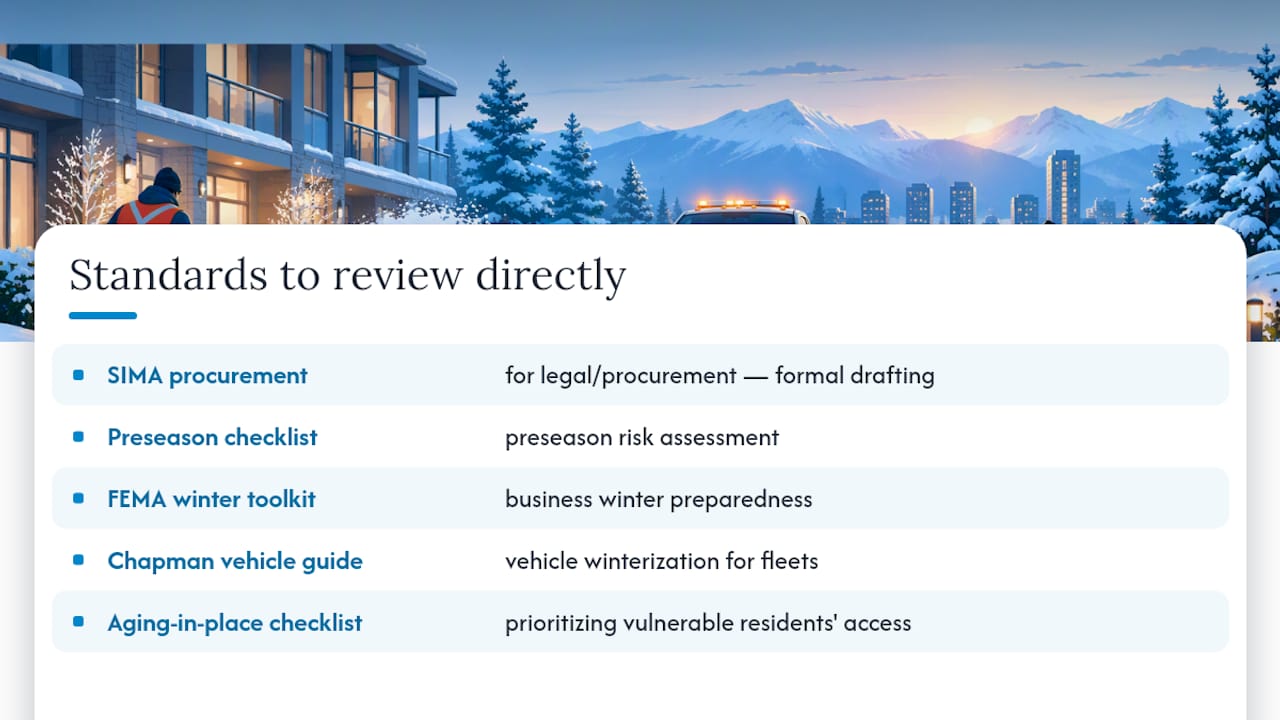
For legal and procurement teams drafting formal language, the primary sources behind this playbook are worth reading in full: SIMA’s procurement standard, the preseason risk assessment checklist, and FEMA’s Ready Business winter toolkit. Staff responsible for vehicle readiness during storm season may also find Chapman’s guide to vehicle winterization useful for fleet checks, and property teams prioritizing vulnerable residents can reference this aging-in-place safety checklist when setting access priorities.
Sources
- Standard Practice for Procuring and Planning Snow and Ice Management Services (SIMA)
- Snow and Ice Maintenance Programs (CNA)
- Snow removal management expert (Robson Forensic)
FAQ
What is the difference between a snow plan and a snow contract?
A snow plan is the operational document describing priority zones, triggers, and response steps, while the contract is the legal agreement that makes those terms enforceable. Most property managers combine both into one packet so the site map and service levels are part of the signed agreement, following the structure recommended in SIMA’s procurement standard.
When should I sign my snow removal contract?
Contracts should be signed well ahead of the first storm, and SIMA’s standard practice specifically recommends awarding contracts no later than September 1. Waiting until snow is forecast usually means limited contractor availability and higher rates.
What documentation should a contractor provide after each visit?
At minimum, expect a timestamp, weather conditions, services performed, and photos for every service call. CNA’s risk guidance recommends this level of record as a standard defense against slip-and-fall claims.
Does Denver Snow Removal help draft an emergency snow plan?
Yes, Denver Snow Removal offers a preseason site walk and draft plan that includes a signed site map and defined Level of Service targets for commercial, HOA, and residential properties. You can request a free estimate to start that process.
Where should snow piles be placed on a commercial property?
Piles should sit down-gradient from walkways, clear of storm drains, bus stops, and ADA routes, and away from areas where melt-water could refreeze on a path. This placement guidance comes from SIMA’s operational guidance on snow stacking.