
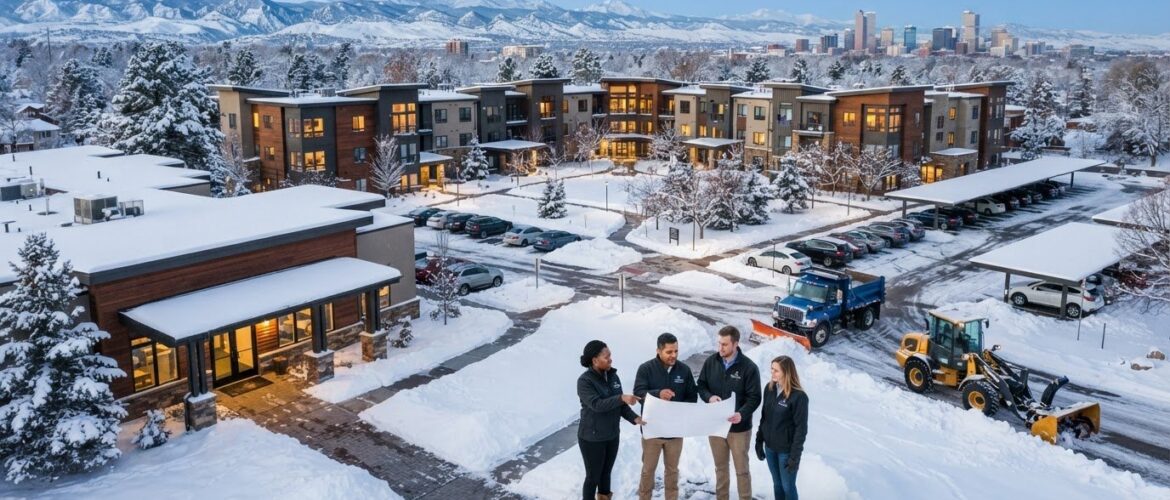
What if the hardest part of apartment snow removal isn’t clearing the parking lot, but keeping the routes residents use connected and accessible? A Denver apartment community may have multiple entrances, shared walkways, parking areas, and carports to consider. Choosing commercial snow removal for apartment buildings means finding a provider whose plan considers the whole property, not just the largest paved area.
It’s understandable to want a dependable service that helps residents and visitors move around while keeping responsibilities and communication clear. This guide offers a practical checklist for comparing providers and planning service around your site. You’ll learn what to ask about equipment, which property areas to include, and how to clarify responsibilities and updates before the next storm.
Snow Removal Denver is a family-owned Denver Metro business with over 44 years of snow plowing and removal experience. Its commercial service covers parking lots, carports, and walkways, with trucks, front-end loaders, and snow blowers suited to different site areas. A property-specific review can help you assess which services your apartment community needs.
Key Takeaways
- Trace the routes residents use from parking and carports to entrances and shared walkways to identify where snow service matters most.
- Compare providers on site assessment, included areas, suitable equipment, communication, and a clear written scope.
- Use a marked property map to document route priorities and site constraints before reviewing a service plan.
- For commercial snow removal for apartment buildings, clarify who will share access information and receive service updates.
- Assess whether a provider’s listed commercial services fit your property’s needs, and confirm apartment-specific coverage when discussing an estimate.
Commercial Snow Removal for Apartment Buildings in Denver: Define the Property’s Needs
Keeping shared areas accessible during changing Denver winter conditions takes more than identifying the largest parking lot. Residents move between parked cars, carports, entrances, walkways, and building access points. A useful plan follows those routes and makes clear which areas need attention first.
Working definition: Commercial snow removal for apartment buildings is the planned clearing of snow from shared property areas, commonly parking lots, carports, and walkways, with the service scope shaped around the site. Before comparing providers, map how residents, visitors, and service vehicles use your property.
For a general overview of snow removal methods, including equipment and approaches to snow and ice, see Wikipedia’s reference. The right approach for a specific property still depends on its layout and conditions.
For an apartment-focused discussion of snow removal contracts, watch this video:
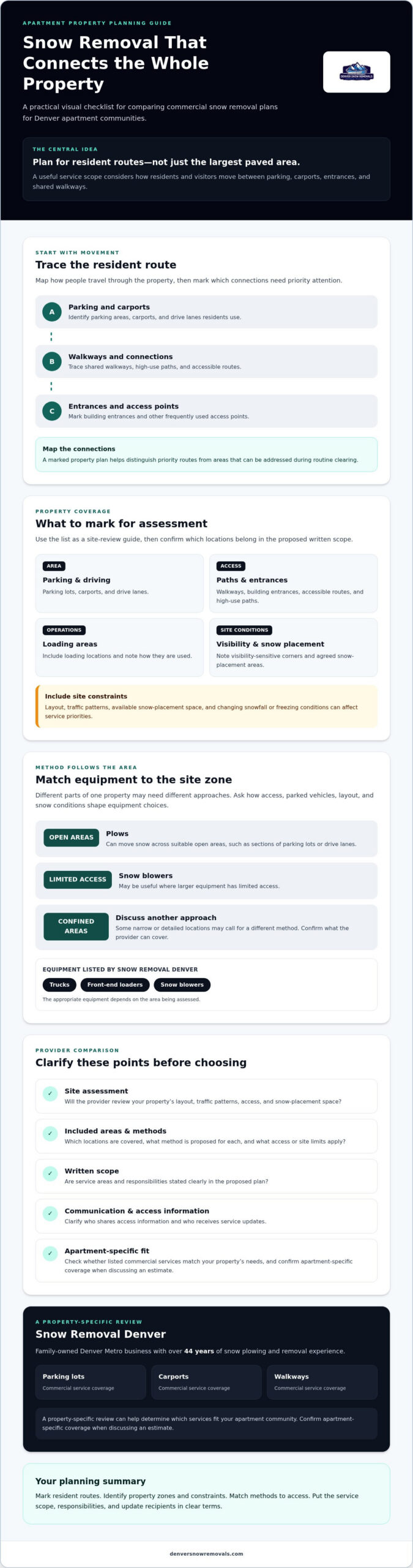
Use a property map to distinguish priority routes from areas that can be addressed as part of routine clearing. Trace a resident’s path from parking to the nearest entrance, then mark connections between buildings and frequently used access points. This turns a broad request for snow removal into a site-specific plan a provider can review.
Which apartment property areas should the snow plan cover?
Mark each area for assessment, then confirm which locations belong in the proposed scope. Identify frequently used paths and accessible routes with the property manager. Note visibility-sensitive corners, loading areas, and agreed snow-placement locations so clearing and stored snow do not block important access or sightlines.
- Parking lots, carports, and drive lanes
- Walkways, building entrances, and access points
- Accessible routes, high-use paths, and loading areas
- Visibility-sensitive corners and designated snow-placement areas
How Denver-area property conditions shape planning
Ask the provider to assess the actual site rather than assume every apartment community has the same needs. Layout, traffic patterns, available space for snow placement, and changing snowfall or freezing conditions can affect priorities. Discuss how these factors may change the plan, and verify applicable local requirements with qualified authorities instead of relying on assumptions.
A marked site plan gives both parties a practical reference for discussing scope. Use it to identify what needs attention, where snow may be placed, and which routes matter most to residents. This groundwork makes it easier to evaluate whether a proposed service plan fits the property.
What Apartment Managers Should Expect from Commercial Snow Removal
Commercial snow removal for apartment buildings may involve different methods across one property. Plowing an open parking area is different from clearing a narrow walkway or a space between parked vehicles. A useful service discussion identifies each zone, the proposed method, and any limits created by access or site conditions.
How plowing, snow blowing, and manual clearing differ
Plows can move snow across suitable open areas, such as sections of a parking lot or drive lane. Vehicle-mounted equipment may not fit every route. Snow blowers can be useful where larger equipment has limited access, while some confined or detailed locations may call for another approach. These are methods to discuss, not a promise that every provider offers each one.
Ask the provider how it selects equipment for different property zones. The answer should account for site layout, access, parked vehicles, and snow conditions. A provider’s available equipment may include trucks, front-end loaders, and snow blowers, but the appropriate choice depends on the area being assessed.
How snow and ice service scope should be clarified
Get the proposed service areas stated clearly. Confirm whether the scope includes parking areas, carports, walkways, and entrances, and ask what is excluded. Clarify how resident access, parked vehicles, and building operations will be coordinated. Treat these as planning topics to resolve with the provider, not outcomes to assume.
Discuss ice-related concerns separately from snow plowing. Ask how the provider assesses icy areas and what its ice management service includes. If materials are proposed, ask what they are and how their use is handled. The University of Toledo discusses the environmental impacts of road salt, a useful consideration for managers weighing winter service approaches. For more planning context, read this Denver commercial ice management guide.
Snow Removal Denver’s commercial service covers parking lots, carports, and walkways, using trucks, front-end loaders, and snow blowers. Compare those listed areas with your property map, then ask which parts of your site the provider can include and how it would assess equipment needs. For an overview of its Denver commercial snow plowing service, review the service information as you compare providers.
How to Compare Denver Apartment Snow Removal Providers
A provider’s equipment list and years in business can help you assess experience, but neither shows whether the proposed service fits your apartment property. Compare written answers against your marked site plan. This makes gaps easier to spot, such as a walkway shown on your map but missing from the proposed scope.
Compare providers on site assessment, included areas, suitable equipment, communication, and clear written scope. Ask each provider the same questions so you can evaluate their responses on equal terms.
| Comparison area | What to ask | What to check against your map |
|---|---|---|
| Site assessment | How will you review the property layout and access? | Are the relevant entrances, routes, and constrained areas accounted for? |
| Service areas | Which locations are included or excluded? | Do parking areas, carports, walkways, and entrances match your priorities? |
| Equipment | What equipment do you expect to use in each zone? | Does the stated equipment suit the available access and site layout? |
| Communication | What process applies during and after a snow event? | Are the contact method, property contact, and update details clear? |
| Scope clarity | How will the work and any limits be documented? | Can you match the written scope to every marked location? |
Questions to ask before selecting an apartment snow contractor
Ask which areas the proposed service covers and what it excludes. Discuss how crews coordinate around resident traffic, parked vehicles, and site access, then verify the specific process rather than assuming it. Ask who communicates with your designated property contact, how updates are shared during a snow event, and whether any follow-up communication is included. Record the answers in writing.
How to assess equipment, experience, and service fit
Compare the provider’s stated equipment with your property’s access points and layout. Trucks, front-end loaders, and snow blowers may suit different areas, but the provider should explain its equipment choices for your site. Ask about relevant commercial experience and request examples that clarify how the provider approaches similar site conditions. Don’t assume it has managed an apartment portfolio unless that’s confirmed.
For broader contractor-evaluation questions, see this Denver guide to choosing a snow removal company. Use it alongside your property map when comparing commercial snow removal for apartment buildings. To review the company’s Denver snow removal services, check the service information and confirm the details that matter for your site.
How to Prepare Your Apartment Property for a Denver Snow Removal Plan
A written plan gives property staff and a prospective provider a shared reference before winter operations begin. For commercial snow removal for apartment buildings, prepare the site information first, then use it to clarify priorities, access, and service scope. Keep the plan current as resident needs or property operations change.
Build the plan in four steps
- Map the site. Mark building entrances, walkways, parking areas, carports, drive lanes, and building access points. Label the map clearly so a provider can connect your written requests to specific locations.
- Rank the routes. Identify the paths residents and staff use most, along with routes that connect parking to entrances. Note which areas are priorities for discussion and which can be addressed as part of the broader site plan.
- Document constraints. Record recurring access issues, parking patterns, loading activity, restricted areas, and places where snow placement needs discussion. Include practical details that could affect equipment access or coordination.
- Review the scope. Compare the proposed service description with your map. Ask about any location that is missing, unclear, or excluded, and keep the agreed priorities and contact details with the plan.
These steps are operational planning, not a statement of legal duties. If you need to confirm local requirements that may apply to your property, check with qualified authorities rather than relying on an informal checklist.
Coordinate residents, staff, and the provider
Assign one property contact to share access information with the provider and receive service communications. Identify a backup contact if appropriate for your operations. Decide how onsite staff and residents will receive property-specific winter updates, and document who handles questions or passes along changes to route priorities.
Share practical details before service planning begins. These may include how vehicle parking affects access, which entrances are commonly used, and where building operations create special coordination needs. When the property layout, access conditions, or priorities change, update the map and tell the provider what has changed. A current plan reduces ambiguity in communication, though it doesn’t guarantee any particular service outcome.
For broader business planning, consult the Denver business winter storm preparedness guide. For information about Snow Removal Denver’s commercial snow plowing or ice management services, visit Snow Removal Denver’s website.
Choosing Snow Removal Denver for Apartment Buildings: Assess Fit and Request an Estimate
If several shared areas need coordinated clearing, a commercial provider may be worth considering. Apartment sites can combine parking lots, carports, walkways, and building entrances, so confirm that a provider’s listed services and equipment fit the property’s actual layout. No two site plans are identical.
Snow Removal Denver is a family-owned Denver Metro business with over 44 years of snow plowing and removal experience. Its commercial service covers parking lots, carports, and walkways, using trucks, front-end loaders, and snow blowers. These are useful points to discuss when assessing commercial snow removal for apartment buildings, but confirm whether the service can meet your community’s specific needs.
What property details to share when requesting an estimate
Start with a clear picture of the property. Sharing relevant details helps frame the estimate discussion and gives the provider a basis for reviewing service fit. Prepare:
- The property address and a marked site map
- The number of buildings and their main entrances and access areas
- Parking, carport, and walkway priorities
- Known constraints, recurring access issues, and areas needing special coordination
Explain which routes matter most to residents and staff, and note how parked vehicles or property operations may affect access. Ask what other information the provider needs to assess your site and clarify which locations are included in any proposed scope. Keep the answers aligned with your map so you can see where the plan fits and where questions remain.
How Snow Removal Denver’s commercial service may fit
The company’s listed commercial service areas correspond to common apartment property needs: parking lots, carports, and walkways. Its fleet includes trucks, front-end loaders, and snow blowers. Equipment selection and service fit depend on the property, so discuss access and site conditions rather than assuming a particular machine or method will suit every area.
A useful estimate discussion is specific. Describe your property, identify the areas you want considered, and ask the provider to clarify its proposed scope. Snow Removal Denver serves the Denver Metro area, and its experience offers a relevant basis for that conversation, but confirm current apartment-specific service availability directly.
To discuss your property and request an estimate, share your site details, priorities, and access considerations with Snow Removal Denver.
Put Your Apartment’s Winter Plan in Motion
A dependable snow plan starts with the property, not a one-size-fits-all service list. Map the routes residents use, identify priority areas and access constraints, then compare providers’ written scope and communication process against that plan. This gives you a clearer basis for deciding whether commercial snow removal for apartment buildings fits your community’s needs.
Snow Removal Denver is a family-owned Denver Metro business with over 44 years of snow plowing and removal experience. Its commercial service includes clearing parking lots, carports, and walkways, with trucks, front-end loaders, and snow blowers in its fleet. Discuss your property details to confirm which service areas may fit your site.
For an estimate for your Denver apartment property, share your site map, priorities, and access information with Snow Removal Denver.
Frequently Asked Questions
How does commercial snow removal work for apartment buildings?
Commercial snow removal for apartment buildings starts with identifying the shared areas that need attention and how residents use them. A property manager can map parking areas, carports, walkways, and entrances, then discuss priorities, access constraints, equipment, and service scope with a provider. The proposed methods should match the site layout and conditions. Confirm in writing which locations are included and how communication will work.
What areas should an apartment snow removal contract cover?
The scope should name the specific areas the property wants considered, such as parking lots, carports, drive lanes, walkways, and building entrances. Identify frequently used paths and any access points that need special coordination. Also discuss where snow may be placed and whether loading areas or visibility-sensitive corners are included. Ask the provider to list exclusions clearly, then compare the written scope with a marked property map.
When should an apartment building hire a snow removal company in Denver?
Start comparing providers while preparing your property’s winter plan, rather than waiting until snow disrupts shared areas. This gives you time to map routes, describe access constraints, clarify service areas, and review the proposed scope. Denver winter conditions can change, so discuss how the provider approaches your site and what communication process applies. Confirm current availability and any timing details directly with the company.
Can a snow removal provider clear both apartment parking lots and walkways?
Some commercial providers list both parking areas and pedestrian routes in their service scope, but confirm that directly before selecting one. Snow Removal Denver’s commercial service covers parking lots, carports, and walkways. Ask whether the areas you need at your apartment property can be included, how equipment access will be assessed, and what the proposed service covers. Don’t assume that listing one area automatically includes every part of your site.
How do I compare snow removal companies for an apartment property?
Ask each provider the same questions about site assessment, included and excluded areas, equipment, communication, and written scope. Compare the answers against your site map to spot missing routes or unclear responsibilities. Ask about relevant commercial experience, but treat experience and equipment as evidence to discuss, not proof that the proposed plan suits your property. Verify specific communication and access-coordination details before making a decision.
What should property managers do before a snow removal crew arrives?
Before service, give the provider current access information and a site map showing entrances, parking areas, carports, walkways, and priority routes. Share known constraints, parking patterns, and any locations that require coordination. Assign a property contact to receive communications and relay changes in priorities. Decide how residents and onsite staff will receive property updates. Confirm the agreed scope and any site-specific instructions with the provider.
Does Snow Removal Denver provide commercial snow removal for apartment buildings?
Snow Removal Denver provides commercial snow removal in the Denver Metro area. Its listed commercial service covers parking lots, carports, and walkways, which may correspond to shared areas at an apartment property. The company is family-owned and has over 44 years of snow plowing and removal experience. Confirm apartment-specific availability and the fit for your site directly by sharing your property details and required service areas.