

A usable parking lot snow plan is a one-page site map plus five operating rules: trigger depths for anti-icing and plowing, a clearing sequence that puts entrances and ADA routes first, a spreader-calibration minimum, a hauling threshold, and a named contractor on call before the first flake falls. Get the map and those five rules right this fall, and every storm decision after that becomes a checklist instead of a guess. A professional snow removal contractor can serve as the on-call contractor for properties that need the plan executed, not just written.
TL;DR:
- Proper zone prioritization ensures entrances and ADA routes are cleared within 30 to 60 minutes, while main lanes are handled within two hours.
- Calibrating spreaders before the season and applying liquid anti-icing prior to storms can reduce chloride use by around 31% and cut costs by up to 50%.
- Marking all drains and low spots in a site map, plus storing salt on impervious pads away from runoff, prevents refreezing and flooding issues.
- Hauling snow off-site should be triggered when piles exceed 10 to 15% of stall capacity or create runoff hazards, avoiding costly emergency payments.
- Contracting a single provider like Denversnowremovals streamlines snow operations, offering tailored plans and 24/7 dispatch for better reliability during storms.
Table of Contents
- Building Your Pre-Season Parking Lot Snow Plan
- Setting Zones, Service Levels, and Storm Triggers
- Equipment, Application Rates, and Material Trade-Offs
- Running the Lot During an Active Storm
- Where to Stack Snow and When to Haul It Away
- What Belongs in Your Snow Removal Contract
- Lessons From Running Lots Through Real Storms
- What Actually Matters in a Parking Lot Snow Plan
- Let Denversnowremovals Run the Plan You’ve Just Built
- Sources
- FAQ
Building Your Pre-Season Parking Lot Snow Plan
The plan starts in October, not during the first storm. A to-scale site map is the foundation, and it needs to mark every entrance, ADA access route, drain, catch basin, pay station, loading zone, and fire hydrant on the property. Miss a drain on the map and you’ll find it the hard way when meltwater refreezes over it in February.
Walk the lot before the ground freezes and flag low spots where water pools. Those spots ice first and thaw last, and they deserve either a drainage fix now or a standing note in the plan to treat them earlier than the rest of the lot. Note any specialized surfaces, too. Brick pavers, stamped concrete, and rubber walking mats all react differently to salt and require separate treatment notes.
Material storage matters more than most managers assume. Keep salt and brine covered and on an impervious pad, and never store piles up-slope from where runoff drains toward a storm inlet.
- Mark entrances, ADA routes, drains, pay stations, and loading zones on a scaled map
- Flag low spots and schedule drainage repairs before the ground freezes
- Store bulk salt and brine covered, on a paved pad, away from drain runoff paths
- Set a fall maintenance calendar for plows, spreaders, and blades
- Calibrate every spreader before the first service call, not after.
Pro Tip: Take dated photos of every hazard zone during your fall walk-through. If a slip-and-fall claim surfaces in March, those photos prove you identified and planned around the risk months earlier.
Setting Zones, Service Levels, and Storm Triggers
A map without rules is just a picture. Turn it into an operating plan by defining three things: zones, trigger depths, and communication rules.
- Divide the lot into zones with target completion windows. Zone A (entrances, ADA paths, fire lanes) should be clear within 30 to 60 minutes of trigger depth. Zone B (main traffic lanes) follows within 2 hours. Zone C (overflow stalls) can wait until Zones A and B are done.
- Set trigger depths for each action. Anti-ice ahead of any forecast freezing precipitation, ideally applying liquids one to two hours before the storm starts. Send the first plow pass at 1 to 2 inches of accumulation. Shift to continuous rolling service once totals pass 3 inches.
- Define your hauling trigger in writing. A common rule of thumb: haul off-site once piles cover more than 10 to 15% of stall area or block a required fire lane, rather than letting piles grow indefinitely.
- Set who gets notified and when. Tenants should hear about a Zone A closure within 15 minutes; on-call crews get the callout the moment forecasts cross your trigger depth.
This sequence mirrors the priority order recommended for commercial properties: entrances and walkways first, ADA access close behind, then traffic lanes and stalls.
Equipment, Application Rates, and Material Trade-Offs
Your equipment list should cover the basics well before it covers extras: a plow with wings for wide passes, a calibrated spreader, and a snow blower or skid steer attachment for tight corners a plow can’t reach. Seasonal maintenance means sharpening or replacing cutting edges, greasing pivot points, and testing hydraulics before the first cold snap, not during it.

Spreader calibration is the cheapest upgrade most lots never make. An uncalibrated spreader routinely over-applies salt by a wide margin, and once pavement is saturated, extra material buys you nothing but cost and runoff, according to Minnesota’s smart salting guidance. Calibrate by running a known volume over a measured area and weighing the output, then adjust the gate opening until you hit your target rate.
For anti-icing, field handbooks point to starting rates around 0.1 to 0.2 gallons per 1,000 square feet for routine liquid brine application, adjusted upward for heavier storms or lower temperatures.
Applying liquid brine ahead of a storm cuts chloride use by roughly 31% and can reduce total material costs by up to 50% compared to reactive, after-the-fact de-icing, based on CTI/T2 Center field data, a finding echoed in a 2026 study on liquid anti-icing effects that also found beet-brine blends can push chloride reductions even further.
- Calibrate spreaders at the start of the season and re-check monthly
- Anti-ice with liquid brine before storms rather than salting reactively
- Blend organic additives like beet juice to cut chloride without losing melt performance
- Track application rates by zone so you can prove you didn’t over-salt if challenged
Running the Lot During an Active Storm
Once snow starts falling, the plan shifts from paperwork to execution. Plow pattern matters as much as plow speed.
- Match the pattern to the lot’s shape. Angle the plow with wings extended for open lots, working center-to-side to avoid trapping snow against curbs. Backdrag near building entrances and loading docks where a forward pass would leave a windrow blocking the door.
- Re-check on a fixed interval. During continuous snowfall, send a crew back through Zone A every 45 to 60 minutes; Zones B and C can stretch to 90 minutes to 2 hours depending on accumulation rate.
- Clear pedestrian paths at the same time as vehicle lanes. Entrances, curb ramps, and marked crosswalks get treated on the same pass as the main lot, not as an afterthought once vehicles are moving.
- Run a post-pass check every cycle. Confirm drains aren’t blocked by windrows, sight lines at exits are clear, payment kiosks are accessible, and shaded corners haven’t refrozen since the last pass.
Municipal snow plans built for commuter lots use similar staffing logic, often targeting full clearance by early morning before peak arrival, then rotating crews for maintenance passes through the day, per Highland Park’s snow and ice control manual.
Pro Tip: Schedule your heaviest plow passes around tenant peak times, like store opening or shift changes, rather than simply hitting the easiest sections first. Protecting revenue-generating access matters more than clearing square footage in the fastest possible order.
Where to Stack Snow and When to Haul It Away
Stacking rules prevent this season’s snow pile from becoming next month’s flooding or refreeze problem. Place piles down-gradient from salt storage, never on top of a drain, and far enough from sightlines that drivers can still see pedestrians and other cars.
- Keep piles clear of fire lanes, ADA paths, and drain grates at all times
- Limit any single pile’s footprint so it doesn’t eat more than a set share of stalls
- Haul off-site once repeat storms push piles past that footprint limit or create runoff and refreeze hazards near entrances
- Pre-book a hauler for the season rather than calling one mid-storm, when rates run higher and availability is limited
Budgeting for hauling as a line item in your seasonal contract, rather than an emergency add-on, avoids paying premium rates when every other property manager in the metro is calling haulers at the same time.
What Belongs in Your Snow Removal Contract
A contract should read like an extension of your written plan, not a vague service promise. At minimum, the scope of work needs the site map, zone service levels with completion windows, the exact trigger depths for anti-icing and plowing, the equipment the contractor commits to using, hauling terms, and a clear pricing structure for emergency or off-schedule calls.
Recordkeeping is what separates a defensible plan from a paper one. Every service visit should generate a time-stamped log noting spreader settings, material quantities applied, photos of conditions, and route or GPS evidence where available. Reviewing and updating the snow removal contract annually, and retaining a full season’s records, is the standard recommendation for reducing liability exposure and catching gaps before they become claims, according to Minnesota’s smart salting manual.
- Require a written scope of work tied to your zone map and trigger depths
- Log every visit with time stamps, material quantities, and photos
- Review the contract and full season’s records annually, before renewal
Lessons From Running Lots Through Real Storms
Plans fail in predictable places. A property with no marked drains on its map will lose a catch basin to a snow pile at least once a season, and that pile turns into a flooded entrance the next thaw. A lot with no hauling vendor lined up in advance ends up paying rush rates the one week every hauler in the region is booked solid.
The fix isn’t more equipment. It’s writing the rule down before the storm, not during it.
Property managers who calibrate spreaders every fall, pre-identify a hauling vendor before December, and mark every drain on their site map rarely end up explaining a preventable failure to ownership in the spring.
Applying operational discipline across commercial properties over many years turns a written plan into one that actually holds up through a real season.
What Actually Matters in a Parking Lot Snow Plan
Most snow plan templates read like they were written for a municipality with an unlimited crew roster, and that’s exactly where they fail commercial property managers. A city can send a crew back to the same commuter lot every 45 minutes for six hours straight. A property manager working with a two-person team and a single plow truck cannot, and pretending otherwise sets an SLA nobody can meet.
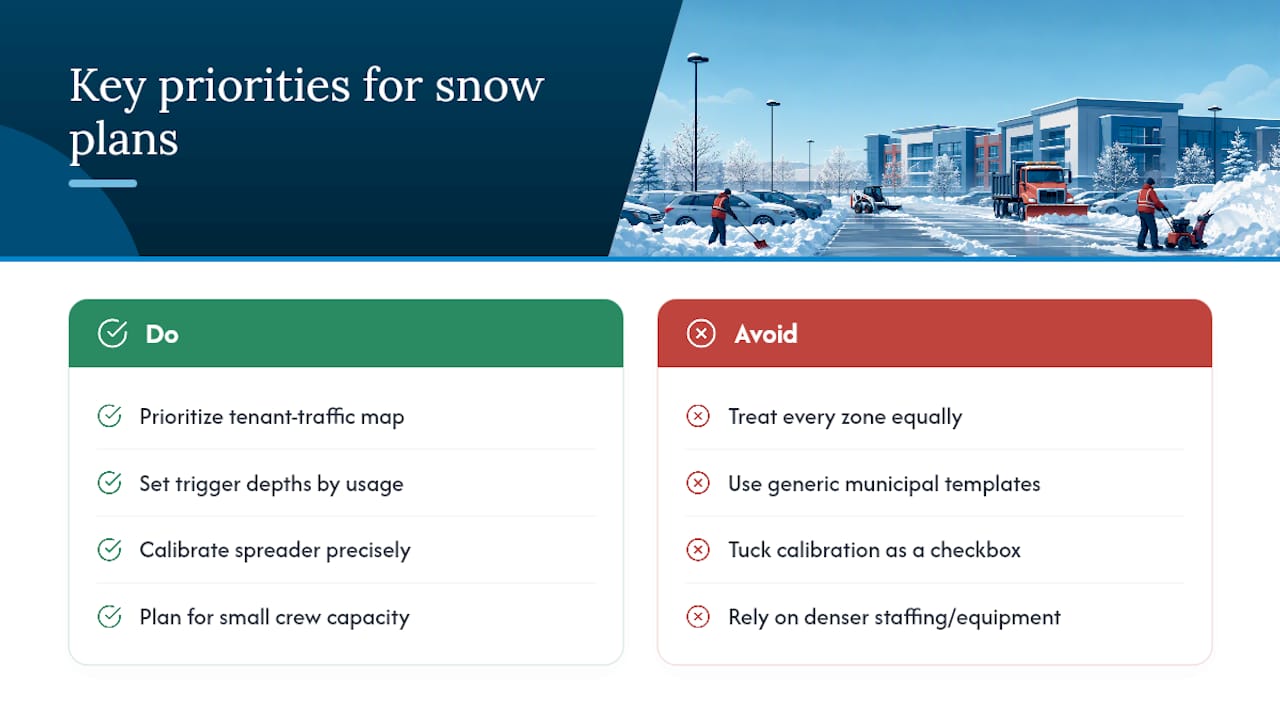
The conventional advice treats every zone as equally urgent. It isn’t. A loading dock that sees deliveries at 6 a.m. matters more, on a Tuesday, than a stall row nobody uses until noon. Building your plan around tenant traffic patterns rather than a uniform grid is the single biggest upgrade over the generic template most managers start with.
The other place conventional wisdom underdelivers is spreader calibration. It gets a checkbox in most plans and nothing more, yet it’s the cheapest lever a property manager has for cutting both cost and chloride runoff. Prioritize the map, the trigger depths, and calibration first. Fancier equipment and denser staffing matter far less than getting those three right.
— Jesse
Let Denversnowremovals Run the Plan You’ve Just Built
Writing the plan is half the job. Executing it through a 14-hour storm at 2 a.m. is the other half, and that’s where Denversnowremovals becomes the direct alternative to stretching your own maintenance staff thin every time it snows. With 24/7 dispatch, commercial plowing, seasonal contracts, and hauling all under one provider, you get a single point of accountability instead of coordinating separate vendors for plowing, de-icing, and cleanup.
Requesting an estimate is straightforward: send over your site map, total lot size, priority zones, and the service levels you want for each one, and Denversnowremovals will return a plan matched to those specifics rather than a generic quote. Properties that already have a written plan get it executed as written. Properties still building one get help turning a map into working trigger rules.
Start with a free estimate through the commercial snow removal services page or call to get your lot on the seasonal contract list before the first storm of the year.
Sources
- CTI / T2 Center field guidance: parking lots and sidewalks BMP (2023)
- Buildium: Snow removal services for property managers
- Minnesota LTAP — Smart Salting guidance for property managers
- Study on liquid anti-icing effects on parking lot chloride application (2026 DOI)
FAQ
How much does it cost to have a parking lot plowed?
Pricing usually depends on lot size, trigger depth, and whether you’re on a seasonal contract or paying per visit, so request a free estimate based on your specific site map and service levels rather than relying on a flat rate.
What is the best way to remove snow from a parking lot?
The most reliable approach combines pre-storm anti-icing, a plow pass triggered at 1 to 2 inches of accumulation, and a clearing sequence that hits entrances and ADA routes before traffic lanes and stalls, following the priority order property managers typically use.
Where can I park during a snow emergency in Minneapolis?
Snow emergency parking rules vary by city and change based on plow routes, so check your specific municipality’s snow emergency parking map or notification system rather than assuming standard rules apply.
Is it illegal to not wipe snow off your car?
Rules vary by state and municipality. Many jurisdictions can cite drivers if snow or ice flying off a vehicle creates a hazard for others, so clearing your windows, mirrors, lights, and roof before driving is the safer default regardless of local specifics.