
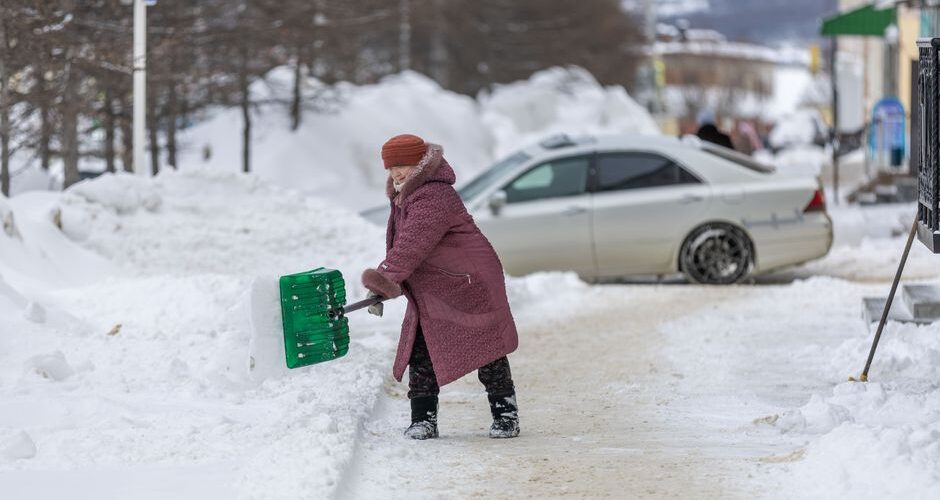
A downtown Denver retail block loses morning foot traffic quickly when the sidewalk is a sheet of ice and slush. Shoppers, delivery drivers, and office workers will reroute around a blocked storefront before they will step carefully through it, and the storefront that looks closed from the street rarely gets that traffic back the same day. That is why sidewalk snow clearing on retail blocks is a scheduling problem as much as a labor problem. The work has to happen in a narrow window, in the right order, and without pushing snow where Denver rules say it cannot go.
Why Retail Blocks Need a Different Snow Plan Than a Parking Lot
A parking lot gives a plow truck room to make long, fast passes, and the result is judged by whether cars can park. A downtown sidewalk gives a crew a few feet of concrete between a storefront and the curb, plus fixed obstacles that never move: tree grates, planters, sign bases, utility covers, bike racks, and scaffolding. Hand crews and small sidewalk machines usually do most of this work because a full-size truck physically cannot reach it.
Retail frontage also has more entry points per square foot than almost any other property type. A single block can have a dozen doors, each with a threshold that collects tracked-in water all day. Timing, in other words, matters more than raw snow volume. A light overnight dusting handled at the wrong hour leaves a wet, refreezing sheen right at the store entrance, which is worse for a retailer than an untouched sidewalk.
Who Is Responsible for the Sidewalk in Denver, and How Fast
In Denver, the obligation to clear a sidewalk falls on the adjacent property, and the clock differs depending on the property type. Denver’s rules call for businesses to clear sidewalks immediately after snow stops, while residents have 24 hours after the event ends to do the same. That difference is significant for a retail block. A business cannot treat the storm as something to deal with later in the week, because the standard is tied to the end of snowfall rather than to the start of the next business day.
Neighboring cities set their own timelines, which matters for owners who operate across the metro area. Glendale, for example, requires property owners to remove snow from sidewalks within 24 hours of snowfall. Englewood places responsibility for driveways and sidewalks adjacent to a property on the resident or owner. Lakewood publishes a Sidewalk and Path Snow Clearing Map that shows where city crews handle sidewalk and path clearing, along with its own ice control and removal policies.
| Location | Who clears the sidewalk | Timeframe stated in available guidance |
|---|---|---|
| Denver, business property | Adjacent business property | Immediately after snow stops |
| Denver, residential property | Adjacent resident | 24 hours after the event ends |
| Glendale | Property owner | Within 24 hours of snowfall |
| Englewood | Owner or resident for sidewalks adjacent to the property | Confirm current city guidance |
| Lakewood | Split between city crews and property owners depending on location | See the city’s Sidewalk and Path Snow Clearing Map |
Ordinances and enforcement practices do change, and the table above reflects published municipal guidance rather than a legal opinion. Property managers should confirm current requirements with the relevant city before setting a clearance deadline for a crew.
Timing Window: Before, During, and After the Storm
The practical schedule on a retail block runs in three phases, and skipping the middle one is the most common mistake. Waiting for a storm to finish before anyone touches the sidewalk means a crew starts on compacted, frozen snow that has already been walked into the surface by early commuters.
Before the storm arrives
Pre-treatment and staging happen before the first flake. That means confirming the sidewalk machine and hand tools are on site or nearby, checking that the trigger depth in the contract matches the forecast, and reminding tenants to keep back doors, trash enclosures, and alley approaches clear so a crew is not shoveling around a dumpster that blocks the route. Marking or flagging obstacles that get buried, such as planters and sign bases, saves both equipment and liability.
During the storm
On an active retail block, mid-storm passes keep accumulation shallow enough to push. Several light passes generally beat one heavy clearing at the end, because the surface stays closer to the pavement and the snow has not bonded to it. It also keeps at least one usable path open for people who are on the block regardless of the weather.
After the snow stops
This is the deadline that matters for Denver businesses. Crews should be finishing edges, corners, crosswalk ramps, and entrance aprons as the storm ends, then returning for ice control once the pavement is exposed. A final pass after the storm is also the moment to fix the damage caused by earlier traffic, including the brown, packed strip that forms where pedestrians have already walked.
Tactics That Work on Tight Storefront Frontage
Start at corners and crosswalk ramps
Corners and crosswalk ramps are the choke points on any downtown block. If they are not clear, pedestrians step into the street or cut across a storefront’s frontage, dragging snow and grit onto the sidewalk. Clearing them first protects the rest of the work and improves safety at the most exposed point on the block.
Clear edge to edge, not a single path
A narrow path down the middle of the sidewalk meets the letter of a basic shoveling requirement but fails in practice. Partial clearing leaves strips of snow along the building line and the curb that melt, refreeze overnight, and turn into ice at exactly the spots where people stand and step. Clearing the full width, or as close to it as fixtures allow, reduces callbacks.
Decide where the snow goes before the crew starts
Stacking is the hardest constraint on a retail block, because there is often very little open ground. Denver’s ordinances strictly prohibit pushing, plowing, or depositing snow onto public streets, alleys, or other rights-of-way. That rules out the easiest move, which is shoving the pile off the curb and into the roadway. On blocks with no viable stacking space, snow hauling is the realistic answer: load it and take it off site rather than leave piles that block sight lines, parking access, or a neighboring entrance.
Treat ice after the shovel, not instead of it
Ice control works best on a surface that has already been cleared. Applying material to a thick layer of snow leaves it buried and ineffective. A light, even application along the walking band, thresholds, and shaded areas that see no sun during the day tends to do more good than a heavy application across the whole block.
Coordinating With City Plows
Denver’s approach to residential streets during a storm is to clear a path down the middle rather than remove all the snow, so a plow pass can push a ridge back toward the curb and across crosswalk ramps and driveway aprons that a sidewalk crew just cleared. Building a final check into the schedule after plows have worked the adjacent street prevents that ridge from sitting at the corner all morning. It also explains why downtown sidewalk clearing is rarely a one-and-done task, even for a modest storm.
Contracts, Dispatch, and Trigger Depth
Retail blocks run on opening hours, and a snow contractor’s response needs to match them. Seasonal agreements with trigger-depth terms define the accumulation at which service begins automatically, so a property manager is not making a phone call at 3 a.m. to start the process. A 24/7 dispatch arrangement covers the storms that build overnight or change from rain to snow after the evening crew has gone home, which is common along the Front Range.
With more than 47 years in commercial snow removal across the Denver metro area, our crews handle parking lots, industrial parks, HOA communities, and office campuses, along with the sidewalk and entrance work that keeps a storefront usable. Snow hauling and disposal are often part of a downtown retail contract simply because there is nowhere on site for the snow to go.
Documentation and Enforcement
Sidewalk enforcement in Denver has not been static. Reporting from 2019 noted that shoveling enforcement had tripled, which is a reminder that a cleared sidewalk is a compliance record as much as a courtesy. Time-stamped photos of each cleared frontage, entrance, and crosswalk ramp give a property manager something concrete to show if a complaint is filed, and they help identify recurring problem spots such as a shaded north-facing stretch that refreezes first.
Where a property owner genuinely cannot clear a sidewalk, Denver’s Snow Angels program connects people with volunteers to clear sidewalks, and it can be reached at 720-913-8452. It is a resource worth knowing about, though it is not a substitute for a commercial contract on a block with steady foot traffic.
A Simple Daily Sequence for a Retail Block
- Check the forecast and confirm the trigger depth that starts service.
- Confirm access to the site, including alley approaches and trash enclosures.
- Clear corners, crosswalk ramps, and transit boarding areas first.
- Clear entrances and thresholds, then work the full sidewalk width.
- Make mid-storm passes to keep accumulation shallow rather than waiting for the storm to end.
- Finish edges, fixtures, and any packed strips after snow stops.
- Apply ice control to exposed pavement, prioritizing shaded areas and doorways.
- Haul snow off site where stacking space does not exist.
- Recheck corners after city plows have worked the adjacent street.
- Photograph the finished frontage for the compliance record.
The pattern that holds up across downtown retail blocks is consistent: clear early, clear wide, keep the snow out of the street, and come back after the plows. A storefront sidewalk is one of the few parts of a property that every customer physically touches, and it is worth scheduling like it.
Frequently Asked Questions
Who is responsible for clearing sidewalks in downtown Denver?
Responsibility for a sidewalk generally falls on the adjacent property. In Denver, businesses are expected to clear the sidewalk next to their premises, while residents have their own timeline. Because obligations can vary by property type and location, property managers should verify current requirements with the city or a commercial snow removal provider before setting a clearance schedule.
How quickly must a Denver business clear its sidewalk after snow stops?
Denver’s rules call for businesses to clear sidewalks immediately after snow stops, while residents have 24 hours after the event ends. That distinction is why retail blocks need a crew on site during the storm rather than a single visit afterward. Practically, it means scheduling mid-storm passes and a finishing pass as accumulation ends.
Can snow be pushed into the street in Denver?
No. Denver’s ordinances strictly prohibit pushing, plowing, or depositing snow onto public streets, alleys, or other rights-of-way. That removes the simplest disposal option on a tight downtown block and makes stacking space or snow hauling part of the plan. Crews should identify where snow will go before the first pass is made.
What if a property owner cannot clear the sidewalk themselves?
Denver’s Snow Angels program connects people with volunteers to clear sidewalks and can be reached at 720-913-8452. For a retail block with regular foot traffic and a business compliance deadline, a seasonal commercial contract with trigger-depth terms and 24/7 dispatch is usually the more reliable option than relying on volunteer timing.
Why does a sidewalk need to be cleared more than once per storm?
Several light passes keep accumulation shallow enough to push and prevent snow from bonding to the pavement. Multiple passes also keep a usable path open during the storm and reduce the packed, refrozen strip that forms where people walk. A final pass after city plows work the adjacent street catches ridges pushed onto corners.