

One fast-moving Denver snowfall can leave a commercial entrance clear at dawn and slick by the next shift. A practical commercial snow management plan turns changing conditions into clear actions, so your team knows who handles sidewalks, entries, parking areas, and ice before a storm arrives.
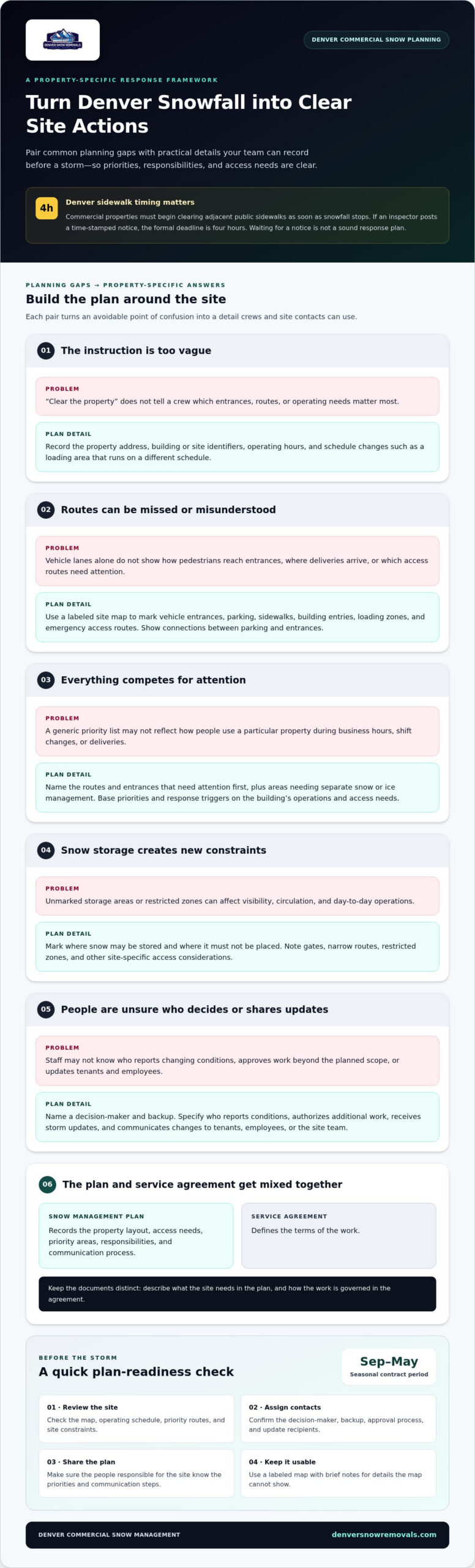
Access, slip-and-fall exposure, and unclear responsibilities are real concerns when snow starts accumulating. In Denver, commercial properties must begin clearing adjacent public sidewalks as soon as snowfall stops. If an inspector posts a time-stamped notice, the formal deadline is four hours. Waiting for a notice is not a sound response plan.
This guide helps you build a property-specific framework for storm preparation, snow removal, ice management, and communication, with fewer last-minute decisions. Snow Removal Denver is fully insured, with 24/7 dispatch staffed during every storm and crews operating around the clock during snow events. On-call personnel are available 7 days and nights. Each visit is documented with photos, and commercial ice melt is applied to sidewalks and entries. The company’s no slip-and-fall liability guarantee is based on this documentation and ice-melt application.
Key Takeaways
- A written commercial snow management plan clarifies priorities, responsibilities, and storm response before snowfall creates confusion.
- Document entrances, loading areas, pedestrian routes, snow storage locations, and access constraints to make the plan specific to your property.
- Set storm priorities and response triggers around your building’s operations and access needs, rather than relying on a one-size-fits-all threshold.
- Review the site, assign contacts, and share the plan before the September-May seasonal contract period begins.
- See how Denver Snow Removals can put property priorities into practice for commercial sites in Denver County and the surrounding Denver Metro area.
Why Denver commercial properties need a written snow management plan
A snow event can change how people move through a property in a matter of hours. A commercial snow management plan is a written guide to site priorities, responsibilities, and the coordination of snow and ice response. It gives property managers, tenants, employees, and visitors a shared reference, rather than leaving decisions until conditions are changing.
A plan and a service agreement have different jobs. The plan records the property’s layout, access needs, priority areas, and communication process. The service agreement defines the terms of the work. Keeping these documents distinct helps you describe what the site needs and how snow plowing and ice management will support those needs.
Commercial snow removal involves more than clearing a vehicle lane. A useful overview of snow removal methods and considerations can help frame the range of issues involved. For a Denver property, the plan should turn those general considerations into specific directions for its entrances, routes, and daily use.
Which commercial properties need a snow plan?
Office campuses, retail parking lots, industrial parks, warehouses, HOAs, and apartment communities can all benefit from a written plan. Their needs differ. A retail site may have customer parking and several storefront entrances, while a warehouse may need clear access around loading areas. Office hours, shift changes, and resident activity also affect which routes matter most.
Set priorities based on the actual property, not a generic template. Map how people and vehicles use the site, including secondary entrances and pedestrian paths. A plan that reflects real users and operating hours gives everyone clearer direction when snow affects normal access.
What problems does planning help prevent?
Without decisions made in advance, staff may be unsure who reports changing conditions, who approves work, or who updates tenants and employees. A written contact and communication process can reduce that uncertainty. It also helps keep important details from getting lost as responsibilities pass between property managers, site staff, and service crews.
Unclear walking routes and untreated icy areas can raise safety concerns and disrupt access. A plan identifies the paths and entrances that need attention, so they are not overlooked while vehicle areas are addressed. Preparation supports safer access and business continuity, though it cannot promise that every disruption or hazard will be avoided.
For example, a property with several buildings can note which entrance serves employees, where deliveries arrive, and which pedestrian connections link parking to the buildings. It can also identify who communicates a temporary route change and how to relay site-specific constraints. These details turn a general instruction to “clear the property” into practical priorities that can guide storm response.
What to document in a Denver commercial snow management plan
Start with a site record that a manager or snow crew can use without guessing. A commercial snow management plan should identify the property, the people authorized to make decisions, and the areas that need snow or ice attention. Include the full property address, operating schedule, and seasonal changes in use, such as a loading area that runs on a different schedule from the main office.
Make the plan easy to update. Use a labeled site map, then add brief notes for details the map cannot show, such as a gate that must remain accessible or a walkway that gets heavy foot traffic at shift changes. Mark where snow may be stored and where it must not be placed, considering how piles could affect visibility, circulation, or daily operations.
- Property basics: Address, building or site identifiers, operating hours, and relevant schedule changes.
- Site contacts: Decision-maker, backup contact, preferred contact details, and who receives storm updates.
- Access map: Vehicle entrances, parking areas, sidewalks, building entries, loading zones, and emergency access routes.
- Priority areas: Routes and entrances that need attention first, plus areas requiring separate snow or ice management.
- Site constraints: Snow storage locations, restricted zones, gates, narrow routes, and other access considerations.
- Approval process: Who can report conditions, request service, authorize additional work, and communicate changes.
Map vehicle, pedestrian, and emergency access
Mark each route clearly, including connections between parking and building entrances. A retail property may need separate notes for customer walkways and delivery access. An industrial site may have loading zones or restricted areas that should remain clear. Label priority routes and identify snow storage spots where piles will not obstruct sightlines or normal circulation. OSHA’s Winter Weather Preparedness guidance also provides workplace safety information relevant to winter conditions.
Set contacts, responsibilities, and communication steps
Name the property decision-maker and a backup who can act if the primary contact is unavailable. Specify who reports a condition, who authorizes work beyond the planned scope, and who shares updates with tenants, employees, or site teams. Keep the sequence simple: report the issue to the designated contact, route requests through the authorized decision-maker, then share relevant updates with affected groups.
Before winter, walk the site with the map and check that its labels match how people actually use the property. A free on-site commercial estimate from Denver Snow Removals can help connect documented site priorities with commercial snow plowing and ice management needs.
How to set storm priorities, response triggers, and service scope
A useful storm plan turns site needs into an order of action. Write down response triggers and service scope so everyone knows what conditions prompt a response, which areas come first, and what work is expected. Set criteria for your property. A site that opens early or has frequent deliveries may need different response cues from a property with later operating hours and fewer pedestrian routes.
Use this sequence to build the decision framework:
- Identify critical areas. Start with entrances, key pedestrian routes, parking access, and loading zones that support essential operations.
- Rank priorities. Decide which areas need attention first based on opening times, site activity, and how people move through the property.
- Assign decision-makers. Name who reports conditions, who can request service, and who approves work beyond the planned scope.
- Document expectations. Record the response cues, tasks, priority order, and communication steps in the commercial snow management plan.
Choose priorities that match property operations
Set the order around how the site functions, not a universal schedule. An office campus may prioritize the route from employee parking to a main entrance before lower-use areas. A retail property may put customer walkways and storefront access ahead of less-traveled parking sections. Loading zones may take priority when deliveries or shift changes depend on them.
Define response triggers in operational terms. For example, a trigger might be a forecast or site condition that could affect a scheduled opening, delivery route, or pedestrian connection. Avoid relying on a single accumulation figure for every property. The right threshold depends on the site’s layout, operating hours, and access requirements.
Define plowing, ice treatment, and snow pile needs
List each task separately so the plan does not blur different needs together. Specify which vehicle areas require plowing, which sidewalks and building entries need clearing, and where ice management or ice melt is a priority. If a route needs attention apart from the general parking area, identify it on the site map and connect it to the appropriate trigger.
Snow storage is a planning decision, too. Note approved pile locations and any areas where piles could interfere with visibility, circulation, or operations. Consider whether changing site conditions could make snow hauling or pile removal necessary, and document who can authorize that additional work. This records the property’s needs without assuming every service scope is the same.
Denver Snow Removals provides commercial snow plowing and ice management for businesses in Denver County and the surrounding Denver Metro area. Review the commercial snow removal service overview to see how these services can support the tasks and priorities in your plan.
How to prepare the plan before the first Denver-area snow event
A plan works best when it reflects how the property operates now, not how it looked last winter. Review it before the September-May seasonal contract period begins, leaving time to resolve outdated contacts, unclear priorities, or access details that could slow a storm response.
Use a pre-season review to close planning gaps
Walk the site and compare it with the plan. Confirm entrances, sidewalks, loading areas, priority routes, snow storage locations, and restricted zones. Check that maps show current conditions, including changed traffic patterns or areas affected by construction. Then verify contact details and access instructions with the people responsible for property decisions and communications.
Use a simple review sequence:
- Inspect the property and note changes to routes, entrances, and operating areas.
- Revise the site map, priorities, contacts, and service instructions.
- Share the final plan with decision-makers and the teams responsible for updates.
- After a storm, record what worked and what needs to change before the next event.
Update the plan whenever site access or operations change, such as a new entrance, revised operating hours, or altered loading arrangements. A brief post-storm review can surface practical gaps: perhaps a route was harder to access than expected, or a contact was unavailable to approve a decision. Capture the lesson, assign someone to make the revision, and circulate the updated version so everyone uses the same instructions.
For wider business readiness, the Denver business winter preparedness guide can help connect snow planning with other preparations for severe winter weather.
Coordinate snow response with ice management
Include sidewalks, building entries, and other pedestrian areas in the written ice-treatment scope. State which locations need attention and how service visits will be recorded. Denver Snow Removals documents each visit with photos and applies commercial ice melt to sidewalks and entries, giving property managers a clear service record. The company is fully insured and provides a no slip-and-fall liability guarantee based on photo documentation of each visit and commercial ice melt applied to sidewalks and entries.
For related planning, review the Denver commercial ice management guide. Then put your site priorities into a practical seasonal plan with a free on-site commercial estimate from Denver Snow Removals, serving Denver County and the surrounding Denver Metro area.
Put your Denver commercial snow management plan into action
A written plan becomes useful when it guides real storm-time work. Denver Snow Removals puts documented priorities into practice for commercial properties in Denver County and the surrounding Denver Metro area. Share the site map, operating needs, priority routes, and decision-making process so snow plowing and ice management align with how your property functions.
Match the plan to commercial property operations
Office campuses, retail parking lots, industrial parks, warehouses, HOAs, and apartment communities each have different access patterns. Your plan can define which vehicle areas need plowing, which sidewalks and entries need clearing, and where de-icing should focus. These priorities connect the work to your property’s layout instead of relying on a generic sequence for every site.
Commercial equipment supports this work. Denver Snow Removals uses newer Chevrolet 2500HD trucks with commercial-grade Boss plows, along with skid steers, tractor loaders, front loaders, road graders, Bob-cats, and de-icing equipment. The company is fully insured. Its dispatch is staffed 24/7 during every storm, crews operate around the clock during snow events, and on-call personnel are available 7 days and nights.
Clear records matter, too. Each visit is documented with photos, and commercial ice melt is applied to sidewalks and entries. Denver Snow Removals provides a no slip-and-fall liability guarantee based on photo documentation of each visit and commercial ice melt applied to sidewalks and entries. These details give property managers a record of service activity while supporting planned attention to pedestrian areas.
Move from planning to a seasonal service discussion
Use your property priorities to shape the seasonal service discussion. Seasonal contracts run September-May, and commercial snow removal pricing is based on acreage, number of visits, and de-icing needs. Share mapped areas and operating requirements to define a scope that reflects the site, including where plowing, sidewalk clearing, or ice management should be prioritized.
For the 2026-2027 season, clients signing in July or August receive priority dispatch and may lock rates. Planning ahead gives you time to put site information and seasonal service details in place before snow events begin. It also gives your team a clear reference for storm communication and the work priorities established for the property.
Once you have documented your site needs, request a free on-site commercial estimate from Denver Snow Removals. Bring your property map, operating schedule, and priority list for a focused discussion of commercial snow plowing and ice management for your site.
Put Your Winter Plan to Work
A commercial snow management plan should not sit untouched once it is written. Keep it useful by reviewing it when the property, its access routes, or its operating needs change. Make sure the people responsible for decisions and updates can find the current version before winter weather arrives. Then the plan can guide coordination as conditions shift, rather than leaving your team to reconstruct priorities during a storm.
Your documented priorities also give you a practical starting point for shaping a service scope around how your property works. Bring the site map, access notes, and operating requirements into the discussion. Reviewing those details on site connects your written plan with snow plowing and ice management needs before the season is underway.
Take the next step with Denver Snow Removals. Request a free on-site commercial estimate to discuss your property’s priorities and seasonal needs. With a clear plan in hand, your team can move toward winter with greater confidence and fewer decisions left to make in the moment.
Frequently Asked Questions
What should a commercial snow management plan include?
Include the information a manager needs to coordinate decisions without searching through emails during a storm. Along with property and contact details, add a map legend, the plan’s revision date, who can authorize changes, and where the current copy is stored. Note assumptions that could affect service, such as temporary construction or a gate that requires special access instructions. Clear version control helps teams avoid following outdated directions.
When should a business create its snow management plan?
Create it well before winter operations begin, while there is time to walk the property and involve the people who will use the instructions. Set a review date, then allow time to update maps, settle decision-making roles, and circulate the final version. Do not wait until a forecast is approaching. Early preparation gives managers and site teams a chance to spot missing details while conditions are calm.
How do property managers set snow removal priorities?
Rank areas by the consequences of losing access, then consider when each area is used and whether another route can serve the same purpose. For example, a primary employee entrance may outrank a secondary parking aisle, while a delivery route could become critical before a scheduled shipment. Record the reason behind each priority. That rationale helps staff make consistent decisions if conditions change during the event.
Should a commercial snow plan include snow hauling?
Include snow hauling as a possible scope decision if on-site storage could eventually interfere with circulation, visibility, parking, or site operations. Identify approved pile areas and note what conditions would prompt a review, such as storage space narrowing a key route. The plan can also name who is authorized to approve hauling. This keeps a changing site condition from becoming an unplanned decision during active operations.
How can a business document snow and ice service visits?
Keep a site-specific log that connects each visit to the areas addressed. Record the date and time, the affected routes or entrances, observed conditions, work completed, and any issue that still needs attention. Attach visit photos to the relevant entry and use consistent area names that match the property map. A manager can then review the record, communicate follow-up needs, and spot recurring trouble areas after the event.
Can a snow management plan cover multiple commercial properties?
Yes. A company can use one shared framework for common procedures while keeping a separate site sheet for each property. Give every site its own map, operating details, access constraints, priority order, and authorized contacts. A shared communication process may work across a portfolio, but a warehouse and an office campus will not necessarily share the same critical routes. Keep the property-specific pages easy to locate and update.
What should happen after a snow event ends?
Review the property once conditions allow, noting blocked routes, areas where piles affected operations, and any ice concerns that need follow-up. Compare what happened with the plan’s stated priorities and record changes for next time. A short debrief with site contacts can clarify whether updates reached the right people and whether decisions were made by the intended approver. Revise the plan promptly, then share the current version with everyone who relies on it.