
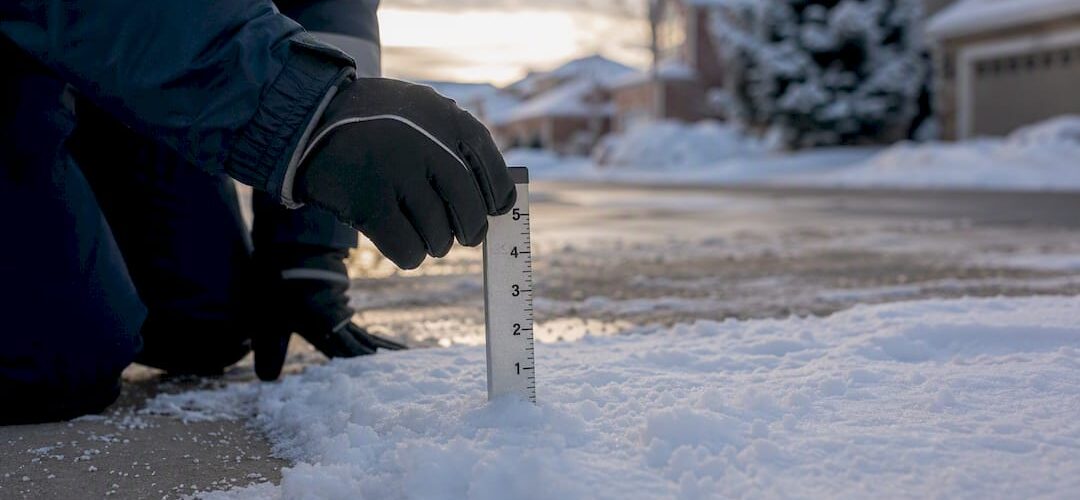
A trigger depth is the snow accumulation, measured in inches, that your contract names as the point when a plow crew gets dispatched or billing starts. It sounds simple. In Denver, it rarely works as written, because freezing rain, wind-driven drift, and sudden surface ice do not care what the contract says the trigger is.
The safer approach, and the one Denversnowremovals recommends to every commercial account and HOA board, pairs a numeric trigger with condition-based language: ice presence, forecasted freezing precipitation, or pavement temperature. A contract built this way should spell out five things:
- The measurement source (on-site gauge versus a nearby weather station)
- A defined response window after the trigger is met
- Condition-based salt or deicing language for surfaces that ice over before the depth threshold hits
- Exactly which areas the contractor covers, and which fall to the customer
- Documentation requirements: time-stamped reports and photos
Many Denver contracts specify numeric thresholds for trigger depths, commonly expressed in whole inches, with lower thresholds increasing service frequency and safety but raising costs, and higher thresholds reducing cost but potentially increasing risk from compacted snow turning to ice.
Key Takeaways
A safe Denver snow contract replaces a single inch-based trigger with condition-based language, a named measurement source, and a defined response window.
| Point | Details |
|---|---|
| Define trigger depth precisely | Name it as a Service Initiator per SIMA’s glossary, including the exact measurement point. |
| Add condition-based wording | Cover ice, freezing rain, and pavement temperature so service isn’t delayed waiting on an inch count. |
| Match threshold to site risk | Retail and high-traffic lots need lower triggers (1 inch) than warehouses or low-traffic sites (2 to 3 inches). |
| Require documentation | Time-stamped reports and photos protect both parties in a liability dispute. |
| Work with an experienced local provider | Denversnowremovals brings 44+ years of Denver winters, 24/7 dispatch, and contract-review support to get the wording right. |
Table of Contents
- How Much Snow Does Denver Actually Get?
- When Does Denver’s Snow Season Actually Run?
- How Is Snow Depth Measured Accurately on a Property?
- What 44 Years of Denver Winters Have Taught Us About Triggers
- Get Contract Language That Actually Protects Your Property
- Sources
- FAQ
How Much Snow Does Denver Actually Get?
Denver’s snow pattern is erratic by design. The city sits at the base of the Front Range, where storms can dump six inches downtown and barely dust areas twenty miles east. That variability is exactly why a single citywide “average” figure misleads anyone writing a contract trigger.
What matters more than the seasonal total is storm frequency and intensity. Denver typically sees frequent, moderate snow events rather than a few massive dumps. A property might accumulate 1 to 2 inches several times a week during an active stretch, never quite reaching a 3" trigger, while still building up compacted, icy layers that create real slip hazards.
This is the mechanical flaw in depth-only contracts: a property can experience five separate 1.5" events in a week, none of which trip a 2" trigger, and still end the week buried under four inches of packed, refrozen snow. SIMA’s own guidance on trigger depths points directly at this gap, noting that rigid inch-based rules often delay salt application even when ice has already formed on the surface.

For HOA boards and property managers, the practical takeaway is that Denver’s snow behavior punishes contracts written for one big storm. Multiple smaller events, each below your stated threshold, add up to the same liability exposure as one large one, sometimes worse.
When Does Denver’s Snow Season Actually Run?
Denver’s snow season stretches longer than most residents assume. Early-season events show up in September or October, well before most contracts activate. The heaviest, most consistent snowfall typically arrives between December and March, with March itself often producing some of the year’s biggest single storms.
That means a seasonal contract signed in November, expecting the season to wind down by February, can leave a property uncovered during its riskiest month. Late-season storms in March and even April tend to be wetter and heavier, which changes plowing time and salt behavior compared to the drier snow common in January.
A practical service-planning calendar looks like this:
- September to October: early, isolated events; confirm contract activation dates now, not after the first storm
- November to January: the core season; expect frequent moderate accumulation and the highest call volume for 24/7 dispatch
- February to March: heavier, wetter storms; response windows matter more because saturated snow refreezes into ice faster
- April: occasional late storms that catch property managers off guard once contracts have started winding down
Denver Snow Removal keeps active crews through the full window rather than a fixed calendar range, precisely because trigger events do not respect a start and end date on paper.
How Is Snow Depth Measured Accurately on a Property?
Depth measurement sounds straightforward until two parties disagree about it. A weather station report and an actual reading in a parking lot can differ by an inch or more, especially where wind piles snow against a building or clears it entirely from an exposed loading dock.

Reliable field measurement starts with a fixed reference point, a flat measuring board or stake placed in a location unaffected by drift, plowing, or foot traffic. Crews take readings at set intervals rather than relying on a single check, since Denver’s snow can intensify or taper within an hour. Contractable’s contract guidance recommends naming this measurement point directly in the contract, because disputes over “how much snow actually fell” are one of the most common triggers for billing disagreements.
Depth alone does not tell the whole story, though. Surface conditions matter just as much, which is why more sites now pair depth readings with pavement temperature checks. Research on facility-level snow triggers shows infrared pavement sensors and calibrated surface inspections often catch ice risk before a depth gauge would ever justify dispatch. A parking lot at 30°F with a quarter inch of compacted snow can be more dangerous than one with two dry inches sitting on pavement well below freezing. Reliable technology means a tape measure or fixed stake, a thermometer for pavement checks, and a written log tying every reading to a time and location.
What 44 Years of Denver Winters Have Taught Us About Triggers
After 44 years in this market, we have learned that the contract number on paper and the ice on the ground rarely agree. Our crews measure at fixed reference points on every property, checking pavement temperature alongside depth, because a half inch on a cold slab freezes faster than two inches on warmer ground.
We apply deicer when conditions call for it, even under the stated trigger, because waiting for an inch count while a lot glazes over is how claims happen.
Get Contract Language That Actually Protects Your Property
Denversnowremovals offers an alternative to a generic, boilerplate snow contract for properties across the Denver metro. Instead of locking you into a single inch-based number that fails the first time freezing rain hits, we draft condition-based clauses, name the exact measurement point, and set response windows you can hold us to.
Our services cover seasonal contracts, per-event dispatch, sidewalk deicing, and parking-lot plowing, all backed by time-stamped reports and photo documentation so you have proof of service if a slip-and-fall claim ever surfaces. If your current contract is vague on what triggers dispatch or where responsibility ends, we will review it and suggest sample clause language built from four decades of Denver winters. Request a free estimate or contract review and get language that holds up before the next storm, not after it.
Sources
- Rethinking trigger depths in snow contracts
- SIMA glossary of terms
- Snow Plowing Contract Template | Contractable
- Snow Removal Service Levels: Examples And SLA Guide
FAQ
What Is a Trigger Depth in a Snow Removal Contract?
It is the snow accumulation, usually stated in inches, that a contract identifies as the point when a crew must be dispatched or billing begins, also called a Service Initiator under SIMA’s definitions.
Why Do Inch-Based Triggers Fail in Denver?
Freezing rain, drifting snow, and rapid pavement icing can create hazards before a depth threshold is reached, which is why SIMA recommends condition-based language alongside any numeric trigger.
What Trigger Depth Should a Commercial Property Use?
Commercial lots typically run 1 to 3 inches with a 1 to 4 hour response window, and high-traffic sites should lean toward the lower end to reduce slip-and-fall risk.
Should I Rely on Weather Station Data or an On-Site Measurement?
Contracts should name one specific source, since weather station readings and on-site measurements often diverge enough to cause billing disputes.
Can Denversnowremovals Help Me Rewrite My Current Contract?
Yes, Denversnowremovals reviews existing agreements and drafts condition-based clauses, measurement language, and response windows drawing on 44 years of Denver-specific service experience.
Recommended
- Snow Removal Contracts: What Every Property Owner Must Know – Snow Removal Denver 303-591-2089
- Snow Removal Insurance: What Denver Property Owners Must Require – Snow Removal Denver 303-591-2089
- What Triggers Emergency Snow Removal in Denver CO:2026 Guide
- Lot Striping After Snow Removal: A Denver Manager’s Guide – Snow Removal Denver 303-591-2089