

Commercial parking lots, retail strip centers, multifamily communities, healthcare campuses, hotels, senior living facilities, educational campuses, industrial warehouses, municipal sites, and construction staging areas all routinely require professional snow removal contracts. These property types share two traits that make DIY or reactive approaches inadequate: significant pedestrian or vehicle flow that creates immediate slip-and-fall exposure, and legal obligations under ADA accessibility standards and OSHA workplace safety guidance that demand documented, timely response.
- Liability and access: High-traffic properties face slip-and-fall claims the moment a walkway, ADA ramp, or fire lane stays icy past a reasonable clearance window. Documented service logs are your first line of defense.
- Operational continuity: Hospitals, retail centers, and distribution warehouses cannot afford delayed access. Professional crews with the right equipment and defined response-time guarantees keep those sites running through Denver’s heaviest storms.
The clock starts ticking the moment snow stops falling. For property managers overseeing high-liability sites, a contractor without a written trigger depth, a completion benchmark, and time-stamped documentation is not a contractor — they are a liability waiting to happen. Denversnowremovals has managed snow removal services across the Denver Metro area for several decades.
Table of Contents
- Which types of properties need professional snow services?
- What on-site areas belong in every site-specific snow plan?
- When should you call a contractor, and what response times are realistic?
- Which pricing model fits your property and risk profile?
- What equipment and materials should your contractor bring?
- What liability, code, and accessibility requirements must you manage?
- How do you build a site-specific snow plan from scratch?
- What does 44 years of field experience look like in practice?
- Key Takeaways
- What managers consistently get wrong about snow contracts
- Denversnowremovals covers the Denver Metro area, start to finish
- Useful sources and references
- FAQ
Which types of properties need professional snow services?
Understanding the right service tier for each asset class is the first decision a property manager needs to make before winter arrives. Here is a breakdown by property type, along with the primary risk, typical service level, and a budgeting signal for each.
Commercial retail and strip centers
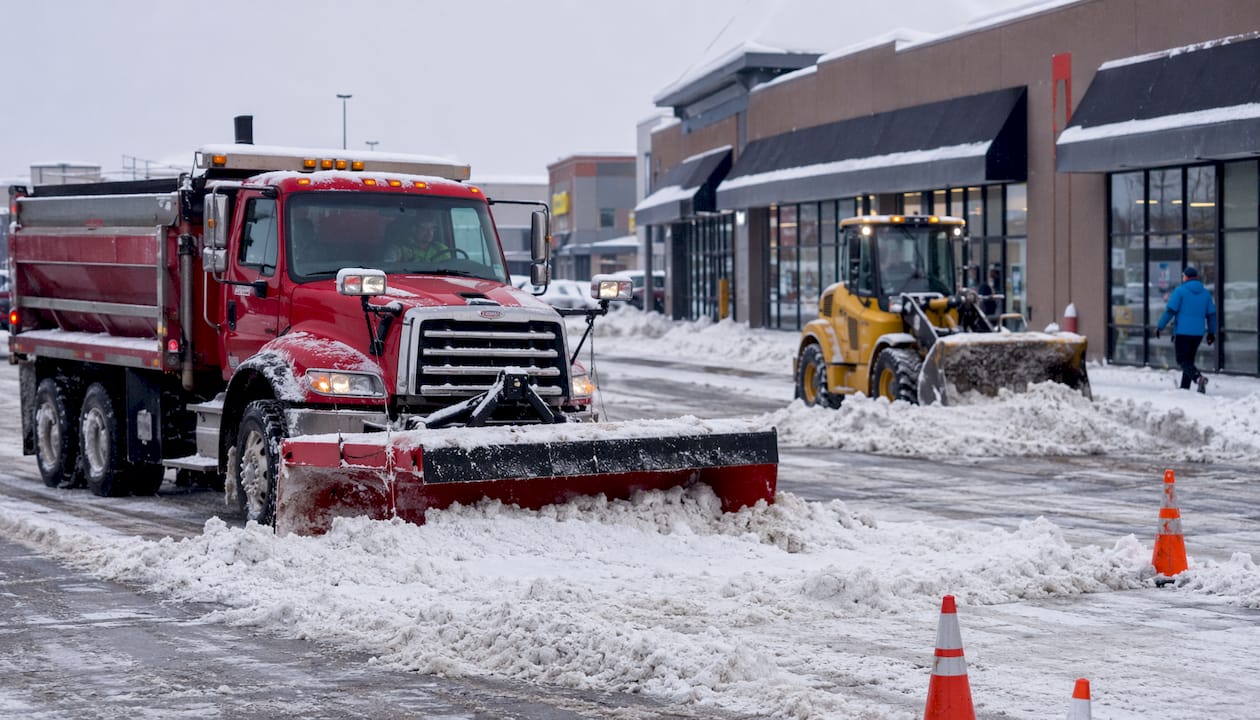
High foot traffic from open to close means any icy patch in a parking lot or at an entrance becomes a liability event within hours. These sites typically require Tier 2 or Tier 3 service: plowing plus sidewalk clearing plus deicing. For most active retail properties, plowing alone is insufficient when pedestrian exposure is significant. Budget for a seasonal retainer if your center operates year-round.
Office parks
Employees arrive early; clients arrive throughout the day. The primary risk is slip-and-fall in parking areas and at building entrances before the first plow pass. Coordinated plowing and salting timed to pre-business-hours completion is standard. Seasonal retainers work well here because snowfall frequency in Denver makes per-event costs unpredictable.
Multifamily apartments and HOAs
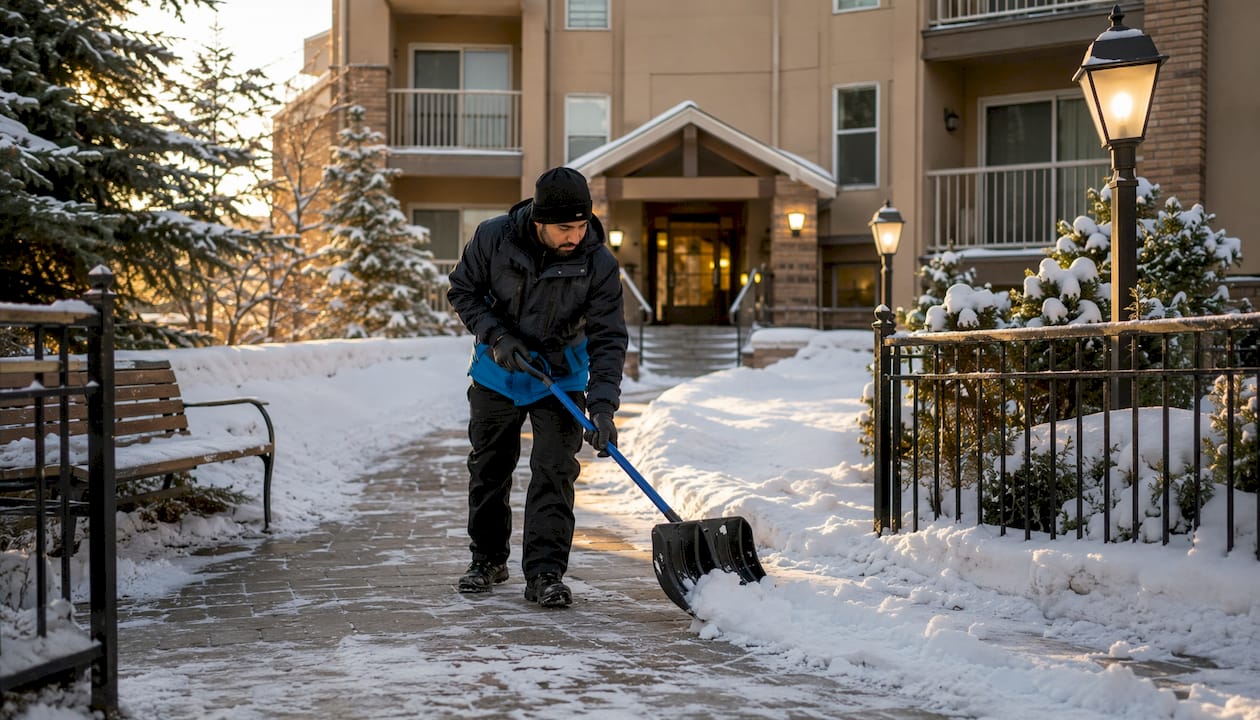
Residents expect clear walkways, driveways, and parking areas as a condition of their lease or HOA dues. Shared driveways and common sidewalks are the HOA’s legal responsibility, and seasonal flat-rate contracts give boards the budget predictability they need. Fire hydrant access and emergency routes must stay clear at all times.
Healthcare and medical centers
Hospitals and urgent care clinics carry the highest liability exposure of any property type. Delayed patient access or a slip in a parking structure can have serious consequences. These sites demand Tier 3 full winter maintenance: pretreatment, plowing, sidewalk clearing, deicing, and post-storm refreeze monitoring. Response time SLAs of one hour or less are standard for hospital campuses.
Hotels and resorts
Guests arrive at all hours, often in rental vehicles, and expect clear drop-off zones, visible curbs, and open pathways from the parking area to the lobby. Commercial snow operations for hotels often require multiple overnight passes during heavy snowfall. Flat-rate seasonal contracts simplify budgeting during peak winter occupancy.
Senior living facilities
Residents have reduced mobility and a higher fall risk, making this category second only to healthcare in liability exposure. Every walkway, ramp, and entrance must meet ADA standards after each snow event. Full winter maintenance with anti-icing pretreatment is the baseline expectation.
Educational campuses
Universities and K–12 schools face large pedestrian volumes across sprawling sites. Priority zones include main entrances, bus drop-off areas, pedestrian crosswalks, and parking lots. Service triggers are typically set at 1–2 inches for primary zones, with a secondary trigger for peripheral lots.
Industrial warehouses and distribution centers
Loading docks and delivery lanes are the critical zones here. A blocked dock means delayed shipments and potential contract penalties. Parking lots see heavy truck traffic that compacts snow quickly. Equipment choices matter significantly on large industrial sites where speed of clearance directly affects operational cost.
Municipal sites and public works
Government-owned parking facilities, transit stops, and public walkways carry both liability and public-service obligations. Compliance with local ordinances and ADA requirements is non-negotiable. The Denver Department of Transportation and Infrastructure maintains specific snow-clearing standards for public rights-of-way.
Construction sites and temporary or seasonal properties
Active construction sites need staging areas, site entrances, and temporary roads cleared for worker safety and equipment access. Vacation homes and seasonal rental properties present a different challenge: the property may sit unoccupied for weeks, but a guest arrival to an icy driveway creates immediate liability. Ski-area infrastructure, including access roads, shuttle stops, and ski-in/ski-out trails, requires specialized clearing that integrates with guest experience and safety.
Pro Tip: Match your service tier to foot-traffic intensity and emergency-access requirements. If the site has emergency vehicle access, ADA-required routes, or 24-hour pedestrian use, default to Tier 3 full maintenance. Reserve Tier 1 basic plowing for low-traffic storage yards and seasonal properties with no overnight guests.
What on-site areas belong in every site-specific snow plan?
A site plan without clearly mapped priority zones is a plan that fails under pressure. When a storm hits at 2 AM, your crew needs to know exactly which surfaces get cleared first, what finish standard applies, and which zones can wait.
Priority zones to map on every site:
- Main parking lots and drive aisles
- Primary building entrances and vestibules
- ADA-compliant routes, ramps, and accessible parking spaces
- Sidewalks and pedestrian walkways connecting parking to entrances
- Stairs and exterior ramps
- Loading docks and delivery lanes
- Emergency and fire lanes (must remain passable at all times)
- Roofs and gutters where ice-dam or structural load risk exists
- Pedestrian crosswalks and bus stops
- Drainage channels and low spots prone to refreeze after a storm
Priority ranking rubric (1 = highest urgency):
- Emergency/fire lanes and ADA routes — legal obligation, zero tolerance for delay
- Main entrances and primary pedestrian paths — highest slip-and-fall exposure
- Parking lots and drive aisles — operational access and vehicle safety
- Loading docks and delivery lanes — revenue and contract continuity
- Peripheral lots, secondary walkways, and rooftop clearing — lower immediate risk but must be addressed within the SLA window
When you build your scope of work, tag each zone with its priority number, the finish standard required (bare pavement, center-bare, or passable condition), and the completion benchmark. That tagging structure becomes the basis for your SLA and gives your contractor a clear, unambiguous map to work from. For common area responsibilities in multifamily or HOA settings, the zone map also clarifies which surfaces belong to the property and which are the tenant’s or homeowner’s responsibility.
When should you call a contractor, and what response times are realistic?
Service triggers define the snowfall depth or condition that activates your contract. Without a written trigger, you are relying on your contractor’s judgment, which is not a defensible position when a tenant slips at 7 AM.
Typical trigger thresholds by property type:
- Hospitals and senior living: any measurable accumulation, often 0.5–1 inch, with pretreatment before the storm
- Retail centers and office parks: 1–2 inches, with completion before business hours
- Multifamily and HOAs: 2–3 inches for parking lots; 1 inch for primary walkways
- Industrial warehouses: 2–3 inches for lots; immediate for loading docks
- Low-traffic storage or seasonal vacation homes: 3–5 inches, or upon guest arrival notice
Heavy flurries and drifting are exceptions worth specifying. A 1-inch snowfall that drifts to 4 inches at a main entrance triggers the same liability as a full storm. Your contract should address drifting and blowing snow as a separate condition.
Realistic SLA response-time bands:
- Urgent (hospitals, senior living, 24-hour retail): 1 hour or less from trigger
- Standard commercial (retail, office, multifamily): 2–4 hours from trigger
- Lower-priority (peripheral lots, storage, seasonal homes): 6–12 hours from trigger
Response time directly affects pricing. A guaranteed 1-hour response requires dedicated crew capacity and commands a premium. For emergency snow removal in Denver, understanding what qualifies as an emergency call versus a standard service visit helps managers budget for those premium events separately.
Pro Tip: When reviewing a contractor’s SLA, ask for a “trigger-plus-completion” benchmark, not just a response-time window. “We will begin within 2 hours” is weaker than “Primary entrances will be bare pavement within 2 hours of a 1-inch trigger.” The second version is what holds up in a liability claim.
Example trigger set for a mixed-use site:
- Retail entrance: 1-inch trigger, bare pavement within 1 hour of trigger
- Office parking lot: 2-inch trigger, center-bare within 3 hours of trigger
- Peripheral overflow lot: 3-inch trigger, passable condition within 6 hours of trigger
Which pricing model fits your property and risk profile?
Choosing the wrong contract structure costs money in one of two directions: you overpay in a light snow year, or you face unpredictable invoices in a heavy one. The right model depends on your property’s liability exposure, Denver’s snowfall variability, and your budget cycle.
| Pricing Model | Best For | Key Advantage | Key Risk |
|---|---|---|---|
| Seasonal retainer | HOAs, multifamily, high-liability commercial | Fixed cost, full-season coverage | Overpay in low-snow years |
| Per-event billing | Vacation homes, low-traffic seasonal properties | Pay only for actual service | Budget spikes in heavy winters |
| Time-and-materials | Complex or irregular sites, one-off events | Transparent cost breakdown | Difficult to budget; costs vary widely |
| Hybrid retainer + overage | Mixed portfolios, retail centers | Predictability with storm-event flexibility | Overage caps must be clearly defined |
Seasonal retainer works best when snowfall is frequent and liability exposure is high. HOAs and multifamily boards consistently prefer this model because it eliminates invoice surprises and simplifies annual budgeting. The benefits of seasonal pricing are most pronounced in markets like Denver, where storm frequency varies significantly year to year.
Per-event billing suits properties that sit vacant for stretches of winter, such as vacation rentals or seasonal construction sites. The risk is real: Denver can deliver multiple heavy storms in a single month, and per-event costs stack up fast.
Time-and-materials is rarely the right choice for ongoing commercial contracts. It works for one-time snow-hauling jobs or unusual post-storm cleanup, but it offers no budget predictability.
Hybrid retainer plus overage is increasingly common for retail centers and mixed-use portfolios. A base retainer covers standard events; a defined overage rate kicks in for storms above a threshold depth or frequency. This model rewards managers who negotiate clear overage caps upfront.
Pro Tip: Always define “storm” in your contract. Ask the contractor to specify the accumulation threshold and time window that separates one storm event from two. Without that definition, a 36-hour snow event with a brief pause can be billed as two separate per-event charges.
What equipment and materials should your contractor bring?
A professional snow contractor’s equipment list tells you a great deal about their capacity and cost structure. Heavier mechanized equipment speeds completion on large sites but raises base costs. Walk-behind equipment is appropriate for tight pedestrian areas but cannot keep pace with a large parking lot during a heavy storm.
Common equipment you should expect:
- Plow trucks (pickup-mounted or commercial-grade) for parking lots and drive aisles
- Skid-steer loaders for large lots, loading dock areas, and snow relocation
- Snow blowers and walk-behind blowers for sidewalks and pedestrian zones
- Salt spreaders (truck-mounted or walk-behind) for granular deicing
- Brine and liquid anti-icer application rigs for pretreatment
- Snow-hauling trucks when on-site stacking space runs out
De-icing and anti-icing materials:
- Granular rock salt: the most common and least expensive option, effective above 15°F
- Blended salts: rock salt mixed with calcium or magnesium chloride for improved low-temperature performance
- Calcium chloride: effective to lower temperatures, faster activation, but more corrosive to concrete and metals
- Magnesium chloride: gentler on hardscapes and vegetation, commonly used near landscaped areas
- Liquid brines: applied as pretreatment before a storm to prevent bonding; reduce the total material needed
De-icing salts can damage landscapes and hardscapes when over-applied or when the wrong chemical is used near sensitive plantings. Ask your contractor for a site-specific chemical plan that identifies which products will be used in which zones. For properties with significant landscaping investment, protecting plants and hardscapes from plow damage and chemical runoff should be a named item in your scope of work.
Finish standards and their cost implications:
- Bare pavement: all snow and ice removed; highest material and labor cost; required for hospitals, main retail entrances, ADA routes
- Center-bare: driving lanes clear, edges may retain packed snow; standard for most commercial parking lots
- Passable condition: snow reduced to a safe travel depth; lowest cost; appropriate for low-traffic peripheral areas
Pro Tip: Request liquid anti-icer pretreatment for any storm forecast above 2 inches. Pretreatment prevents snow from bonding to pavement, reduces the total salt needed, and cuts the number of passes required. It is almost always more cost-effective than reactive granular application after the fact.
What liability, code, and accessibility requirements must you manage?
Snow removal is not optional for most commercial and multifamily properties. Local ordinances, ADA requirements, and OSHA workplace safety standards create a compliance framework that shapes your scope of work before you negotiate a single contract clause.
Compliance items every manager must address:
- ADA-compliant path maintenance: accessible routes, ramps, and parking spaces must remain clear and passable after each snow event
- Fire-lane and emergency-access standards: fire lanes must stay open at all times; local fire codes specify clearance widths
- Local sidewalk clearing ordinances: Denver’s snow-clearing ordinances require property owners to clear public sidewalks within a defined window after snowfall ends
- Insurance documentation: time-stamped service logs and photos are the primary evidence in slip-and-fall defense
Contract and SOW checklist items:
- Priority zone map with finish standards assigned to each zone
- Trigger depths and completion benchmarks by zone
- Documentation procedure: who logs service, what format, how long records are retained
- Indemnification language and contractor liability coverage
- Proof of general liability insurance and workers’ compensation
- Worker safety procedures for overnight and storm-condition operations
Most slip-and-fall incidents occur during refreeze after a storm, not during the storm itself. Post-storm monitoring and return visits are high-value services that belong in every SLA for high-liability sites. Documenting snow removal with time-stamped photos and digital logs gives you a defensible record if a claim is filed weeks after the event.
Pro Tip: Require your contractor to submit a digital service log within two hours of each completed visit. The log should include arrival time, departure time, trigger depth recorded on-site, materials applied by zone, and at least two geo-tagged photos. That record is worth far more than a verbal confirmation.
How do you build a site-specific snow plan from scratch?
A solid snow plan takes less than a day to build if you follow a structured process. Here is a numbered checklist managers can use before the first storm of the season.
- Inventory all assets and map priority zones. Walk the site and identify every surface that needs clearing. Tag each zone with its priority number (1–5) using the rubric from the earlier section.
- Set service triggers for each zone. Assign a trigger depth and a condition exception (drifting, freezing rain) for each priority tier.
- Choose finish standards. Assign bare pavement, center-bare, or passable condition to each zone based on liability and operational need.
- Assign SLA response bands. Match each zone’s priority level to a realistic completion benchmark.
- Define reporting and documentation. Specify the format, timing, and retention period for service logs.
- Confirm equipment and hauling plan. Identify on-site snow-stacking areas. If stacking space is limited, include a snow-hauling provision in the contract.
- Include a contingency for heavy events. Define what constitutes a “major storm” and how overage pricing or additional crew deployment is triggered.
Site map elements to include:
- Priority zone boundaries with finish-standard labels
- Snow-stacking areas (away from drainage, fire lanes, and ADA routes)
- Snow-haul routes if removal is needed
- Drainage channels and refreeze-prone low spots
- Tenant contact responsibilities for private driveways or individual unit entries
For managers overseeing multiple properties, rank sites by liability exposure first, then by revenue or operational impact. A hospital campus and a senior living facility always outrank a storage facility when crew time is limited during a major storm. A pre-season inspection of gutters, drainage, and roof condition also reduces mid-winter surprises, particularly for older buildings prone to ice-dam formation.
What does 44 years of field experience look like in practice?
Denversnowremovals has managed snow services across the Denver Metro area since the early 1980s, covering a portfolio that includes commercial retail centers, multifamily communities, healthcare campuses, and HOAs. The operational approach they use offers a practical template managers can adapt for their own contracts.
How Denversnowremovals structures a site plan:
- Priority zones are mapped before the season and reviewed with the property manager at a pre-season walkthrough
- Trigger depths are defined per zone and recorded in the contract, with a separate threshold for drifting and freezing-rain events
- Completion benchmarks are set by zone, not by property, so a hospital entrance carries a 1-hour benchmark while a peripheral lot carries a 4-hour benchmark
- Every service visit generates a time-stamped digital log with photos, materials applied, and crew sign-off
- Post-storm refreeze monitoring is a named line item, not an afterthought
Sample contract clauses worth borrowing:
- Priority zone map: “Attached Exhibit A identifies all service zones, their priority tier (1–5), and the applicable finish standard for each.”
- Trigger definition: “Service is activated when accumulation at the on-site gauge reaches [X] inches, or when drifting creates impassable conditions at any Priority 1 zone regardless of total accumulation.”
- Completion benchmark: “Priority 1 zones shall reach bare-pavement standard within [X] hours of trigger activation. Priority 3 zones shall reach center-bare standard within [X] hours.”
- Overage pricing: “Events exceeding [X] inches in a 24-hour period are billed at the agreed overage rate per additional inch, capped at [Y] per event.”
- Documentation: “Contractor shall submit a digital service log within two hours of each visit, including arrival/departure times, trigger depth recorded on-site, materials applied by zone, and geo-tagged photos.”
Post-storm refreeze is where most incidents happen. Meltwater from afternoon sun refreezes on walkways and ramps after sunset, often hours after the crew has left. A return visit scheduled for early evening on the day after a storm catches that refreeze window and closes the liability gap that a single morning visit leaves open.
Pro Tip: Ask your contractor whether post-storm return visits are included in the base contract or billed as separate events. For any Priority 1 or Priority 2 zone, they should be included. If they are not, negotiate them in before you sign.
Key Takeaways
Property managers who contract snow services without a written priority zone map, defined trigger depths, and completion benchmarks are exposed to liability that documentation alone could prevent.
| Point | Details |
|---|---|
| Identify priority zones first | Map every surface by legal risk and operational impact before writing a scope of work. |
| Match service tier to liability | Hospitals and senior living require Tier 3 full maintenance; low-traffic storage sites can use Tier 1. |
| Demand completion benchmarks | “Bare pavement within 2 hours of a 1-inch trigger” is enforceable; “we’ll get there soon” is not. |
| Document every visit | Time-stamped digital logs with geo-tagged photos are your primary defense against slip-and-fall claims. |
| Denversnowremovals | Offers 44-year Denver Metro experience, 24/7 crews, and documented service logs for residential and commercial properties. |
Run a site audit before the first storm. Walk every priority zone, assign finish standards, set trigger depths, and confirm your contractor has the equipment and documentation process to meet your SLA. Managers who do this in September avoid the scramble that happens in December.
What managers consistently get wrong about snow contracts
Most snow-service mistakes are not made during a storm. They are made in August, when the contract is signed without enough specificity, or in November, when the site plan is never built.
Common mistakes and how to fix them:
-
Using per-event billing for high-liability sites. A hospital or senior living facility on per-event pricing faces unpredictable costs during heavy winters and may be tempted to delay a call to save money. Fix: move these sites to a seasonal retainer or a hybrid contract with a defined overage cap.
-
Failing to specify completion benchmarks. A contract that says “snow removal within a reasonable time” gives you nothing to enforce. Fix: write a trigger depth and a zone-specific completion time into every contract before you sign.
-
Ignoring post-storm refreeze. Afternoon melt followed by overnight refreeze creates the most dangerous surface conditions of the entire storm cycle. Fix: require post-storm return visits as a named line item for all Priority 1 and Priority 2 zones.
-
Leaving landscaping unprotected. Plow blades and over-applied salt damage turf edges, shrubs, and hardscapes. Fix: include a site-specific chemical plan and physical markers (snow stakes) along all landscape borders in the scope of work.
-
Omitting roofs from the SOW when risk exists. Older buildings with poor attic ventilation and clogged gutters are vulnerable to ice-dam formation and structural load stress. Roof preparation before winter and a roof-raking provision in the contract address this before it becomes an emergency.
Pro Tip: When negotiating a seasonal contract, ask the contractor to include one pre-season site walkthrough and one mid-season review in the base price. Those two touchpoints catch zone changes, new landscaping, and equipment-access issues before they become service failures.
Denversnowremovals covers the Denver Metro area, start to finish
Property managers in the Denver Metro area who want a written scope, defined SLAs, and a crew that shows up at 3 AM during a February storm have one practical option: work with a provider who has done exactly that for over four decades.
Denversnowremovals brings 44 years of Denver-specific experience, 24/7 crew availability, and documented service logs to every residential and commercial contract. Whether you manage a single HOA community or a portfolio of retail centers, the process starts with a free site audit and a written scope of work that maps your priority zones, sets your trigger depths, and defines completion benchmarks for each area. That written scope is what protects you when a tenant files a claim in March. For properties where 24/7 commercial coverage is non-negotiable, Denversnowremovals structures contracts around guaranteed response times, not best-effort estimates. Call 303-591-2089 or visit denversnowremovals.com to request a free estimate and a sample scope of work before the season starts.
Useful sources and references
- Snow Removal Service Levels: Examples and SLA Guide — service-tier definitions (Tier 1–3), trigger depths, response-time guidance, and finish standards
- Do You Need Plowing Only, or Full Snow and Ice Management? — explains when plowing alone is insufficient for commercial properties with significant pedestrian exposure
- Commercial Snow Removal in Denver: What to Expect During Heavy Snowfall — operational approach for commercial sites during heavy Denver snowfall, including multiple-pass requirements
- Effects of De-icing Salts on Landscapes (University of Minnesota Extension) — research on chemical damage to plants and hardscapes; supports chemical-plan requirements in contracts
- How to Prepare Your Roof for Heavy Snowfall in Denver — roof preparation steps, ice-dam risks, and when to engage licensed roof contractors
- What Triggers Emergency Snow Removal in Denver — local trigger examples and emergency-service thresholds from Denversnowremovals
- Benefits of Seasonal Snow Removal Pricing for Property Owners — seasonal vs. per-event pricing decision factors for HOAs and multifamily properties
- How Equipment Drives Affordable Snow Removal Costs — equipment selection, cost impacts, and landscaping protection considerations
- Document Snow Removal for Liability Protection — documentation workflows, time-stamped logs, and insurance defense practices
- How to Assess Your Snow Removal Needs: A Property Manager’s Guide (Buildings) — property-type breakdown and evaluation criteria for property managers
FAQ
Which property types need snow removal contracts most urgently?
Healthcare facilities, senior living communities, and high-traffic retail centers carry the highest liability exposure and should be the first properties under contract, with Tier 3 full winter maintenance and response-time SLAs of two hours or less.
How much do snow removal services typically cost for commercial properties?
Pricing varies by contract model, site size, and service tier. Seasonal retainers offer fixed costs for the full winter and are generally preferred for high-liability commercial sites; per-event billing suits low-traffic or seasonal properties where storms are infrequent.
How do property managers find and vet reliable snow removal contractors?
Start with local directories and verified online reviews to confirm the contractor has a track record in your market. Then request a written scope of work, proof of general liability insurance, and a sample service log before signing any agreement.
What should a snow removal contract always include?
Every contract should specify trigger depths by zone, completion benchmarks, finish standards, documentation procedures, overage pricing terms, and proof of insurance. A priority zone map attached as an exhibit is the single most useful addition to any scope of work.
Does Denversnowremovals serve HOAs and multifamily properties?
Yes. Denversnowremovals provides snow plowing and removal services for both residential and commercial properties across the Denver Metro area, including HOA communities, multifamily complexes, and commercial portfolios, with free estimates and flexible service plans.
Recommended
- Common Area Snow Removal: What Property Managers Must Know – Snow Removal Denver 303-591-2089
- Why Hire a Snow Removal Service: 2026 Guide – Snow Removal Denver 303-591-2089
- Snow Removal Scope of Work: A Denver Property Guide – Snow Removal Denver 303-591-2089
- Document Snow Removal for Liability Protection – Snow Removal Denver 303-591-2089