

A snow removal scope of work is a formal document that defines exactly which snow management tasks a contractor will perform, which areas they will cover, and what standards they must meet. In the industry, this document often appears as part of a Master Service Agreement, or MSA, and it functions as the operational backbone of any professional snow contract. Standard scopes set a snow event trigger threshold of 1–4 inches, with 2 inches being the most common commercial benchmark, and require service completion within 2–4 hours after snowfall ends. Denver’s Front Range winters bring unpredictable accumulation, rapid temperature swings, and frequent refreeze cycles, which makes a precise scope document even more critical here than in more temperate markets.
What tasks are typically included in a snow removal scope of work?
Snow removal services are categorized into six core activities, and each one carries different equipment requirements, labor costs, and billing implications. Listing them separately in a contract prevents billing surprises and keeps both parties accountable.
Here is what each task means in practice:
- Clearing: Removing snow from walkways, steps, and entryways by hand or with a snow blower. This task protects pedestrian access and is often the first priority after a storm.
- Plowing: Using a truck-mounted blade to push snow across parking lots, driveways, and access roads. Plowing moves snow but does not remove it from the property.
- Removal: Physically loading and transporting snow off the property. This is a separate, higher-cost service that many property owners confuse with plowing.
- Relocation: Moving piled snow from one area of the property to another, typically when stacking zones fill up. Relocation avoids blocking parking stalls or fire lanes without the cost of full hauling.
- De-icing: Applying granular or liquid materials such as rock salt or calcium chloride after snow falls to melt existing ice. De-icing is reactive.
- Anti-icing: Applying liquid materials before a storm to prevent ice from bonding to pavement. Anti-icing is proactive and often reduces total material use. You can read more about how plowing methods compare when evaluating which tasks belong in your scope.
A common misunderstanding is that plowing and removal are the same service. Plowing costs are typically calculated per push, while hauling snow off-site adds a separate line item based on volume and distance. If your contract does not distinguish between the two, you may find yourself paying removal rates for a simple plow pass, or worse, discovering that your contractor has no obligation to haul at all.
Pro Tip: Ask your contractor to define each task in writing with a unit of measure. “Plow parking lot” is vague. “Plow main parking lot (12,000 sq ft) per push, per event exceeding 2 inches” is a contract term.

How is the snow removal scope of work documented?
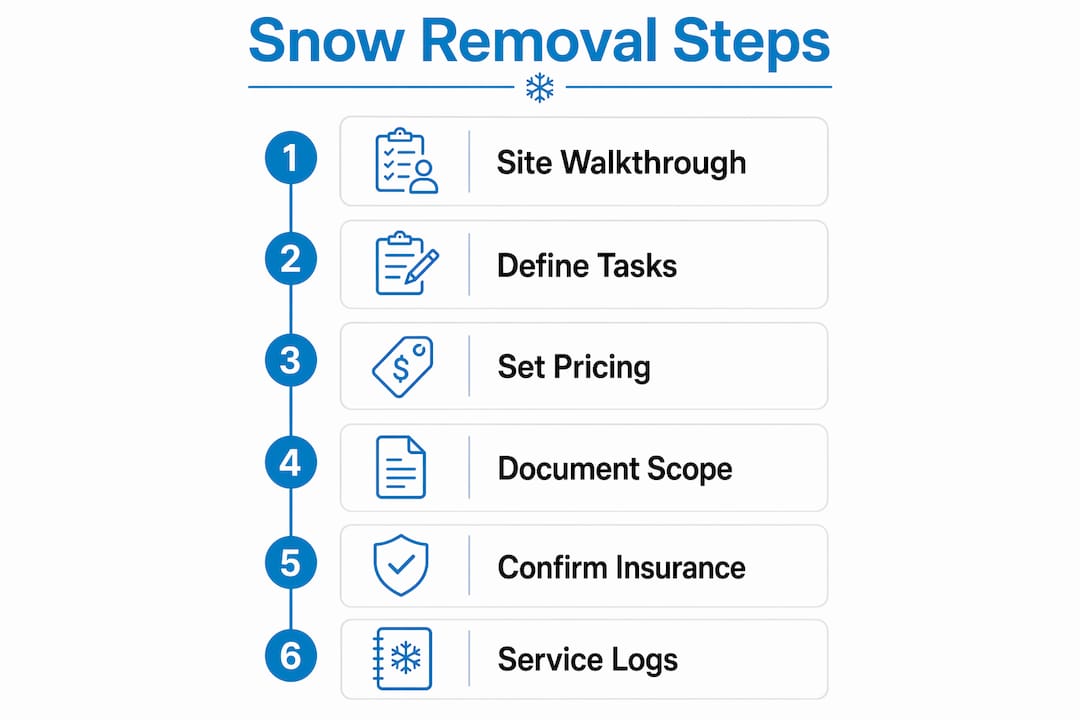
A well-documented scope of work does more than describe services. It functions as an operational manual that defines who authorizes service, what triggers a dispatch, and how performance is measured.
The core components of a documented scope include:
- Service area maps: Site maps showing plow lanes, snow stacking zones, and restricted areas prevent contractors from blocking traffic, fire lanes, or sightlines. Site maps with stacking zones are a recognized best practice for commercial properties.
- Trigger thresholds: The contract must state the exact accumulation level that initiates service. Vague language like “as needed” gives contractors too much discretion and delays service.
- Dispatch authority: The scope should name who can authorize a service call, whether that is automatic dispatch or a will-call system where the property manager initiates contact.
- Refreeze clauses: A refreeze clause defines contractor obligations for ice that forms after the initial service window closes. Without one, overnight refreeze becomes a gray area that neither party wants to own.
- Service logs and photo documentation: Timestamped service logs with photos of completed work are the strongest legal defense against slip-and-fall claims. These records prove that service occurred and met the defined standard.
The table below shows how key contract components map to their purpose and risk function:
| Contract component | Purpose | Risk it addresses |
|---|---|---|
| Trigger threshold | Defines when service starts | Delayed service, liability exposure |
| Site map with stacking zones | Directs snow placement | Blocked parking, sightline hazards |
| Refreeze clause | Assigns overnight ice responsibility | Billing disputes, slip-and-fall claims |
| Service log with photos | Documents completed work | Legal defense in injury claims |
| Dispatch authority | Names who initiates service | Service delays, miscommunication |
Pro Tip: Request that your contractor submit a digital service log after every event. A simple timestamp and photo sent by text or email creates a paper trail that protects both sides.
Liability insurance is also a documented scope requirement. Liability minimums typically run $1 million per occurrence, with the property manager named as an additional insured. If your contract does not include this requirement, you carry more risk than you should.
What is “scope fog” and how do you avoid it?
“Scope fog” is the term facilities professionals use for vague or recycled contract language that leaves critical service details undefined. Scope fog is a leading cause of slip-and-fall liability exposure and billing disputes for property managers.
The most common sources of scope fog include:
- Recycled contract templates: Contractors who reuse last year’s scope without reviewing the current site conditions create gaps between what the document says and what the property actually needs.
- Ambiguous trigger language: Phrases like “maintain safe conditions” or “service as needed” give no measurable standard. The contractor decides what “safe” means, and that definition may not match yours.
- Undefined snow storage: Without stacking location guidelines, contractors often pile snow in the nearest open space, which may be a parking stall, a fire lane, or a visibility corner.
- Missing haul-off procedures: If the contract does not specify when snow must be hauled off-site and who pays for it, stacking areas fill up mid-season and operations stall.
- No internal stakeholder alignment: Property managers sometimes sign contracts without briefing maintenance staff or tenants on service triggers and expectations. When a storm hits at 3:00 AM and no one knows the dispatch protocol, the clock starts ticking on liability.
“Vague contract language is not a minor administrative problem. It is a safety risk. When a tenant slips on ice that a contractor was arguably responsible for treating, the scope document is the first thing an attorney reads. If it does not clearly assign that responsibility, the property owner often absorbs the loss.”
A pre-season site walkthrough with your contractor is the single most effective way to close scope gaps. Walk the property together, mark stacking zones, identify problem areas like shaded corners that refreeze quickly, and confirm that the written scope matches what you both see on the ground. For shared driveways or multi-unit properties, this step is especially critical because responsibility boundaries are rarely obvious from a map alone.
What pricing models affect the scope of work?
Pricing structure and scope clarity are directly connected. The model you choose shapes how your contractor responds to storms and what your contract must define.
The three standard pricing models each carry different scope implications:
Per-push pricing charges a flat fee each time the contractor visits the property during a qualifying snow event. This model rewards fast response and works well for properties with predictable storm patterns. The scope must define what constitutes a “push” and whether multiple visits during a single storm count separately.
Per-inch pricing ties the charge to measured accumulation. This model requires the scope to specify which weather station or measurement method the contractor uses. Disputes arise when the contractor measures at the curb and the property owner measures on the lawn.
Seasonal flat-rate pricing covers all events for a fixed annual fee. This model gives property owners budget certainty but requires the scope to cap the number of events or total accumulation included. Without a cap, an unusually heavy Denver winter can make the contract unprofitable for the contractor, which creates service quality risks.
Contracts should clearly outline additional charges for material price spikes, snow hauling, and events that exceed defined parameters. Salt prices fluctuate significantly from season to season, and a scope that locks in a fixed material rate without an adjustment clause can lead to service cutbacks when costs rise.
Balanced indemnification provisions hold contractors accountable for failing to fulfill defined scope tasks, which reduces risk to property owners. An unbalanced clause that shifts all liability to the property owner regardless of contractor performance is a red flag in any snow contract.
Pro Tip: If you choose a seasonal flat-rate contract, add a clause that defines the maximum number of service events included and the per-push rate that applies once that cap is reached. This protects both parties in an extreme winter.
Response time commitments also belong in the scope. Some contracts include liquidated damages clauses that apply a defined penalty if the contractor fails to complete service within the agreed window. These clauses create accountability without requiring litigation to enforce.
Key Takeaways
A clear snow removal scope of work is the single most effective tool for protecting Denver property owners from liability, billing disputes, and service failures during winter.
| Point | Details |
|---|---|
| Define all six service tasks | List clearing, plowing, removal, relocation, de-icing, and anti-icing separately to prevent billing confusion. |
| Set measurable trigger thresholds | Use a specific accumulation level (e.g., 2 inches) rather than vague language like “as needed.” |
| Document with logs and photos | Timestamped records and photos are the strongest legal defense against slip-and-fall claims. |
| Include a refreeze clause | Assign overnight ice responsibility explicitly to avoid disputes after the initial service window. |
| Conduct a pre-season walkthrough | Walk the property with your contractor to align the written scope with actual site conditions. |
Why scope clarity matters more than most Denver property owners realize
After years of watching snow contracts get signed in a hurry before the first October storm, I have seen the same pattern repeat itself. The scope looks fine on paper until the first major event, and then the gaps show up fast.
The most expensive mistakes I have seen are not caused by bad contractors. They are caused by good contractors working from a bad document. A contractor who plows a parking lot efficiently but stacks snow in front of a fire hydrant is not being negligent. They are filling a gap the scope left open. The property owner pays for it, sometimes literally in fines, sometimes in a lawsuit.
What I tell property owners in Denver is this: treat your snow scope the way you treat a lease. You would not sign a lease with blank sections or undefined terms. Your snow contract deserves the same attention. The seasonal preparation steps you take before winter starts, including reviewing your scope, are worth more than any reactive fix mid-storm.
Denver’s weather adds a layer of complexity that generic contracts do not account for. The rapid temperature swings between afternoon sun and overnight freeze create refreeze conditions that a standard Midwest scope may not address. A scope written for Denver needs to reflect Denver’s actual conditions, not a template from another region.
— Jesse
Denversnowremovals: clear scopes, reliable service
Denversnowremovals has served Denver Metro homeowners, business owners, and property managers for over 44 years. The team works with clients before the season starts to define service areas, set trigger thresholds, and document every detail that protects your property and your liability position. Whether you need a residential driveway cleared or a commercial parking lot managed through a full Denver winter, Denversnowremovals builds contracts that leave no gray areas. Review snow removal service options or compare plowing and blowing methods to find the right fit for your property before the first storm arrives.
FAQ
What is a snow removal scope of work?
A snow removal scope of work is a formal document that defines which services a contractor will perform, which areas they will cover, and what triggers service. It functions as the operational section of a snow removal contract.
What tasks should be listed in a snow removal contract?
A complete scope lists six tasks separately: clearing, plowing, removal, relocation, de-icing, and anti-icing. Separating these tasks prevents billing confusion and establishes clear accountability for each service.
How do I protect myself from liability in a snow contract?
Require timestamped service logs and photos after every event, include a refreeze clause, and name yourself as an additional insured on the contractor’s liability policy, with a minimum of $1 million per occurrence.
What is “scope fog” in snow removal?
Scope fog refers to vague or recycled contract language that leaves service triggers, stacking zones, and task definitions undefined. It is a leading cause of slip-and-fall liability exposure and billing disputes for property managers.
Which pricing model is best for Denver properties?
Seasonal flat-rate pricing offers budget certainty, but per-push pricing rewards fast response and works well for properties with variable storm patterns. The best model depends on your property’s size, traffic, and risk tolerance.