
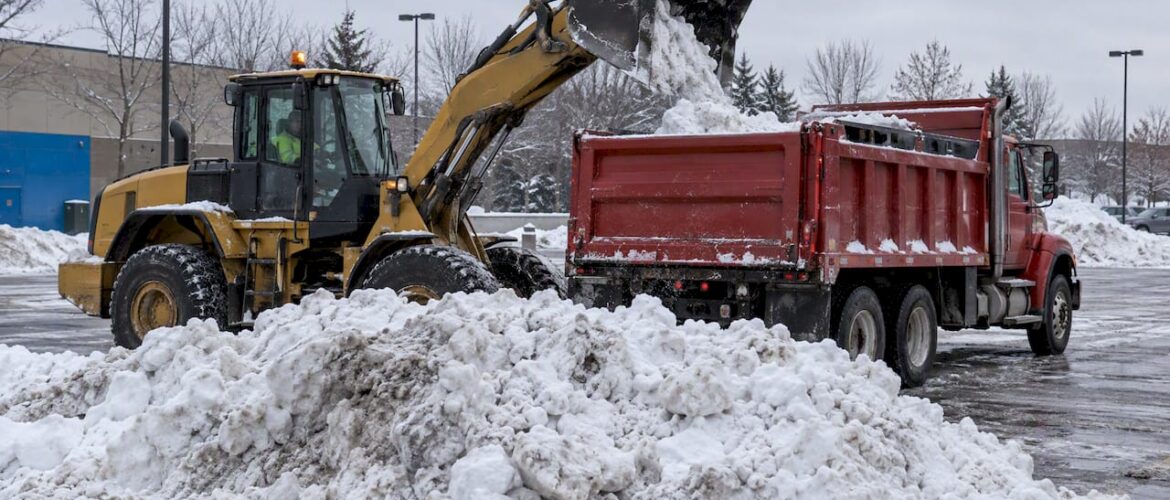
Haul snow when your property has no room left to store it, not when the piles merely look big. In practice that means three things: the stored snow is costing you parking or loading space, it blocks sightlines or walkways, or there is nowhere to put the next storm. Everything else about hauling, including the best time of day and how to budget for it, follows from those triggers.
This guide is written for Denver property managers, HOA boards, business owners and homeowners with tight lots. It explains how hauling differs from plowing, how to spot the point where hauling pays for itself, how to schedule it, and what to put in a contract so it never becomes a 10 p.m. scramble.
TL;DR
- Plowing pushes snow aside. Hauling loads it onto trucks and takes it off site, which makes it the most expensive step in a winter service plan.
- Haul when approved storage areas are full, when parking, fire lanes or sightlines are lost, or when a forecast storm has nowhere to go.
- Schedule hauling overnight or during closed hours. Daytime work means congestion, staging problems and higher cost.
- Put hauling triggers and a spending cap in your seasonal agreement before the first storm, not after it.
- Never push snow into Denver streets or onto storm drains, and remember the city’s sidewalk deadlines apply no matter where the snow ends up.
Table of Contents
- Plowing, Pushing and Hauling Are Three Different Jobs
- The Triggers That Tell You It Is Time to Haul
- How Much Snow Before You Haul?
- The Best Time of Day to Haul
- What Hauling Costs and How to Budget for It
- Snow Placement: Where the Snow Can and Cannot Go
- Sidewalks Cannot Wait for the Haul
- Why Not Just Shovel It Away Yourself?
- Our Perspective: Hauling Should Be Planned, Not Panicked
- What to Put in Your Seasonal Contract
- Get a Hauling Plan Before the Next Storm
- FAQ
- Sources
Plowing, Pushing and Hauling Are Three Different Jobs
Most winter invoices cover plowing: a truck or skid steer clears the surface and stacks the snow somewhere on the property. That works until the stack becomes the problem. One industry explainer puts it plainly: when a property runs out of room to store pushed-aside snow, or never had room for it, the snow has to be carried away.
Here is how the three services compare.
| Service | What happens to the snow | Typical use | Relative cost |
|---|---|---|---|
| Plowing | Pushed to the edges of the lot or drive | Every storm over your trigger depth | Lowest |
| Push and pile (skid steer or loader) | Stacked higher and farther from work areas | Mid-season, to reclaim stalls | Moderate |
| Hauling | Loaded onto trucks and removed from the site | When storage is full or space is critical | Highest |
Because hauling needs loaders or snow blowers, dump trucks, a staging area and a disposal site, it is priced very differently from a plow pass. That is why the question of timing matters so much.
The Triggers That Tell You It Is Time to Haul
Guidance from snow contractors is consistent on one point: the real triggers are about function, not appearance. A pile that looks huge but sits in a corner nobody uses is fine. A smaller pile that blocks a driver’s view of a street exit is not.
Watch for these signs.
Parking is disappearing
If you have lost more stalls than your tenants or customers can absorb, the pile is now costing you money. Retail and office sites feel this first. When employees circle the lot or customers park on the street, hauling often pays for itself.
Sightlines and access routes are blocked
Piles at lot exits, along drive aisles and near loading docks create real collision risks. Snow stacked near an accessible route can also push pedestrians into the drive lane. These are safety triggers, and they should override cost considerations.
Storage areas are genuinely full
Every site has designated storage: planting beds, back corners, open turf. Once those are full, additional plowing only makes piles taller and wider, and the next storm has nowhere to go. A commercial hauling guide describes the same cycle in a cold-climate city: a thaw softens the edges, the lot refreezes overnight, and the pile becomes a dirty ice wall.
Meltwater is heading toward walkways
Colorado’s freeze and thaw cycles are hard on large piles. Daytime sun sends meltwater across pavement and the water refreezes at night. If a pile’s runoff crosses a sidewalk or entrance, you have an ice problem as well as a snow problem. Our Denver commercial ice control buying guide covers how to manage that side of the equation.
The forecast shows another storm
Hauling before a big storm is often cheaper than hauling after it, because you restore your storage capacity while the lot is still clear and crews are not rushed. If a significant system is forecast and your piles are already near capacity, call before the snow starts.
How Much Snow Before You Haul?
There is no universal depth. Readers often ask how many inches before you plow, and the same logic applies to hauling: the answer lives in your contract and your site layout, not in a number on a ruler.
A rough way to think about it:
- Plow triggers are usually set by depth on the pavement, often a couple of inches, so lots stay safe for traffic.
- Haul triggers are set by what is left of your storage. Some contracts haul after every major event on tight urban sites. Others haul only when piles pass a set size or height.
That difference shows up in what Google’s top results say too. One municipal-style summary notes that hauling is done during every snow event or after piles become excessive, depending on the specifications. The takeaway: decide which model fits your site, write it down and agree on it before winter.
Site type changes the answer:
- Downtown lots and plazas: little or no on-site storage, so hauling after heavy storms is routine. See our notes on downtown Denver parking lot planning and high-rise entrances and plazas.
- Suburban retail and office campuses: moderate storage, so push and pile first, then haul when stalls are at risk.
- Industrial parks and warehouses: truck courts and docks must stay open, so haul when piles begin to narrow turning radii.
- HOAs and apartment communities: guest parking and mailbox areas are the usual pressure points.
The Best Time of Day to Haul
Hauling during business hours is more disruptive and more expensive. Loaders, dump trucks and staging equipment compete with customers, delivery vans and employees for the same space. Contractors who publish guidance on this agree that overnight or closed-hours hauling minimizes cost and disruption.
Plan the hauling window like this:
- Let the storm finish. Hauling during active snowfall means you may be hauling the same lot twice.
- Plow first. Clear drive aisles and parking so trucks and loaders have room to work.
- Haul in the quiet window. Late night through early morning works for most retail and office sites. Residential communities may have noise rules, so check yours.
- Finish with ice control. Once piles are gone, treat the areas where meltwater and compacted snow sat.
Other cities take the same approach on public streets. Fairbanks, for example, runs its crews overnight into early morning so operators have space and visibility in tight urban areas.
What Hauling Costs and How to Budget for It
We do not publish a flat hauling price, because it depends on volume, haul distance, equipment and time of day. What we can tell you is how to stop it from surprising you.
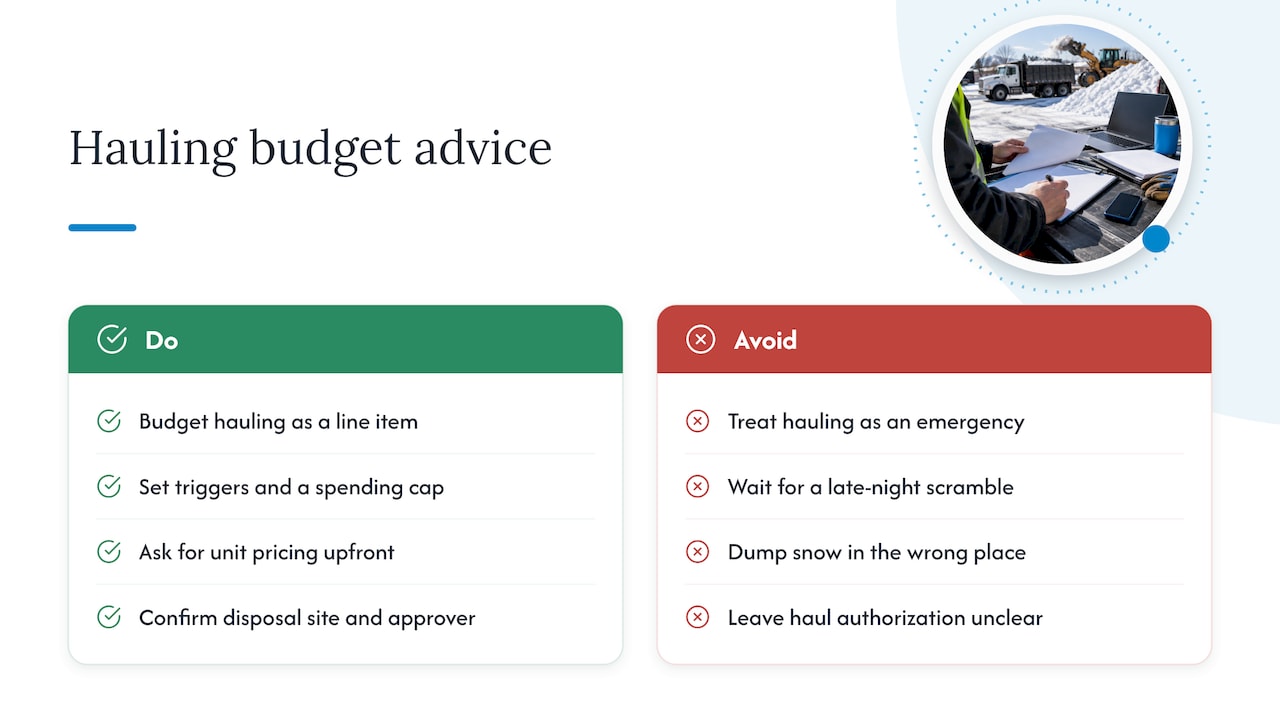
Budget it as a line item. Hauling is an expensive last resort, so treat it as a planned part of the season rather than an emergency. Define the triggers (for example, when designated storage is full), set a spending cap in advance and you avoid premium pricing during a late-night scramble.
Ask for the unit pricing up front. Per-hour, per-truckload or per-event pricing each work, but you should know which you have. Our guide to emergency snow removal costs in Denver explains the factors that move a quote.
Confirm the disposal site. Your contractor should know where the snow goes. Dumping in the wrong place creates drainage and environmental problems later, and you want that responsibility spelled out.
Decide who authorizes the haul. Many property managers set a rule: the contractor documents the trigger with photos, and a named person approves it. That keeps both sides honest.
Snow Placement: Where the Snow Can and Cannot Go
Before you haul, make sure the pushing stage did not create a hazard. The City and County of Denver advises against pushing snow into streets or onto storm drains, because it worsens ice formation and creates hazards. Lawns and sunny areas where snow can melt without blocking access are better places to stack it.
Blocked drains are also a drainage risk once the piles melt. If your yard or lot already has grading trouble, a guide to yard drainage problems and emergency steps is worth reading before you pick a storage spot.
Sidewalks Cannot Wait for the Haul
Hauling is a lot-capacity decision. Sidewalks are a legal one, and the clock starts ticking when the snow stops. Denver requires property owners to keep sidewalks clear, and inspectors begin enforcement once snow stops falling: business areas are checked the same day, and residences get until the next day. Per the city’s snow page, fines start at $150 after an initial notice and a re-check by an inspector.
Other metro cities set their own rules. Many Denver-area communities give residents 24 hours after the snow stops, but check your own municipality’s code.
Two practical points follow:
- If a pile has swallowed the sidewalk, haul or relocate it. Do not leave a narrow path that refreezes.
- Once the snow is gone, stubborn ice and grime on concrete can linger. Winter pressure washing for owners and managers is one way to deal with the residue, but only in temperatures where the water will not simply freeze back into ice.
For residential owners, we cover this in more detail in our homeowner’s guide to Denver sidewalk clearing.
Why Not Just Shovel It Away Yourself?
Homeowners with a driveway or a small pile sometimes try to move it all by hand. Be careful. The CDC reports that about 100 people, mostly men, die each year in the US during or right after shoveling snow. Cold air plus heavy exertion raises heart rate and blood pressure, which can trigger cardiac events, particularly in people with existing conditions.
If you have heart disease, a history of chest pain, or you are older and out of practice, talk to your physician before you shovel at all. The same CDC material recommends shoveling during the warmest part of the day, taking frequent breaks and using a self-propelled snow blower rather than a manual shovel for heavy or packed snow. Moving a season’s worth of piles by hand is not a job to take on. Hauling is a job for equipment and trained operators.
Our Perspective: Hauling Should Be Planned, Not Panicked
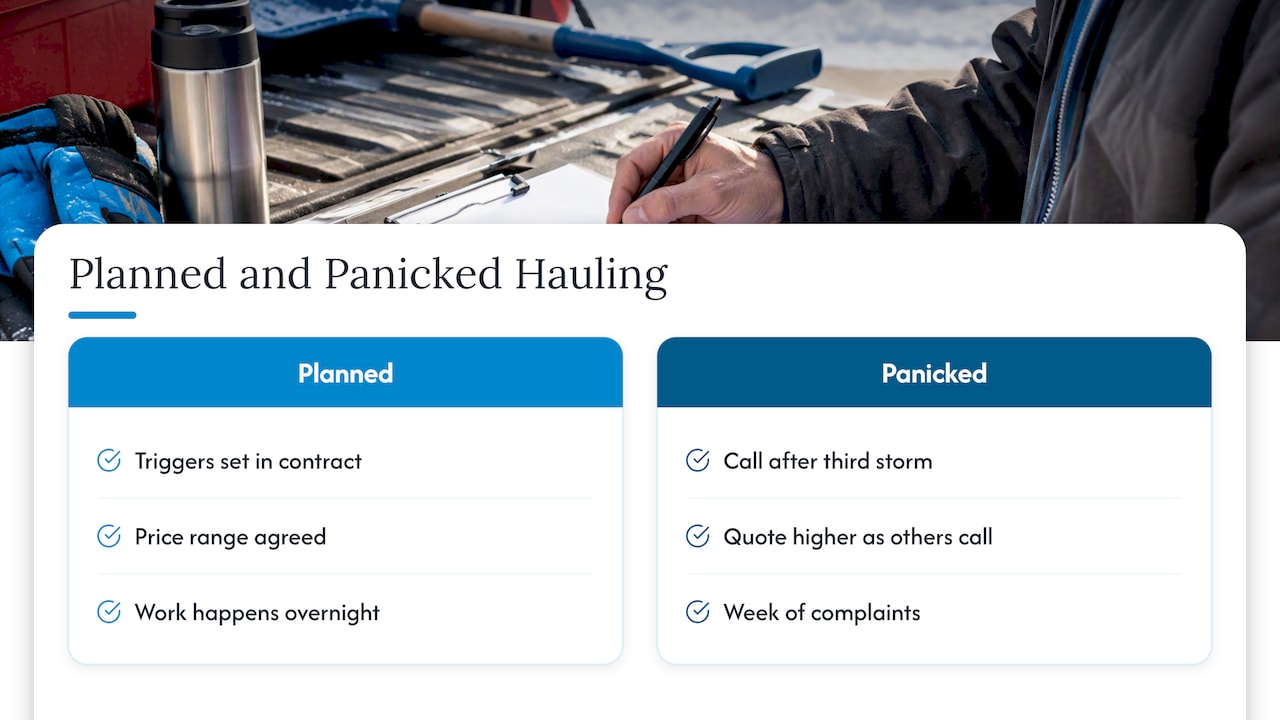
We have been plowing Denver properties for over 44 years, and the pattern repeats every winter. A property manager calls after the third storm in two weeks. The lot is half gone, the exits are narrow and the quote is higher because everyone else is calling too.
The fix is not complicated. Walk the site with us before the season. We mark the storage areas, agree on what counts as full and write the hauling triggers into the contract. If a trigger is hit, we have already got permission and a price range, so the work happens overnight, not after a week of complaints.
We also try to keep hauling to what is needed. Good plowing patterns put snow where it can sit without hurting the site, and our parking lot plowing patterns cheat sheet shows how stacking choices affect how often you will need to haul. Our crews are on call 24/7 and our equipment is built to clear commercial lots in one pass, so the lot is ready for the haul crew rather than fighting it.
The most expensive snow is the snow nobody planned for.
— Jesse
What to Put in Your Seasonal Contract
Use this checklist when you sign or renew an agreement for the season, which for us runs September through May.
- Hauling triggers: a written definition, such as storage areas full, stalls lost past a set number, or sightlines blocked.
- Spending cap or pre-approved range, so you are not surprised on the invoice.
- Who approves a haul, and how fast the contractor can start.
- Hauling window: overnight or after closing, unless the site is an emergency.
- Disposal location and who is responsible for it.
- Documentation: dated service visits and photos of before and after conditions, which matter if a slip-and-fall claim is ever made.
- Ice control after hauling: anti-icing and de-icing where piles were removed.
- Emergency response: what happens when a surprise storm arrives. Our page on emergency snow removal during a heavy storm explains how that works.
Legal and insurance questions about liability belong with your attorney and insurer. A well-documented contract helps both of them.
Get a Hauling Plan Before the Next Storm
If you manage a Denver lot, plaza, industrial site or HOA, we will walk it with you, tell you what we expect to haul and give you a free estimate before you commit. We handle plowing, skid steer push and pile work, snow hauling, anti-icing and sidewalk de-icing, for commercial, industrial, HOA and residential properties. See our commercial services or, for lots, our parking lot snow removal page. Residential driveway and walkway clearing starts from $41.25 per visit.
FAQ
How many inches of snow before you plow?
That depends on your contract and your site. Many commercial contracts trigger plowing at a couple of inches on the pavement, so customers and deliveries are not affected. Residential contracts often use a similar threshold, but ask what yours is and whether it is measured at the site or from a nearby weather station.
Is hauling included in a regular plowing contract?
Usually not. Plowing pushes snow aside, and hauling is priced separately because it needs trucks, loaders and a disposal site. Ask for hauling to be written into the agreement with triggers and a cap, so you are not negotiating during a storm.
Can I leave big piles to melt instead of hauling?
Sometimes. If the piles are in an approved storage area, away from drains, walkways and exits, melting is the cheapest option. If meltwater crosses pavement and refreezes, or the piles block sightlines or parking, hauling is the safer choice.
What time of day is best for snow hauling?
Overnight or when the business is closed. Daytime hauling creates congestion around loaders and dump trucks and generally costs more. Residential communities should also check any noise rules for overnight work.
Do Denver sidewalk rules change if my snow is hauled?
No. The city’s deadlines run from when the snow stops falling, and enforcement does not wait for a haul. Clear the sidewalk first, then schedule the hauling.
Sources
- Snow Removal, City and County of Denver
- Neighborhood Inspections, City and County of Denver
- Here are the shoveling rules around the Denver metro area, 9NEWS
- CDC NIOSH FACE Report 18MA031
- When Snow Hauling Is Necessary: commercial haul-off guide