
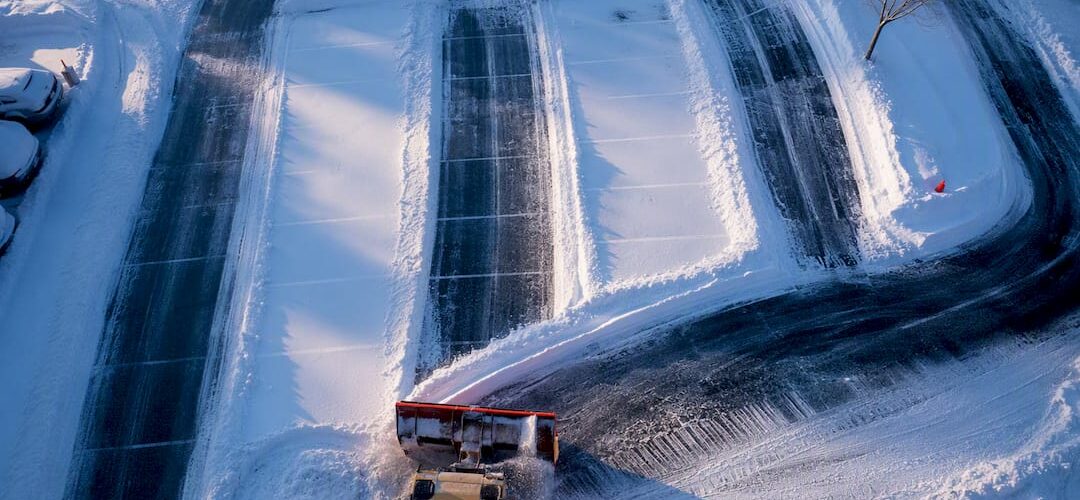
For most commercial lots, center-to-edge or perimeter passes work best, staged to designated edge piles while keeping the plow moving forward instead of backing up. The right pattern depends on lot shape, traffic flow, and snow depth, but the core rule holds everywhere: protect access points first, minimize backing, and stack snow where it will not create drainage or sightline problems later.
TL;DR:
- Center-to-edge passes are ideal for long rectangular lots, especially when access points are prioritized and backing is minimized.
- Perimeter-first plowing suits sites with limited disposal space, avoiding snow blockage near buildings and hazards.
- Deep snow over six inches requires removing the top layer with a raised blade first before full-depth pushing to prevent equipment bogging down.
- Marking hazards and dividing large lots into zones before storms helps streamline operations and reduces rework.
- Equipment choices, such as angle or straight blade use and wing plows, directly influence the quality, speed, and safety of snow removal.
Table of Contents
- Common plowing patterns and when to use each
- How lot layout and obstacles change your pattern
- Equipment and blade techniques that change outcomes
- Operator safety and efficient operating practices
- Snow stacking, pile placement, and disposal best practices
- Sequencing and crew deployment for large lots
- Quick reference checklist and pattern cheat sheet
- What years of Denver storms have taught us about plowing patterns
- Get a plowing plan built for your property
- Sources
- FAQ
Common plowing patterns and when to use each
Choosing a pattern starts with the shape of the lot and how snow will need to move once it is off the pavement.
- Center-to-edge passes work well for long, rectangular lots: the operator plows a straight center line first, then pushes successive passes outward toward the edges or designated piles.
- Perimeter-first plowing suits sites with limited disposal room. Snow gets pushed to the outer boundary in a ring pattern, leaving the center open until edge piles are established.
- Spiral or clockwise patterns handle odd-shaped lots, cul-de-sacs, and stadium-style layouts, where a single continuous loop clears the space without repeated turnarounds.
- Windrow or widening passes matter most in deep snow or narrow aisles, where a single pass cannot move the full load and the operator widens the row in stages.
Deep snow changes the math regardless of pattern. Industry guidance recommends taking off the top layer first with a raised blade in snow deeper than six inches, then following with a full-depth pass, rather than trying to move the entire load at once. A rough decision matrix helps here: long rectangular lots with open edges favor center-to-edge, tight or irregular lots favor spiral routes, and any lot with restricted haul space favors a perimeter-first approach that concentrates snow where a loader can reach it.
How lot layout and obstacles change your pattern
No two lots plow the same way twice once islands, curb cuts, and accessible parking enter the picture. Breaking a large lot into zones, rather than trying to clear it in one continuous pattern, cuts down on backtracking and rework.
- Segment large lots into zones so a crew can finish one section completely before moving to the next, which avoids doubling back over already-cleared pavement.
- Clear doors, fire lanes, and accessible spaces first. Step-by-step industry guidance recommends starting at building entrances before moving to main aisles, since those areas carry the highest foot traffic and the most liability exposure.
- Mark curbs, drains, and hydrants before the first storm so operators know where buried hazards sit under a blanket of snow.
- Plan for angled aisles and one-way flow. Narrow lanes often require a modified windrow pattern rather than a straight push, since there is nowhere to stage a full-width row.
A pre-season walk-through, done before the first flakes fall, is what makes this kind of zone planning possible instead of improvised on the fly.
Equipment and blade techniques that change outcomes
Pattern choice only gets you halfway there. Blade position and equipment capability decide whether a pattern executes cleanly or turns into a series of half-finished passes.
- Angle the blade for most forward passes, since an angled blade rolls snow off to one side instead of piling it in front of the truck.
- Use the straight position for scraping a final pass over a cleared lane, when the goal is maximum contact rather than lateral movement.
- Backdrag sparingly. Kolpin’s plowing guidance treats backdragging as a short, specific maneuver for building turning room or clearing tight edges, not a routine technique, since backing repeatedly slows the job and raises collision risk.
- Deploy wing plows or reversible blades on wide lanes, where a single truck can clear more width per pass and echelon runs with a second truck become practical.
- Reduce blade width as depth increases. Cutting a narrower swath in heavy snow preserves traction and keeps the truck from bogging down mid-pass.
Pro Tip: Plan your route before you start plowing so the truck can stay in forward gear for nearly the entire job, saving backdragging for the last few feet near a wall or island.
Operator safety and efficient operating practices
Safety and speed are not competing goals here. A truck that backs less, drives at a controlled pace, and follows a pre-walked route almost always finishes faster than one working reactively.
- Pre-walk the lot and mark hazards before the first storm, flagging curb stops, speed bumps, and anything else hidden once snow covers the ground.
- Drive forward whenever possible and use a spotter for the backing that remains necessary, particularly near pedestrian paths.
- Hold a controlled speed rather than accelerating hard between passes, and raise the blade fully when moving between separate sites or crossing clear pavement.
- Rotate crews and build in breaks during long storms, since fatigue is a major factor in plowing incidents according to safety guidance for parking lot operators.
- Monitor weather in real time so crews can adjust timing rather than plowing into an active storm and having to redo completed sections.
Snow stacking, pile placement, and disposal best practices
Where the snow ends up matters as much as how it got there. A pile in the wrong spot can turn into a drainage problem or a liability claim by spring.
- Avoid stacking against foundations, drains, hydrants, or anywhere it blocks sightlines, since meltwater from a poorly placed pile can seep into a building or refreeze across a walkway.
- Choose upland or pervious disposal sites where possible. State snow-disposal guidance recommends keeping piles away from water resources and setting clear haul triggers before piles grow unmanageable.
- Plan meltwater routing so runoff drains away from entrances and walkways rather than refreezing into ice overnight.
- Document pile locations each storm, which supports both municipal compliance and a clear record if a slip-and-fall claim ever surfaces. Our guide to pile placement and haul triggers covers how to set those thresholds for a specific site.
Sequencing and crew deployment for large lots
A repeatable sequence keeps a large commercial site moving instead of stalling out on the first unexpected obstacle.
- Clear priority access points first: building entrances, fire lanes, and accessible parking.
- Open main aisles next so vehicles and equipment can circulate through the site.
- Work parking aisles zone by zone, finishing each section before shifting crews to the next.
- Finish with edging and cleanup passes to tidy corners, curb lines, and any spots pushed snow left behind.
For wide spans, pairing trucks in an echelon formation, with one truck running slightly behind and beside the other, clears more pavement per pass and cuts down on overlap. Clear Roads’ best-practice manual documents these formations for a range of complex layouts, along with the radio coordination they require. When piles hit a haul trigger, bringing in a loader keeps the crew from losing momentum on cleanup. Our sequencing guide for commercial sites walks through how to divide zones on a larger property. Any storm severe enough to reduce visibility or create unsafe footing for operators is a reason to pause and reassess rather than push through.
Quick reference checklist and pattern cheat sheet
Print this section, or hand it to whoever runs point during a storm.
- Before the storm: walk the site, mark hazards, set pile zones, and confirm who is covering which zone.
- On the job: keep speeds controlled, save backdragging for tight edges only, and adjust blade width as snow depth increases.
| Lot shape | Recommended pattern |
|---|---|
| Long rectangular lot | Center-to-edge passes |
| Odd-shaped or stadium lot | Spiral or clockwise loop |
| Limited disposal space | Perimeter-first with edge piles |
| Deep snow or narrow aisles | Windrow with widening passes |
What years of Denver storms have taught us about plowing patterns
Most of the jobs we run involve the same handful of headaches: undersized disposal areas, blocked fire lanes, and lots where a single bad pattern choice on hour one costs an extra hour by hour three. Matching the pattern to the lot, not the other way around, is what actually saves time. Round-the-clock dispatch and site-specific plans matter because storms rarely wait for a convenient start time.
— Jesse
Get a plowing plan built for your property
A well-chosen pattern only helps if the crew executing it knows the lot as well as you do. A site-specific plan for each property can cover commercial parking lot plowing, seasonal contracts, and emergency response when a storm arrives outside business hours.
- Site evaluation: we walk the property to map entrances, fire lanes, drains, and pile zones before the season starts.
- Custom snow plan: pattern, pile locations, and haul triggers set in advance, not improvised mid-storm.
- Free estimate: a no-obligation quote based on your lot’s actual layout and traffic.
Get a free estimate for commercial parking lot plowing and have a plan in place before the next system rolls in.
Sources
The patterns and safety practices above draw on Clear Roads’ best-practice manual for formation diagrams and training materials, state guidance on snow disposal for pile-placement rules, and safe parking lot plowing guidance for operator practices. Crews and property managers planning their own operations should consult these directly for full diagrams and video walkthroughs. For heavy hauling and loader support on large piles, a land clearing and site prep partner can supplement equipment capacity when volumes exceed what a plow crew alone can move.
- Best Practices and Techniques for Snow Plowing (Clear Roads)
- How to safely plow parking lots (ForConstructionPros)
- Mass
FAQ
How much should I charge to plow a parking lot?
Pricing depends on lot size, snow depth, and whether the job is one-time or under a seasonal contract, so there is no single rate that fits every site. Property managers evaluating cost should request quotes based on their specific lot, and our parking lot plowing cost guide breaks down the factors that drive pricing up or down.
What is the pattern to plow a field or large open lot?
Large open areas typically use a center-to-edge or spiral pattern, starting from one point and working outward in continuous passes to avoid repeated crossings. The specific route depends on where the snow needs to end up and how many entrances the site has.
What is the best way to remove snow from a parking lot?
The most reliable approach combines the right pattern for the lot’s shape with forward-driving whenever possible and designated pile zones set before the storm. Industry guidance points to pre-walking the site and marking hazards as the step that prevents the most damage and delay.
How long does it take to plow one acre of parking lot?
Clearing time varies widely based on snow depth, equipment size, and lot obstacles, so there is no fixed figure that applies across sites. A property manager working with a contractor should ask for a time estimate based on their lot’s specific layout and typical storm conditions.