
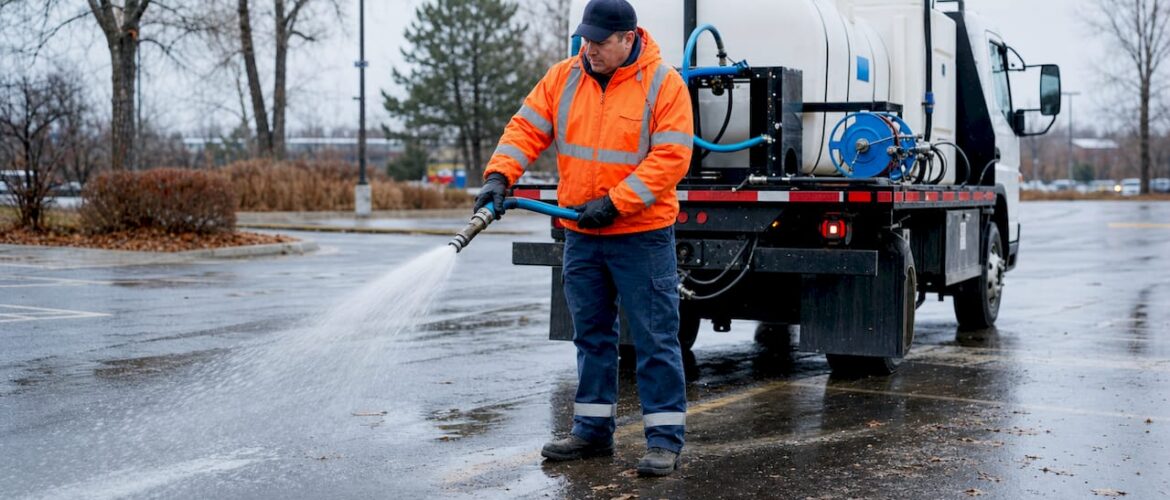
Pre-treatment snow service is the process of applying liquid anti-icing solutions to pavement surfaces before winter precipitation begins, preventing ice from bonding to the ground. The industry standard term for this practice is anti-icing, and it differs fundamentally from deicing, which removes ice after it has already formed. Property owners and managers who understand this distinction gain a real operational advantage. Pre-treatment snow removal reduces the time crews spend on site, cuts material use, and lowers slip-and-fall risk during the most dangerous hours of a storm. Denversnowremovals has built this practice into its core winter service model for the Denver Metro area.
What is pre-treatment snow service and how does it work?
Anti-icing works by creating a chemical barrier between the pavement surface and falling snow or freezing rain. The most common agent is salt brine at 23% concentration, a ratio that maximizes the solution’s freezing point depression without wasting material. That concentration is not arbitrary. It represents the eutectic point of sodium chloride and water, the mix that stays liquid at the lowest possible temperature.
The brine is applied using spray trucks or mounted sprayers that distribute the solution evenly across driveways, parking lots, and walkways. When snow falls onto a pre-treated surface, it cannot grip the pavement the way it would on an untreated one. Crews can then plow or push the snow away with far less resistance and far less residual ice left behind.
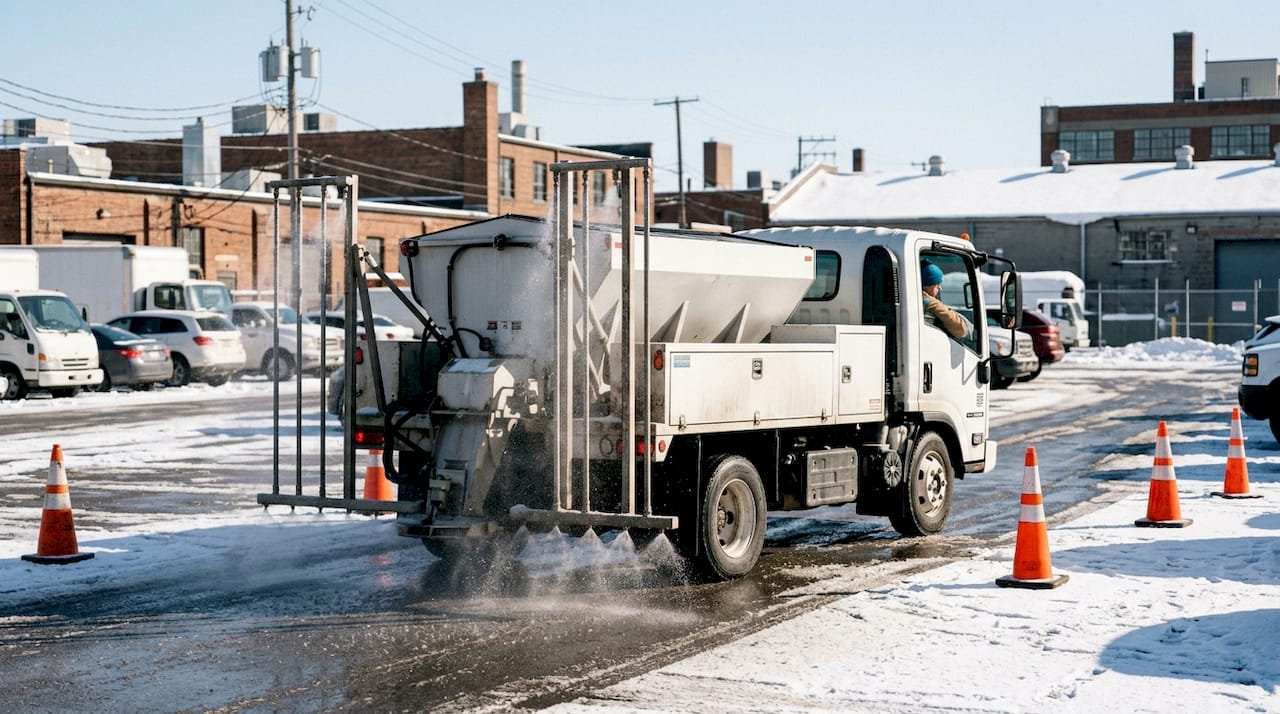
Timing is the most critical variable in the entire process. Effective pre-treatment requires application within 12–24 hours before a forecasted storm, close enough to the event that the brine has not dried out or been disturbed. Applying it too early wastes material and reduces effectiveness. Applying it too late means the ice bond has already begun to form.
Anti-icing is not the same as deicing. Deicing melts ice that has already bonded to pavement, which requires far more chemical product and more labor. Anti-icing prevents the bond from forming in the first place, which is a fundamentally more efficient approach. Think of it as the difference between sealing a surface before a spill versus scrubbing after one.
Key operational factors that determine success:
- Pavement temperature: Brine works best when surface temps are above 15°F to 20°F.
- Surface condition: The pavement must be dry at the time of application.
- Storm timing: Application should fall within the 12–24 hour window before precipitation.
- Storm type: Light to moderate snowfall responds best. Heavy, fast-moving storms require follow-up plowing regardless.
Pro Tip: Check pavement temperature, not just air temperature. A sunny afternoon can leave pavement warmer than the air, which affects how quickly brine activates and how long it holds.
What are the benefits of pre-treatment snow service for property owners?
Pre-treatment delivers measurable advantages across safety, cost, and legal risk. Property owners who include it in their winter snow service contracts typically see faster clearing cycles and fewer callbacks after storms.
-
Faster snow removal cycles. Pre-treated surfaces allow plows to clear snow in fewer passes. The snow does not pack and bond, so crews move through a property more quickly. That speed matters when you manage multiple buildings or a large parking lot during a heavy storm.
-
Reduced deicing material use. When anti-icing works as intended, less de-icing product is needed after the storm. That translates directly to lower material costs per event and less chemical runoff affecting landscaping and drainage systems.
-
Extended pavement life. Repeated freeze-thaw cycles and heavy salt application degrade asphalt and concrete over time. Pre-treatment reduces the need for aggressive post-storm deicing, which means less surface wear across a full winter season.
-
Lower slip-and-fall liability. Slip-and-fall claims are the primary winter-related legal risk for commercial properties. Pre-treatment keeps surfaces safer during the first hours of a storm, which is exactly when most incidents occur.
-
Alignment with zero-tolerance contracts. Many 2026 commercial snow management plans now include anti-icing as a standard feature. If your property operates under a zero-tolerance accessibility requirement, pre-treatment is not optional. It is the baseline.
“Pre-treatment is a critical duty-of-care component. Property managers who skip it face greater legal exposure during the early hours of every storm, when conditions are most dangerous and response crews are still mobilizing.”
When and how should pre-treatment be applied for best results?
Timing and conditions determine whether anti-icing works or wastes money. The application window and environmental thresholds are specific, and deviating from them produces poor results.
| Condition | Optimal Range | Why It Matters |
|---|---|---|
| Pavement temperature | Above 15°F–20°F | Brine loses effectiveness below this threshold |
| Surface moisture | Dry at application | Wet surfaces dilute brine before it can bond |
| Application timing | 12–24 hours before storm | Too early: brine dries out. Too late: ice bond starts forming |
| Storm intensity | Light to moderate snow | Heavy accumulation still requires mechanical plowing |
| Rain risk | None between application and snow | Rain washes brine off the surface entirely |
The table above reflects industry practice thresholds used by professional snow management programs. These are not conservative estimates. They are the conditions under which brine actually performs as intended.
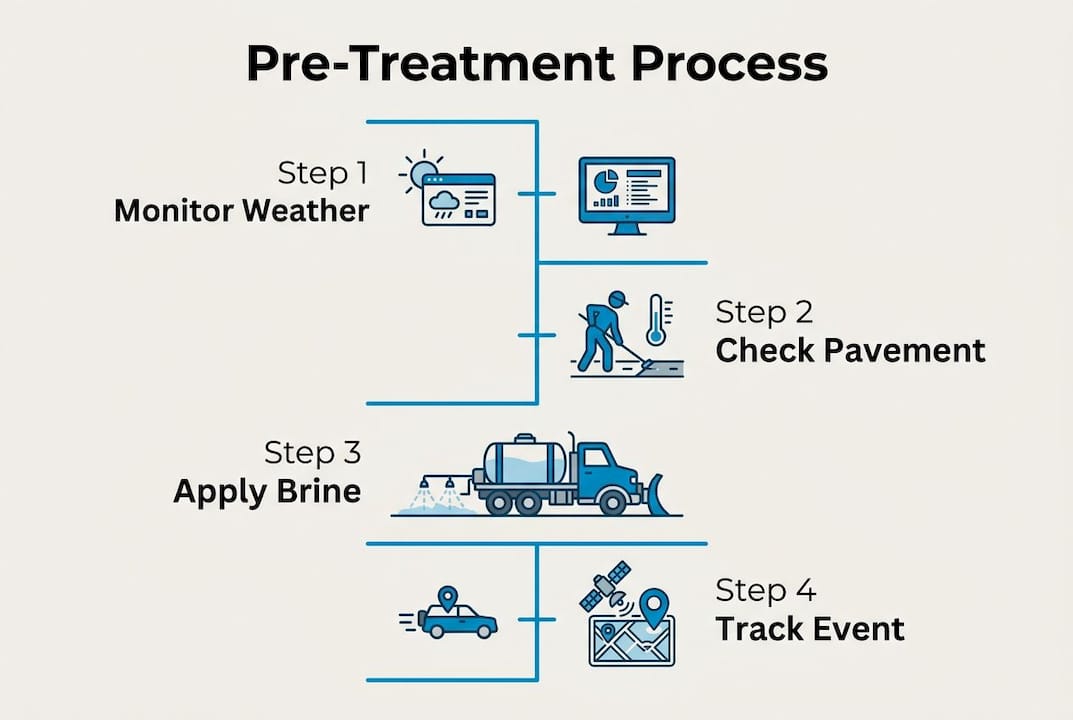
Trigger logic is the operational framework that makes pre-treatment consistent. Rather than applying brine on a fixed schedule, professional programs define specific weather triggers: a forecasted accumulation above a set threshold, a pavement temperature reading below a set point, or a storm arrival window within a defined number of hours. Well-defined service triggers produce reliable results across different storm types and prevent both over-application and missed treatments.
Documentation matters as much as application. GPS timestamps and photos of each pre-treatment event are now industry best practice for commercial snow management. If a slip-and-fall claim is filed, that documentation is your primary defense. A service log without verification is far weaker than one with timestamped photographic evidence.
Pro Tip: Ask your snow removal provider for a copy of their pre-treatment log after each storm event. If they cannot produce one with timestamps and locations, that is a gap in your liability protection.
What limitations and misconceptions surround pre-treatment snow service?
Pre-treatment is not a complete solution on its own. Property managers who treat it as a standalone fix consistently get worse outcomes than those who integrate it into a full winter maintenance plan. Setting accurate expectations is part of responsible snow management.
Common limitations and misconceptions to understand:
- Pre-treatment does not replace plowing. When accumulation exceeds a few inches, mechanical removal is still required. Brine prevents bonding; it does not melt heavy snow loads.
- Effectiveness drops sharply below 15°F. At very low temperatures, brine loses its ability to depress the freezing point enough to prevent ice formation. Alternative products or methods are needed in extreme cold.
- Rain between application and snowfall washes brine away. If rain falls after the brine is applied but before snow arrives, the treatment is gone. Weather monitoring before application is non-negotiable.
- Applying too early is as bad as not applying at all. Brine applied more than 24 hours before a storm can dry, crystallize, and blow off the surface. The timing window is narrow for a reason.
- Anti-icing and deicing are not interchangeable terms. Anti-icing prevents the ice bond. Deicing breaks an existing bond. Confusing the two leads to wrong product choices and misaligned service expectations.
- Heavy or fast-moving storms overwhelm pre-treatment. A nor’easter or a rapid accumulation event will deposit snow faster than any anti-icing agent can manage. Pre-treatment buys time and reduces effort; it does not eliminate the need for active storm response.
Integrated snow management solutions combine pre-treatment with real-time monitoring, mechanical plowing, and post-storm cleanup. That combination is what actually keeps properties accessible and safe through a full winter season.
Key Takeaways
Pre-treatment snow service is the most cost-effective first step in any winter maintenance plan, but it only delivers full value when applied at the right time, under the right conditions, and as part of an integrated storm response.
| Point | Details |
|---|---|
| Anti-icing prevents bonding | Brine applied before snow stops ice from gripping pavement, making removal faster and easier. |
| Timing is the critical variable | Apply brine 12–24 hours before a storm. Too early or too late reduces effectiveness significantly. |
| Temperature thresholds matter | Brine loses effectiveness below 15°F–20°F. Check pavement temperature before every application. |
| Documentation protects you legally | GPS timestamps and photos of each treatment are the standard for liability defense in 2026. |
| Pre-treatment requires integration | It works best alongside active plowing and storm monitoring, not as a replacement for them. |
What I’ve learned from watching pre-treatment get misused every winter
After years of observing how property managers handle winter preparation, the most common mistake is not skipping pre-treatment. It is applying it without a plan. I have seen properties get pre-treated 36 hours before a storm, only to have the brine dry out and blow away before a single snowflake fell. The crew checked a box. The property was not protected.
The second most common mistake is treating anti-icing as a cost-cutting shortcut rather than a precision tool. When brine replaces plowing instead of preceding it, properties end up with packed, slippery surfaces that are harder to clear than if nothing had been applied at all. Pre-treatment works when it is the first step in a sequence, not the only step.
What actually works is trigger-based scheduling tied to real weather data. That means a crew does not go out because it is Tuesday and snow is in the forecast. They go out because pavement temperature is above 20°F, the surface is dry, and accumulation is expected within 18 hours. That specificity is the difference between a professional program and a reactive one.
Contract terms matter more than most property managers realize. If your agreement does not specify what triggers pre-treatment, which areas get treated, and what documentation you receive, you have no way to verify the service was performed correctly. Clear terms protect both sides and make the whole system more reliable.
— Jesse
How Denversnowremovals handles pre-treatment as part of full winter service
Denversnowremovals builds anti-icing into its winter service programs for residential and commercial properties across the Denver Metro area. With over 44 years of experience, the team applies brine treatments based on real-time weather monitoring and defined storm triggers, not guesswork or fixed schedules.
Every pre-treatment event is logged with verification records, giving property owners the documentation they need for liability protection. Service plans are flexible, and free estimates are available for properties of any size. If you want to understand how snow preparation steps fit into a full-season plan, or you are ready to get a quote for pre-treatment-inclusive snow removal, visit Denversnowremovals to connect with the team directly.
FAQ
What is the standard concentration for snow pre-treatment brine?
Salt brine used for pre-treatment is typically mixed at 23% salt to water concentration. That ratio provides the most effective freezing point depression without wasting material.
How far in advance should pre-treatment be applied before a snowstorm?
Pre-treatment should be applied 12–24 hours before forecasted precipitation. Applying it earlier risks the brine drying out or blowing off before the storm arrives.
Does pre-treatment work in all winter conditions?
Pre-treatment is most effective when pavement temperatures stay above 15°F–20°F and no rain falls between application and snowfall. Below those temperatures or in heavy storms, additional deicing and plowing are required.
Is pre-treatment snow service worth it for residential properties?
Pre-treatment reduces the time and material needed to clear driveways and walkways after a storm. For residential properties with long driveways or high foot traffic areas, it lowers both clearing costs and slip-and-fall risk.
What documentation should I expect from a pre-treatment snow service provider?
Professional providers should supply GPS-timestamped records and photos for each pre-treatment application. That documentation is the primary evidence used to defend against slip-and-fall liability claims.
Recommended
- Snow Removal Scope of Work: A Denver Property Guide – Snow Removal Denver 303-591-2089
- How to Set Snow Clearing Expectations for Residents – Snow Removal Denver 303-591-2089
- Why Hire a Snow Removal Service: 2026 Guide – Snow Removal Denver 303-591-2089
- How to Protect Landscaping During Snow Plowing – Snow Removal Denver 303-591-2089