
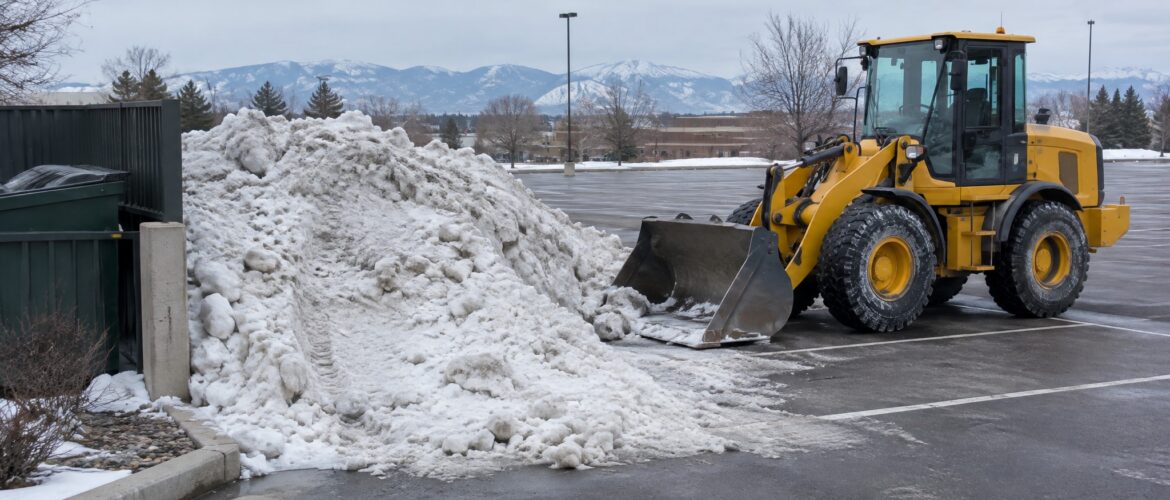
If you need a snow hauling service Denver businesses can trust, we handle overnight commercial pile removal with timely, upfront pricing. Call us 24/7 for service and we’ll clear your lot fast so your business stays open and safe. It does not make snow disappear. Every push leaves a pile somewhere on your property, and by the third or fourth storm of a Colorado winter, “somewhere” starts to run out. When storms stack up, a snow hauling service Denver lot owners can call 24/7 makes all the difference. Our snow hauling service Denver crews haul piles off-site overnight so your lot is clear by morning.
Key takeaways
- Piles must leave the lot once the next push would block stalls, accessible spaces, fire lanes, dumpster access, or entrance sightlines, or once the snow storage area is full.
- Sanded, refrozen plow piles can sit long after a storm even though Denver’s sun melts clean snow fast, so waiting for melt is not a plan.
- Piles that narrow walks are where slip-and-fall exposure starts, so hauling them is part of managing liability.
- Hauling is billed per load, meaning each truckload that leaves the site, based on pile volume, haul distance, and loader time.
- Call once the snow stops and the piles stop growing, with the site address, pile locations, and reopening time ready.
That is when you need a snow hauling service in Denver. We are Denver Snow Removals, we have 47+ years of experience, and we focus on large parking lots, industrial parks, office campuses, and HOA communities rather than residential driveways. This article explains when piles have to leave your lot, how hauling is priced, and how we run the job overnight so your lot is open before anyone arrives.
Commercial Snow Hauling: When Piles Have to Leave the Lot
Once the next push has no safe place to go on the lot, the pile has to leave the property, and hauling is how it leaves. That is what snow pile removal in Denver comes down to: an off-site snow removal parking lot job that trucks the snow to a proper disposal site, so your plow crew can keep working. If your piles are eating parking spots, a snow hauling service Denver businesses trust will free up space fast. We load, haul, and document every load with photo proof.
Picture a typical office campus lot in the Denver Metro after a heavy, wet overnight storm. The plow crew has made repeated passes since midnight. Each pass has stacked more snow along the perimeter and in the end rows.
Now look at what those piles are sitting on. They cover the end-row stalls, which is where lost parking shows up first. They press against the dumpster pad, so the waste hauler cannot reach the bins. They crowd the entrance drive, where drivers need a clear sightline to pull out safely. And the designated snow storage area is already full.
That is the decision point.
Pushing works while there is room to store the next push. It stops working when the next push would block stalls, accessible spaces, fire lanes, or access routes. If you are standing at that line, more plowing only makes the problem taller, and every extra pass costs you parking you have already lost.
Why waiting for the sun is not a plan
Denver’s sun melts clean snow fast, and plenty of property managers lean on that. It works for a light, clean dusting on open pavement. It does not work for the piles a commercial lot builds. The best time to book a snow hauling service Denver commercial service is before the pile becomes a liability. Our snow hauling service Denver team offers upfront pricing, so you know the cost before we roll a truck.
Plow piles are packed, mixed with sand and de-icer, and dirty enough to soak up less sun than fresh snow. They melt by day and refreeze by night. A sanded, refrozen pile can sit for a long time after the storm is over, and the next storm stacks on top of it. If your plan is to wait, you are planning to lose those stalls for weeks, not hours.
Where the liability starts
Piles also move water. A pile that narrows a walk pushes pedestrians toward the drive lane or onto the slick edge of the pavement. Meltwater from the base runs across the walk in the afternoon and refreezes after dark. That is where slip-and-fall exposure starts, long before anyone falls.
So we do not treat clearing piles as a cosmetic fix. It belongs in the case for hauling, right next to your obligations under Denver’s sidewalk snow removal rules. A pile you can see from the lobby, narrowing a walk your tenants use every morning, is a pile you own the risk on.
Hauling has limits. It does not replace plowing, and it does not replace de-icing on the pavement you reopen. If your lot has storage room left, pushing is still the right call and the cheaper one. This service is for the lot that has run out of room. From retail centers to HOAs, a snow hauling service Denver property managers rely on keeps entrances, fire lanes, and ADA spots open. We work overnight to avoid disrupting your customers.
Skid Steer Snow Removal at Night: How the Haul Runs
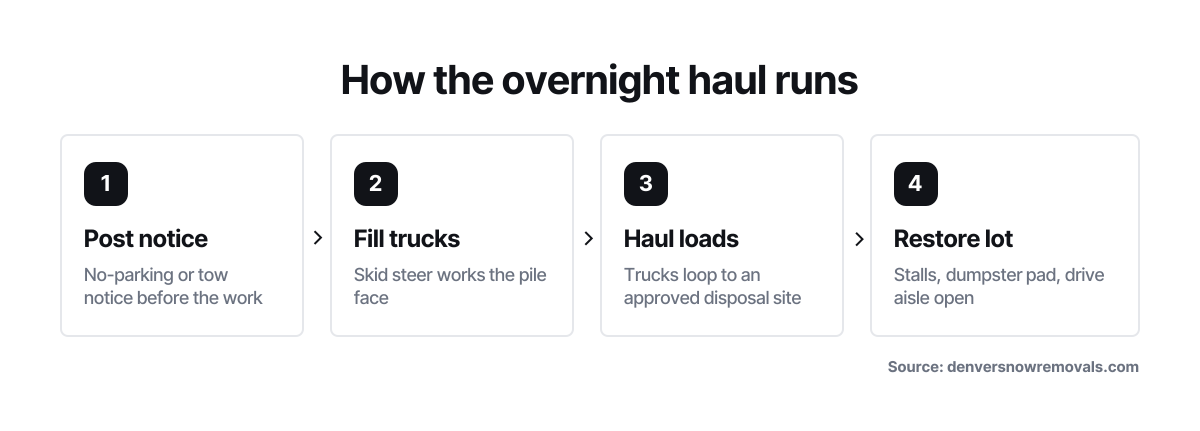
Run that same office campus lot overnight, and this is how we handle it.
First, the property posts a no-parking or tow notice before the work window opens. A loader cannot work around parked cars, and we will not gamble with vehicles or people in the dark. Getting that notice out early is the one job that falls on you.
Once the plow pass ends, a skid steer works the pile face and fills the trucks. While one truck pulls out, the next backs in, so the trucks run a loop instead of idling while the loader catches up. That rhythm is what lets a haul finish in one night rather than dragging into the next business day.
Each truck runs to a disposal site that accepts snow. Never a storm drain, and never a waterway. Dumping snow where it does not belong exposes you to far more trouble than the haul ever cost.
The crew logs loads as it goes, so the invoice matches the trucks that actually ran. You can check the count against what you see leave.
Then we restore the lot. The end-row stalls come back, the dumpster pad is clear, and the drive aisle is open with a clean sightline at the entrance. The goal is simple: your lot is open again before staff and visitors arrive.
This is skid steers and trucks, not a pickup and a shovel. Our equipment pairs commercial plow trucks with skid steers and de-icing equipment, so the loading side of a haul runs on commercial equipment, not pickup trucks. We are also fully insured, which matters when loaders and trucks work around parked cars and pedestrians after dark.
Snow Removal Hauling Cost: How Per-Load Pricing Works
Snow removal hauling cost follows a simple unit: the load. A load is one truckload that leaves your site. You are billed for the loads that actually ran, which is why we log them as the night goes.
We build your quote from three things:
- the expected load count, set by how much snow is piled on the lot
- the haul distance to the disposal site
- loader time to fill the trucks
Hauling costs more than pushing because it adds a loader and trucks on top of the plow work. Plowing needs one machine moving snow a short way. Hauling needs a skid steer, a line of trucks, a driver for each, and a round trip to the disposal site. Your quote reflects that crew and that distance.
Per-load pricing also differs from how plowing is billed. If you are weighing per-push plowing versus a seasonal contract, note that hauling is its own line: it is priced by the load, not by the push, because the work depends on pile size rather than on storm count. For wider context on how contracts are structured, read about commercial snow removal contract pricing.
We quote up front. You will know how the haul is priced before the first truck rolls, not when the invoice lands.
Scheduling a Denver Snow Hauling Job After a Big Storm
After a big storm, demand spikes across the metro. Every property manager with full piles wants a crew at once, and the trucks and loaders can only be in so many places.
Schedule the haul once the snow stops and the piles stop growing. Hauling while plows are still adding snow means loading the same lot twice. And compacted, frozen piles take longer to load than fresh ones, so waiting days after the storm to call makes the night’s work slower, not easier. You get the best result by calling early and letting us plan the loads around when the storm ends.
Have these ready when you call:
- ✔ The site address
- ✔ Where the piles sit on the lot
- ✔ The time the lot must reopen
- ✔ Any gate or access rules
With those four details, dispatch can plan the night’s loads, the truck loop, and the order we clear the lot.
Our staffed 24/7 dispatch runs from September to May, so an overnight hauling call is answered that night, not the next business day. The same line backs our 24-hour snow plowing crews, and it is also how we handle overnight emergency response in Denver when a storm outruns the plan.
Call dispatch with your address, your pile locations, and your reopening time. If you would rather start in writing, request a hauling quote and we will price the haul up front.
Frequently asked questions
How do I know if my lot needs snow hauling instead of more plowing?
Look at where the next push would go. If it would block stalls, accessible spaces, fire lanes, dumpster access, or the entrance sightline, or if your snow storage area is already full, the piles need to leave the property. If there is still room to store the next push, plowing alone is enough.
Can I just wait for the piles to melt?
Not reliably. Denver’s sun clears clean snow quickly, but sanded, refrozen plow piles can sit long after the storm ends. Meanwhile they cost you parking and narrow your walks.
Why Choose Our Snow Hauling Service Denver?
When snow piles start taking up parking spots and blocking visibility, you need a snow hauling service Denver property managers rely on. We haul piles off-site overnight, document every load with photo proof, and keep your lot clear without shutting down your business.
How is snow hauling priced?
Hauling is billed per load, and a load is one truckload that leaves your site. The quote reflects the expected load count, the haul distance to the disposal site, and loader time. We quote it up front and log loads during the haul so the invoice matches the trucks that ran.
Do you need the lot empty of cars?
Yes. A loader cannot work around parked cars, so the property posts a no-parking or tow notice before the work window. That lets the skid steer work the pile face and keep trucks moving.
When should I call after a big storm?
Call once the snow stops and the piles stop growing. Compacted, frozen piles take longer to load, and demand spikes across the metro after a big storm. Our dispatch is staffed 24/7 from September to May, so an overnight call is answered that night. Ready to clear your lot? Book our snow hauling service Denver service today and get overnight pile removal with timely, upfront pricing. Call us 24/7 — we’ll handle the haul so you don’t have to.