

Denver winters rarely deliver one clean storm. They deliver a cycle: snow, sun, melt, refreeze, and another round before the first one is fully cleared. For a commercial property, every trip through that cycle costs money and adds liability. A retail center, office campus, industrial park, or HOA community either stays open or it does not, and the difference usually comes down to whether the snow plan was written before the season started or improvised at 4 a.m. after the first front rolled through.
Parking lot snow plowing in Denver works best as a system: a defined plowing sequence, de-icing that keeps pace with freeze-thaw, snow stacked or hauled where it will not refreeze into a hazard, and a contract that spells out exactly when crews roll. Here is what property owners and managers need to plan for.
Start With the Rule That Applies to Your Lot
Denver treats public streets and private parking lots differently. The city’s Department of Transportation and Infrastructure handles emergency snow response on the street network, including residential plowing that runs between 3:00 a.m. and 3:00 p.m. and typically takes one pass down the center of a street. That work does not extend to a privately owned lot, no matter how many vehicles use it.
Private lots fall to the property owner. Local rules require owners to clear snow from privately owned parking lots within 24 hours after snowfall ends. Denver also enforces sidewalk clearing, and enforcement can arrive as a time-stamped notice. Once a commercial property is noticed, the window to comply is measured in hours, which is not enough time to start searching for a contractor. Confirm the current requirement with the City and County of Denver, since deadlines and enforcement language can be updated.
Why the 24-Hour Clock Is Really a 12-Hour Problem
The ordinance allows 24 hours. Your tenants, customers, and residents do not. A retail center needs accessible stalls by opening. A distribution center needs trucks moving through drive lanes and loading docks. An office campus needs a safe path from the garage to the lobby, and an HOA needs residents out of their driveways in the morning.
The practical timeline compresses for another reason. Clearing early lets crews push snow while it is still manageable. A lot left to sit through a melt-and-refreeze cycle turns into packed ice that cannot be plowed off, only chipped or chemically treated. Waiting also means the lot fills with parked vehicles, forcing operators to work around obstacles and return later.
The Plowing Sequence That Keeps a Lot Open
A commercial lot is not one surface. It is a set of zones with different priorities, and the order crews work them determines how fast the property returns to normal. A typical sequence looks like this:
- Entry and exit drives, so vehicles can get in and out before stalls matter.
- Main drive lanes and fire access routes, keeping circulation open across the property.
- Loading docks and service areas, which often need attention first for industrial and distribution tenants.
- Customer, tenant, and resident stalls, pushed from the center rows out to the banks.
- Accessible parking and the walkway connections to each building entrance.
- Sidewalks, entry mats, and steps, cleared and treated separately from the lot.
Walkway clearing deserves its own line item rather than a mention at the end of the invoice. It is the surface people actually walk on, and it is the one most often cited in slip-and-fall claims. Salting and walkway clearing should run on the same schedule as plowing, not after the trucks are packed up.
Where the Snow Goes
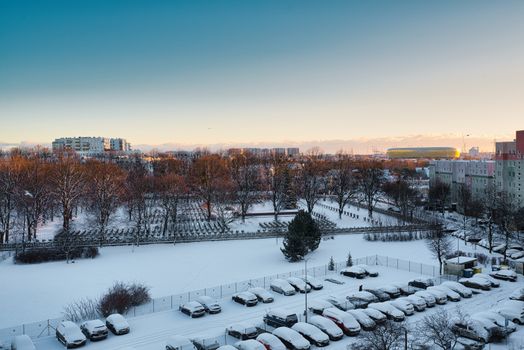
Snow stacking is where good plans and bad plans separate. Piles placed at the end of a row block sightlines and shrink the stall count. Piles pushed against a building trap meltwater against the wall. Piles over a storm drain guarantee an ice rink at the low point of the lot when the thaw refreezes overnight.
Before the season, decide where snow will live. Identify and mark stacking areas that will not obstruct drivers, block accessible routes, or cover drains. When a lot has no room for the volume a storm produces, snow hauling and disposal is the alternative. Hauling is slower and more expensive than stacking, so it belongs in the plan deliberately, not as a surprise line item after a 12-inch storm.
Equipment Matters More When the Lot Is Tight
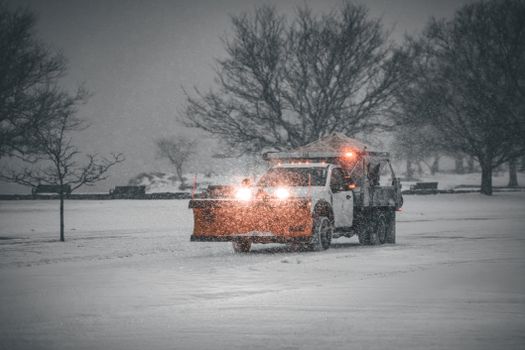
Full-size plow trucks handle large parking lots efficiently, and multiple plows can be assigned to a single large property so the work finishes in one pass instead of three. Drive lanes, access roads, and loading docks are all within reach of a standard commercial plow.
Tighter areas call for different tools. Skid steers plow snow in confined spaces, work around islands and cart corrals, and clean up edges a truck cannot reach. A crew running the same few pieces of equipment on every property will leave corners behind. Matching equipment to lot geometry keeps islands, curbs, and drive-through lanes clear without gouging asphalt or clipping wheel stops.
De-Icing Is Not Optional After the Plow Leaves
Denver’s daytime sun melts snow on asphalt even when air temperatures stay low, and that water has to go somewhere. Overnight it refreezes, and the lot cleared at 2 p.m. is a hazard at 6 a.m. Plowing moves snow. De-icing addresses what is left behind.
Salting and traction treatment on drive lanes, entry aprons, walkways, and any shaded area that stays frozen through the afternoon should be part of every service visit during a storm cycle. Black ice on a sloped drive or at a stop sign is the kind of problem a property manager hears about within minutes. Identify which surfaces in your lot hold water and freeze first, then put them on the treatment list.
Mark the Hazards Before the First Storm
Plow operators cannot see what is buried. Islands, curbs, fire hydrants, bollards, drains, expansion joints, and wheel stops all disappear under a few inches of snow, and hitting them damages equipment and property. Marking dangerous areas in your parking lot before winter is one of the least expensive things a property can do.
Marking also protects the people using the lot. A painted or flagged edge at a raised island tells a driver where the curb line sits. A visible hydrant saves fire crews time. A stake over a storm drain keeps snow from sealing it and flooding the lot when the melt arrives.
Contract Structure: Seasonal Versus Per-Event
Denver snow contracts are arranged before the season, usually from late summer through autumn. By the time the first storm lands, most contractors have already committed their capacity, which is why calling around in December tends to produce either no answer or a much higher number.
Two structures dominate. Seasonal contracts set a fixed scope for the winter, often with trigger-depth terms that define the snow depth at which crews are dispatched. Per-event service bills each storm as it happens. Seasonal agreements give a property a guaranteed place on the route and predictable budgeting. Per-event service offers flexibility but leaves you competing for trucks during the busiest weeks. Trigger depth is the detail to read closely, because a two-inch trigger and a four-inch trigger describe two very different winters.
Published rates vary widely by contractor, lot size, and service mix. Some Denver-area providers list hourly plow rates with separate pricing for skid steer work, and one area rate listing shows $95 per hour for large lot plowing. Treat any published number as a starting point and ask for a written quote that names the trigger depth, the response window, and which surfaces are included.

What 24/7 Response Should Look Like
Snow does not respect business hours, and a plan that depends on someone answering the phone at 7 a.m. will always be behind. Round-the-clock dispatch lets crews roll before the storm ends, staying ahead of accumulation instead of fighting a finished snowfall. Denver Snow Removals has handled commercial lots, industrial parks, HOA communities, and office campuses across the metro for more than 47 years, with dispatch available at 303-591-2089.
Ask any prospective contractor three questions: who answers the phone at 2 a.m., how long after trigger depth is reached does a crew arrive, and will the same crew be assigned to your property all season. A familiar crew knows your lot, your stacking areas, and the obstacles that need a wider berth.
Pre-Season Checklist for Denver Property Managers
- Confirm the current clearing deadline for private lots and sidewalks with the City and County of Denver.
- Walk the lot and mark islands, curbs, hydrants, drains, bollards, and wheel stops.
- Identify stacking areas that will not block sightlines, accessible routes, or drains.
- Rank zones by priority: drives, loading docks, accessible stalls, walkways.
- Confirm who treats walkways and entry mats, and when.
- Set trigger depth and response window in writing.
- Line up a contractor before the season, not after the first storm.
- Share a current site map and on-call contact with your plow provider.
Frequently Asked Questions
How quickly must a Denver parking lot be cleared after it stops snowing?
Local rules require property owners to clear snow from privately owned parking lots within 24 hours after snowfall ends. Sidewalk clearing is enforced separately, and a commercial property that receives a time-stamped notice may have only hours to comply. Confirm current deadlines with the City and County of Denver, and build a service schedule that finishes well inside the limit.
Do I need a seasonal contract, or can I call for plowing storm by storm?
Both options exist. Seasonal contracts are typically arranged from late summer through autumn and lock in service for the winter. Per-event service bills each storm individually. Because most contractors commit their capacity before the first snowfall, properties without a seasonal agreement can find themselves waiting during the busiest weeks of the season.
What does trigger depth mean in a snow removal contract?
Trigger depth is the snowfall amount that activates service. When accumulation reaches the agreed depth, the contractor dispatches crews to plow and treat your lot. A lower trigger means faster service and more visits per storm, while a higher trigger means fewer visits. Read the number carefully and confirm your walkways and drive lanes are covered.
What happens when a parking lot runs out of room to stack snow?
Snow hauling and disposal is the answer. Piles that block sightlines, cover storm drains, or reduce usable stalls create hazards and complaints, and repeated stacking in the same spot builds ice that lasts into spring. Identify hauling needs before the season and include them in your contract so removal is a planned step rather than an emergency decision.
Which areas of a lot should be marked before winter?
Mark anything a plow operator or a driver cannot see under snow: islands, curbs, wheel stops, bollards, fire hydrants, storm drains, and expansion joints. Visible markers protect equipment, asphalt, and vehicles, and they help drivers judge where the curb line sits. Marking takes a few hours in the fall and prevents damage all winter.