
Winter weather can bring operations to a standstill without proper planning. When snowfall accumulates on parking lots, access roads, and walkways, businesses and property managers need reliable professionals who respond quickly and clear surfaces safely. Searching for "snow clearing services near me" has become the starting point for countless facility managers, HOA boards, and commercial property owners who want to maintain accessibility and minimize liability during winter months. Understanding what separates exceptional snow removal providers from unreliable operators helps you make informed decisions that protect your property, employees, and customers throughout the season.
What Professional Snow Clearing Services Include
Snow clearing encompasses far more than simply pushing snow with a plow. Professional services deliver comprehensive winter maintenance that keeps commercial properties operational regardless of weather conditions.
Core Service Offerings
Most commercial snow clearing providers offer several essential services bundled into seasonal contracts or per-event agreements:
- Parking lot plowing that creates safe traffic patterns and preserves adequate parking capacity
- Sidewalk and walkway clearing to maintain pedestrian access and reduce slip-and-fall liability
- De-icing and anti-icing treatments using salt, calcium chloride, or environmentally responsible alternatives
- Snow hauling and relocation when accumulation exceeds available stacking space
- Emergency response services available 24/7 during active storm events
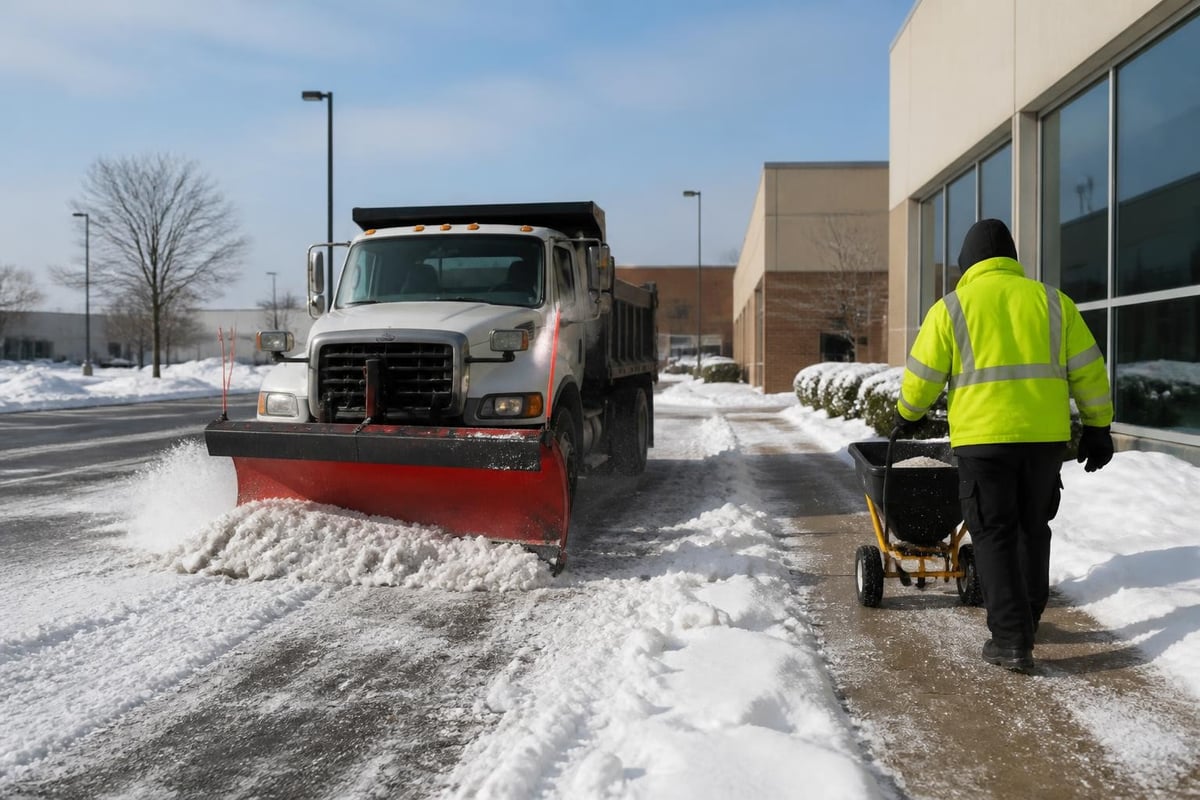
Commercial properties typically require different approaches than residential driveways. Large parking lots demand heavy equipment, strategic snow stacking plans, and careful attention to drainage patterns.
Equipment and Technology Standards
The equipment fleet directly impacts service quality and efficiency. Professional operators maintain diverse machinery matched to different property types and conditions.
| Equipment Type | Primary Application | Capacity Range |
|---|---|---|
| Wheel loaders | Large lot clearing, stacking | 2-6 cubic yards |
| Pickup trucks with plows | Smaller lots, access roads | 7-9 foot blade width |
| Skid steers with pushers | Tight spaces, loading docks | 8-14 foot push width |
| Sidewalk machines | Pedestrian walkways | 24-48 inch clearing path |
Modern providers increasingly utilize GPS tracking, real-time weather monitoring, and automated dispatch systems. These technologies ensure consistent service delivery and provide documentation that proves compliance with contractual obligations.
Finding Reliable Snow Clearing Services Near Me
Location matters significantly when selecting snow removal providers. Response time during active storms depends on geographic proximity and route density.
Service Area Considerations
When evaluating "snow clearing services near me" search results, verify the provider's actual service coverage. Many companies advertise broad regional availability but prioritize certain zones during heavy snowfall events.
Key questions to ask prospective providers:
- What percentage of your client base operates within a 15-mile radius of my property?
- How many properties do you service along the same route corridor?
- What guaranteed response time can you commit to for my specific address?
- Do you maintain equipment staging areas near my facility?
Denver Metro properties benefit from providers with deep local knowledge. Microclimates, typical storm patterns, and municipal requirements vary considerably across the region. Companies with decades of experience understand how different neighborhoods accumulate and melt snow.
Licensing, Insurance, and Credentials
Professional snow clearing services maintain proper business credentials that protect clients from liability exposure. Never hire a provider without verifying these essential requirements:
- General liability insurance with minimum $2 million aggregate coverage
- Commercial auto insurance covering all equipment and operators
- Workers' compensation insurance for all employees and subcontractors
- Business licensing appropriate to your municipality
The Insurance Information Institute provides guidance on winter-storm insurance considerations that property owners should review when assessing coverage needs and vendor requirements.
Request certificates of insurance directly from the provider's insurance carrier. Certificates should name your property or management company as additionally insured, providing automatic notification if coverage lapses.
Pricing Models for Commercial Snow Removal
Understanding how snow clearing services structure pricing helps property managers budget appropriately and compare proposals accurately. Most providers offer multiple billing approaches tailored to different risk tolerances and budget preferences.
Seasonal Contracts vs. Per-Event Billing
Seasonal contracts provide fixed pricing regardless of snowfall totals. Providers quote an all-inclusive rate based on historical snowfall data, property square footage, and service specifications. This approach offers budget certainty but may result in overpayment during mild winters.
Per-event billing charges only when services are actually performed. Rates typically include a trigger depth (often 2-3 inches) that initiates plowing, plus additional charges for de-icing, hauling, or extended storm duration.
| Pricing Model | Best Suited For | Average Cost Range |
|---|---|---|
| Seasonal flat rate | Budget-conscious properties | $8,000-$45,000/season |
| Per-push pricing | Properties with variable needs | $250-$2,500/event |
| Hourly equipment rates | Flexible, on-demand service | $125-$350/hour |
| Retainer with per-push | Guaranteed priority response | Base + per-event fees |
Many experienced facility managers prefer hybrid arrangements that combine a retainer ensuring priority service with per-event charges above a specified number of service visits. This balances budget predictability with usage-based fairness.

Hidden Costs and Contract Clauses
Review proposals carefully for charges that appear only in fine print. Common additional fees include:
- Premium rates for service outside standard hours (though snow rarely falls conveniently)
- Per-application charges for specialized de-icing products
- Minimum billing increments that round up service duration
- Fuel surcharges tied to diesel price fluctuations
- Snow relocation fees when stacking areas reach capacity
Clarify exactly what triggers a billable service event. Some contracts count any snow accumulation, while others specify minimum depths. The difference significantly impacts seasonal costs in regions experiencing frequent light snowfall.
Response Time Guarantees and Service Level Agreements
When searching for "snow clearing services near me," response time commitments often matter more than pricing. Uncleared parking lots force business closures, create liability exposure, and frustrate customers.
Understanding Response Time Metrics
Professional providers specify response parameters in writing through service level agreements. These contractual commitments define exactly when crews will arrive and complete work.
Critical SLA components include:
- Trigger depth: Snow accumulation that initiates service (typically 1-3 inches)
- Response time: Hours from trigger depth until equipment arrives on-site
- Completion time: Hours from arrival until all contracted areas are cleared
- Re-service intervals: Frequency of return visits during ongoing storms
For example, a strong SLA might guarantee arrival within two hours of reaching a two-inch trigger, complete lot clearing within four hours of arrival, and return visits every six hours during active snowfall. Properties requiring emergency snow removal services need even tighter response commitments.
Priority Routing and Storm Management
Providers manage dozens or hundreds of properties during major storm events. Understanding your position in their service rotation helps set realistic expectations.
Higher-priority properties typically include medical facilities, emergency services access routes, and clients paying premium rates for guaranteed first-response service. Standard commercial properties usually fall into secondary tiers serviced after critical accounts.
Request a written priority designation and route position. Some contracts specify exact service windows: "Your property will be serviced between 4:00 AM and 7:00 AM on service days." This specificity enables better operational planning than vague "within 24 hours" promises.
Environmental Considerations in Snow Clearing
Traditional rock salt and chemical de-icers create significant environmental impacts. The EPA has documented serious concerns about freshwater salinization from road salt runoff, including damage to aquatic ecosystems, soil degradation, and infrastructure corrosion.
Sustainable De-Icing Alternatives
Progressive snow clearing services offer environmentally responsible products that balance safety with ecological stewardship:
- Calcium magnesium acetate (CMA) works at lower temperatures with reduced environmental impact
- Beet juice and agricultural byproducts enhance salt effectiveness while reducing total chloride application
- Pre-treatment anti-icing strategies prevent bonding and reduce material usage by up to 70%
- Mechanical clearing emphasis that prioritizes plowing over chemical application
The EPA’s technical guidance on deicing material application provides detailed best management practices that responsible providers follow to minimize environmental impacts.
Property owners increasingly request sustainability provisions in snow removal contracts. Specify maximum application rates, require environmentally certified products, and mandate proper material storage to prevent groundwater contamination.
Application Rate Monitoring
Over-application wastes money and harms the environment. Professional services calibrate spreaders precisely and train operators on appropriate rates for varying conditions.
| Surface Temperature | Salt Effectiveness | Recommended Application Rate |
|---|---|---|
| 30°F to 32°F | Highly effective | 50-100 lbs per acre |
| 20°F to 30°F | Moderately effective | 100-150 lbs per acre |
| 10°F to 20°F | Limited effectiveness | 150-200 lbs per acre |
| Below 10°F | Ineffective | Alternative products required |
Request application logs documenting product types, quantities, and conditions. This data helps verify appropriate usage and provides documentation if environmental concerns arise.
Evaluating Provider Experience and Reputation
Years in business and client retention rates reveal operational stability and service quality. The snow removal industry experiences high turnover because undercapitalized operators underestimate costs, overcommit capacity, and fail during their first major storm season.
Portfolio and Reference Verification
Request a client list showing properties similar to yours in size, type, and complexity. A provider experienced with office parks may lack expertise in industrial facilities with specialized equipment and operational requirements.
Contact references directly and ask specific questions:
- How many times during the past three winters did the provider fail to meet contractual response times?
- What communication systems does the provider use for storm updates and service confirmations?
- Have you experienced equipment failures or staffing shortages during major events?
- How does the provider handle damage claims when equipment causes property damage?
Long-term client relationships indicate consistent performance. Providers retaining 85-90% of their client base annually demonstrate reliability that newcomers cannot match.

Local Market Knowledge
Companies operating in specific markets for decades understand regional challenges that national franchises often miss. Denver's unique combination of heavy, wet snow and rapid temperature swings demands specialized knowledge.
Experienced local providers know which products work best on different surface types, how to manage snow storage as accumulation builds through the season, and which municipal regulations govern snow disposal. This expertise prevents costly mistakes and ensures compliant operations.
Contract Negotiation and Service Specifications
Well-written contracts protect both parties by clearly defining expectations, responsibilities, and remedies. Never rely on verbal promises or vague proposals.
Essential Contract Elements
Comprehensive snow removal agreements should specify:
- Scope of work: Exact areas to be cleared, measured in square feet or linear feet
- Service triggers: Snowfall depths or weather conditions that initiate response
- Performance standards: Completion timeframes and surface condition requirements
- De-icing protocols: Product types, application rates, and temperature thresholds
- Communication procedures: How service notifications, delays, and completions are reported
- Damage liability: Responsibility for property damage, vehicle damage, and injury claims
- Force majeure provisions: Performance obligations during extraordinary weather events
- Payment terms: Due dates, late fees, and invoice documentation requirements
Service specifications should reference industry standards for clarity. For instance, "cleared to bare pavement where operationally feasible" sets a reasonable expectation, while "100% snow-free surfaces" creates an impossible standard during active storms.
Multi-Year Agreements and Rate Locks
Providers often offer pricing incentives for multi-year commitments. These arrangements benefit both parties: clients secure rate stability while providers guarantee revenue and justify equipment investments.
Negotiate annual rate escalation limits tied to documented cost indices. Fixed percentage increases (typically 2-4% annually) provide predictability while allowing reasonable adjustments for inflation, fuel costs, and labor market changes.
Technology Integration and Service Documentation
Modern snow clearing services utilize technology platforms that improve communication, verify service delivery, and support dispute resolution.
GPS Tracking and Time-Stamped Reporting
Advanced providers equip all vehicles with GPS systems that create precise service records. These systems automatically document arrival times, departure times, total service duration, and exact coverage areas.
Property managers access web portals showing real-time equipment locations during storms and historical service records for billing verification. Time-stamped photographs provide visual confirmation of conditions before service, during clearing, and after completion.
This documentation proves invaluable when addressing liability claims. If a slip-and-fall incident occurs, detailed records showing exact service timing and subsequent accumulation rates help establish reasonable care standards.
Automated Alert Systems
Professional providers send automated notifications through multiple channels:
- Storm alerts when weather forecasts predict service-triggering conditions
- Dispatch confirmations when crews are en route to your property
- Service completion reports documenting work performed and materials applied
- Follow-up notices for scheduled return visits during extended events
These communication systems reduce uncertainty and enable better operational planning. Facility managers know exactly when lots will be cleared, allowing them to coordinate employee arrivals, customer communications, and safety protocols.
Selecting the Right Provider for Your Property
Choosing among "snow clearing services near me" search results requires balancing multiple factors against your specific property needs and operational priorities.
Decision Framework
High-priority properties (medical facilities, emergency services, senior living communities) should prioritize guaranteed response times and equipment redundancy over cost savings. Service failures at these locations create serious safety consequences and potential liability.
Cost-sensitive properties (retail centers with flexible hours, warehouse facilities, secondary office locations) might accept longer response windows in exchange for lower seasonal costs.
Properties with sustainability mandates should screen providers for environmental certifications, alternative product offerings, and documented application rate controls.
Create a weighted scoring matrix evaluating prospects across key criteria:
| Evaluation Criteria | Weighting | Provider A | Provider B | Provider C |
|---|---|---|---|---|
| Response time commitment | 25% | Score | Score | Score |
| Insurance coverage adequacy | 20% | Score | Score | Score |
| Equipment capacity | 15% | Score | Score | Score |
| Pricing competitiveness | 15% | Score | Score | Score |
| References and experience | 15% | Score | Score | Score |
| Technology capabilities | 10% | Score | Score | Score |
This structured approach prevents single-factor decisions and ensures comprehensive evaluation.
Pre-Season Preparation
Once you've selected a provider, invest time in pre-season coordination that sets both parties up for success:
- Conduct property walkthroughs to identify obstacles, mark curbs and landscape features, designate snow storage areas, and clarify drainage concerns
- Establish communication protocols with primary and backup contacts for both organizations
- Review site maps showing service areas, priority zones, and restricted access locations
- Clarify special requirements like timing restrictions near residential areas or chemical limitations near sensitive plantings
- Test notification systems to verify alerts reach appropriate personnel
Providers appreciate clients who invest in thorough planning. This collaboration reduces confusion during storms and minimizes property damage from avoidable equipment strikes.
Ongoing Partnership Management
The relationship with your snow clearing service provider extends beyond contract signing. Active management throughout the season ensures consistent performance and addresses issues before they escalate.
Regular Performance Reviews
Schedule mid-season check-ins to review service delivery against contractual commitments. Discuss any concerns about response timing, communication gaps, or quality issues while there's still time for corrective action.
Document both positive performance and deficiencies. Specific feedback ("Your crew arrived 45 minutes past the guaranteed response window during the January 15 storm") enables meaningful discussion and improvement.
Most service failures result from miscommunication rather than negligence. Perhaps your facility manager didn't receive the completion notification, or crews misunderstood which entrance required priority clearing. Addressing these issues promptly prevents recurrence.
Building Long-Term Relationships
The best client-provider relationships span many years, with both parties working collaboratively toward shared success. Long-term partnerships enable providers to justify significant equipment investments, hire and retain quality operators, and develop deep property knowledge that improves service efficiency.
Demonstrate your value as a client by communicating clearly, paying invoices promptly, and providing constructive feedback. Reliable clients receive priority service during capacity-constrained events because providers know the relationship is worth protecting.
Companies like Denver Snow Removals build their reputation through decades of consistent performance, maintaining client relationships that span entire careers in facility management.
Finding the right snow clearing services requires careful evaluation of capabilities, contractual commitments, and long-term reliability rather than simply selecting the lowest bidder. Properties that invest time in thorough provider vetting, clear contract specifications, and active partnership management maintain safe, accessible facilities throughout winter while minimizing costs and liability exposure. With over 47 years of experience clearing commercial properties across the Denver Metro area, Denver Snow Removals delivers the responsive, professional service that parking lots, office campuses, and HOA communities depend on when winter weather strikes.