
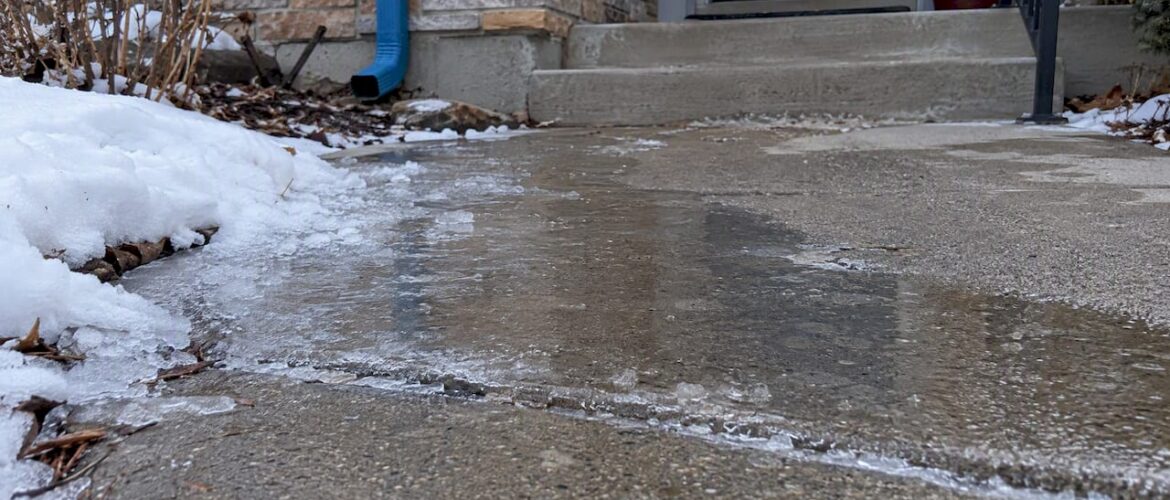
Freeze-thaw cycle management means controlling where meltwater goes and what happens to it after sundown. Clear the snow first, move runoff away from walkways, treat the places where water will refreeze, and check those places again when temperatures fall. Do that, and a sunny afternoon stops turning into a slippery morning. Skip it, and the same water that melted at 2 p.m. becomes a sheet of ice by 6 a.m., and it slowly breaks down your concrete along the way.
If you own a home, manage an HOA, or run a commercial lot in Denver, this guide covers how to recognize refreeze conditions, how to sequence plowing, drainage and deicing, how often to check, and how to limit pavement damage.
TL;DR
- A freeze-thaw cycle is water freezing at 32°F, thawing, and freezing again. Each round creates ice hazards and slowly damages concrete, brick and asphalt.
- Remove snow mechanically first, then treat only the slick spots. Anti-icing before a storm makes the clearing easier.
- Watch shade, low spots, downspouts and the base of snow piles. That is where meltwater refreezes.
- Check high-priority areas (entrances, ramps, stairs, fire lanes) on cold evenings and early mornings after any warm day.
- Use only as much salt as you need. Excess salt shortens the life of concrete and harms landscaping.
Table of Contents
- What a freeze-thaw cycle is, and why it matters on a property
- How to recognize refreeze conditions before they catch you
- Sequence matters: clear, drain, then treat
- A quick reference: what to do at each temperature trigger
- How often to check during a freeze-thaw period
- Denver rules: your sidewalks are your responsibility
- Preventing freeze-thaw damage to concrete, brick and pavement
- Our perspective: freeze-thaw is a scheduling problem
- Choosing between seasonal and per-storm service for freeze-thaw winters
- How we can help
- FAQ
- Sources
What a freeze-thaw cycle is, and why it matters on a property
A freeze-thaw cycle happens when air temperature drops low enough to freeze water at 32°F and then rises enough to thaw it. Repeat that enough times and roads, sidewalks and other outdoor surfaces start to break apart, which is how potholes form.
For a property owner, there are two separate problems:
- A short-term safety problem. Meltwater from snow refreezes into ice on walkways, stairs, ramps and parking stalls.
- A long-term asset problem. Water seeps into pavement, freezes, expands and widens cracks, so the surface deteriorates a little more each winter.
Denver makes both worse in a particular way. Sunny days after a storm can melt snow quickly, then the evening drop brings the water back to ice. The clock starts ticking at sunset, and most slip-and-fall incidents happen on surfaces that looked fine at noon.
How to recognize refreeze conditions before they catch you
Air temperature alone is a poor guide. Snow and ice melt when the pavement warms above 32°F and can refreeze when it later cools below 32°F, and sun, shade, pavement type and wind all change how warm the surface actually is. Pavement temperature can differ from air temperature, and it decides whether snow accumulates or melts on contact, whether melt may refreeze, and which deicer will work.
In practice, learn to read these signs:
- Dripping and pooling in the afternoon. Any water you can see at 3 p.m. will be ice by morning if the forecast dips below freezing.
- Shaded stretches. North-facing walkways and the shadow side of buildings stay colder and hold ice long after the open lot is bare.
- Dark, glossy patches. Black ice can form when warm, moisture-laden air condenses on pavement below 32°F and freezes into a thin layer. It looks like wet pavement.
- Water crossing a path. Downspout discharge, sprinkler overspray, and runoff from the base of a plowed pile all create dependable ice patches.
- Roof edges. Roof ice dams form when attic heat melts roof snow that then refreezes at the colder eaves or gutters. The drips and icicles land on your entry steps.
Walk the site once, in daylight, before the season
A short walk-through pays off. Industry guidance recommends that you mark drains, gutters and downspouts, clear around them so melt can flow, and identify low spots where water and ice build up. Note where the grading sends water, and note which areas see no sun after noon. Take photos. That list becomes your treatment map for the winter.
Sequence matters: clear, drain, then treat
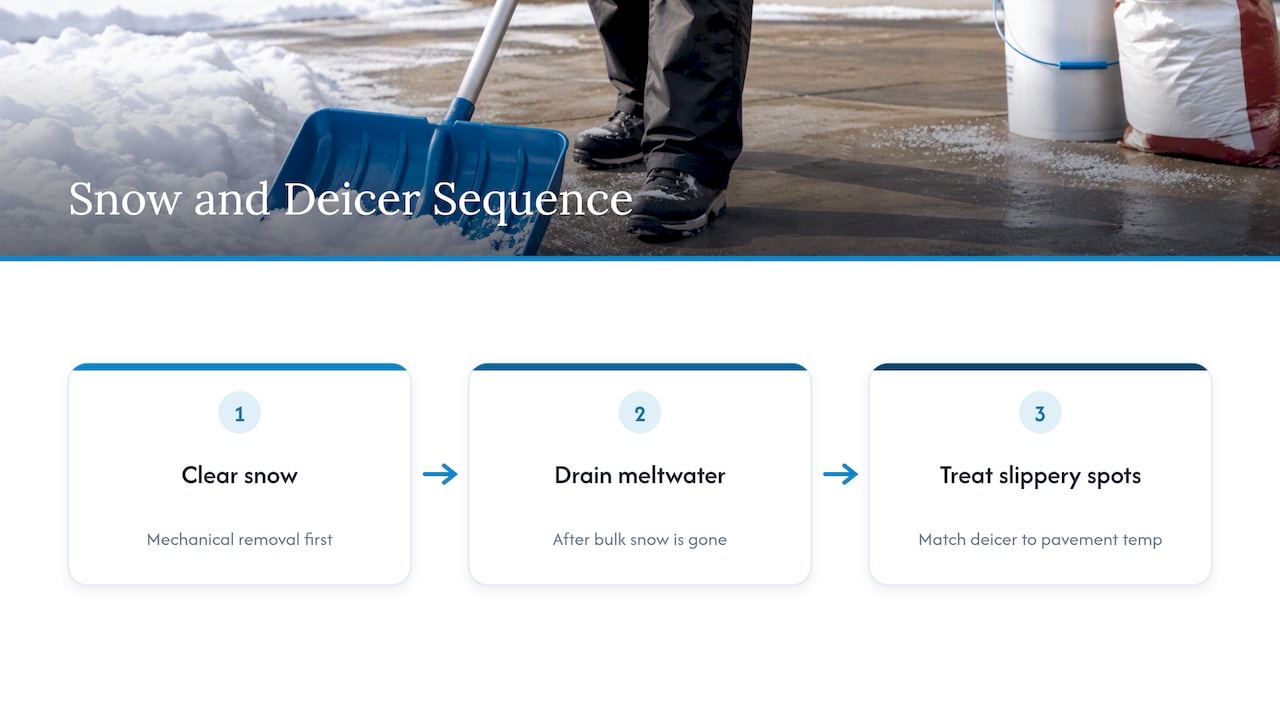
Most refreeze problems are made worse by doing the right steps in the wrong order. The guidance from salt-reduction programs is consistent: mechanical removal (shoveling, plowing) should always precede deicing, which prevents compaction and reduces salt use. Once the bulk of the snow is gone, apply deicer only to the slippery spots that remain, and match the product to the pavement temperature.
Step 1: Pre-treat before the storm when you can
Anti-icing means applying a liquid such as salt brine before snow arrives. According to the Minnesota Pollution Control Agency, it creates a barrier that keeps snow and ice from bonding to the pavement, so the plow lifts snow off cleanly. For a freeze-thaw forecast, it is the most efficient single step, because it works on the layer that would otherwise form overnight. For the details, see our guide on sidewalk ice control with anti-icing and our pre-freeze salting checklist.
Step 2: Plow and shovel completely
Push snow down to the surface. Leftover packed snow melts and refreezes into a rough, hard layer that is harder to remove than fresh snow. This is where equipment matters: a lot cleared in one pass leaves less slush to freeze in tire tracks.
Step 3: Put the piles where meltwater can’t hurt you
The pile you create today is tomorrow’s runoff. Designating snow staging areas away from critical walkways and sensitive landscaping helps limit ice formed by meltwater runoff. Avoid piling snow upslope of an entrance, across a drain, or at the edge of a drive aisle. When there is nowhere safe to stack it, hauling is the answer. Our guide on when to haul snow explains the triggers and budget, and where the piles go in downtown lots covers tight sites.
Step 4: Treat what is left, with the right product
After clearing, treat the remaining slick areas only. The Minnesota agency also notes that abrasives like sand do not melt ice, and are a temporary measure when pavement is too cold for chemical deicers to work. Denver’s dry cold often puts pavement below the range where standard rock salt performs well, so product choice is a real decision. Our piece on ice melt products for Denver properties walks through which product suits which surface.
A quick reference: what to do at each temperature trigger
| Situation | What is happening | What to do |
|---|---|---|
| Storm forecast, temperatures near or below 32°F | Snow will bond to pavement | Anti-ice beforehand, plow promptly |
| Sunny afternoon after a storm, shaded areas still frozen | Meltwater runs across walkways | Clear remaining snow, redirect runoff, move piles |
| Afternoon melt, forecast to fall below 32°F overnight | Standing water will refreeze | Clear water and slush, treat low spots and entrances before dark |
| Pavement too cold for deicer to work | Chemicals are ineffective | Use sand for traction temporarily, re-treat when it warms |
| Early spring thaw | Salt residue collects in soil and joints | Flush salt-heavy areas with water |
The table is a decision aid, not a substitute for checking your own pavement. Sun exposure changes the answer from one side of a building to the other.
How often to check during a freeze-thaw period
There is no single number that suits every site, but one principle holds: check on a schedule tied to the temperature, not the calendar. Road-weather guidance advises that maintenance crews learn the wet areas where groundwater or other water drains onto the road and check them frequently on cold nights when air temperatures fall toward the mid-30s. The same logic applies to your property. The trouble spots are the known wet areas, and the risky hour is the evening when the air is dropping toward freezing.
A workable routine:
- Late afternoon: look at every known wet spot. If water is present and the forecast is below freezing, treat now.
- Late evening or before the first arrivals: re-check entrances and shaded stretches.
- After any new snow or melt event: reset and repeat.
Prioritize by risk
Not every square foot is equal. Walkways, stairways, ramps, entrances, exits, fire lanes and community areas are high-risk, high-priority areas. Start there, then work out to parking stalls and secondary paths. If your property has a parking structure, ramps and deck surfaces freeze differently, and our guide on underground parking garage snow and ice control covers them.
Denver rules: your sidewalks are your responsibility
Denver requires property owners to clear snow and ice from adjacent sidewalks, including ADA ramps. Reporting from 9NEWS says businesses are expected to begin clearing immediately after snow stops, while residences have until the next day. Surrounding suburbs set their own deadlines and fees, so confirm the current rule with your own city before relying on any timeline, especially if you manage properties across several municipalities.
The ordinance covers snow. A refrozen puddle on the same walkway is still your hazard, and a documented routine of checking and treating after melt events is the best evidence that you acted reasonably.
Preventing freeze-thaw damage to concrete, brick and pavement
The slipping risk disappears when the ice does. The structural risk does not. Water in concrete and brick voids expands by 9% when it freezes, and repeated cycles enlarge the voids and cause more cracking. The National Institutes of Health, in a technical bulletin on masonry, explains that this pressure exceeds the material’s tensile strength, leading to spalling and internal cracking. It is also cumulative: each cycle opens room for more water in the next.
What limits the damage:
- Keep water out. Seal cracks and joints before winter, and keep gutters and downspouts flowing away from slabs.
- Drain earth away from structures. Grade matters. Soil that slopes toward steps and foundations feeds the cycle.
- Use appropriately designed materials when you repair or replace surfaces.
- Go easy on salt. Salt on already-stressed concrete accelerates surface scaling. Our guide on protecting concrete from salt damage in Denver explains the trade-off.
Homeowners with brick steps, patios or retaining walls can also read this research-backed plan to stop freeze-thaw brick damage. If your driveway is gravel, the same drainage logic applies: see this overview of gravel driveway installation and drainage for how grading keeps water from pooling and refreezing.
Use salt carefully
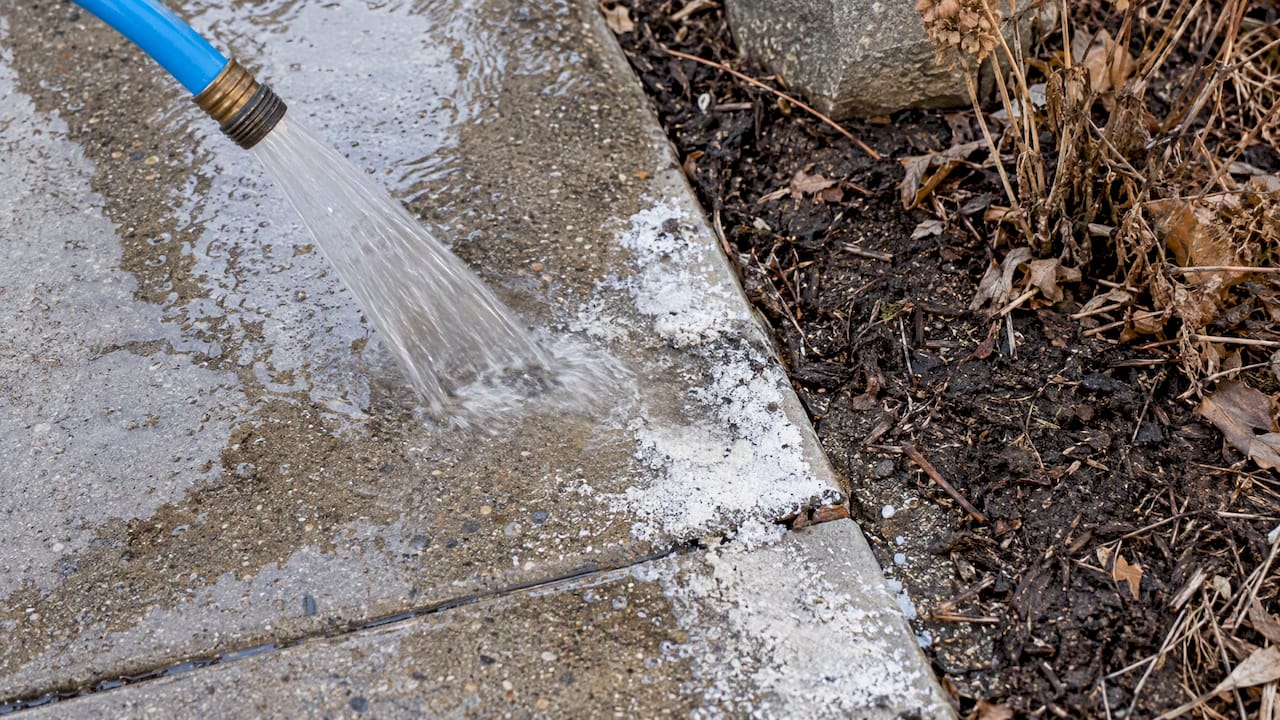
University extension guidance is straightforward: remove as much snow and ice as possible before applying salt, use only as much as needed, and heavily water areas where salt accumulates once the ground thaws in early spring. More salt does not melt faster in cold pavement. It just leaves more residue on your concrete and in your planting beds.
Our perspective: freeze-thaw is a scheduling problem
After more than 44 years working Denver winters, we see the same pattern. Properties rarely get into trouble during the storm. They get into trouble the day after, when the sun is out, the lot looks fine, and nobody is watching the meltwater. The plow did its job, but the refreeze arrives with no crew on site.
So we treat freeze-thaw as a scheduling problem more than an equipment problem. The best results come from a plan that names the trouble spots in advance, pre-treats before a storm, and returns after melt events, not just after snowfall. For our commercial and HOA accounts, we write that into the contract: which areas get priority, when we check, and how each visit is documented. Documentation matters. If someone does fall, a record of when you cleared and treated is what separates a defensible site from an exposed one.
For residential clients, the advice is simpler: clear fully, keep downspouts off the walk, and call us before the cold night, not after the fall.
— Jesse
Choosing between seasonal and per-storm service for freeze-thaw winters
Freeze-thaw conditions are the strongest argument for a seasonal contract. Per-storm service triggers on snowfall, but refreeze hazards come after snowfall, when nothing is falling. A seasonal agreement that includes ice management and pre-treatment covers those quieter days. Our comparison of seasonal contract and per-storm service lays out the trade-offs. Before you sign any contract, ask:
- Does it include anti-icing before storms, or only after?
- Will crews return for ice formed by melt and refreeze, with no new snow?
- Is there a written response expectation for high-priority areas?
- Are visits documented?
- Where will snow be stacked, and is hauling available?
Commercial managers can also look at downtown parking lot plowing schedules and our commercial de-icing playbook.
How we can help
Denver Snow Removal handles snow plowing, anti-icing pre-treatment, sidewalk de-icing, snow hauling and ice management for residential, commercial, industrial and HOA properties across the Denver metro area, with 24/7 emergency dispatch and free estimates. Seasonal contracts run September through May. Residential driveway and walkway clearing starts from $41.25 per visit. For commercial lots, HOAs and apartment communities, we quote after seeing the site. You can see our parking lot and driveway services or request a free estimate before the next cold snap.
FAQ
What is a freeze-thaw cycle?
It is one complete round of water freezing at 32°F and then thawing as temperatures rise. Repeated rounds crack concrete, brick and asphalt, and on a property they also turn daytime meltwater into overnight ice.
How do I stop meltwater from refreezing on my sidewalk?
Remove snow down to the surface, point downspouts and runoff away from the walk, and move snow piles to areas where their melt will not cross a path. Then treat the remaining slick spots with a deicer suited to the pavement temperature. Anti-icing before the storm reduces the problem from the start.
Does salt make freeze-thaw damage worse?
It can. Heavy salt use on stressed concrete speeds surface scaling and harms nearby plants. Clear the snow first, apply only what is needed, and flush salt-heavy areas in early spring.
How often should a commercial property be checked during a freeze-thaw period?
Tie checks to temperature. Inspect known wet spots and high-priority areas in the late afternoon when melt is visible, and again in the evening or early morning as temperatures fall toward freezing. Re-check after every new snow or melt event.
Sources
- Freeze-Thaw Cycles, GLISA
- Winter Salt Guide: Importance of Pavement Temperature, Minnesota LTAP
- Preventing Roof Ice Dams, State of Michigan
- Site Awareness Checklist, SIMA
- Snow and Ice Management for Parking Lots and Sidewalks, Salt Smart
- Smart Salting for Property Management Manual, MPCA
- Roadway Icing and Weather: A Tutorial, University of Washington
- The Freeze-Thaw Cycle in Concrete and Brick Assemblies, NIH
- Using Deicing Salts in the Home Landscape, Iowa State Extension
- Shoveling rules around the Denver metro area, 9NEWS