
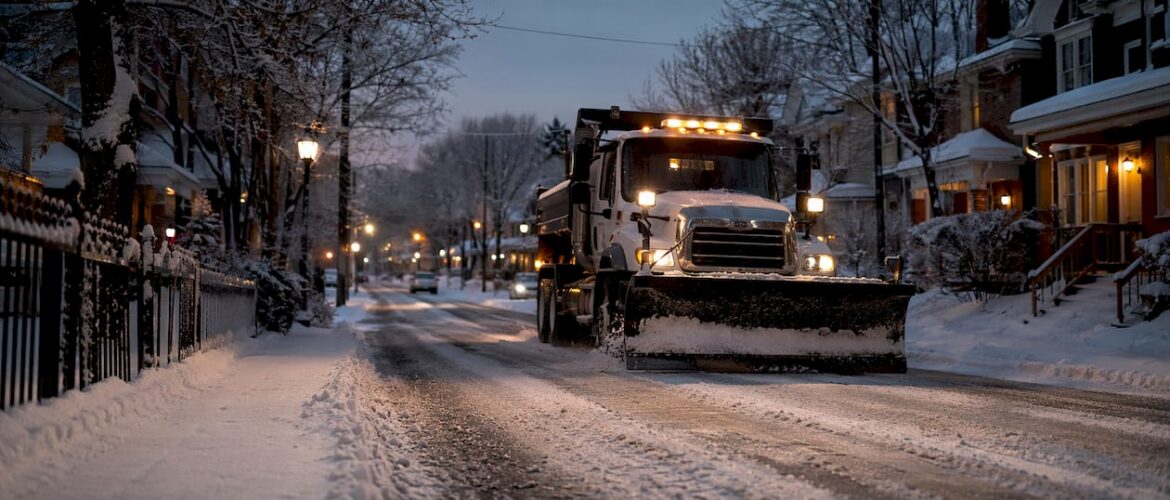
Curb-to-curb snow clearing is defined as the full-width removal of snow across an entire street or parking lot, from one curb line to the other, leaving no snow banks that narrow traffic lanes or eliminate parking spaces. This method is the gold standard for municipal snow removal and professional snow clearing services because it preserves the complete pavement width, supports emergency vehicle access, and prevents the drainage problems that partial clearing leaves behind. If you own a home or manage a property in a snowy region, understanding how this method works, what your municipality guarantees, and how to coordinate with professional services will save you time, money, and frustration every winter.
What is curb-to-curb snow clearing and how does it differ from other methods?
Curb-to-curb snow removal means removing snow across the entire width of streets or parking lots up to the curbs, maintaining full pavement width and all parking spaces throughout winter. The alternative, a single-lane or “passable lane” plow, clears only enough width for one or two vehicles to pass. That narrower approach is faster and cheaper, but it leaves snow banks that shrink usable road width, block sight lines at intersections, and reduce parking capacity for weeks.
The difference in snow clearing methods comes down to scope and intent. Curb-to-curb clearing treats the full roadway as the asset to protect. Passable-lane clearing treats the storm as an emergency to survive. Property managers with parking lots, loading docks, or high-traffic driveways need the full-width approach because partial clearing creates liability when vehicles clip snow banks or pedestrians slip on compressed snow left near curb lines.
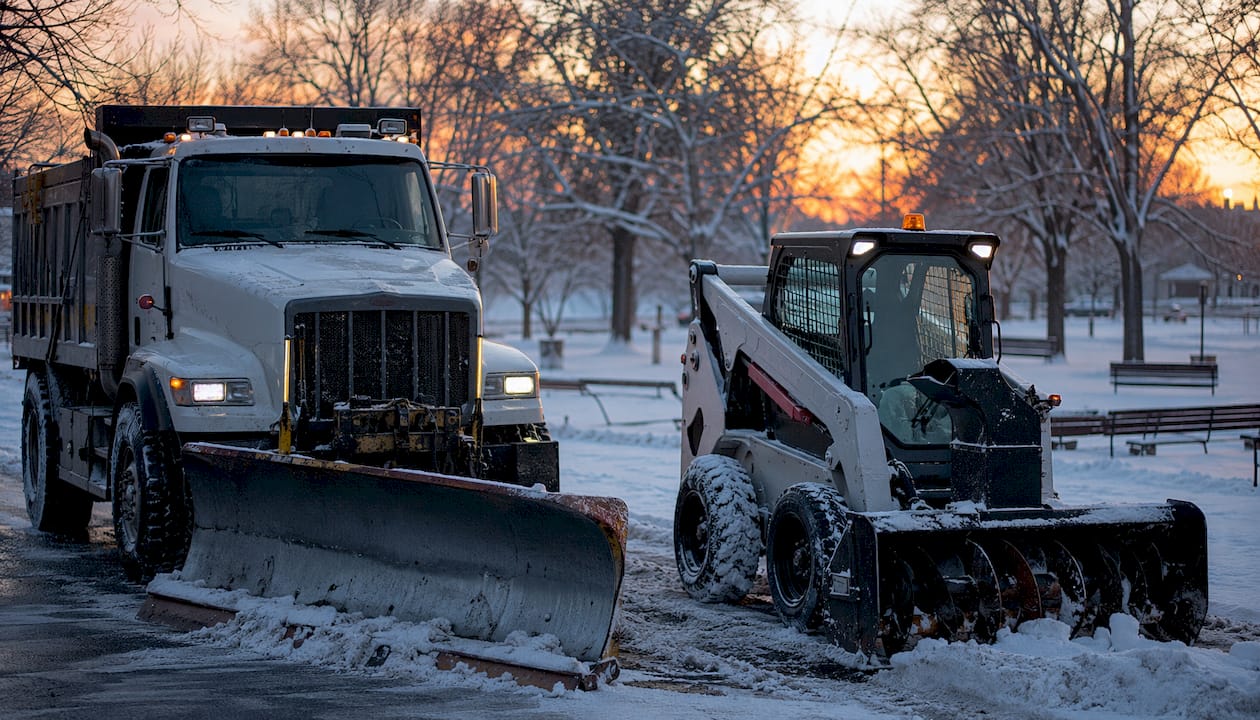
Alley snow clearing follows its own logic. Alleys are typically narrower, lower priority, and often cleared only to a passable width even when adjacent streets receive curb-to-curb treatment. If your property relies on alley access for deliveries or parking, confirm the clearing scope with your municipality or service provider before the first storm of the season.
How does curb-to-curb snow clearing work in practice?
Full-width snow removal requires the right equipment and a staged process. A standard curb-to-curb operation uses a combination of front-mounted plow blades, wing plows that extend the clearing width, and sometimes motor graders for wide commercial lots. The plow makes multiple passes, pushing snow toward the curb line on each pass until the full pavement width is clear.
A typical stepwise process during a snowfall looks like this:
- Pre-treatment: Anti-icing agents, such as liquid brine, are applied to pavement before snow begins. This prevents bonding and reduces the volume of material that needs to be plowed.
- Initial plow pass: Once accumulation reaches a trigger depth (often 2 inches for commercial properties), crews make a first pass to open the road or lot.
- Widening passes: Subsequent passes push snow further toward the curbs, progressively widening the cleared area.
- Curb cleanup: A final pass or wing plow extension clears snow flush to the curb line, achieving full-width clearance.
- Deicing application: Salt or a sand-salt mix is spread on the cleared surface to address residual ice and prevent refreezing.
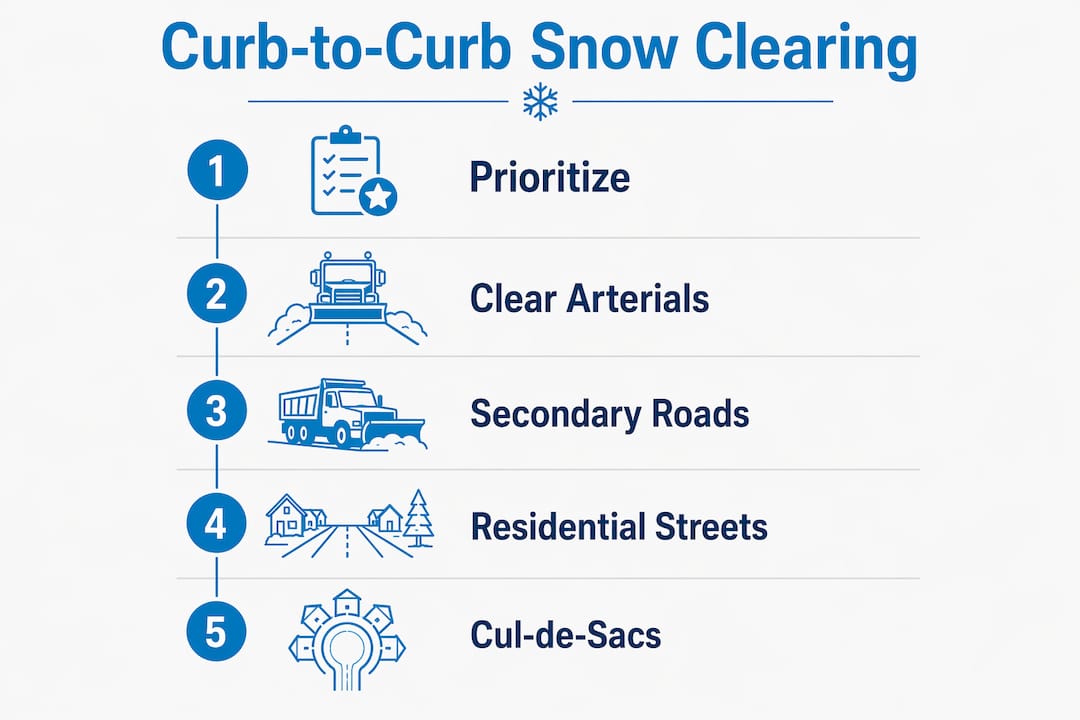
Municipalities prioritize arterial streets first, then secondary roads, and residential streets last. Cul-de-sacs present a specific challenge. Clearing curb-to-curb in a cul-de-sac creates large snow piles near homes, and some municipalities allow residents to petition for alternative plowing configurations. Those petitions typically require 100% neighborhood agreement, and approved changes take effect the following winter season.
Pro Tip: Mark your curb lines and any landscape features with driveway markers before the first snowfall. Crews clearing to the curb cannot see buried edging, irrigation heads, or low-profile landscaping under snow.
What are municipal policies and timelines for curb-to-curb snow removal?
Municipal snow clearing timelines vary more than most homeowners expect. Some cities commit to completing curb-to-curb clearing within 2 workdays after a storm ends, prioritizing arterial streets first and residential areas later. Other cities, such as Champaign, IL, target 24–36 hours for secondary routes after snowfall stops. The key phrase is “after snowfall stops.” The clock does not start until the storm ends.
Many municipalities guarantee curb-to-curb clearing only for major thoroughfares. Residential streets may receive only a passable-lane plow to manage costs and crew resources. That distinction matters for property managers who assume full-width clearing is automatic. Check your city’s published snow removal plan, not just general service descriptions.
Key policies homeowners and property managers should know:
- No snow in the street: Most municipalities prohibit shoveling or blowing snow back onto a cleared street. Violations carry fines in cities including Indianapolis and Willoughby, OH.
- Parking bans: Many cities impose temporary parking bans on residential streets during active plowing to allow full-width passes.
- Petition processes: Neighborhoods with cul-de-sacs or unusual layouts can often request alternative plowing configurations through a formal petition, but changes rarely take effect the same season.
- Driveway apron responsibility: The strip of pavement between your driveway and the street is typically the homeowner’s responsibility to clear after municipal plows pass.
- Sidewalk ordinances: Separate from street clearing, sidewalk clearing ordinances require homeowners to clear adjacent sidewalks within a set window after a storm, often 24 hours.
During active blizzards, full curb-to-curb clearing is rarely guaranteed. Priority shifts to keeping major routes passable repeatedly, and secondary street clearing is deferred until snowfall stops. Officials describe snow clearing operations during storms as “organized chaos,” with staged crews and shifting priorities rather than a fixed schedule.
What are the benefits and challenges of curb-to-curb snow clearing?
Safety and emergency access
Curb-to-curb clearing maximizes lane space for safety and emergency vehicle access. A full-width cleared street allows ambulances, fire trucks, and utility vehicles to reach any address without navigating around snow banks. Partial clearing, by contrast, can reduce a two-lane residential street to a single-lane passage, forcing vehicles to take turns and creating blind spots at intersections.
Drainage and flood prevention
Snow left at curb lines blocks storm drains and prevents meltwater from reaching sewers. When drainage is blocked, water pools on pavement, refreezes overnight, and creates ice patches. Worse, meltwater can back up onto lawns and against foundations, causing water damage that shows up weeks after the storm. Curb-to-curb clearing eliminates this risk by keeping drain inlets clear.
Cost and environmental trade-offs
The trade-off between curb-to-curb and partial clearing involves taxpayer cost, environmental impact, and recovery speed. Full-width clearing requires more passes, more equipment time, and more deicing material. Salt runoff affects soil, vegetation, and waterways, which is why some municipalities limit salt application rates even when full-width clearing is the goal. Partial clearing is cheaper and faster but leaves restrictive snow banks that compound with each subsequent storm.
Pro Tip: Ask your snow clearing service whether they use liquid brine pre-treatment. Brine applied before a storm reduces the total salt needed afterward, cutting both cost and environmental impact.
| Factor | Curb-to-curb clearing | Passable-lane clearing |
|---|---|---|
| Lane width preserved | Full pavement width | Reduced, often one lane |
| Emergency access | Unrestricted | Potentially limited |
| Drainage protection | Storm drains kept clear | Drains may be blocked |
| Cost per event | Higher | Lower |
| Salt/deicing use | Higher volume | Lower volume |
| Snow bank buildup | Minimal | Significant over time |
Understanding how equipment drives costs helps property managers budget accurately for full-width service rather than assuming all snow removal contracts are equivalent.
How should homeowners and property managers approach curb-to-curb snow clearing services?
Choosing the right snow clearing service starts with asking the right questions. Not every contractor offering snow removal provides true curb-to-curb results. Confirm the scope in writing before signing any seasonal contract.
Practical steps for homeowners and property managers:
- Confirm clearing scope in writing. Ask whether the contract covers full-width clearing to the curb or only a passable lane. Get the trigger depth (the accumulation level that activates service) in writing.
- Time your driveway clearing after the plow. Waiting for municipal plowing before clearing your driveway prevents the plow windrow from refilling your cleared apron. Clearing before the plow passes means doing the work twice.
- Mark curbs and property boundaries. Driveway markers placed before the first storm protect landscaping, irrigation systems, and edging from plow blades working close to the curb line.
- Set realistic service frequency expectations. During a multi-day storm, even contracted services may prioritize safety passes over full-width clearing until snowfall stops. Discuss this scenario with your provider before winter begins.
- Coordinate with neighbors on shared access. If your property shares a driveway or parking area, agree on a clearing schedule before the season. Shared driveway clearing works best when all parties align on timing and responsibility.
- Communicate with your municipality. If your street consistently receives only passable-lane clearing when you expect full-width service, contact your public works department. Many cities have formal processes for residents to report inadequate clearing.
Seasonal preparation is the most overlooked part of curb-to-curb service success. Reviewing your property’s seasonal snow preparation steps before october gives you time to address drainage issues, mark hazards, and lock in a service contract before demand peaks.
Key Takeaways
Curb-to-curb snow clearing is the most effective method for preserving full road width, protecting drainage, and maintaining emergency access throughout winter.
| Point | Details |
|---|---|
| Full-width clearing defined | Curb-to-curb removal clears the entire pavement width, not just a passable lane. |
| Municipal priorities vary | Arterial streets get full-width clearing first; residential streets may receive only a passable lane. |
| Drainage protection matters | Clearing to the curb keeps storm drains open and prevents meltwater from flooding foundations. |
| Time driveway clearing correctly | Clear your driveway after the municipal plow passes to avoid repeated snow buildup at the apron. |
| Confirm service scope in writing | Not all snow removal contracts guarantee curb-to-curb results; verify the scope before signing. |
What I’ve learned after years of watching homeowners get blindsided by snow clearing gaps
Most homeowners assume curb-to-curb clearing is automatic. It is not. The gap between what a municipality promises and what actually happens on a residential street during a heavy storm is real, and it catches people off guard every single winter.
The biggest misunderstanding I see is the timing issue. Homeowners clear their driveways at 6 AM, the plow comes through at 9 AM, and suddenly there is a two-foot windrow blocking the driveway again. That is not a service failure. That is the sequence working exactly as designed. The fix is simple: wait for the plow, then clear your apron.
The second issue is environmental. Property managers often push for maximum salt application because they want bare pavement fast. That instinct is understandable, but over-salting damages landscaping, corrodes concrete, and contributes to runoff problems that affect the whole neighborhood. Liquid brine pre-treatment and targeted post-storm deicing deliver better results with less material.
My honest advice: treat your snow clearing contract like any other property maintenance agreement. Read it carefully, ask about storm-event protocols, and build a relationship with your provider before the first major storm. The crews who know your property clear it better and faster than crews seeing it for the first time in a blizzard.
— Jesse
Denversnowremovals: professional curb-to-curb snow clearing for Denver properties
Denversnowremovals has served residential and commercial properties in the Denver Metro area for over 44 years, providing full-width snow plowing and removal that keeps driveways, parking lots, and access points clear through every storm. The team operates 24/7 with professional-grade equipment sized for both tight residential driveways and large commercial lots.
If you want reliable curb-to-curb results without the guesswork of coordinating multiple contractors, Denversnowremovals offers free estimates and flexible seasonal plans. Whether you need to understand which clearing method fits your property or you are ready to book service, the team at Denversnowremovals is available to walk you through your options before the season starts.
FAQ
What is curb-to-curb snow clearing exactly?
Curb-to-curb snow clearing is the removal of snow across the full width of a street or parking lot, from one curb line to the other, preserving the entire pavement surface rather than just opening a single passable lane.
Does my municipality guarantee curb-to-curb clearing on my street?
Most municipalities guarantee full-width clearing only on major arterial streets. Residential streets often receive only a passable-lane plow, with full-width clearing completed later as resources allow.
How long does curb-to-curb snow removal take after a storm?
Timelines vary by city. Some municipalities target completion within 24–36 hours for secondary routes after snowfall stops, while others aim for 2 workdays. The timeline begins after the storm ends, not when it starts.
Can I shovel snow back onto the street after the plow passes?
No. Most municipalities prohibit returning snow to a cleared street, and violations carry fines. Clear snow onto your own property, not into the roadway or onto a neighbor’s cleared area.
Why does curb-to-curb clearing matter for drainage?
Snow left at curb lines blocks storm drains and traps meltwater on pavement, where it refreezes or backs up against foundations. Full-width clearing keeps drain inlets open and allows water to flow to sewers during melt periods.
Recommended
- How to Set Snow Clearing Expectations for Residents – Snow Removal Denver 303-591-2089
- How Shared Driveways Get Cleared Safely in Winter – Snow Removal Denver 303-591-2089
- How Equipment Drives Affordable Snow Removal Costs – Snow Removal Denver 303-591-2089
- Common Area Snow Removal: What Property Managers Must Know – Snow Removal Denver 303-591-2089