
Commercial snow removal Denver County property managers need cleared before opening is not just a plow pass — it’s a full overnight service. You need lots, sidewalks, entrances, loading docks, and de-icing cleared and documented before your first customer or employee arrives. Snow doesn’t care that your tenants arrive at 7 a.m. It falls at 2 a.m. while you’re asleep, and by sunrise you either have a safe property or a liability.
Key takeaways
- Clear fire lanes, accessible parking and the loading dock early, then finish sidewalks before the first foot traffic arrives.
- A skid steer works dock aprons and tight corners that full-size plow trucks can’t reach cleanly.
- W-2 crews, GPS-tracked trucks and timestamped photos on every push give you a record that defends against a slip-and-fall claim.
- Piles stacked uphill of a drive lane melt and refreeze across it, so stack away from lanes and sight lines, and haul when piles outgrow the lot.
- A snow scope should name trigger depth, ready-by time, sidewalks, docks, de-icing, hauling and required records.
We’ve plowed commercial property in Denver County for 47+ years, and the pattern never changes. The managers who sleep well know three things: who is coming, in what order they’ll work, and how they’ll prove it afterward. This article walks through one overnight storm at one property so you can see what good commercial work looks like, and what to demand in writing.
How Commercial Snow Removal in Denver County Gets a Property Open on Time
Picture a typical office campus in Denver County. It has a main parking lot, public sidewalks along the street, and a rear loading dock where deliveries start early. Doors open at 7 a.m. Snow starts falling after midnight and keeps going.
The night, in order
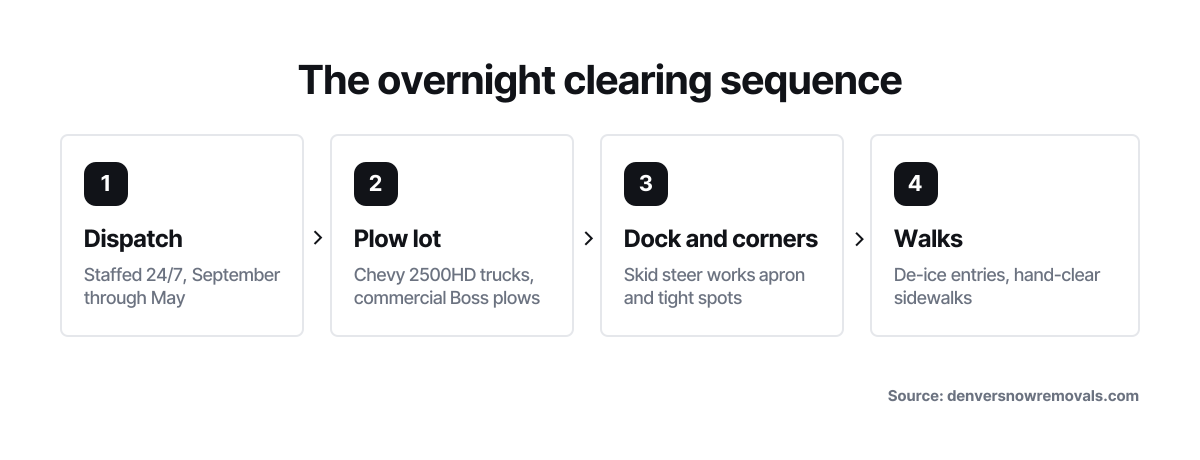
Dispatch. Our dispatch is staffed 24/7 from September through May. We are actually 24/7, which means a person is watching the storm and sending trucks while it’s still building, not a voicemail box that gets checked at dawn.
Main lot and drive lanes. Our newer Chevy 2500HD trucks, fitted with commercial Boss plows, take the main lot first. That is commercial equipment, not tired pickups with a light-duty blade. Big plows move big lots quickly, and speed matters when the clock ends at 7 a.m.
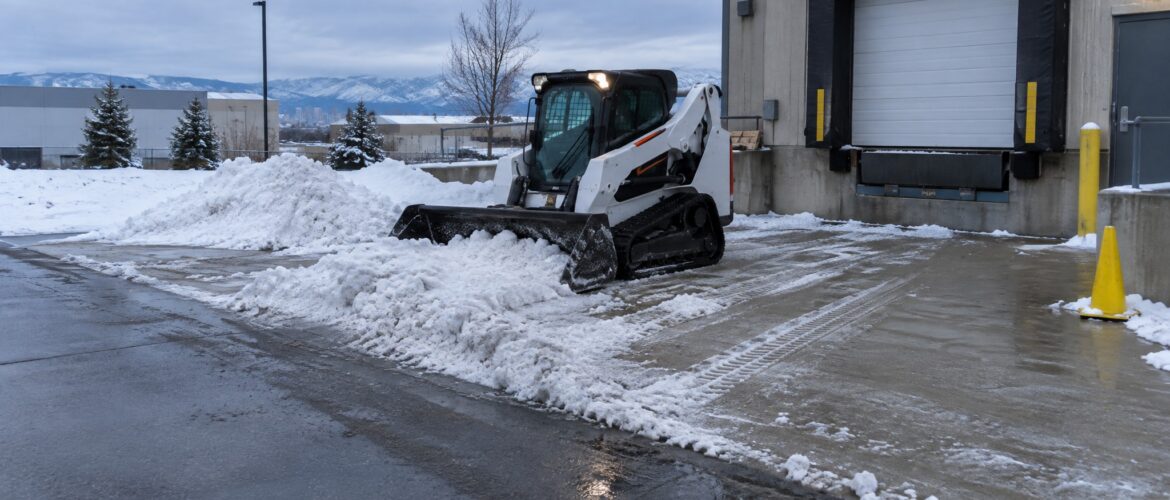
Dock apron and tight corners. A full-size truck can’t work a loading dock well. The apron is tight, the corners are tighter, and a plow blade pushes snow into places that are hard to dig out. A skid steer handles that ground. It turns in its own length, lifts snow into a clear stacking area, and cleans the corners a truck would leave behind.
Walkways and entries. De-icing goes down on walkways and at building entrances, where a thin film of ice does the most damage. The material choice matters, and we cover ice melt versus rock salt for parking lots separately.
Sidewalks. Crews hand-clear the sidewalks and the paths between the lot and the doors, because no plow gets that close to a curb ramp or a door threshold.
Why the order is what it is
Order is not arbitrary. Fire lanes, accessible parking and the loading dock come early because they carry the highest consequences. A blocked fire lane is a safety failure. An accessible space buried in snow shuts out the people who most need that spot. And delivery drivers often show up before anyone else does.
Sidewalks have to be finished before the first foot traffic, not after it. Once people walk on fresh snow, they pack it down, and packed snow is far harder to remove than loose snow. Under Denver’s sidewalk snow removal rules, responsibility for those walks sits with the property owner, so a sidewalk that isn’t cleared is your problem, not the city’s.
Commercial Snow Removal Denver County: What Your Property Needs Before Opening
Commercial snow removal Denver County works best when you compare the same scope. Ask for trigger depth, response time, and proof. A good Denver County contractor will tell you up front: what depth triggers a push, how fast lots are cleared before opening, whether sidewalks and entrances are included, and whether you get photo proof on every push. That proof protects your budget and your liability.
Where the snow goes matters just as much. We stack piles away from entrances, exits and the corners where drivers need to see oncoming traffic, and never uphill of a drive lane. Pile meltwater that runs across a lane in the afternoon refreezes by evening, and you open the next morning on a sheet of ice. When the piles outgrow the lot after repeated storms, the answer is commercial pile removal and hauling, not squeezing the stacks higher.
Three pieces of accountability, and the liability behind each
A property can look clear at 7 a.m. and still be exposed to a claim at 7:30. These three things are what close that gap.
W-2 crews. The people on your lot are our employees, trained, insured and supervised, not a loose chain of subcontractors who may or may not have been briefed. If something goes wrong, you know exactly who was there and who answers for it.
GPS-tracked trucks. You can see when a truck arrived and when it left. That ends the “did they even come?” argument before it starts, and it puts a real time stamp on the work.
Photo proof on every push. Every visit produces timestamped before-and-after photos. A claim that arrives weeks later turns on one question: what was the condition of the surface, and what was done about it?
The crews who do this work will tell you the same thing: the photo and GPS record is what turns “we plowed” into evidence you can defend.
What the proof looks like after each push
After each push, you receive the arrival and departure times for the trucks and a set of before-and-after photos of the lot, sidewalks and dock. You don’t have to chase us for it, and you don’t have to take our word for anything.
If someone later claims they slipped on your property, that record tells you when the lot was last serviced, what it looked like before and after, and how long it had been between the last push and the reported incident. Your insurer and your attorney can work from that. Without it, you’re relying on memory and on whoever remembers the storm best.
This record has limits. It doesn’t prevent a fall, and it doesn’t make a valid claim disappear. It shows what was done and when, and that is the entire point.
Parking Lot, Sidewalk and Dock Priorities: What to Put in Your Scope
Plowing the main lot is the part everyone remembers to write down. The parts that cause trouble are the ones left out. If a sidewalk or a dock isn’t named in your scope, you have no firm basis to expect it to be cleared, and no basis to complain when it isn’t.
Here is what we’d want written into any commercial snow removal scope for a Denver County property:
✓ Trigger depth. Name the snowfall depth that sends a crew out. Don’t leave it to “when it looks bad.”
✓ Ready-by time. State the hour the property must be open and safe, such as 7 a.m. so crews work backward from it.
✓ Sidewalks named explicitly. List the public sidewalks, entry paths and curb ramps, so there’s no argument about whether they were included.
✓ Loading docks and fire lanes. Spell out the dock apron, the fire lanes and accessible parking as early priorities.
✓ De-icing. Say where it goes down, such as walkways and entries, and whether it’s included or billed separately.
✓ Hauling. Decide in advance what happens when piles outgrow the lot, and who authorizes the haul.
✓ Records. Require arrival and departure times and before-and-after photos after every push.
Two decisions sit behind the list. The first is the contract structure, and you’ll want to weigh per-push versus seasonal contracts against how your property actually gets used. The second is cost, and how commercial lot contracts are priced explains what drives a quote up or down.
A scope won’t fix a bad contractor. It makes expectations clear, but a company with no GPS and no photo habit will still hand you nothing to defend yourself with.
Choosing a Contractor Who Can Prove the Work
Anyone can say they’ll be there at 3 a.m. Few can show you afterward that they were. So when you collect bids, ask each bidder the same three questions.
Are the crews W-2 employees or subcontractors? Can you see GPS records of arrival and departure? Do you get a photo log from every push, and will they show you a sample?
If the answers are vague, you have your answer. We have 47+ years in Denver County, we’re fully insured, and we price up front, so you know what you’ll pay before the first flake falls. For a fuller checklist, read how to hire a commercial snow plow company.
The next storm won’t wait for your decision. Call us for a property walkthrough and we’ll look at your lot, your sidewalks and your dock, then give you an up-front quote you can compare line by line.
Frequently asked questions
What does commercial snow removal cover besides plowing the main lot?
Done properly, it covers drive lanes, fire lanes, accessible parking, the loading dock apron, de-icing on walkways and entries, and hand-clearing of sidewalks. Hauling is the next step when piles outgrow the lot. Each of these should be named in your scope.
What order should a lot, sidewalks and dock be cleared in?
Start with the main lot and drive lanes, with fire lanes, accessible parking and the dock early because they carry the highest consequences. De-icing and hand-clearing of sidewalks follow, and sidewalks must be done before the first foot traffic. That order gets a property open by a 7 a.m. start.
Why does photo proof matter if my lot is already plowed?
A slip-and-fall claim can arrive weeks after the storm. Timestamped before-and-after photos, together with GPS arrival and departure times, show what condition the property was in and when it was last serviced. That is evidence your insurer and attorney can use.
Why use W-2 crews instead of subcontractors?
W-2 crews are our own employees, trained, insured and supervised. You know who was on your property and who answers for the work. A loose chain of subcontractors blurs that accountability.
Do you serve properties outside Denver County?
We focus on commercial properties in Denver County: large lots, industrial parks, office campuses and HOA communities. We don’t do residential driveways. Call us for a walkthrough and we’ll confirm your property is within our service area.
See the Best Snow Plows of 2026 ❄️
Commercial snow removal Denver County is not just a plow pass, it’s a full overnight service. Commercial snow removal Denver County means lots, sidewalks, entrances, loading docks, and de-icing cleared before opening. Commercial snow removal Denver County needs a clear trigger, a fast response time, and photo proof on every push. Commercial snow removal Denver County works best with W-2 crews and GPS-tracked trucks who can prove where they were. Commercial snow removal Denver County saves you money when you lock a seasonal contract with the full scope in writing. Commercial snow removal Denver County is the difference between opening on time and opening late with a liability claim. Commercial snow removal Denver County is the smart way to protect a property in winter. Commercial snow removal Denver County starts with a clear trigger so you know when a push happens. Commercial snow removal Denver County uses a stain-free process for lots — plow, shovel walks, de-ice entrances. Commercial snow removal Denver County finishes with photo proof so you can see the lot was cleared. Commercial snow removal Denver County is best on a seasonal contract — same crew, same trigger, same proof all season. Commercial snow removal Denver County — if you want lots cleared before opening, get a Denver County quote in writing.