

Reopen the lot once the perimeter is secured, hazards are documented, and no active dangers remain, which for most storms means within 24 hours of the last snowfall. Keep it closed if you find live utilities, washed-out pavement, or standing floodwater. Your first move: rope off unsafe zones, snap time-stamped photos, and call a professional crew if clearing exceeds your team’s equipment or staffing.
TL;DR:
- Reopening should occur within 24 hours of the last snowfall once hazards are documented, hazards are addressed, and active dangers are eliminated.
- Lot assessment must follow a set order: designate a point person, clear emergency routes first, scan for hazards, zone the lot by traffic volume, and document every step with photos and logs.
- Pavement washouts, exposed electrical lines, large debris, and deep water pooling require full closure until repairs or emergency clearances are completed.
- Anti-icing with brine before snowfall is more cost-effective and effective than reactive de-icing, with proper timing and coverage being critical to success.
- Establishing a detailed winter operations plan, verifying equipment, pre-stocking supplies, and maintaining thorough documentation shortens reopening times and reduces liability.
Table of Contents
- What Is the Post-Storm Lot Reopening Checklist?
- How Do You Decide Between Holding Closed and Reopening?
- What Is the Right Clearing and De-Icing Sequence?
- How Do Drainage and Snow Storage Prevent Refreeze?
- What Should a Snow Contractor Contract Cover?
- How Should You Document Damage for Insurance and Repairs?
- How Can You Cut Reopening Time Next Season?
- Why Documentation and a Reliable Contractor Shorten Reopen Time
- Get Professional Help Reopening Your Lot Fast
- Sources
- FAQ
What Is the Post-Storm Lot Reopening Checklist?
A defensible reopening follows a set order, not a scramble. Courts that have weighed a landowner’s duty after a storm, including the New Jersey opinion in Paula Russo vs. Garden Commercial Properties, generally give owners latitude while snow is actively falling but expect prompt action once it stops. That “reasonable time” standard is the backbone of every step below.
Work through this sequence before you unlock the gates or lift a barricade:
- Name a point person. One manager owns the walkthrough, the call log, and the go/no-go decision.
- Open emergency and ADA routes first. Fire lanes, ambulance access, and accessible parking spaces get cleared before anything else.
- Scan for hazards. Look for standing water, scattered debris, downed lines, or damaged light poles before foot traffic returns.
- Zone the lot. Split the property into sections and rank them by traffic volume so crews clear high-use areas first.
- Document everything. Time-stamped photos and a short written log turn a walkthrough into evidence.
A few things belong on every clipboard regardless of lot size:
- Flashlight and phone camera charged for low-light inspections
- Cones or barricades for any zone still under repair
- A printed or digital log sheet for the point person to fill in real time
How Do You Decide Between Holding Closed and Reopening?
Never walk an unassessed lot after a major storm. Inspect from a safe vantage point first, whether that’s a window, a doorway, or the edge of the property, and only send someone onto the surface once you’ve confirmed there’s no active collapse, exposed wiring, or moving water.
Certain conditions mean the lot stays closed, full stop, until repairs happen or emergency crews clear it:
- Pavement washouts or sinkholes large enough to swallow a tire
- Exposed or sparking electrical lines near the surface
- Large debris (tree limbs, signage, roofing material) blocking drive lanes
- Water pooling deep enough to hide curbs or wheel stops
For everything short of those show-stoppers, temporary controls let you open partially while repairs catch up: traffic cones around a cracked section, sandbags diverting runoff, or a marked bypass lane around a blocked entrance. Notify tenants immediately if any section stays roped off, and loop in fire or EMS contacts if the storm damaged an access route they’d need in an emergency.
Pro Tip: Keep a laminated map of your lot’s fire lanes and utility shutoffs in the site office. When a storm knocks out signage, that map is often the only way a new crew member knows where the hazards actually are.
What Is the Right Clearing and De-Icing Sequence?
Clearing order matters as much as clearing speed. Work main drive lanes first, then ADA and accessible routes, then fire lanes, then individual parking stalls, and finish with medians and landscaped islands. Skipping that order, say, clearing stalls before the fire lane, creates the exact liability gap that turns a routine storm into a claim.
Anti-icing beats reactive de-icing almost every time it’s used correctly. Applying brine ahead of a storm stops snow and ice from bonding to pavement in the first place, and it typically costs about half of what reactive de-icing runs after the fact, according to Connecticut’s BMP guidance for parking lots and sidewalks. Timing depends on conditions:
- Apply brine 1 to 2 hours before precipitation starts when conditions allow
- In some cases, crews can pre-treat 2 to 3 days ahead depending on temperature and forecast confidence
- Hold off if freezing rain is expected to start the event. Freezing rain can wash pre-applied brine away before snow even falls
Standard brine coverage runs 0.5 to 0.75 gallons per 1,000 square feet, a rate worth writing into any contract you sign so a crew isn’t guessing on-site.
Once plowing starts, push snow to piles that won’t melt back across cleared lanes. A pile on the wrong side of a slope turns yesterday’s clean pavement into tomorrow’s ice sheet. Before dispatch, confirm backup plows exist if the primary breaks down, spreaders are calibrated, liquid tanks are full, and operators have documented experience running that specific equipment.
How Do Drainage and Snow Storage Prevent Refreeze?
Meltwater that has nowhere to go refreezes, and refreeze is what turns a cleared lot back into a hazard overnight. Clear catch basins and drainage leak-offs before a major melt cycle starts, not after water is already pooling against a curb.
Where you pile snow matters as much as how fast you clear it:
- Stack snow at high points or on the downhill side of the lot so meltwater runs away from drive lanes, not across them
- Store rock salt and brine on impervious surfaces with secondary containment to stop runoff from reaching soil or storm drains
- Cover salt piles when possible; site design guidance from MinnState treats covered storage as standard practice, not an extra step
- Patch undermined pavement temporarily with cold patch or compacted gravel so traffic can move safely until a permanent fix is scheduled
Skipping any one of these steps rarely causes trouble on day one. It shows up on day three, when the temperature swings and a lot you thought was done reopening needs a second closure.
What Should a Snow Contractor Contract Cover?
A verbal understanding with a plow driver is not a plan. A written contract with your snow and ice contractor should spell out response times after a trigger event, exact scope (plowing, de-icing, hauling), what “complete” looks like, and what happens if primary equipment fails mid-storm.
- Response time clause. Specify hours from trigger snowfall to first equipment on-site.
- Scope of work. List every service included: plow, de-ice, sidewalk clearing, snow hauling.
- Completion standard. Define what a finished lot looks like: bare pavement on drive lanes, treated stalls, cleared ADA access.
- Backup equipment provision. Require a named backup plow or spreader if the primary breaks down.
- Documentation requirement. Mandate service logs, timestamps, photos, and materials used on every visit.
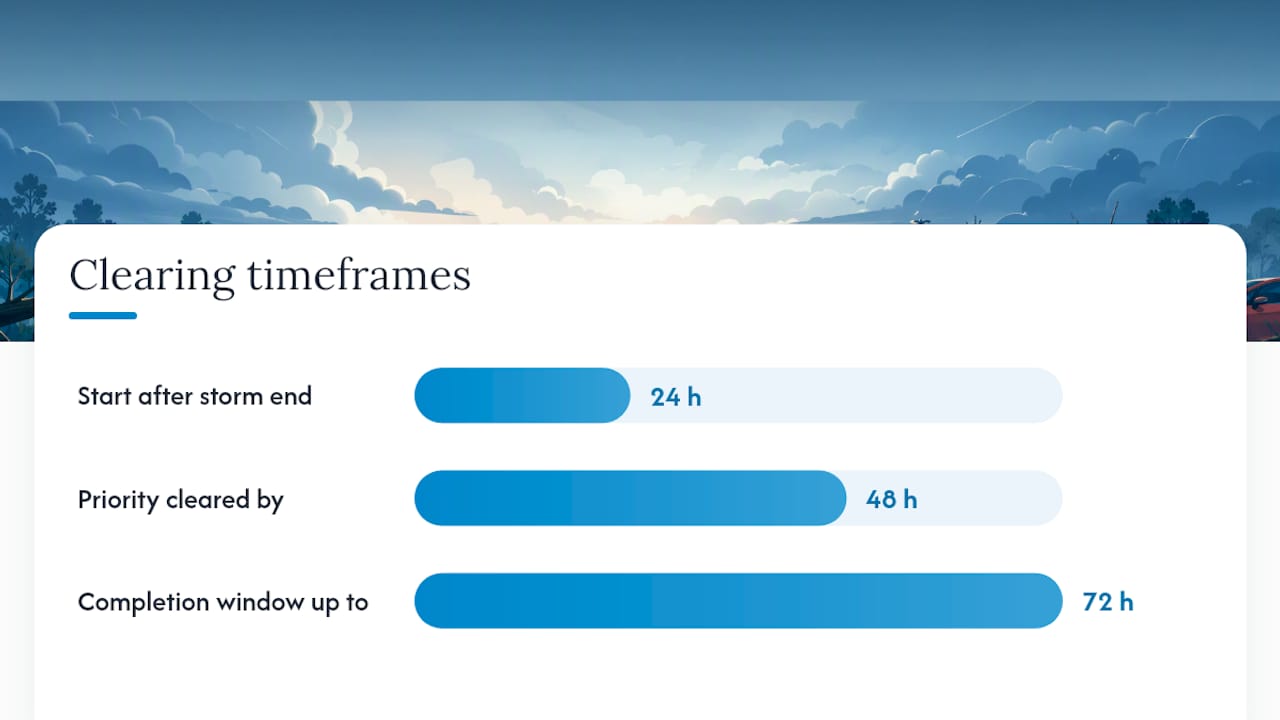
Facility guidance commonly points to starting clearing within 24 hours of a storm’s end and completing prioritized clearing within 48 to 72 hours for lots with public access. Courts don’t apply a fixed number, but that window reflects what most reasonable-care standards expect in practice.
Pro Tip: Before signing a seasonal contract, ask for a sample service log from a past storm. If a contractor can’t produce one, they likely aren’t tracking the documentation you’ll need if a slip-and-fall claim ever lands on your desk.
How Should You Document Damage for Insurance and Repairs?
Not every crack needs an immediate crew. Cold patch, gravel infill, or a ring of cones can stabilize a damaged section long enough to reopen safely while you line up a permanent fix.
Photo and video work is where most managers cut corners, and it’s the piece that matters most once an adjuster gets involved:
- Shoot wide establishing shots of each damaged zone, then close-ups with a visible object for scale (a tape measure, a boot, a coin)
- Keep photo metadata intact rather than screenshotting or cropping images before storing them
- Log the date, time, and location of every photo alongside your written damage notes, a practice insurance and repair guidance consistently recommends
- Collect contractor estimates and invoices and file them next to the matching photos, not in a separate folder
Call a licensed paving contractor for anything beyond surface patching, structural cracking, base failure, or repeated washouts included.
How Can You Cut Reopening Time Next Season?
Every storm you survive teaches you something the next one will test. Build that lesson into a written plan before the first flake falls, not while you’re standing in a flooded lot at 6 a.m.
- Write a winter operations plan. Define objective trigger conditions (inches of snow, ice accumulation) that automatically activate your contractor.
- Fix design flaws that cause repeat problems. Move drains away from high-traffic spots, route roof gutters away from walkways, and pre-designate snow storage zones.
- Prep materials early. Confirm salt and brine stock, pre-mix brine solutions, and pre-qualify a backup contractor before the season starts.
- Verify equipment before the first storm. Test plows, spreaders, and liquid tanks in October, not during the first emergency dispatch.
- Decide which low-use areas can stay closed longer. Document that decision in writing so it reads as a planned choice, not neglect, if anyone ever questions it.
Why Documentation and a Reliable Contractor Shorten Reopen Time
The lots that reopen fastest aren’t always the ones with the biggest equipment. They’re the ones with a storm event file already built: pre-storm baseline photos, time-stamped post-storm images of high-risk zones, and service logs naming who did what and when. That kind of recordkeeping turns a liability question into a five-minute conversation instead of a weeks-long dispute.
A contractor answering 24/7 dispatch calls matters less for convenience than for the paper trail it creates. Every documented visit is a data point proving reasonable care was taken. Make documentation routine, something logged on every visit, not something you reconstruct from memory after a lawsuit lands.
— Jesse
Get Professional Help Reopening Your Lot Fast
This company offers an alternative to assembling your own crew, equipment, and documentation system from scratch, providing 24/7 emergency dispatch and commercial-grade equipment designed to clear lots efficiently, with documented service visits to support liability protection.
When you call, expect a straight answer on response time, a clear scope of work, and equipment capable of handling everything from a small retail lot to a full industrial park. Denversnowremovals offers commercial parking lot plowing and anti-icing pre-treatment built around the same trigger-based, priority-sequenced approach outlined above, along with seasonal contracts running September through May. If your lot needs reopening or you want a plan in place before the next storm, consider requesting a free estimate and scheduling service in advance of conditions.
This article is general information, not a substitute for advice from a qualified lawyer. Consult a qualified legal professional about your own circumstances before acting on anything here.
Sources
- A-0262-23 – Paula Russo vs. Garden Commercial Properties (NJ Courts opinion)
- Winter parking lot maintenance: Ice control, snow removal, and cold-weather operations | Facility Parking Guide
- CT Guide: BMP for Parking Lots and Sidewalks — Anti-icing and materials handling (2023)
- After the storm: How to document parking lot conditions for repairs and insurance conversations — CasTech
- Minnesota LTAP: Smart Winter Salt — property manager impacts and recordkeeping
FAQ
How Soon Must a Lot Be Cleared After a Storm?
Most risk guidance points to starting within 24 hours of the storm ending and completing prioritized clearing within 48 to 72 hours for lots with public access, though courts evaluate reasonableness case by case.
What’s the Difference Between Anti-Icing and De-Icing?
Anti-icing applies brine before precipitation to stop ice from bonding to pavement, while de-icing reacts to snow or ice already on the ground; anti-icing typically costs about half as much as reactive treatment.
What Documentation Do I Need for an Insurance Claim?
Keep wide and close-up time-stamped photos of every damaged area, a written log of conditions, and contractor estimates filed alongside matching images.
Can I Reopen Part of a Lot While Repairs Continue?
Yes, if you cordon off the damaged section with cones or barricades and route traffic through a clearly marked bypass while confirming no active hazard, like exposed wiring or a washout, remains in the open areas.
Does Denversnowremovals Offer Emergency Reopening Support?
Yes. Denversnowremovals provides 24 hour emergency commercial plowing, parking lot de-icing, and snow hauling, with current pricing available directly through their site.