

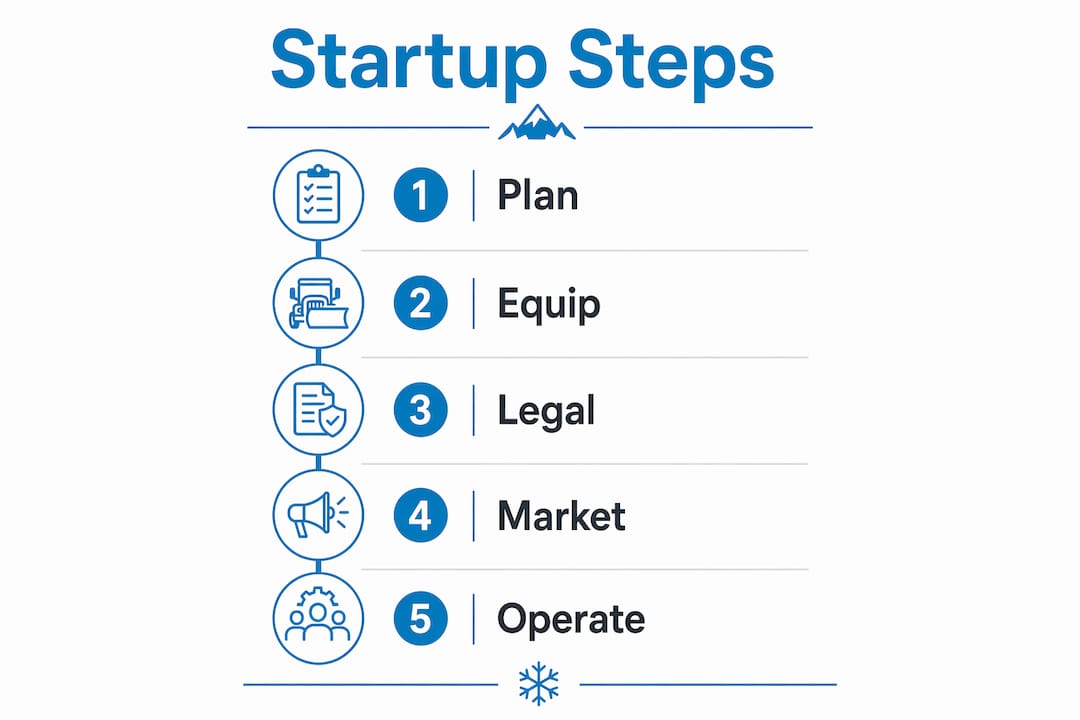
Emergency snow removal business setup is the process of building a seasonal operation that delivers fast snow and ice clearing during winter storms, combining legal compliance, equipment readiness, and signed contracts to generate reliable income. The industry term for this type of venture is a “snow and ice management business,” and understanding that label matters when you apply for commercial insurance or join trade groups like SIMA (Snow and Ice Management Association). Startup costs range from $6,000 to over $35,000 depending on your equipment level. A well-run route can produce $30,000 to $80,000 in a single season. This guide covers every step, from registering your LLC to locking in contracts before the first snowflake falls.
What equipment and legal steps are needed for your emergency snow removal business setup?
The right equipment is the foundation of any snow removal service startup. You need at minimum a plow truck, a salt spreader, a snow blower, and hand shovels for tight spaces. The choice between plowing and blowing affects both your startup cost and the types of properties you can serve efficiently.

Equipment tiers and what they cost
Budget setups use a used plow truck, a basic walk-behind snow blower, a tailgate salt spreader, and standard liability insurance. Professional setups add newer trucks, V-box spreaders, GPS tracking, and scheduling software. Startup costs range from $6,000 for a budget residential operation to over $35,000 for a professional commercial rig. That gap reflects the difference between serving a handful of driveways and holding multi-site commercial contracts.
| Setup level | Typical cost | Best suited for |
|---|---|---|
| Budget residential | $6,000–$12,000 | Driveways, small lots |
| Mid-range | $12,000–$25,000 | Mixed residential and commercial |
| Professional commercial | $25,000–$35,000+ | Large lots, HOAs, retail centers |
Legal requirements you cannot skip
Register your business as an LLC before you take a single job. An LLC separates your personal assets from business liability, which matters enormously when a client slips on ice you were hired to clear. Obtain an EIN (Employer Identification Number) from the IRS, which is free and takes minutes online. You also need a business license from your city or county, commercial auto insurance for your plow truck, and general liability insurance covering slip-and-fall claims.
- LLC registration (state filing fee varies by state)
- EIN from the IRS (free)
- City or county business license
- General liability insurance ($1 million minimum coverage recommended)
- Commercial auto insurance for plow vehicles
- Workers’ compensation if you hire employees
Pro Tip: Test all equipment before october. A hydraulic failure on your plow truck during the first storm costs you clients, not just repair fees.
Backup equipment and extra de-icing supplies should be ready before the season starts. Salt prices spike after the first major storm, and a broken spreader with no spare means missed routes and broken contracts.
How do you build a profitable snow plowing business plan?
A profitable snow plowing business plan centers on one decision: seasonal contracts versus on-demand pricing. Seasonal contracts pay a flat fee for the entire winter regardless of snowfall. On-demand or “per push” pricing charges clients each time you clear their property. Balancing both models creates stable cash flow and protects you in low-snowfall years.
Pricing structure that works
Per-push pricing typically runs higher per visit but leaves your income unpredictable. Seasonal retainers give you guaranteed revenue from day one of the contract. The most profitable operators use a hybrid model: seasonal contracts for their core client base, with per-push pricing for overflow or one-time storm calls.
- Set your per-push rate based on property size, average clearing time, and material costs.
- Calculate a seasonal retainer by multiplying your per-push rate by the average number of storms in your area, then apply a small discount for the client’s commitment.
- Price salting and deicing as a separate line item, not bundled into the base rate.
- Offer a multi-property discount to property managers who bring you three or more sites.
- Review pricing every august before sending renewal contracts.
Contracts must clearly define snow clearing depths, ice control scope, and service priority tiers to prevent disputes. Vague agreements are the single biggest source of client conflict in this industry.
Pro Tip: Target commercial clients between august and october. Property managers finalize winter service contracts early, and waiting until november means the budget is already spent.
A well-managed plow route can generate $30,000 to $80,000 in seasonal revenue. Profit depends on route density and cost control, not on how much equipment you own.
How do you acquire clients for your snow clearing business?
Client acquisition for a snow clearing business follows a tight seasonal window. 70–80% of clients who receive quality service rebook before the snow season. That means your best leads are last year’s clients, and your second-best leads are their neighbors.
Start marketing in august, not november. Property managers, HOAs, and retail center operators finalize winter contracts months before the first storm. Showing up after the snow falls means you are competing for the scraps.
Tactics that actually bring in contracts
- Door hangers: Place them in dense residential neighborhoods where you already have one or two clients. Geographic clustering cuts your drive time and builds route density fast.
- Google Business Profile: Set up and verify your profile before september. Local search traffic for snow removal spikes in october and november, and a complete profile with reviews puts you at the top.
- Direct outreach to property managers: Call or visit commercial property management offices with a one-page service summary and a clear pricing sheet.
- HOA boards: Attend a board meeting or send a formal proposal. HOAs manage multiple properties and can represent a significant portion of your seasonal revenue.
- Referral incentives: Offer existing clients a discount on their next service for every new signed contract they send your way.
Pro Tip: Ask every new client how they found you. That data tells you which marketing channel to double down on before next season.
Seasonal contracts secure early income and stabilize cash flow, while on-demand work supplements revenue during peak storm events. The goal is to enter december with enough contracted revenue to cover your fixed costs, so storm-day income becomes pure profit.
What are the best practices for operations and route planning?
Operations separate profitable snow removal businesses from ones that barely break even. Route density and geographic clustering are more profitable than large, scattered contracts. A tight cluster of 15 driveways on the same block takes far less time than 15 driveways spread across three zip codes.
Building a route that runs itself
Successful operators treat snow days as coordinated events with assigned route maps and clear service triggers. A service trigger is the snow depth at which you automatically dispatch, typically 2 inches for commercial clients and 3–4 inches for residential. Setting triggers in your contracts removes the guesswork and the 3:00 AM phone calls.
- Map all client addresses before the season and group them by proximity.
- Assign priority tiers: commercial clients with high foot traffic get cleared first.
- Set service triggers in every contract so dispatch is automatic.
- Document every completed visit with time-stamped photos or digital logs.
- Review route efficiency after each storm and adjust for the next one.
Documenting every visit with time-stamped photos protects you against liability claims. If a client says you never showed up or left ice on their walkway, your documentation is your defense.
Operational best practices also include careful attention to property features. Knowing how to protect landscaping during plowing reduces damage claims and builds client trust. Marking curbs, garden beds, and obstacles with driveway markers before the season starts saves you from costly mistakes mid-storm.
Pro Tip: Stock at least two weeks of salt and de-icing materials before the season. Prices spike after the first major storm, and shortages can shut down your operation at the worst possible time.
Staffing follows route volume. Start solo or with one helper, then add crew members as your contract base grows. Train every crew member on your documentation process before they run a single route independently.
Key Takeaways
A profitable snow and ice management business is built on pre-season contracts, dense routes, and documented service delivery, not on equipment size alone.
| Point | Details |
|---|---|
| Start costs vary widely | Budget setups begin at $6,000; professional commercial rigs exceed $35,000. |
| Sign contracts early | Target commercial clients in august and september before budgets are committed. |
| Use a hybrid pricing model | Combine seasonal retainers with per-push rates to stabilize cash flow year-round. |
| Route density drives profit | Clustered routes reduce travel time and increase jobs completed per storm. |
| Document every service visit | Time-stamped photos protect against liability claims and build client trust. |
What I have learned after years of watching snow businesses succeed and fail
The operators who struggle most are the ones who buy a big truck and wait for it to snow. The ones who thrive spend their summers on the phone, knocking on doors, and mapping routes. Equipment matters, but relationships close contracts.
The most underrated skill in this business is contract clarity. I have seen operators lose entire client relationships over a single ambiguous line about ice remediation scope. A contract that defines trigger depth, service frequency, and what counts as a completed visit prevents 90% of the arguments that kill repeat business. Clear, detailed service agreements are not paperwork. They are your reputation in writing.
Route planning is the other area where new operators leave money on the table. Driving 20 minutes between stops is not a logistics problem. It is a pricing problem. If your routes are scattered, you either need to raise rates on distant clients or stop taking them. Dense routes let you serve more properties per storm, which is the only way to grow revenue without buying more trucks.
My honest advice: treat your first season as a learning year. Lock in 10 to 15 solid contracts, run tight routes, document everything, and ask every client for feedback in march. The operators who do that consistently are the ones who show up to their second season with a waiting list.
— Jesse
How Denversnowremovals can support your startup
Starting a snow removal company means making dozens of decisions before the first storm arrives, from equipment selection to route design to client contracts. Denversnowremovals has spent over 44 years refining exactly those processes in the Denver Metro area, and the resources on the site reflect that depth of experience.
The equipment comparison guide breaks down the real-world tradeoffs between plowing and blowing so you can match your gear to your client base. The seasonal preparation guide covers pre-season checklists that apply directly to new operators building their first operational plan. Whether you are pricing your first contract or planning your first storm response, Denversnowremovals offers practical, field-tested guidance to help you get it right from the start.
FAQ
What does it cost to start a snow removal business?
Startup costs range from $6,000 for a budget residential setup to over $35,000 for a professional commercial operation. The gap reflects equipment quality, insurance coverage, and the scale of clients you intend to serve.
When should I start signing snow removal contracts?
Target commercial clients between august and october, before property managers commit their winter budgets. 70–80% of clients who received good service the prior year rebook before the season starts, so early outreach is critical.
What insurance does a snow removal business need?
You need general liability insurance and commercial auto insurance at minimum. If you hire employees, workers’ compensation is also required. General liability coverage of at least $1 million is the standard for commercial contracts.
How do I protect myself from liability claims?
Document every service visit with time-stamped photos or a digital log. Clear contracts that define service scope and trigger depths also reduce the risk of disputes.
How much can a snow removal business earn in one season?
A well-managed plow truck route can generate $30,000 to $80,000 in seasonal revenue. Profitability depends on route density, cost control, and the balance between seasonal contracts and per-push pricing.
Recommended
- Seasonal Snow Preparation Step for Homeowner Denver Colorado
- How to Protect Landscaping During Snow Plowing – Snow Removal Denver 303-591-2089
- How Shared Driveways Get Cleared Safely in Winter – Snow Removal Denver 303-591-2089
- Snow Plowing vs Snow Blowing: Which Method Wins? – Snow Removal Denver 303-591-2089