
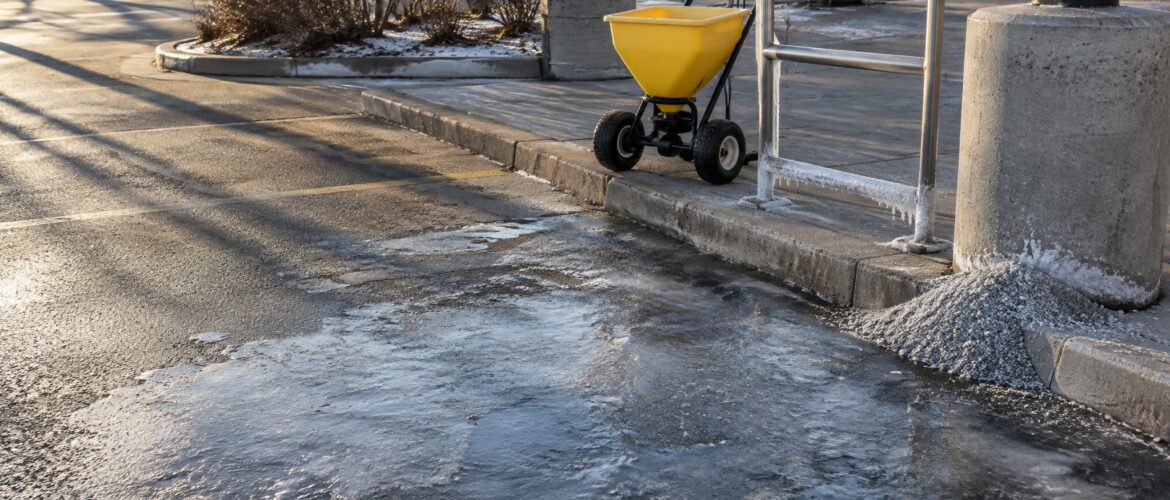
The storm is rarely what hurts someone on your property. The ice that forms after the plows leave does it, usually at an hour when nobody is out looking for it.
Key takeaways
- Sunny-day melt runs to shaded entrances and low spots, then sets overnight into a thin sheet that looks like wet pavement.
- A fall claim usually turns on what the owner knew and how quickly it acted, so de-icing works as liability prevention.
- Anti-icing before the evening drop helps keep ice from bonding; salting after the first fall is only cleanup.
- “Stop ice before it forms” means cutting the chance of bonding, not promising bare pavement after every storm.
- Our dispatch is staffed 24/7 from September through May, and you can request a quote through the Contact page for the rest of the 2026–2027 season.
We’re Denver Snow Removals. We have more than 47 years of experience, and we work on commercial properties: large parking lots, office campuses, industrial parks, and HOA communities. We don’t do residential driveways. This article explains why a commercial de-icing service in Denver works best as liability prevention, and when the treatment has to go down for it to count.
Commercial De-Icing in Denver Is Liability Prevention, Timed to the Freeze-Thaw Cycle
Denver’s winter sun does half the plow’s job for free, and then it sets the trap. Bright afternoons after a storm are what make the overnight problem so easy to miss.
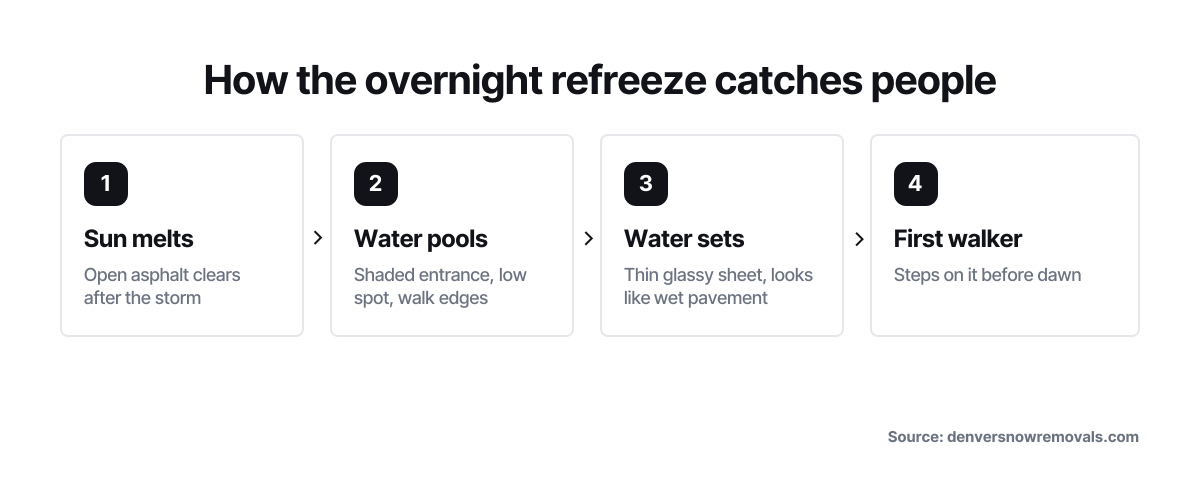
Here is a typical case, not a client story. A storm moves through and drops snow across an office campus. By afternoon the sky clears, and the sun hits the open asphalt. Dark pavement soaks up that heat, so snow slumps and runs off the lot.
The meltwater doesn’t stay where it formed. It runs toward the shaded entrance, where the sun never reaches, and it pools in the low spot beside the walk. The lot looks clear, the crew has moved on, and everyone assumes the storm is over.
Then the sun drops. A clear sky holds no heat, so the temperature falls fast, and all that standing water sets into a thin, glassy sheet. It looks exactly like wet pavement. Nobody slows down for wet pavement.
The first employee arrives before dawn, parks, and walks toward the door. That person steps onto the ice at the one spot on the property where everyone has to walk.
Nobody in that story was careless. The plowing was done, and the lot passed a quick look. The hazard simply wasn’t visible, which is why a sheet this thin catches people off guard well after the snow has stopped falling.
Where refreeze forms first
Meltwater follows the same routes every time, so the trouble spots are predictable:
- Shaded entrances, where the sun never gets the chance to dry the surface.
- Low spots where meltwater pools, including the dip beside a walk or a drain that can’t keep up.
- The edges of walks, where water from snowbanks and piles drains across the path.
Walk your own property after the next clear afternoon and you’ll likely find these spots within minutes. We find them the same way.
Why this is a Denver problem
This is the freeze thaw cycle that Denver’s clear-sky winters produce again and again: sunny-day melt, then overnight refreeze. Other cities see it too, but here it’s routine, not a freak event. Ice that forms this way isn’t a one-off. You can see it coming, and so can a court.
What a fall claim turns on
A fall claim usually turns on what the owner knew and how quickly the owner acted. If snow fell, the sun melted it, and the evening was going to refreeze it, an owner can’t easily argue the hazard was a surprise. That is why we treat commercial de-icing as liability prevention, timed to the refreeze, and not as a chore that follows plowing.
Anti-icing and re-treatment before the evening drop help keep ice from bonding to the surface. Salting after the first fall is cleanup.
We also want to be plain about the wording. “Stop ice before it forms” means cutting the chance of ice bonding to your pavement. It is not a promise of bare pavement after every storm. Heavy snowfall, drifting, and foot traffic can still leave patches. That’s why we go back and re-treat, rather than treat once and call it done. This work is freeze thaw ice prevention and ice management for commercial property. It does not turn winter off.
This is general information, not legal advice. Check your actual obligations with an attorney or your insurer.
What follows is the treatment itself and the records that show it happened.
Pre-Storm Anti-Icing for Parking Lots and Sidewalks
Anti-icing treatment goes down before the snow arrives or before the evening drop. The point is simple: material is already in place when the melt-refreeze starts, so refreezing water has a much harder time bonding to the surface.
For parking lot de-icing, we focus on the places where traffic funnels and meltwater collects. That means the entrance drives, the ramps, and the low spots we described above. A lot can be mostly dry and still have one patch at the main entrance that causes the claim.
Sidewalk ice melt service works the same way, one level down. We treat the door approaches, the shaded stretches, and the walk edges where refreeze forms first. Those are the strips people use before the sun is up, and they’re the strips a full-lot pass can miss.
Material choice matters here, and it depends on your pavement and your conditions. Our guide to ice melt versus rock salt for Denver lots covers that in depth, so we won’t repeat it. Sidewalks bring the city’s requirements into play too. Denver’s sidewalk clearing rules are laid out in their own guide.
We run commercial equipment, not pickup trucks: skid steers and de-icing equipment built for large lots, not a bed-mounted spreader on a borrowed truck.
One limit you should know about. Anti-icing doesn’t replace plowing, and it doesn’t make a heavy snowfall safe to walk on by itself. It works alongside clearing, not instead of it.
Application Logs and How to Request De-Icing
If a slip-and-fall claim lands on your desk, the question will be what you did and when. An application log answers it. It is the dated record of each treatment: when the material went down, which areas it covered, what material was used, and the conditions noted at the time.
A record like that helps show timely care. It can’t win a claim for you, and it doesn’t replace insurance. What it does is replace “we think someone treated it” with a specific entry. Again, this is general information, so ask an attorney or your insurer how a log fits your situation.
Before you sign with any contractor, ask what their log records and ask to see a sample. We are fully insured, and we encourage property managers to ask any contractor, us included, for proof of coverage before signing. Boards negotiating this in writing should read what HOA boards should put in a contract first.
Requesting de-icing
Requesting service is short. You tell us about the property, we price it up front, and we get it on the schedule. Pick a per-visit or seasonal contract based on how much exposure you want to carry.
Timing is why you shouldn’t wait for the first hard freeze. Our dispatch is staffed 24/7 from September through May, so an overnight refreeze reaches a live dispatcher rather than a voicemail. You can read more about our round-the-clock dispatch.
For the rest of the 2026–2027 season, the simplest next step is to request a de-icing quote through our Contact page.
Frequently asked questions
What does commercial de-icing cost?
We price up front, so you know the number before we treat anything. The figure depends on the property, so we quote it after you tell us about your lot and walks. Send the details through our Contact page.
Will de-icing leave my lot bare after every storm?
No. Anti-icing cuts the chance of ice bonding to the surface, but heavy snow, drifting, and foot traffic can still leave patches. We re-treat when conditions call for it.
Why not just salt after someone slips?
Salting after a fall only deals with ice that has already formed. Anti-icing before the evening drop works earlier, while ice still has little to grab onto. It also shows you acted before the hazard existed.
What should an application log include?
A useful log records when each treatment went down, which areas were covered, what material was used, and the conditions at the time. Ask any contractor to show you a sample before you sign. For how it fits a claim, check with an attorney or your insurer.
Who answers if ice forms overnight?
Our dispatch is staffed 24/7 from September through May. An overnight refreeze reaches a live dispatcher, not a voicemail.