
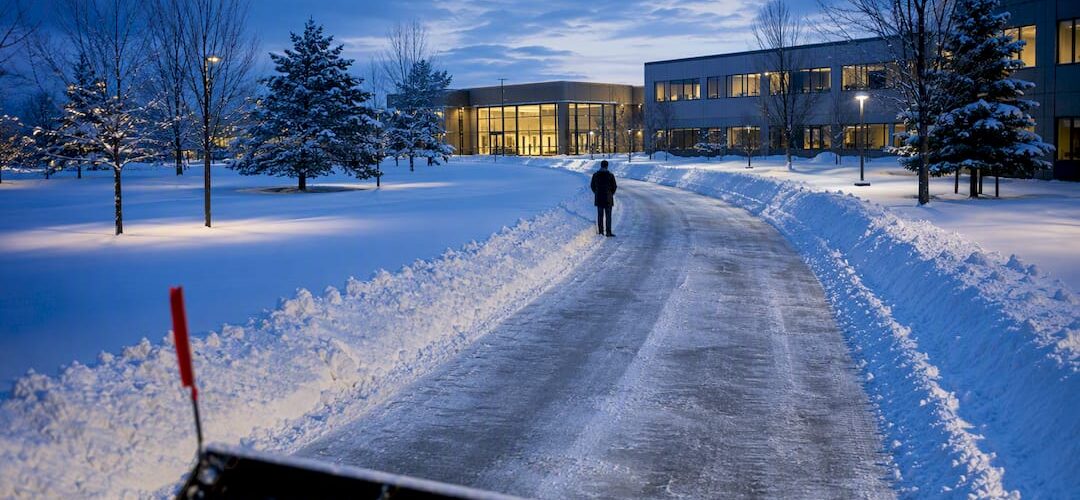
The right approach is to hire a professional contractor on a seasonal or event-based contract that spells out exact deliverables: parking lot plowing, sidewalk and ADA route clearing, de-icing and anti-icing, snow hauling, and emergency call-outs with defined response windows. This guide breaks down what to put in that contract, how to judge a vendor’s operations, and what documentation protects your property when a claim comes in.
TL;DR:
- A comprehensive snow removal contract must specify all surfaces, trigger thresholds, response times, and detailed documentation processes to prevent disputes and ensure accountability.
- Anti-icing should be prioritized before storms and combined with plowing, using liquid or prewetted materials at proven application rates to maximize effectiveness and reduce labor.
- Contracts should include clear service level agreements, response windows, backup plans, and transparent pricing with itemized adders to avoid surprises during heavy snow seasons.
- Roof snow load management requires hazard evaluations and fall protection protocols, with documentation to minimize safety risks and liability for rooftop work.
- Maintaining detailed, timestamped service logs and photos enables quick resolution of disputes and supports liability defense if slip-and-fall claims occur later.
Table of Contents
- Operational scope: what “snow removal” must explicitly include
- Service levels and contract essentials for snow response
- Anti-icing versus deicing: operational practices that actually work
- Safety and liability: OSHA rules and documentation as risk management
- SOPs and documentation: the checklist that keeps everyone accountable
- How to hire and evaluate a snow removal contractor
- What experience with snow contracts actually teaches
- How Denver Snow Removal supports apartment and HOA contracts
- Primary sources on winter operations and safety
- Sources
- FAQ
Operational scope: what “snow removal” must explicitly include
A vague line item like “snow removal services” invites disputes the first time a resident slips near an unplowed curb ramp. The contract should name every surface and every trigger point.
Parking lots and aisles need plow-pass frequency, snow pile placement rules, and clear language on when hauling becomes necessary because there is nowhere left to push snow. Sidewalks, entrances, stairs, ramps, and curb ramps need their own line, tied to ADA access requirements so plow piles never block an accessible route or egress path. De-icing and anti-icing responsibilities should specify who supplies materials, where they get applied, and whether pre-treatment happens before a storm or only after snow has bonded to pavement.
- Parking lots and vehicular aisles: plow-pass count, pile locations, hauling triggers
- Sidewalks, stairs, ramps, and curb ramps: full-width clearing with ADA routes prioritized
- De-icing and anti-icing: material source, application zones, and treatment timing
- Optional add-ons: roof snow load monitoring, snow hauling, and skid-steer pile management for lots with limited storage
Roof clearing and skid-steer services usually apply to sites with heavy snow loads or tight lot geometry rather than every property, so scope them in only where the site needs them.
Service levels and contract essentials for snow response
Once scope is set, the contract needs measurable triggers and response windows so you and the vendor agree on when work starts and what “done” looks like. Comparing bids without this language means comparing apples to guesses.
- Set a trigger threshold, such as mobilization once accumulation reaches a set depth, or an event-based call within a defined number of hours of snowfall starting.
- Define the level of service (LOS) in plain terms: bare pavement, center-lane bare, or a set number of plow cycles per shift.
- Separate response windows for routine storms from major or emergency events, and require named backup coverage if the primary crew cannot respond.
- Confirm pricing structure up front, including whether hauling, reclaiming, and de-icing materials are included or billed as adders.
- Require documentation delivery, such as time-stamped logs and photos, as part of completion confirmation rather than an afterthought.
Pro Tip: Ask vendors to quote pricing as a flat seasonal rate plus itemized adders, so a heavy winter doesn’t turn into a series of surprise invoices.
Anti-icing versus deicing: operational practices that actually work
The FHWA Manual of Practice for an Effective Anti-Icing Program draws a clear line between the two approaches. Anti-icing is a proactive chemical application timed to prevent snow and ice from bonding to pavement, while deicing is a reactive treatment applied after bond has already formed. For apartment sites with a high LOS requirement, such as main entrances and accessible routes, anti-icing tends to reduce labor and material use compared with chipping away bonded ice later.
The manual also emphasizes plowing before applying chemicals whenever there’s enough snow to plow, since chemical products get diluted and lose effectiveness when spread on top of loose snow rather than on cleared pavement.
- Require plowing first, chemical application second, on any surface with meaningful accumulation
- Confirm the contractor uses liquid or prewetted solid products rather than dry rock salt alone for consistent melt performance
- Ask for spread-rate documentation, since correct rates matter more than simply “salting heavily”
- Confirm equipment matches the site: plows sized for lot geometry, a skid-steer for pile management, and hauling trucks for lots with no storage room
FHWA testing found liquid anti-icing chemicals applied at 21 kilograms per lane-mile prevented bridge-deck icing when applied up to four days before freezing on higher-volume roads and up to seven days before on lower-volume roads. That kind of lead time shows why timing, not just material volume, determines whether a treatment holds.
Safety and liability: OSHA rules and documentation as risk management
OSHA’s hazard alert on rooftop snow removal advises employers to minimize the number of workers who access roofs for snow removal and requires a hazard evaluation with fall protection whenever roof access can’t be avoided. Fall hazards remain a leading cause of fatalities during rooftop snow work, so any contract that includes roof snow load management should require the vendor to document that evaluation before crews go up.
Ground-level operations carry their own risk profile. A contract should require trained crews, proper PPE, safe equipment operation around residents and vehicles, and traffic-control measures during active plowing.
- Require certificates of insurance covering general liability, workers’ compensation, and commercial auto, with limits stated in the contract
- Require named-insured status for the property where appropriate
- Require a documented hazard evaluation before any roof access
- Require photo and time-stamped logs for every service visit, not just major storms
Federated Insurance’s guidance on housekeeping and documentation notes that inspection schedules and documented procedures reduce slip-and-fall exposure and protect reputation after an incident. Time-stamped records turn “we think it was cleared” into evidence.
Pro Tip: Keep a folder of every service log and photo set for the full season. If a slip-and-fall claim surfaces months later, that record is often the difference between a quick resolution and a drawn-out dispute.
SOPs and documentation: the checklist that keeps everyone accountable
Standard operating procedures turn a good contract into a repeatable operation. APWA’s guidance on setting up winter SOPs recommends documenting triggers, call-out steps, and decision trees so crews respond the same way every time, regardless of who’s on shift.
- Define trigger depths and call-out steps in writing, with named decision-makers for each.
- Require an equipment checklist confirming plows, spreaders, and hauling trucks are operational before the season starts.
- Document the anti-icing versus deicing decision tree so crews know which treatment applies to which conditions.
- Require post-storm assessment logs covering time-stamped photos, spread-rate records, and hauling receipts where applicable.
- Set an audit cadence: daily inspection during active storms, a post-storm quality check, and a defined record retention period.
Consistent SOPs also simplify disputes. When a resident complains about a missed area, a documented log settles the question faster than a phone call.
How to hire and evaluate a snow removal contractor
An RFP should require explicit scope, trigger definitions, LOS commitments, backup staffing plans, an equipment list, and current insurance certificates, along with references from comparable multifamily or HOA properties. Our guide to apartment complex snow removal in Denver breaks down service-area definitions and response benchmarks in more depth.
Once a vendor is under contract, track a short list of KPIs: average response time from trigger to first plow pass, SLA completion rate across the season, any documented missed events, and how quickly tenant complaints get resolved.
-
Ask how the vendor staffs for a major storm, not just a routine one
-
Ask for references from properties with similar unit counts and parking layouts
-
Ask how documentation gets delivered, and how quickly
-
Vague trigger language, no written SOPs, or no proof-of-service process are all red flags worth walking away from.
Pro Tip: A contractor who can’t explain their hauling and pile-placement plan for a full lot probably hasn’t managed a property like yours before.
What experience with snow contracts actually teaches
Narrow per-event hires look cheaper on paper, but they leave you renegotiating mid-storm when a vendor is already stretched thin across other calls. Seasonal contracts with clear LOS language cost more predictably and deliver more predictably.
Providers built around this model, such as Denver Snow Removal, with 44 years of operating history and a 24/7 team, illustrate the kind of standing capacity worth looking for. Every site is different, so tailor LOS commitments and ADA clearing plans to your specific lot geometry and accessible routes before signing anything.
— Jesse
How Denver Snow Removal supports apartment and HOA contracts
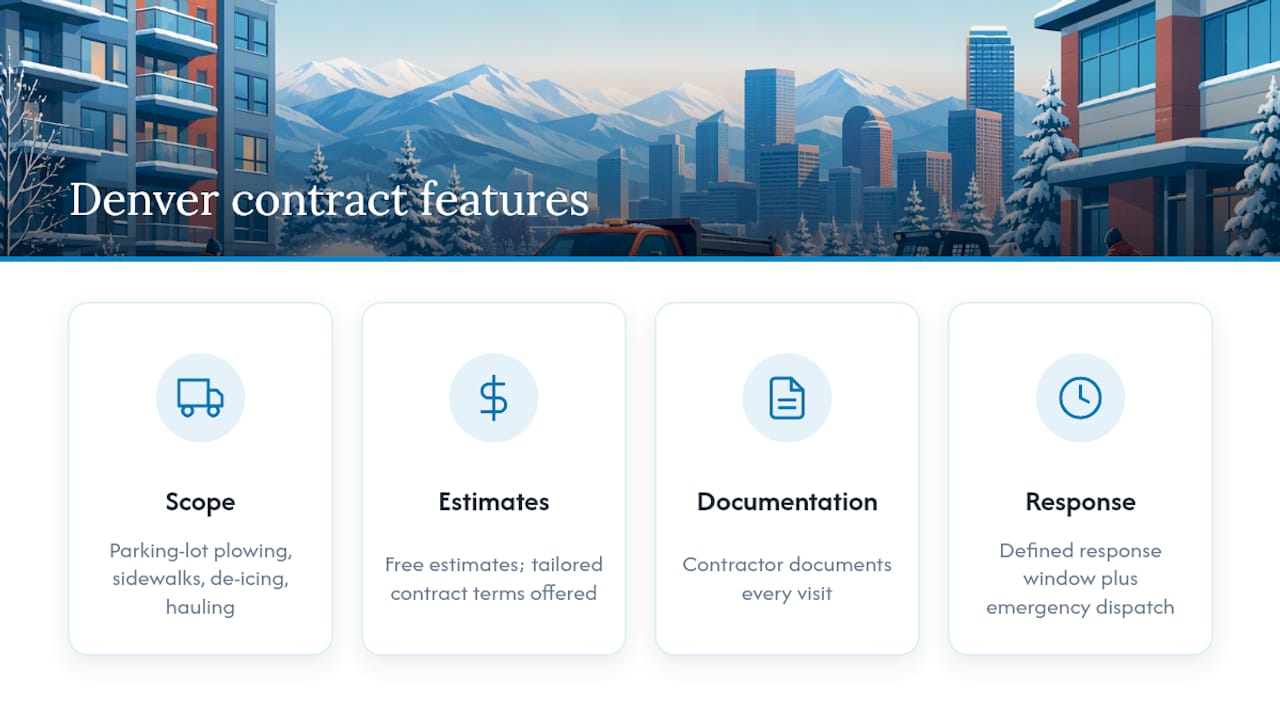
Seasonal contracts typically include scope items such as parking lot plowing, sidewalk clearing and de-icing, snow hauling for constrained lots, and emergency dispatch beyond routine schedules. Free estimates and tailored contract terms may be offered rather than one-size-fits-all packages, which matters when a property has specific ADA routes or limited snow storage.
If your apartment community or HOA needs a contractor who documents every visit and shows up on a defined response window, request a free estimate for parking lot and walkway service to see how a seasonal contract would be structured for your site.
Primary sources on winter operations and safety
For deeper reading: the FHWA anti-icing manual, OSHA rooftop snow guidance, APWA’s SOP resource, and Federated Insurance’s housekeeping guidance all inform the practices above. Property managers reviewing broader site-safety routines may also find this property manager security checklist useful for structuring inspection schedules alongside winter operations.
Sources
- Manual of Practice for An Effective Anti‑Icing Program (FHWA)
- OSHA — Hazards of roof snow removal / hazard alert
- APWA — Setting up winter SOPs
- Federated Insurance — Business general maintenance and housekeeping
FAQ
What should a snow removal contract cover for an apartment complex?
It should name every surface separately: parking lots and aisles, sidewalks, entrances, stairs, curb ramps, and accessible routes, plus de-icing and anti-icing responsibilities. It should also define trigger depths, response windows, and documentation requirements so there’s no ambiguity about when work starts or how completion gets confirmed.
Who is responsible for clearing ice from apartment parking lots?
Under a professional service contract, the contracted vendor holds responsibility for parking lot plowing and ice treatment, not individual residents. The property owner or manager typically sets the scope and level of service, while the contractor executes it and documents each visit.
What is the difference between anti-icing and deicing?
Anti-icing applies chemicals before snow bonds to pavement to prevent that bond from forming, while deicing treats snow and ice after it has already bonded. The FHWA anti-icing manual notes anti-icing programs tend to use less material and labor over a season when applied on a defined schedule.
Is rooftop snow removal required for apartment buildings?
Rooftop snow removal is not a routine requirement and OSHA guidance advises minimizing worker access to roofs whenever possible. When roof access becomes necessary due to snow load, the contractor should complete a documented hazard evaluation and use fall protection before crews go up.
What documentation should property managers keep from their snow contractor?
Managers should keep time-stamped service logs, before-and-after photos, spread-rate or material application records, and hauling receipts for every storm event. This record supports service audits and gives the property a documented defense if a slip-and-fall claim arises later in the season.