
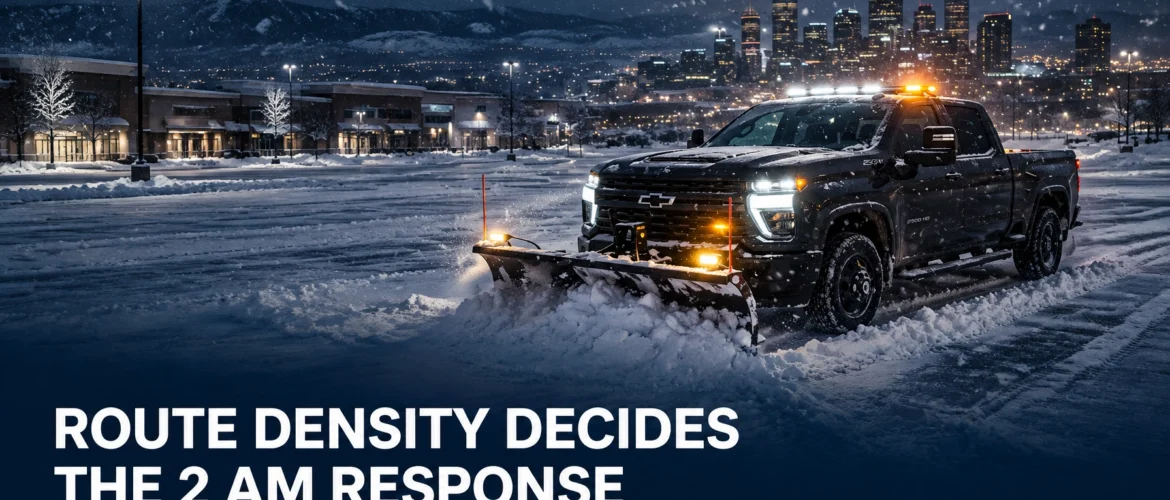
It’s 2 AM during an upslope storm. Snow is building, temperatures are dropping, and tenants are due at 6. The truck assigned to your property may be crawling along I-25, or finishing its third stop on the other side of the metro. A contractor’s website can say “we serve the Denver metro,” but that alone tells you nothing about where the crew will be when your lot reaches its trigger depth.
When you search for commercial snow removal near me, what matters is not just whether a contractor is nearby on a map. It is whether a plow and crew are near your property on their storm route, with enough capacity to get to your site in the order and time your operation needs.
What “near me” means during a commercial snowstorm
“Near me” means the truck’s position when your service trigger is met, plus the stops it must complete before reaching you. Your contractor’s office address or a service-area map cannot tell you that.
Route density describes how closely a crew’s sites are grouped and how much time it spends working versus driving between them. Consider two illustrative routes, each with 12 lots:
- If the lots sit within a two-mile radius, the crew has short drive legs and can move predictably from one site to the next.
- If those same lots are spread across 40 miles, windshield time takes a larger share of the night. Traffic, road conditions and delays at each property add uncertainty.
The site count is the same, but the operating night is not. Ask how many stops your assigned crew handles and how they are grouped, not just how many trucks appear in a fleet photo.

Why Denver routes can be harder to predict than they look
Denver’s geography and weather can make a metro-wide route plan less reliable than it sounds. Upslope storms can bring heavier snow to the west side and foothills edge while eastern areas receive much less. One corridor can reach eight inches while another has about an inch, so the depth at your property, not a general metro forecast, should guide the service decision.
Highway conditions can also disrupt a route. I-25, I-70 and E-470 are important travel routes, but a closure or slow-moving traffic can delay a plow truck just like any other vehicle. A contractor whose plan depends on a truck crossing the metro during a storm has a different exposure than one with equipment and assigned sites grouped along your corridor.
That is why a trigger depth is only one part of the service plan. Your trigger may be reached well before the truck arrives if your property is late in a long or disrupted route. Ask how the contractor monitors conditions and adjusts dispatch; our guide to weather monitoring for snow operations explains why forecasts and on-the-ground decisions both matter.

How route density affects pricing and service
A denser route can reduce drive time per visit and make it easier for a crew to move between nearby properties. A thin route usually means more time traveling, which may be reflected in the quote, or absorbed in a way that can leave less time for service.
That does not mean the densest route is always the right fit. A crew packed with too many stops can still be overcommitted, especially during a long storm when properties need repeat visits. The useful question is whether the contractor’s route has enough capacity for your site’s layout, trigger, opening hours and expected storm workload.
When comparing proposals, ask whether the price assumes a shared route or dedicated crew, and what service priority comes with that arrangement. For more on the factors that shape a quote, see commercial snow removal contract pricing in Denver. For a fair side-by-side review, use the same site details and questions for every bidder; our Denver commercial snow removal bid guide can help.
Questions to ask before you sign
Ask about the actual storm route, assigned crew and dispatch authority, not just the contractor’s advertised service area. You can copy and use this list:
- Which other commercial properties are on the route that would serve my site? Can you share references or comparable sites within a couple of miles?
- How many properties does this crew typically cover in a storm, and are those sites grouped close together?
- What order would my property be in, and what could change that order?
- Is a crew staged on my side of the metro, or would it need to cross the city to reach my lot?
- Where is the equipment staged before a storm?
- Do you assign dedicated crews or share crews across routes and service levels?
- What is the plan if I-25, I-70 or E-470 is closed or crawling?
- Who dispatches at 2 AM, and can that person reassign a truck when conditions or priorities change?
A useful answer describes the route structure, the crew’s workload and the person empowered to make changes. A vague answer such as “we cover all of Denver” does not tell you where your lot sits in the plan.
What “near me” should not mean
A nearby office address, local phone number or large service-area map is not evidence that a plow will be nearby during a storm. Those details may show that a company operates in the area, but they do not show how it assigns equipment or sequences stops.
Ask directly if subcontractors may clear your lot, whether a national account gets assigned to whichever crew is available, and whether the same crew is expected to serve your site all season. Subcontracting is not automatically a problem; an undisclosed handoff with no clear responsibility is.
To verify the answer, request references or the addresses of two or three comparable commercial sites the contractor is permitted to identify near your property. Ask what city the equipment is staged in and whether the assigned crew is consistent through the season. Then confirm what happens if that crew is delayed or unavailable.
How route density plays out across Denver corridors
The operational challenge varies by property and corridor; proximity alone does not predict how quickly a site can be cleared.
Downtown and Cherry Creek have dense commercial properties and potentially short drives between stops, but tight access, parked vehicles and loading conflicts can slow the work on site. The I-70 industrial corridor, the Denver Tech Center and Aurora include large lots with long internal drives, so site size and equipment time matter alongside route distance. The northwest corridor and foothills edge can see stronger upslope snowfall, which can change the amount of work a crew must handle during one event.
These are general operating considerations, not a promise of service in a specific location or a guaranteed response time. A contractor should assess your actual address, layout, access constraints and priorities before committing to a route plan.

Test the “near me” claim before you sign
The best time to test a route claim is before the first storm, when you can compare the answers without a 2 AM deadline. Ask for the route information in writing, then check that the service terms match your trigger depth, opening hours and site priorities.
A strong answer is specific and verifiable. A weak one relies on broad coverage language without naming a crew, route logic, staging plan or backup.
Eight-question route checklist
- Which crew is assigned? Good: a defined crew or clear assignment process. Vague: “someone will come.”
- How many sites are on its storm route? Good: a realistic count and geographic grouping. Vague: no route detail.
- Where are the other stops? Good: comparable nearby properties the contractor can identify. Vague: “all over Denver.”
- What is my place in the sequence? Good: a stated priority method and the factors that can change it. Vague: “we’ll get there.”
- Where is equipment staged? Good: a clear staging location or plan. Vague: an office address presented as proof.
- Are crews dedicated or shared? Good: a direct explanation of staffing and capacity. Vague: no answer about competing assignments.
- What if a highway is blocked? Good: an alternate dispatch or routing plan, with limits stated. Vague: “that never happens.”
- Who can reassign a truck overnight? Good: a named dispatch role with authority. Vague: voicemail or a callback promise.
No route plan eliminates delays, and no responsible contractor should promise an exact arrival regardless of storm conditions. The point is to understand the plan, its constraints and who acts when it needs to change. If you need urgent help, learn how our 24/7 emergency snow removal in Denver works before the next storm.
Get a quote based on your property and route
We provide commercial snow removal for large parking lots, industrial parks, office campuses, retail centers, warehouses and HOA communities. Our services include 24/7 dispatch, commercial plows, skid steer work, sidewalk clearing and de-icing, snow hauling, seasonal contracts and photo-documented visits. See our commercial snow removal services, including sidewalk crew operations.
To discuss a quote, share your property address, site map, preferred trigger depth and opening hours. Include priority entrances, loading areas and sidewalks so we can understand your requirements and evaluate the route fit. We have served Denver businesses since 1979; call 303-591-2089 or contact us about your property. You can also review our frequently asked questions.
This article is general information, not legal advice. Check applicable City and County of Denver requirements and ask your attorney or insurer about your property’s obligations and risk.
Frequently asked questions
What does “commercial snow removal near me” mean for a business?
It should mean a contractor has a practical route and available crew for your property during a storm, not simply an office or service-area map nearby. Ask how many stops the assigned crew covers, where those sites are grouped and what your place in the sequence would be.
Does a local snow removal company guarantee a faster response?
No. A nearby company may have a crew committed to many other properties, while a contractor farther away may have a route that passes your corridor. Ask about staffing, route order, road-disruption plans and dispatch authority; do not rely on distance alone.
How does route density affect commercial snow removal pricing?
A dense route generally reduces travel time between sites, while a spread-out route requires more driving. For a large parking lot snow removal route, drive legs between stops are the part of the night you never see on an invoice. How that affects your price depends on the contractor’s route plan, crew assignment, property scope and contract terms. Compare written bids for the same service level.
What should I ask a snow removal contractor before signing?
Ask which crew will serve your site, how many properties are on its route, where equipment is staged, whether crews are dedicated or shared, and what dispatch does if roads are blocked. Get the answers alongside your trigger depth, opening hours and property priorities in writing.