
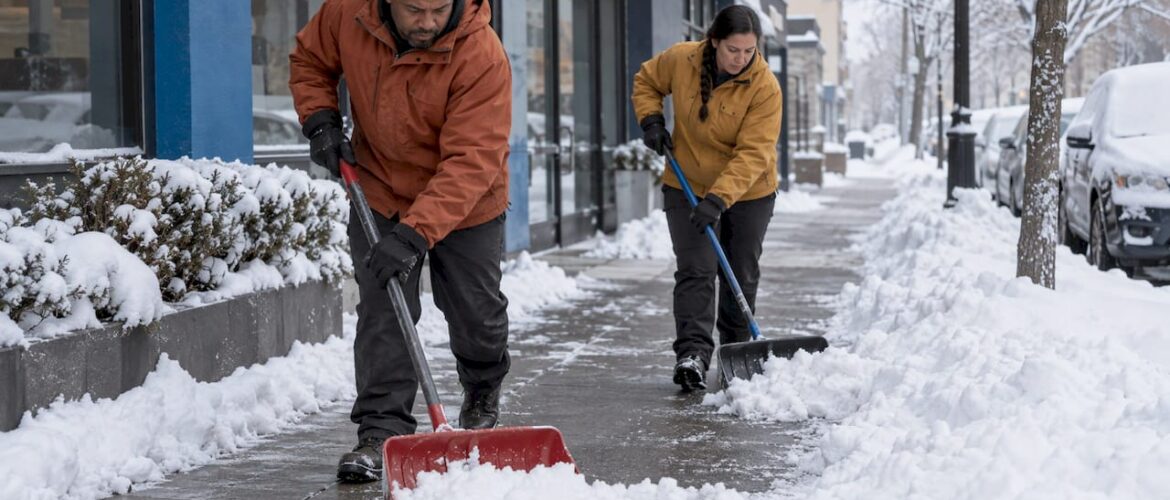
A sidewalk crew is a small team, usually on foot with shovels, walk-behind blowers, and ice melt spreaders, that clears entrances, walkways, ramps, and pedestrian paths after snow. A good one works in a set order: priority routes first, snow cleared down to pavement, ice treated, and the visit documented. If you manage a property in Denver, the timing matters as much as the technique, because the city sets deadlines for when walks must be clear.
This guide explains what a hand crew actually does on a visit, which tools fit which job, how crews stay safe, and how owners and property managers can keep sidewalks accessible and defensible.
TL;DR
- A sidewalk crew clears entrances and accessible routes first, removes snow to pavement, then treats the surface with ice melt.
- Cleared paths should be at least 36 inches wide, or the full walk if it is narrower, and curb cuts and ramps count.
- Denver expects businesses to start clearing right after snowfall stops and residences to finish by the next day, with a $150 fine possible after a notice.
- Documented visits, a written scope, and a monitoring routine protect owners if someone slips.
- Residential driveway and walkway clearing with us starts from $41.25 per visit.
Table of Contents
- What a sidewalk crew does on a service visit
- How a hand crew clears sidewalks step by step
- Tools and equipment: what each one is for
- Crew safety on the walk
- Denver deadlines your crew has to work within
- Coordinating a crew: monitoring, records and accountability
- Perspective: why crew operations decide the outcome
- Hiring a sidewalk crew: what to ask for
- Get a crew that fits your property
- FAQ
- Sources
What a sidewalk crew does on a service visit
The job is more than moving snow. The goal is a safe, slip-resistant path people can actually use. According to Massachusetts state guidance on snow removal and accessibility, adequate removal clears snow and ice down to pavement, treats the surface with ice melt, and leaves a path at least 36 inches wide, or the full sidewalk width if it is narrower. The same page says snow should not obstruct access to the sidewalk.
On a typical commercial or HOA visit, the crew:
- Walks the site first. They note where snow is deepest, where drifts formed, and where ice from yesterday’s melt has refrozen.
- Clears priority routes. Main entrances, accessible parking connections, ramps, and curb cuts come before secondary paths.
- Removes snow to the surface. Mechanical equipment goes first where it fits; shovels handle steps, tight corners, and edges.
- Treats the surface. Ice melt or another traction material goes down on cleared pavement.
- Places the snow correctly. Piles go where they will not block walks, drains, or accessible spaces.
- Records the visit. Time on site, areas cleared, and products applied are logged.
Where the snow goes
Placement is where sloppy crews create new problems. The Massachusetts guidance says snow should not be dumped in roads, bike lanes, crosswalks, curb cuts, accessible parking spaces, or access aisles. Where a municipality assigns sidewalk clearing to property owners, owners are also responsible for the curb cuts that connect to their walks. When a site has no room to stack, the right answer is relocation, which is why snow hauling and pile removal is part of many winter contracts.
The 36-inch benchmark
The U.S. Department of Justice describes an accessible route as an unobstructed pedestrian path connecting accessible elements. Per the ADA Guide for Small Towns, it is generally at least 36 inches wide, without abrupt vertical level changes. A crew that shovels a narrow trench down the middle of a wider walk may meet the minimum on paper, but a berm left at a curb cut can still cut off a wheelchair user. Crews should look at the route the way a person using it would.
How a hand crew clears sidewalks step by step
Hand crew work is physical, and the order of operations is deliberate. A manual snow removal procedure published by a paving contractor (Manual Snow Removal Operations) directs workers to clear entrances, sidewalks, and paths first, using mechanical equipment when possible, and then to shovel what the machines cannot reach.
Technique that protects the crew
The same document gives practical rules for shoveling:
- Use a light-weight shovel with a handle long enough to avoid stooping.
- Choose a shovel with a curved handle, ideally reaching about chest height.
- Use a push-style shovel to push snow rather than lift it.
- If lifting and throwing is unavoidable, take smaller amounts and avoid twisting; turn with the feet instead of reaching.
These details matter commercially too. A crew that is not strained or injured keeps its pace through a long storm, and pace is what keeps a walk clear before the next wave of foot traffic.
Pushing, scraping, then treating
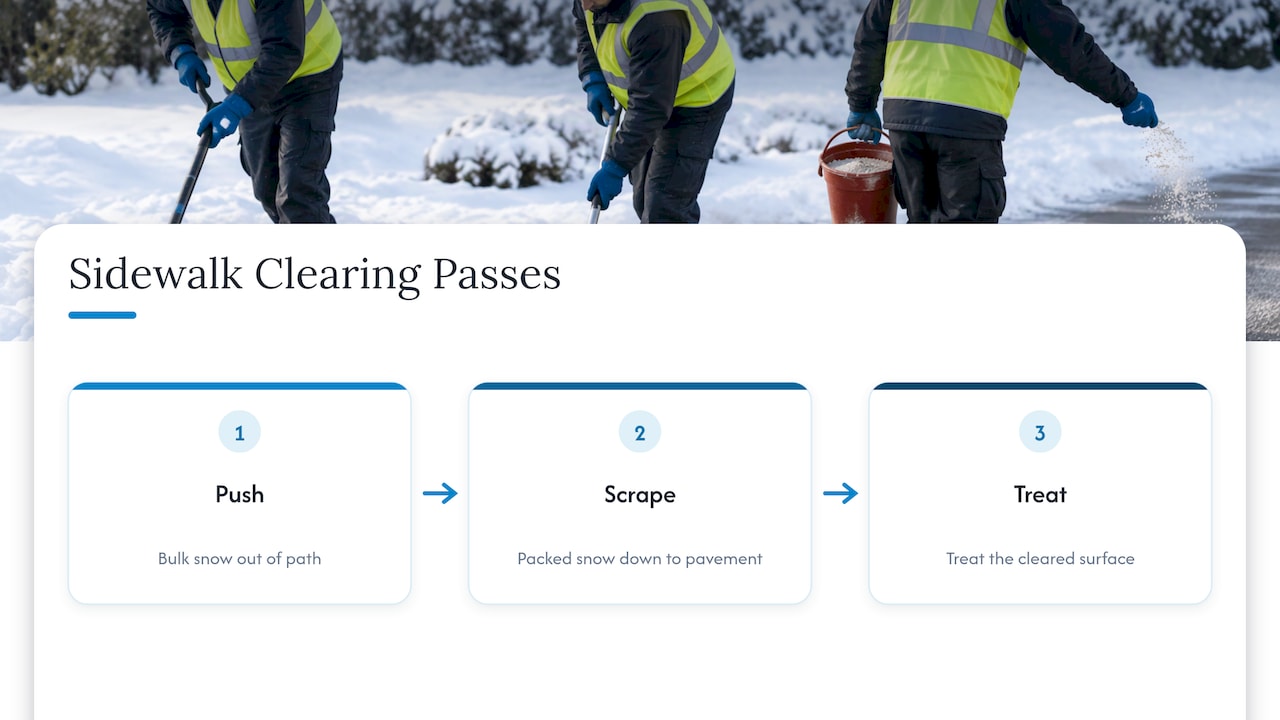
A clean result usually takes three passes. The first pass pushes the bulk of the snow out of the path. The second scrapes down to pavement, which is what removes the packed layer that would otherwise become ice. The third treats the cleared surface. Skipping the scrape and putting melt on top of a snow pack is a common shortcut, and it tends to produce slush that refreezes overnight.
For icy conditions, Boston’s snow-clearing rules call for ice to be removed to bare pavement or made as level as possible, and for treatment with sand, sawdust, or similar material. Colorado properties often combine that mindset with pre-treatment before the storm. We explain how that works in our guide to sidewalk ice control with anti-icing.
Tools and equipment: what each one is for
There is no single piece of equipment that does everything on a sidewalk. Crews pair tools with the surface and the snow depth. The table below reflects common industry practice rather than a rule.
| Tool | Best used for | Watch for |
|---|---|---|
| Push shovel | Light to moderate snow on flat walks, steps, entrances | Needs pushing technique; poor for heavy, wet drifts |
| Lifting shovel | Small piles, corners, clearing around drains | Strain on the back if loads are too large |
| Walk-behind snow blower | Longer walks with moderate depth | Throw direction; do not blow into accessible spaces or roads |
| Compact sidewalk plow or utility vehicle | Long frontage, campuses, retail strips | Turning room, curb cuts, landscape edges |
| Skid steer with pusher or bucket | Piles, large pedestrian plazas, stacking snow | Needs room to work; handover to hand crew for edges |
| Broadcast or walk-behind spreader | Even ice melt or traction coverage | Over-application wastes product and tracks indoors |
| Ice scraper or chipping bar | Bonded ice at doorways and ramps | Surface damage if used carelessly |
For larger properties, hand crews and machines work together. A skid steer might push and pile snow from the main concourse while a hand team follows to finish entrances and ramps. We offer skid steer push and pile services alongside sidewalk clearing for that reason.
When to use ice melt, and when not to over-apply
Ice melt works best on a surface that has already been cleared, because it needs to reach pavement to work. Applying it early, before or at the start of snowfall, helps stop the bond between ice and concrete. Applying too much can damage concrete and landscaping and gets tracked into lobbies. For properties near planting beds, our eco-friendly de-icing guide covers how to protect the site while keeping walks safe.
Crew safety on the walk
Safe crews start before the first shovelful. Per the same manual snow removal guidance, a sidewalk shoveling task begins with inspecting and wearing the required protective equipment and warm winter clothing, using high-visibility gear in low-visibility conditions, and making sure controls are in place before work starts.
In practice, that looks like:
- High-visibility outerwear and traction footwear for pre-dawn and night storms
- Spotters or cones where a crew works near driveways and drive aisles
- Rotation between shoveling and spreading tasks to reduce repetitive strain
- Clear instructions on where machines operate and where pedestrians may pass
Working near customers is the other safety issue. Storms hit during business hours as well as overnight, and a crew that blocks an entrance with equipment without signage creates exactly the fall risk it was hired to prevent.
Denver deadlines your crew has to work within
If your property is in Denver, sidewalk timing is set by the city. According to the city’s Snow & Ice Build-Up Fact Sheet, once snow stops falling, businesses must begin clearing sidewalks immediately and residences must clear by the next day. Inspectors leave a time-stamped notice at unshoveled properties. After a notice, businesses have four hours and residences have 24 hours before the inspector re-checks and a $150 fine can be issued.
Residents can also report problems: if it has been more than 24 hours after a snow event and a sidewalk is still unshoveled, the same fact sheet directs people to call Denver 3-1-1 with the address.
| Property type | Start clearing | After a notice | Possible fine |
|---|---|---|---|
| Business | Immediately after snow stops | 4 hours | $150 |
| Residence | By the next day | 24 hours | $150 |
These rules shape how a crew is scheduled. A business contract that starts clearing “when the crew can get there” is out of step with an immediate-start expectation, so response commitments should be written into the agreement. For a closer look at who is responsible for what, see our guides on Denver property owner snow obligations and business frontage snow rules. Downtown owners can also read the downtown sidewalk shoveling rules.
Coordinating a crew: monitoring, records and accountability
Hiring a crew is half the job. Owners and managers still need to know the work happened and happened well. A business snow and ice guide advises owners to make sure contractors follow the agreement and to keep monitoring protocols and contingency plans in place. It also points to industry best practices that stress documented snow response planning, site plans that mark priority areas and snow relocation zones, training, and inspections during the season.
What to put in the scope
A workable sidewalk scope names:
- Which walks, ramps, curb cuts, and entrances are covered, ideally on a marked site map
- The trigger depth and the response time after snowfall ends
- Where snow can be piled and where it can never go
- Ice treatment: pre-storm, during storm, and post-storm
- What documentation arrives after each visit
The guide’s site awareness checklist also suggests identifying high-risk areas and prioritizing ramps and docks, with complete clearing so meltwater does not run off and refreeze. That means a crew should know the problem spots: the downspout that drains onto a walk, the shaded north entrance, the slope by the loading area.
Records and inspections
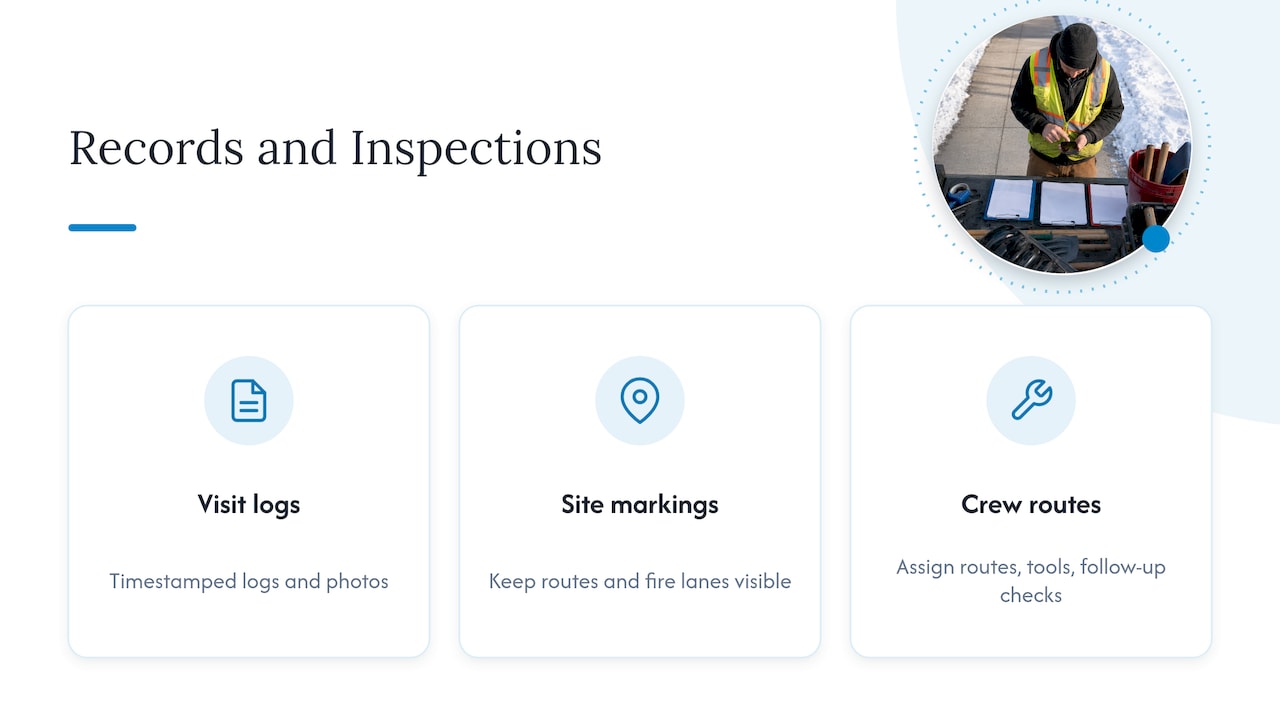
According to a risk guide from an insurer, property owners have a legal responsibility to reduce snow and ice walking hazards, and a failure to control them can be treated as a breach of duty in slip-and-fall contexts. The guide recommends recordkeeping and ongoing monitoring. For many managers, that means timestamped visit logs and photos. Keeping site conditions and pavement markings in order helps too, since pavement marking and parking lot maintenance keeps accessible routes and fire lanes visible once the snow is gone and sweeping resumes.
Crews working across multiple sites also need a way to track who goes where and with what equipment. Scheduling discipline helps, and a work order scheduling process is a useful frame for assigning routes, tools, and follow-up checks.
Accessibility checks
The Department of Justice advises that routes to accessible entrances must be kept clear of snow, leaves, and debris and checked regularly so they are not blocked (Maintaining Accessibility in Museums). One DOJ settlement with a hotel went further, requiring the owner to use best efforts to have staff or a contractor clear the route between designated accessible parking and the accessible entrance within one hour after accumulation begins (Holiday Inn settlement). That is one agreement with one property, not a universal rule, but it shows how quickly accessible routes are expected to be restored.
Perspective: why crew operations decide the outcome
Most of the snow complaints we hear are not about the plow. They are about the last ten feet: the entrance step, the curb ramp, the corner where the berm froze overnight.
That is why we treat sidewalk work as its own operation, not an add-on to the plow route. Our team is dispatched around the clock, and we pair commercial-grade equipment with hand crews so the machine does the bulk and people finish the details. We document our service visits, and our contracts are built around the property, with free estimates and up-front pricing.
Our advice to managers is simple: put the walks, ramps, and response expectations in writing before the first storm. A crew that knows the priority routes can clear them first, and an owner with records can show what was done and when.
Jesse
Hiring a sidewalk crew: what to ask for
Whether you manage a retail strip, an HOA, or an office campus, a few questions separate a reliable crew from a vague promise.
- Is there a defined start time? In Denver, businesses are expected to begin immediately once snow stops, so ask how that is met.
- Who handles ramps and curb cuts? Make sure they are named in the scope.
- What happens when snow cannot stay on site? Ask about stacking areas and hauling. If the site is tight, this snow stacking and relocation guide shows how large volumes are managed.
- What proof of service do you receive? Logs, timestamps, and photos are the minimum.
- How are ice and refreeze handled? Pre-treatment and post-storm checks reduce callbacks.
- Is there 24/7 response? Storms do not follow business hours.
For commercial properties, our commercial de-icing playbook explains how these pieces fit a winter plan. For HOAs and mixed-use sites, our Denver sidewalk clearing and enforcement deadlines page covers the timing side.
Homeowners and small properties
Homeowners do not need a full crew plan, but the same logic applies. The walk from the street to the door, the steps, and the curb ramp if you have one are the parts that matter most. Our homeowner’s guide to choosing residential sidewalk service lays out what to look for.
Get a crew that fits your property
Denver Snow Removal has served the Denver metro area for over 44 years, with residential, commercial, industrial, and HOA clearing, sidewalk de-icing, snow hauling, and seasonal contracts running September through May. Emergency dispatch is available 24/7, and same-day service is available for new and existing clients. Residential driveway and walkway clearing starts from $41.25 per visit, and we provide free estimates for contract work.
Tell us about your walks, ramps, and entrances and we will build the scope around them. Request a free estimate for residential driveway and walkway clearing, or see our commercial snow removal and seasonal contracts.
FAQ
What does a hand crew do that a plow cannot?
A hand crew finishes the places machines cannot safely reach: steps, entrances, ramps, narrow walks, and the edges beside doors and landscaping. Crews use shovels, small blowers, and spreaders to clear to pavement and treat the surface. Plows and skid steers handle the bulk first, and the hand crew handles the detail.
How wide should a cleared sidewalk be?
Massachusetts state guidance says a cleared path should be at least 36 inches wide, or the full sidewalk width if it is narrower. The ADA also describes accessible routes as generally at least 36 inches wide. Check your own city’s rules, since local ordinances can set their own requirements.
How fast do I have to clear my sidewalk in Denver?
Businesses must begin clearing immediately after snow stops falling, and residences must clear by the next day. If an inspector leaves a notice, businesses have four hours and residences have 24 hours before a re-check and a possible $150 fine, according to the city’s fact sheet.
Do sidewalk crews put down ice melt every visit?
Not always. Ice melt goes onto cleared pavement when conditions call for it, and it can be applied before a storm as pre-treatment. Your contract should state when treatment happens and how it is logged.
Sources
- Snow removal and accessibility in Massachusetts, Mass.gov
- Rules on clearing snow, Boston.gov
- Manual Snow Removal Operations
- ADA Guide for Small Towns, ADA.gov
- Snow & Ice Build-Up Fact Sheet, City and County of Denver
- Snow and Ice Removal Guide
- Snow and Ice Maintenance Programs, CNA
- Maintaining Accessibility in Museums, ADA.gov
- Holiday Inn settlement sub-agreement, ADA.gov