

A snow removal contract is a written, legally binding agreement between a property owner or manager and a snow-removal contractor that defines exactly who does what, when, and for how much. At its core, the document locks in four things: the parties responsible, the scope of services (plowing, de-icing, hauling, hand-shoveling), the trigger conditions that put the contractor on your property, and the compensation structure. Without one, you have no guaranteed response time, no clear liability allocation, and no paper trail if something goes wrong.
Here is what a solid snow removal agreement fixes immediately:
- Liability proof. A signed contract with a certificate of insurance (COI) on file is your first line of defense if a visitor slips on an uncleared walk. The New York Attorney General advises homeowners to confirm contractor licensing and proof of liability insurance before signing.
- Guaranteed response. Service-level commitments written into the contract mean the contractor is obligated to show up, not just available.
- Predictable billing. Whether you choose a flat seasonal fee or a per-event model, the contract eliminates surprise invoices mid-storm.
Before you sign anything, verify the COI and confirm the trigger depth and scope of work match your property’s actual needs.
Table of Contents
- What does a snow removal contract need to include?
- Which contract type fits your property?
- How do snow event triggers and response times work?
- How is snow removal priced, and what drives costs up?
- Liability, insurance, and what to verify on a COI
- Sample clauses and a compact contract outline
- How to review, negotiate, and finalize your agreement
- Key Takeaways
- Why the contract language matters more than the price
- Denversnowremovals handles the contract details so you do not have to
- Useful sources
- FAQ
What does a snow removal contract need to include?
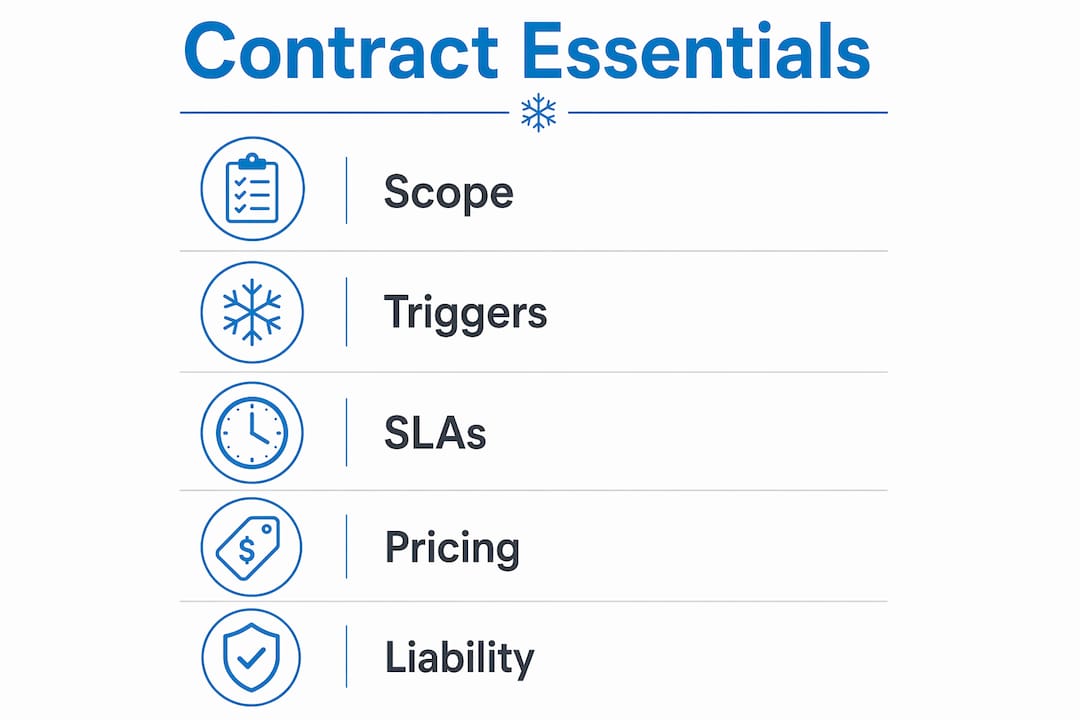
Every reliable snow removal contract covers the same core clauses. Use this checklist to vet a contractor’s draft or build your own.
- Scope of work. Name every service: plowing, salting/de-icing, hand-shoveling, ice remediation, hauling, and roof clearing if applicable. List explicit exclusions too — if the contractor will not clear loading docks or ADA-compliant pathways, that must be stated. A detailed scope attachment prevents the most common disputes.
- Term and renewal. State the start and end dates (typically November 1 through April 15 in most northern U.S. markets), automatic renewal language, and how price adjustments are handled year over year.
- Snow-event trigger. Define the accumulation depth that activates service, the measurement point (curb, center of lot, or a named weather station), and how freezing rain or mixed precipitation is handled.
- Service levels and response times (SLA). Specify priority tiers, when the clock starts (storm start vs. storm end), and a completion benchmark such as “clear to pavement within four hours of storm end.”
- Pricing and invoicing. Identify the pricing model (seasonal flat, per-event, per-inch, time-and-materials), the invoicing schedule, and what triggers overage charges.
- Liability, indemnity, and insurance. List required policy types, minimum coverage limits, and COI language. Include a mutual hold-harmless clause.
- Equipment and materials. State who supplies salt, sand, or other abrasives, who is responsible for equipment damage, and whether fuel surcharges apply.
- Termination and dispute resolution. Define cure periods for nonperformance, termination rights, governing law (name the state), and whether disputes go to mediation or arbitration.
- Site responsibilities. The property owner must mark irrigation heads, clear obstacles from plow paths, identify fire hydrant locations, and designate approved snow-stacking zones. Appending a site-specific stacking map to the contract is best practice and significantly reduces spring damage claims.
- Change orders and extra work. Require written approval before any out-of-scope work is performed and billed.
Pro Tip: Request short sample clause language from any contractor before signing. If they cannot produce it, that is a red flag about their operational maturity.
Sample clause snippets
Scope of work: “Contractor shall plow all designated parking areas, drive lanes, and building entrances to bare pavement following each snow event, as defined in Section 3. Hand-shoveling of all ADA-accessible pathways and building entries is included.”
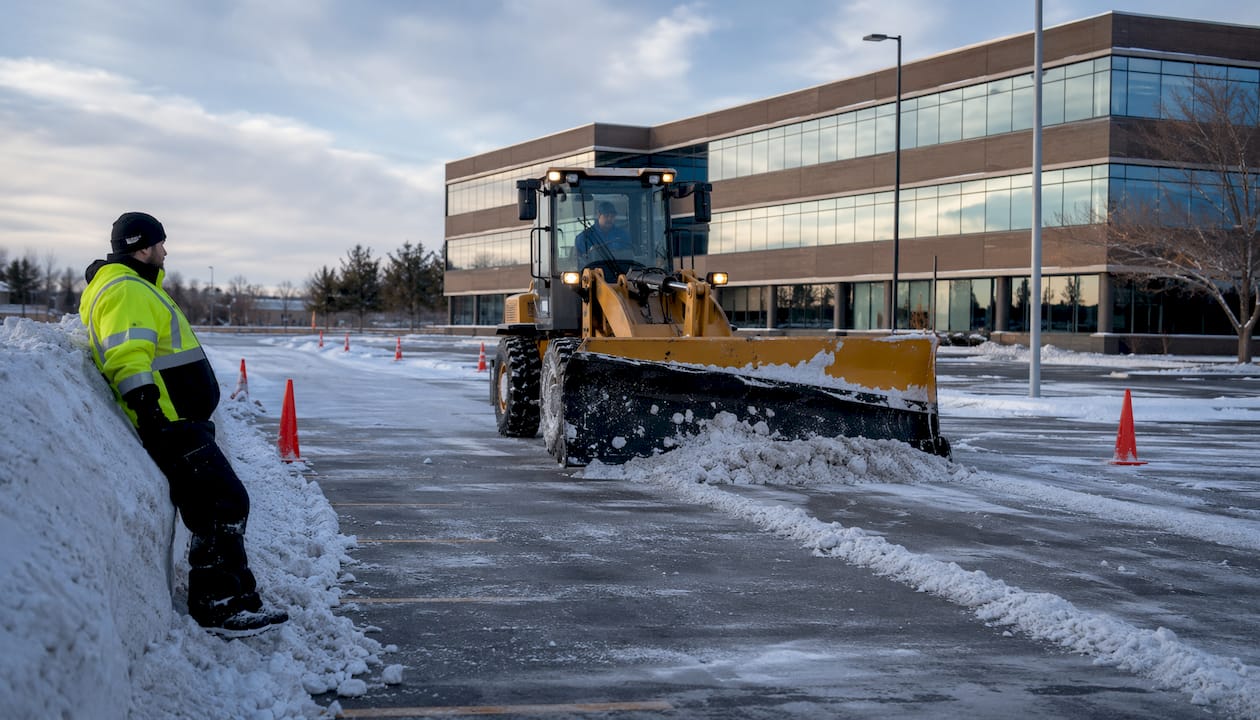
Trigger: “Services shall commence when accumulated snowfall reaches [X] inches as measured at [location/weather station]. Mixed precipitation events producing ice accumulation shall be treated as a snow event regardless of depth.”
SLA/Response: “Contractor shall complete initial clearing of all priority areas within [X] hours of storm end. ‘Storm end’ is defined as the cessation of precipitation for a continuous period of [X] hours.”
Pricing: “Client shall pay a seasonal flat fee of $[amount] for the contract term. Events producing accumulation in excess of [X] inches in a single storm shall be billed at an overage rate of $[amount] per additional inch.”
COI/Insurance: “Contractor shall maintain commercial general liability insurance with limits of not less than $[amount] per occurrence and $[amount] aggregate, naming Client as an additional insured. A current COI shall be provided prior to the first service date.”
Termination: “Either party may terminate this agreement for cause upon [X] days written notice if the breaching party fails to cure the identified deficiency within [X] days of receipt of written notice.”
Which contract type fits your property?
Three main contract structures dominate the U.S. market, and each shifts financial risk differently.

Seasonal flat-fee contracts
You pay one fixed amount for the entire winter regardless of how many storms hit. Contractors price this to cover an average season, so in a heavy-snow year you come out ahead; in a mild year, the contractor does. This model suits commercial properties, HOAs, and multi-family buildings that need budget certainty and guaranteed priority. Seasonal contracts also tend to secure your spot on the contractor’s route before the season starts, which matters enormously during back-to-back storms when crew capacity is stretched thin.
Per-event (per-push) contracts
You pay only when the contractor plows. This works well for single-family homeowners in mild-winter climates or second-home owners who need occasional service. The tradeoff: during a major storm cycle, per-event clients are often lower priority than seasonal accounts. Residential trigger-based plans commonly use 1-inch or 2-inch thresholds, with zero-tolerance options available for homeowners who want clearing at the first sign of accumulation.
Per-inch and tiered pricing
Commercial contracts sometimes price by accumulation band: one rate for 1–3 inches, a higher rate for 3–6 inches, and a premium rate for 6 inches or more. This model rewards transparency but creates more administrative work and can produce large invoices after a major storm.
Time-and-materials (T&M) and hybrid contracts
T&M bills by the hour plus materials (salt, sand, liquid de-icer). It suits unusual properties or one-time emergency events. Hybrid contracts combine a seasonal base fee with per-event overages above a defined threshold, balancing predictability with protection against extraordinary winters.
Pro Tip: For multi-unit residential properties and commercial retail sites with high foot traffic, a seasonal or hybrid contract almost always makes more financial sense than per-push. The priority scheduling alone justifies the upfront cost during a heavy storm season.
How do snow event triggers and response times work?
A snow event is defined by the parties in the contract itself. Most agreements use an accumulation threshold of 2–4 inches as the trigger, though high-traffic commercial properties such as medical buildings and retail centers often specify 1 inch or even zero-tolerance (service at first accumulation).
Key trigger elements to nail down in writing:
- Accumulation depth. Common ranges are 1–4 inches depending on property type and service plan.
- Measurement point. Specify whether depth is measured at the curb, the center of the lot, or a named weather station. Ambiguity here causes billing disputes.
- Mixed precipitation. Freezing rain and sleet may not meet a depth trigger but still require de-icing. State explicitly how ice-only events are handled.
- Anti-icing language. If you want pre-treatment before a storm, that must be written in separately as a distinct service.
| Property Type | Typical Trigger | Response Benchmark |
|---|---|---|
| Single-family residential | 2 inches | Within 4–8 hours of storm end |
| Small retail / restaurant | 1–2 inches | Before business open or within 2–4 hours |
| Medical / high-traffic commercial | 1 inch or zero-tolerance | Continuous during storm, clear by opening |
| Large industrial / campus | 2–3 inches | Phased: priority areas first, full clear within 6 hours |
“Storm end” is a critical definition. Most contracts define it as the cessation of precipitation for a continuous period of one to two hours. Without that definition, a contractor could argue a multi-day storm system is one continuous event, delaying your completion SLA.
How is snow removal priced, and what drives costs up?
Pricing depends on more variables than most property owners expect. The major cost drivers:
- Property size and layout complexity (islands, tight turns, narrow lanes)
- Number of plowable storms in a typical season for your region
- Required hauling or off-site snow disposal
- Salt and abrasive usage (type, application rate, and frequency)
- Parking turnover requirements (retail vs. office vs. industrial)
- ADA pathway and sidewalk clearing
- Distance from the contractor’s base of operations
For context on what these variables produce in practice: seasonal contracts for standard residential driveways in snow-prone areas typically cost several hundred dollars, with per-storm visits billed at moderate rates. Small commercial lots under 10,000 square feet often have seasonal pricing or per-push rates varying widely by region and service specifics. These figures reflect a high-snowfall region; Denver-area pricing will vary based on local storm frequency and property specifics.
Common extra fees to watch for:
- After-hours or emergency storm surcharges
- Fuel surcharges triggered above a defined per-gallon threshold
- Hauling fees when on-site stacking is no longer feasible
- Equipment damage assessments for curb strikes or irrigation damage
For pricing transparency, request line-item invoices that separate labor, materials, and equipment. Ask how accumulation is measured and documented, and whether trip tickets with timestamps are provided. That documentation matters if a billing dispute arises later.
Liability, insurance, and what to verify on a COI
This is where most property owners underinvest their attention. A contractor without adequate insurance effectively transfers their liability to you.
Standard insurance requirements for commercial snow removal contracts include:
- Commercial general liability (CGL): Covers slip-and-fall claims and property damage. Minimum limits for commercial contracts commonly start at $1 million per occurrence and $2 million aggregate, though larger properties often require higher limits.
- Automobile liability: Covers vehicles and equipment operating on your property.
- Workers’ compensation: Required in virtually every U.S. state for contractors with employees.
- Umbrella/excess liability: Larger commercial properties frequently require an umbrella policy on top of the CGL.
The New York Attorney General’s guidance specifically advises confirming that the contractor’s COI covers snow and ice activities, not just general landscaping. Some policies exclude winter services unless specifically endorsed.
Pro Tip: Call the insurance carrier directly to verify the COI is current. Fraudulent or expired certificates are more common than most property owners realize, and a quick phone call takes two minutes.
For liability allocation, include a mutual indemnification clause that holds each party responsible for their own negligence. Address plow strikes and curb damage explicitly: state whether the contractor is liable for documented damage to curbs, landscaping, and irrigation, and require them to report any damage within 24 hours of the service event. Documenting snow removal with timestamped trip tickets and photos is the most practical way to resolve damage disputes quickly.
Sample clauses and a compact contract outline
A complete snow removal agreement for a small commercial property typically runs two to four pages. The structure below shows how the core clauses fit together.
One-page contract outline:
- Parties and property description (legal names, property address, designated service areas)
- Term (start date, end date, renewal conditions)
- Scope of work (services included, services excluded, site map attached as Exhibit A)
- Snow event definition and trigger (depth, measurement point, mixed precipitation)
- Service levels and response times (priority tiers, completion benchmarks, storm-end definition)
- Compensation (pricing model, invoicing schedule, overage triggers, late payment terms)
- Insurance and indemnification (required policies, COI delivery, hold-harmless language)
- Equipment and materials (who supplies what, fuel surcharge terms)
- Site responsibilities (property owner obligations, stacking zones, obstacle marking)
- Termination (cure periods, termination rights, notice requirements)
- Dispute resolution (governing law, mediation/arbitration election)
- Signatures (both parties, date)
Pro Tip: Attach a site map as Exhibit A showing approved stacking zones, irrigation head locations, curb protection stakes, and fire hydrant clearance zones. This single attachment prevents the majority of spring damage disputes.
Free fillable templates are available from resources like eForms and Dochives. Review any template against your state’s contractor licensing requirements before use, and consult an attorney when liability exposure is material.
How to review, negotiate, and finalize your agreement
Walk through these steps before you sign anything.
- Map the scope against your property. Walk the site with the contractor and confirm every service area is named in the contract or on the attached site map. Vague language like “parking lot” is not sufficient for a multi-building campus.
- Confirm trigger and measurement language. Ask the contractor exactly where they measure accumulation and how they document it. If the answer is “we just know,” that is a problem.
- Review SLAs for your operational needs. A retail center that opens at 6 AM needs a different completion benchmark than a warehouse with a 9 AM first shift.
- Inspect the COI. Verify policy type, limits, named-insured status, and expiration date. Call the carrier if anything looks off.
- Confirm licensing. Some states and municipalities require snow removal contractors to hold a specific license or register with a local authority. Check your state’s contractor licensing board.
- Clarify equipment responsibilities. Who supplies salt? Who pays if a plow damages a curb? Get it in writing.
- Request a stacking map. Ask the contractor to mark approved stacking zones on a site plan before the season starts. Stacking maps reduce disputes over parking loss and spring landscaping damage.
Negotiation asks worth making:
- Price-protection window (lock the rate for two seasons)
- Capped overage thresholds (maximum extra charges per storm)
- Service credits for missed SLAs
- Documented trip tickets with timestamps for every service visit
- Priority scheduling confirmation in writing
Red flags to fix before signing:
- Scope described only as “snow removal” with no detail
- Trigger depth undefined or left to contractor discretion
- Open-ended “extra charges as needed” language
- Missing or expired COI
- PO Box as the only contractor contact address
- No dispute-resolution clause
Key Takeaways
A snow removal contract protects your property, your budget, and your liability exposure only when it names specific triggers, services, response times, and insurance requirements in writing.
| Point | Details |
|---|---|
| Verify scope and triggers | Confirm every service area is named and the trigger depth is defined with a measurement point. |
| Confirm insurance and COI | Require a COI naming you as additional insured; verify it covers snow and ice operations specifically. |
| Match pricing model to risk | Seasonal contracts favor budget predictability; per-event suits mild winters or low-traffic properties. |
| Require SLAs in writing | Completion benchmarks and priority tiers must be stated, not assumed, to be enforceable. |
| Denversnowremovals | Provides seasonal plans, 24/7 response, and trip-ticketed documentation for Denver Metro properties. |
Why the contract language matters more than the price
Most property owners spend the most time negotiating the dollar amount and the least time on trigger language and SLAs. That is the wrong priority. A low seasonal rate means nothing if the contractor’s trigger is set at 4 inches and your retail entrance needs clearing at 1 inch. The price is visible; the operational gaps are buried in the clauses.
Seasonal contracts are often misunderstood as a cost-saving product. They are actually a service partnership. When a major storm hits and a contractor has to choose which properties to prioritize, seasonal clients with signed agreements get the equipment first. Per-event clients, especially low-cost on-call arrangements, frequently wait. That gap in service during a 12-inch storm is where slip-and-fall liability is born.
The other underestimated clause is the stacking map. Property owners who skip it spend more on spring landscaping repairs than they saved by leaving it out of the contract. Specify stacking zones, mark irrigation heads, and put it in writing as Exhibit A. A contractor who pushes back on that request is telling you something about how they handle disputes.
Finally, handshake agreements are not agreements. Signed contracts and documented trip tickets are the primary evidence in any dispute over damage or nonperformance. The documentation habit is not bureaucratic overhead; it is the difference between a resolved claim and a protracted one.
Denversnowremovals handles the contract details so you do not have to
Property owners in the Denver Metro area who want guaranteed response, clear scope, and documented service records have a direct option: Denversnowremovals brings over 44 years of operational experience to every agreement, with seasonal plans, emergency response, hauling, and site-specific stacking maps built into the service from day one.
Every service visit is trip-ticketed and timestamped, giving you the liability documentation your insurance carrier and legal counsel expect. The team is available 24/7, and free estimates include a site walkthrough so the scope-of-work attachment reflects your actual property, not a generic template. Whether you manage a single commercial property or a multi-unit residential portfolio, Denversnowremovals tailors the plan to your operational needs and risk profile.
For commercial clients evaluating 24/7 priority response or comparing seasonal pricing structures, the team can walk you through the tradeoffs before you commit. Contact Denversnowremovals at denversnowremovals.com or call 303-591-2089 to request your free estimate and site visit.
Useful sources
Use these resources to verify contractor credentials, review sample language, and check state-specific rules before finalizing any snow removal agreement.
- New York Attorney General — Hiring Snow Removal Contractors: Consumer guidance on verifying licensing, insurance, and reporting price gouging. Applicable as a model checklist even outside New York.
- eForms — Free Snow Removal Contract Template: Fillable PDF and Word templates with standard clause structures for residential and commercial agreements.
- Dochives — Snow Removal Contract Template: Clause checklists and fillable fields covering trigger depths, response times, and insurance minimums.
- LandlordForms: Property management forms and landlord paperwork resources, useful for multi-unit property managers who need standardized contract and notice documentation.
- Denversnowremovals — Scope of Work Guide: Practical guidance on writing a scope-of-work attachment for Denver-area properties.
- Denversnowremovals — Document Snow Removal for Liability Protection: Covers trip tickets, photo documentation, and COI verification practices.
- Bureau of Labor Statistics — Grounds Maintenance Workers: Industry employment and wage data for context on contractor market conditions.
FAQ
What is a snow removal contract?
A snow removal contract is a legally binding written agreement between a property owner or manager and a contractor that defines the scope of services, trigger conditions, response times, pricing, and liability allocation for winter snow and ice management.
What should a snow removal contract include?
At minimum, it should cover scope of work, snow-event trigger depth, service-level benchmarks, pricing model, insurance requirements with a COI, equipment responsibilities, site obligations, and a dispute-resolution clause.
What is a snow event trigger in a contract?
A snow event trigger is the accumulation depth that activates the contractor’s obligation to service the property. Common thresholds range from 1 to 4 inches depending on property type, with high-traffic commercial sites often using 1 inch or zero-tolerance.
What is the difference between a seasonal and a per-push contract?
A seasonal contract charges one flat fee covering all storms during the contract term, while a per-push contract bills per service visit. Seasonal contracts offer budget predictability and typically secure priority scheduling; per-push suits properties in mild-winter areas or owners who want flexibility.
How does Denversnowremovals handle contract documentation?
Denversnowremovals provides trip-ticketed, timestamped service records for every visit, supporting liability protection and giving property owners verifiable documentation if a dispute arises over service performance or property damage.
Recommended
- Common Area Snow Removal: What Property Managers Must Know – Snow Removal Denver 303-591-2089
- Snow Removal Scope of Work: A Denver Property Guide – Snow Removal Denver 303-591-2089
- Document Snow Removal for Liability Protection – Snow Removal Denver 303-591-2089
- Curb-to-Curb Snow Clearing: What Homeowners Must Know – Snow Removal Denver 303-591-2089