

You can terminate a snow removal contract lawfully, but which door you use depends on the clause type in your agreement. If the contractor breached the terms, send written notice citing the exact clause and the specific failures, then wait out the cure period, commonly several days, before the termination takes effect. If your agreement is at-will or up for renewal, the clock runs on notice windows instead, often 30 days before the season restarts.
TL;DR:
- Clear documentation of specific breaches, such as response delays or property damage, is essential to successfully terminate a snow removal contract for cause.
- Use precise language in notices, citing exact clauses and providing time-stamped evidence to support termination decisions effectively.
- Follow the contract’s procedure strictly, including sending written notices via certified mail and allowing the cure period to pass before ending the agreement.
- Vague or subjective performance language makes enforcement difficult, so replace it with measurable metrics like response times and snowfall thresholds.
- Always retain a detailed record of communications, photographs, and third-party data to defend against wrongful termination claims and ensure a smooth exit process.
Table of Contents
- What a Snow Removal Termination Clause Actually Does
- Common Valid Grounds to Terminate a Snow Removal Agreement
- Model Termination Clause Language You Can Adapt
- Step-by-Step Checklist to Terminate Correctly
- Documenting Service Failures So the Termination Holds Up
- What Happens After You Terminate
- What Four Decades of Denver Winters Have Taught Us About Contract Disputes
- Need a Reliable Replacement Contractor Right Now?
- Templates and Documents Worth Keeping on File
- A Few Honest Notes Before You Send That Notice
- Sources
- FAQ
What a Snow Removal Termination Clause Actually Does
A snow removal termination clause spells out when and how either party can end the service before the contract term expires. Most fall into two categories: termination for cause and termination for convenience.
Termination for cause applies when the contractor breaches the agreement. Missed response times, incomplete clearing, or damage to your property all qualify if the contract defines those failures in measurable terms. Termination for convenience, sometimes called an at-will clause, lets either party exit with advance written notice and no breach required. It’s the cleaner exit, but it usually still carries a notice window you can’t skip.
Well-drafted clauses include four working parts:
- Notice requirement — how the terminating party must communicate the decision (written, certified mail, email with confirmation)
- Cure period — how long the contractor has to fix the problem before termination becomes final
- Effective date — when service obligations actually stop
- Scope of termination — whether it ends the whole agreement or just one property or service line
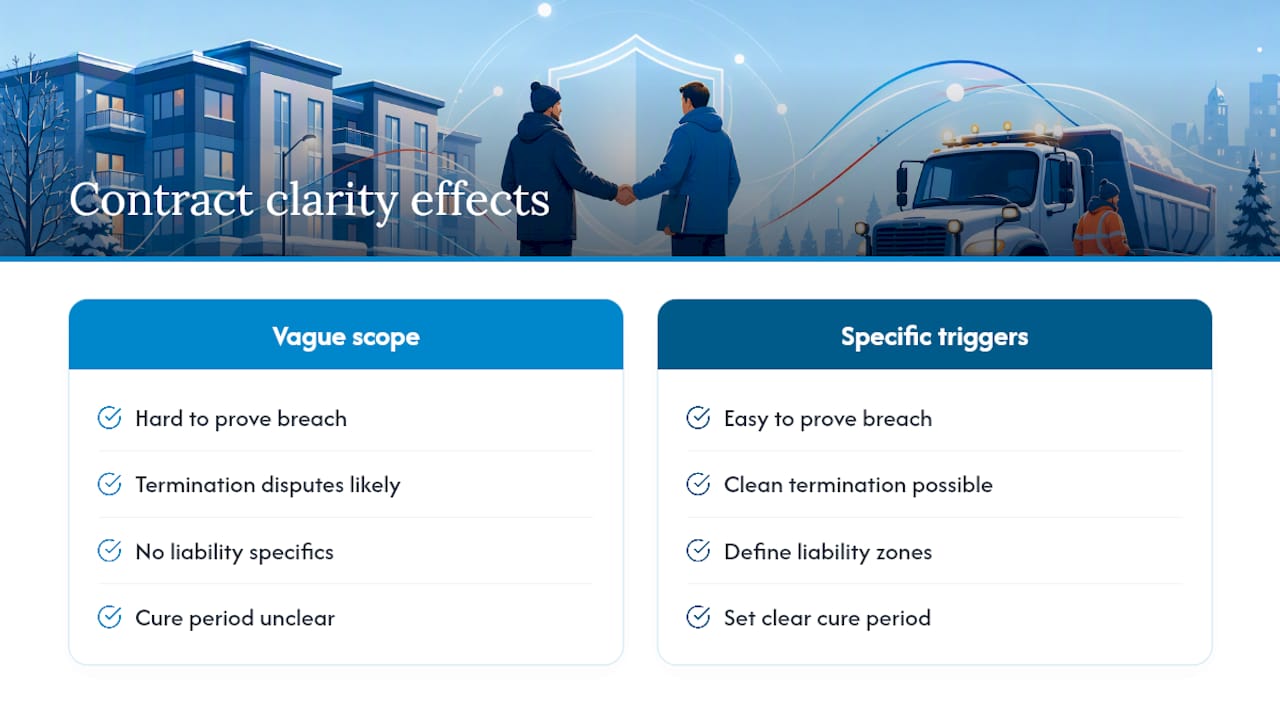
Vague language like “reasonable timeframe” or “as needed” makes a clause almost impossible to enforce. Contracts built around objective metrics, response time in hours, snowfall trigger depth, named priority zones, hold up far better when a dispute lands in front of a judge or arbitrator.
Common Valid Grounds to Terminate a Snow Removal Agreement
Most legitimate terminations trace back to a handful of recurring failures. Here’s what actually holds up when a contract gets challenged:
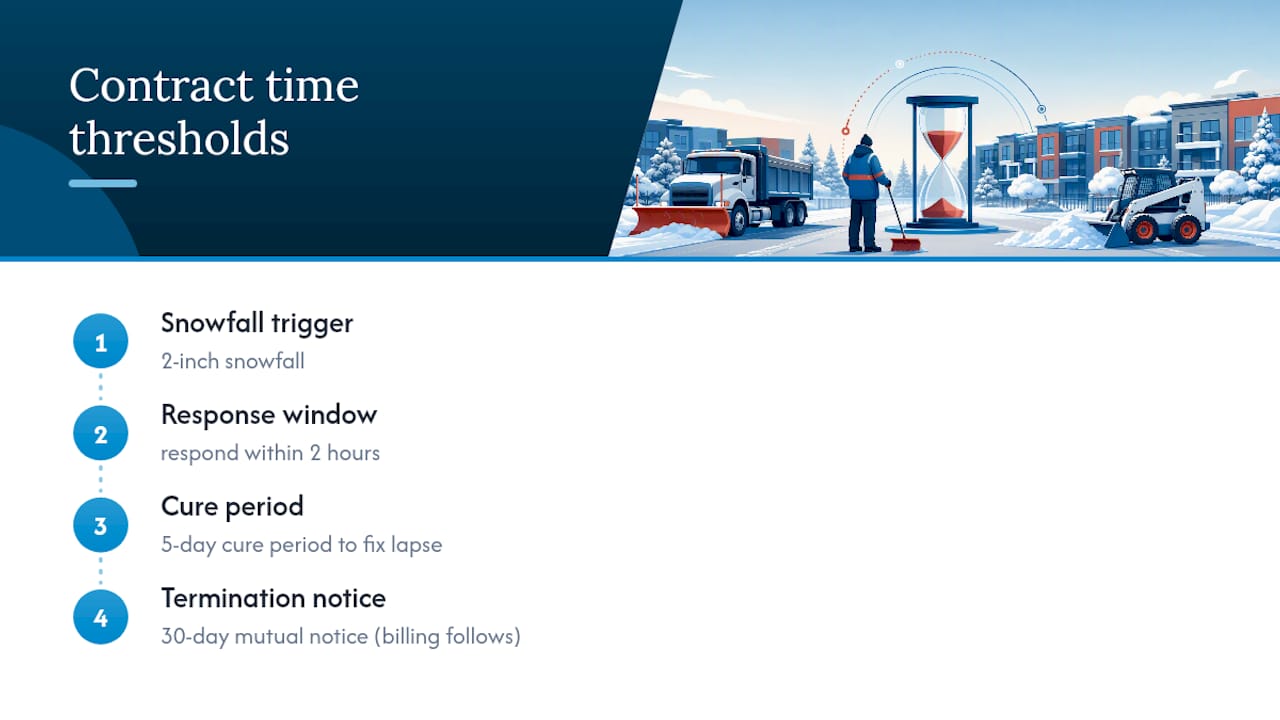
- Repeated missed response times. If your contract specifies a response window, say, plowing begins within two hours of a two-inch trigger, and the contractor blows past it on multiple documented occasions, that’s a for-cause breach.
- Incomplete or unsafe clearing. Ice remediation left undone on walkways, or lots plowed but never salted, violates the service standard if that standard is written into the scope of work.
- Property damage from the crew. Torn-up landscaping, cracked curbs, or damaged irrigation lines caused by equipment operators support a breach claim, especially with photo evidence.
- Billing disputes tied to hidden caps. Some contracts cap the number of pushes or salt applications per month, then bill extra without disclosure. That’s grounds to challenge the agreement, not just the invoice.
- Contractor-initiated termination for non-payment. This cuts both ways. If you’re behind on invoices, most agreements give the contractor the same termination rights you’d exercise against them.
Model Termination Clause Language You Can Adapt
You don’t need a law degree to write enforceable termination language, you need specificity. Below are working templates drawn from common industry structures.
For-cause clause with cure period:
Cure periods of five days show up consistently across service contract templates because they give a contractor real time to fix a lapse without dragging out an unsafe property condition through an entire storm cycle.
At-will / notice-of-termination clause:
Model snow-management contracts frequently build in exactly this 30-day mutual notice window, paired with clear language on what happens to billing once the notice period runs out.
Equipment and final billing clause:
Pro Tip: Swap vague performance language for numbers. “Respond promptly” becomes “respond within 2 hours of a 2-inch snowfall trigger.” That single change turns a subjective complaint into a provable breach.
Step-by-Step Checklist to Terminate Correctly
Terminating without following the clause’s own procedure is how owners end up facing a breach-of-contract counterclaim instead of a clean exit. Work through this sequence in order.
- Reread the clause. Confirm whether you’re working with a for-cause or at-will provision, and note the exact notice period and cure window it requires.
- Gather time-stamped evidence. Photos, service logs, and any third-party corroboration tied directly to the metric your contract defines as the standard.
- Send written notice by certified mail. Cite the specific clause, describe the breach in the contract’s own terms, and keep the delivery receipt.
- Let the cure period run. If the contractor fixes the issue in time, termination doesn’t proceed. If not, the termination becomes effective per the clause’s own timeline.
- Line up replacement service before the notice period ends. A gap in coverage during an active storm is its own liability problem.
- Reconcile the final invoice. Confirm you’re only paying for services actually rendered through the termination date, and keep every document in case the dispute escalates.
Pro Tip: Never terminate verbally, even after a phone call confirming the decision. Follow up in writing the same day, referencing the call and restating the clause you’re invoking.
Documenting Service Failures So the Termination Holds Up
The single biggest reason wrongful-termination claims succeed is thin documentation. Build your evidence file the way you’d build a small-claims case, because that’s often exactly where a contested termination ends up.
- Photograph the specific failure with a visible timestamp and, where possible, a landmark that proves the location and date.
- Log every communication. Note the date, time, and content of calls, texts, and emails, and save copies of every invoice.
- Pull outside corroboration. Local weather station data or municipal snow-emergency declarations back up your timeline if the contractor disputes when a storm actually hit.
- Tie every piece of evidence back to the contract’s own metric. A photo of unsalted ice means little unless the contract specifies salting as part of the standard.
Consistent documentation practices, laid out in detail in Denversnowremovals’ guide to liability protection, give owners a paper trail that holds up whether the dispute stays informal or goes to arbitration.
What Happens After You Terminate
Terminating the contract doesn’t end the relationship instantly. Expect some friction, and plan for it in advance.
- Final billing disputes. Contractors sometimes invoice for the full remaining term. Contest this in writing, citing the clause language that limits recovery to services actually performed.
- Equipment left on-site. Require immediate removal in your termination notice, ideally within 48 hours, to avoid delaying your replacement provider.
- Indemnity exposure. Some agreements try to shift slip-and-fall liability onto the property owner through broad indemnity language. Push back on any clause that isn’t tied to the contractor’s own performance failures.
- Automatic renewal traps. If you’re mid-dispute when the renewal notice deadline hits, send your non-renewal notice anyway, even if termination for cause is still pending.
Ice and snow-related occupational injuries tracked by federal labor data underscore why a gap in coverage during a termination dispute isn’t just inconvenient, it’s a real safety exposure for anyone walking your property.
What Four Decades of Denver Winters Have Taught Us About Contract Disputes
A snow removal company with decades of experience has observed how these disputes actually play out on the ground, not just on paper. The pattern repeats: owners with vague scope-of-work language struggle to prove breach, while owners with specific trigger depths and response windows terminate cleanly and move on.
Commercial properties need tighter language around liability zones, loading docks, ADA-compliant paths, since foot traffic volume raises the stakes. Residential contracts can run simpler, but still need a clear cure period. For agreements above a few thousand dollars a season, loop in an attorney before signing. For an immediate template to adapt, Denversnowremovals’ sample clause library covers both scenarios.
Need a Reliable Replacement Contractor Right Now?
If you’re mid-termination and staring down an open storm window with no coverage, Denversnowremovals gets you back to a cleared lot faster than most owners expect, often the same day you call. Unlike starting the vetting process over from scratch, working with an experienced team offering 24/7 emergency response and equipped resources already staged across the metro area can help you get back to a cleared lot faster.
Beyond emergency plowing, seasonal contracts, sidewalk de-icing, and snow hauling services can help manage snow for properties with limited space for piling. If you’re not sure whether your current agreement even qualifies for termination, a quick site assessment can clarify what’s enforceable before you send anything in writing. For contract disputes involving significant dollar amounts, still get a lawyer’s eyes on the language first. When you’re ready to line up dependable coverage, request a free estimate for snow plowing in Denver and get a plan in place before the next storm hits.
Templates and Documents Worth Keeping on File
A few resources are worth bookmarking any time you’re drafting or enforcing a termination clause.
- The model contract for snow and ice management shows how 30-day mutual notice and vacate-the-property language reads in practice.
- The comprehensive snow removal agreement template covers scope, payment, and default provisions in one document.
- The snow removal service contract template demonstrates selectable at-will versus fixed-term structures.
- For a cross-industry comparison of how maintenance contracts handle termination, Mystic Valley Services’ guide to plumbing maintenance contracts is a useful reference point outside the snow industry.
A Few Honest Notes Before You Send That Notice
The mistake I see most often isn’t a bad clause, it’s an owner who terminates on frustration alone without matching the paper trail to the contract’s own language. A contractor who missed one storm isn’t automatically in breach; a contractor who missed the same trigger depth three times, documented with timestamps, is.
Before you act: reread your clause, confirm the cure period, gather your photos and logs, and send written notice by certified mail. Do those four things in order, and you’ll be in a defensible position no matter how the contractor responds.
— Jesse
Sources
- Termination for poor performance clause — Law Insider
- Model contract for snow and ice management — Nine Mile Creek
- Comprehensive snow removal agreement — US Legal Forms
- How to write a snow removal contract — Housecall Pro
FAQ
Can you provide an example of a termination clause?
A common for-cause clause reads: “Either party may terminate this Agreement for material breach upon written notice specifying the nature of the breach, with a five-day cure period before termination takes effect.” Full sample language appears in the drafting section above.
How does a snow removal contract work?
It defines scope of service, response triggers (like plowing after a two-inch snowfall), payment terms, and termination rights for both the property owner and the contractor. Most agreements also include automatic renewal language unless canceled within a set notice window.
Are landlords legally responsible for snow removal?
Responsibility depends on local ordinances and the lease terms, but landlords who contract for snow removal remain liable if the contractor’s failure creates an unsafe condition and the landlord didn’t act on documented notice of the problem.
What is a valid reason to terminate a contract?
Repeated missed response times, incomplete or unsafe clearing, contractor-caused property damage, and undisclosed billing practices all count as valid grounds when tied to specific, documented breaches of the contract’s own terms.