
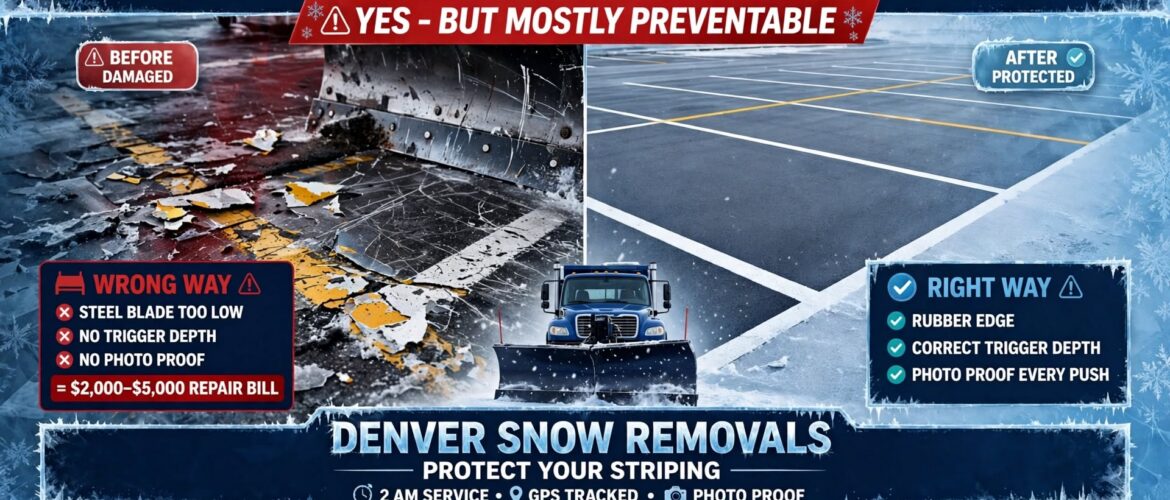
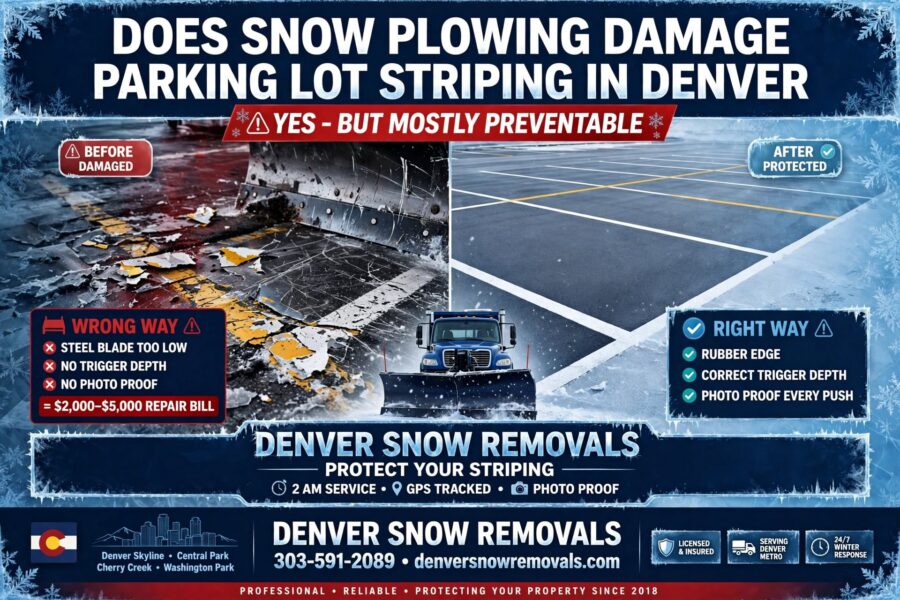
Yes – Plows can scrape striping. Rubber edge + correct depth + photo proof prevents it.
Snow plowing striping damage in Denver is real – plow blades can scrape, peel, and lift parking lot striping, with a hidden repair bill of $2,000-$5,000 on top of the plowing invoice. The damage is mostly preventable with the right trigger depth, blade setup, and photo proof on every push. Property managers and HOA managers in Central Park, Cherry Creek, and Washington Park should ask about all three before signing a 2026 contract. Snow plowing striping damage is preventable with the right setup.
Table of Contents
- What does plow damage to parking lot striping actually look like?
- How much does hidden striping damage really cost a Denver HOA in 2026?
- Why does blade depth and trigger depth decide whether your stripes survive?
- How do you document plow damage so it doesn’t become your HOA’s problem?
- What does Denver’s sidewalk law have to do with striping and lot damage?
- Which Denver neighborhoods see the worst striping damage and why?
- How do you pick a Denver snow removal contract that protects your striping in 2026?
- Key Takeaways
- References
What does plow damage to parking lot striping actually look like?
This snow plowing striping damage guide breaks down real prevention, not guesswork. . Property managers in Denver see the same failure modes after every hard winter. Scraped paint is the most common: the stripe loses its top layer and looks thin or patchy. Peeled edges come next, where the blade catches a raised lip of paint and starts lifting it in strips. We check for snow plowing striping damage on every walkthrough.
Gouged asphalt at the stripe line is the worst version. A steel blade riding too low digs into the pavement right where the paint sits. Faded stall markings that fail an HOA walkthrough often follow, especially in drive lanes and entrance aprons. The biggest cause of snow plowing striping damage is a steel blade set too low. A rubber edge stops most snow plowing striping damage before it starts. Photo proof helps prove there was no snow plowing striping damage on that push. Property managers in Denver ask us about snow plowing striping damage every winter.
Striping takes the hit first because it sits at the surface. Every raised edge and crack becomes a catch point for a blade that is set too low or angled wrong. According to denversnowremovals.com, a 2-inch trigger depth means more pushes than a 4-inch trigger, so the blade passes over the same paint more often during a Denver winter. Correct trigger depth is the #1 fix for snow plowing striping damage.
Damage shows up in the same spots every season. Drive lanes, fire lanes, ADA stalls, and entrance aprons are where trucks turn and angle the blade hardest. The real cost is not just re-striping. It is downtime plus liability exposure if ADA and fire lane markings become unreadable, according to the MCA snow removal guidance for Denver neighborhoods. We train every driver to avoid snow plowing striping damage on every lot.
How much does hidden striping damage really cost a Denver HOA in 2026?
Re-striping a commercial lot is a separate line item that most Denver HOA budgets never plan for. It lands on top of a per-push bill that already runs $250 to $850 per push for commercial parking lot snow removal in Denver, according to denversnowremovals.com. If you already have snow plowing striping damage, we can document it and fix the setup.
The math gets ugly fast in a heavy winter. A season with 12 to 15 push events at $500 per push totals $6,000 to $7,500 for a commercial lot. A striping repair in that same season pushes the true cost well past what the board approved. Get a snow plowing striping damage quote that includes photo proof and rubber edge – call 303-591-2089.
A seasonal contract for that same lot might run $4,000 to $5,000, which leaves a gap of about $2,000 compared with per-push pricing. A surprise striping bill erases that gap quickly. The board thinks it saved money on the contract and then writes a separate check for paint in April. If you compare snow plowing striping damage quotes, check if rubber edge is included.
There is a second hidden cost that costs more than paint. Unreadable ADA and fire lane markings can trigger compliance problems. A faded fire lane or an ADA stall that cannot be read from a car is a liability issue, not just a cosmetic one.
Why does blade depth and trigger depth decide whether your stripes survive?
Blade depth and trigger depth decide whether your stripes survive because both control how often and how hard steel meets paint. A 2-inch trigger means more pushes than a 4-inch trigger, according to denversnowremovals.com. More pushes means more blade passes over the same striping, so setup and operator skill matter more, not less.
The blade-side basics are simple. Proper shoe and skid adjustment keeps the cutting edge off the pavement surface. Rubber or poly edge options help on sensitive lots where paint is older or already lifting. Operators who lift and angle through transitions do less damage than operators who drag the blade straight through.
Denver’s freeze-thaw cycle makes this worse. Water gets under the paint at cracks, freezes, and lifts the stripe. Then a low blade catches that lifted edge and peels it clean in one pass. The damage looks sudden, but the conditions built up over weeks.
The cheapest bid usually skips this setup. A low blade moves snow faster and costs less to run. The striping bill shows up in April, and by then the plow invoice is already paid.
How do you document plow damage so it doesn’t become your HOA’s problem?
Photo proof on every push with GPS time-stamped images is the difference between “your plow tore up our lot” and a clear record of pre-existing striping wear. Without dated images, every scrape and peel becomes a negotiation.
denversnowremovals.com runs W-2 crews, GPS tracked trucks, and photo proof on every push. Property managers and HOA managers get a dated record for every visit, which means a damage claim can be checked against what the lot actually looked like before and after each push.
De-icing and salting are included in the push price at denversnowremovals.com, not a separate line item. That removes a second argument about whether ice damage was caused by the plow or by a skipped salt application.
denversnowremovals.com carries $2 million in insurance and runs backup trucks. When a damage claim actually gets filed, the record and the coverage are both in place. For snow plowing striping damage, the blade setup is everything – rubber edge and correct trigger depth protect your lines.
What does Denver’s sidewalk law have to do with striping and lot damage?
Denver’s 24-hour sidewalk law requires snow to be addressed within 24 hours of the end of the event under normal circumstances, according to denversnowremovals.com. That deadline creates rushed late pushes, and rushed pushes are where blade damage happens. If you compare snow plowing striping damage quotes, ask if they do photo proof on every push.
Neighborhood sidewalks are the adjacent property owner’s or sub-association’s responsibility, according to the MCA snow removal guidance. Neighborhood streets are not plowed unless a major snow event is declared. That means lots and walks take all the pressure during routine storms.
During major events of 12 or more inches, equipment runs continuously, according to the MCA. That is when blade discipline and photo proof matter most. Crews are tired, lots are full, and the pressure to clear fast is highest. Most snow plowing striping damage we prevent in Central Park, Cherry Creek, and Washington Park is from steel blades set too low.
Vehicles left in alleys during snow events may be towed, according to the MCA. That changes how crews route around tight lots in Capitol Hill, LoDo, and Baker, where a blocked alley forces more turning and more blade contact with paint.
Which Denver neighborhoods see the worst striping damage and why?
Tight-lot neighborhoods see the worst striping damage. Capitol Hill, LoDo, Baker, and Cherry Creek have angled parking, alleys, and constant turning. Every turn works the blade harder against paint, and every alley approach forces a lift or an angle change.
Highlands, Sloan’s Lake, Washington Park, and Central Park have HOA-managed lots and shared drive aisles. Boards notice striping wear fast in those neighborhoods because the lots are smaller and the paint is more visible. A single peeled stripe in a shared drive aisle becomes a board meeting topic.
Older asphalt in established Denver neighborhoods holds paint differently than newer lots. The surface has more cracks and patches, which means the paint lifts unevenly. A blade that does fine on a new lot in Central Park can peel paint on an older lot in Washington Park.
This is a Denver-only problem set. Freeze-thaw cycles, altitude sun, and dense parking all stack up. The sun breaks down paint, the freeze-thaw lifts it, and the plow finishes the job.
How do you pick a Denver snow removal contract that protects your striping in 2026?
Ask three questions before signing any Denver snow removal contract in 2026: what is the trigger depth, is de-icing included, and do I get photo proof on every push. The answers tell you whether the operator is set up to protect striping or just move snow.
Per-push versus seasonal pricing needs to match the service level. A 2-inch trigger means more pushes than a 4-inch trigger, according to denversnowremovals.com. Seasonal pricing at $400 to $900 for residential and roughly $4,000 to $5,000 for a commercial lot only works if the trigger and blade setup are right.
Residential driveway snow removal in Denver runs $65 to $150 per push, and sidewalk removal runs $30 to $50 per push, according to denversnowremovals.com. Homeowners in Cherry Creek and Washington Park can budget the same way property managers do, with the same questions about trigger depth and photo proof.
W-2 crews and backup trucks beat 1099 subs when a storm hits and every lot in Denver needs service the same night. A crew that knows the lot and has a dated photo record for every push is the one that protects striping through a full winter.
Key Takeaways
- Plow blades can scrape, peel, and gouge parking lot striping, and the re-striping bill is a separate cost most Denver HOA budgets never plan for.
- Commercial parking lot snow removal in Denver runs $250 to $850 per push, and a heavy winter of 12 to 15 pushes at $500 each totals $6,000 to $7,500.
- A seasonal contract for that same commercial lot might run $4,000 to $5,000, leaving a gap of about $2,000 that a surprise striping repair can wipe out.
- A 2-inch trigger depth means more pushes than a 4-inch trigger, so blade setup and operator skill matter more on sensitive lots.
- Denver’s 24-hour sidewalk law requires snow to be addressed within 24 hours of the end of the event under normal circumstances.
- Photo proof on every push with GPS time-stamped images is the record that separates pre-existing striping wear from plow damage.
- Residential driveway snow removal in Denver runs $65 to $150 per push and sidewalk removal runs $30 to $50 per push, with seasonal contracts at $400 to $900. For an exact snow plowing striping damage quote that protects your striping, call Denver Snow Removals at 303-591-2089. For an exact snow plowing striping damage quote that protects your striping, call 303-591-2089.