A cleared parking lot won’t help emergency crews if a snowbank hides the hydrant or narrows the route in. In Denver, snow clearing for fire hydrants and emergency access needs to be part of the site plan, not an afterthought to plowing. Snow piles and drifting can quickly change which areas are clear and approachable.
Commercial property teams need a practical way to prioritize hydrants, fire lanes, building entrances, and emergency routes as a storm unfolds. Plan these areas before snowfall, tell crews where snow can be stored, and schedule a visual review after plowing. This guide explains how to keep hydrants visible, routes usable, and access priorities in view as conditions change.
Snow Removal Denver provides commercial snow removal across Denver County and the surrounding Denver Metro area. Dispatch is staffed 24/7, with crews operating around the clock during snow events and on-call personnel 7 days and nights. The company is fully insured. Each visit is documented with photos, and commercial ice melt is applied to sidewalks and entries.
Key Takeaways
- Plan snow clearing for fire hydrants and emergency access alongside parking areas, not after plowing is complete.
- Include hydrants, marked fire lanes, entrances, and the routes connecting them in each site walkthrough.
- Use a clear priority sequence during storms: identify access points, clear routes, place snow safely, then reassess as conditions change.
- Watch for snowbanks that hide hydrants or narrow fire lanes, and recheck access after plowing or renewed snowfall.
- Denver Snow Removals serves commercial properties across Denver County and the surrounding Denver Metro area, with 24/7 dispatch and crews operating around the clock during snow events.
Why clear fire hydrants and emergency access during Denver snow events?
A plowed commercial lot can still present an access problem if a snowbank hides a hydrant or blocks the route leading to it. Emergency access depends on crews being able to locate hydrants and move along usable routes to reach them, building approaches, and entrances. These areas work together: a clear lane is of limited use if the hydrant or the final approach is buried.
Hydrant access means keeping a fire hydrant visible and reachable, with a clear approach for emergency crews. A hydrant is a connection used by firefighters as part of their work. The general purpose and design of a Fire Hydrant help explain why snow around it matters. Snow clearing for fire hydrants and emergency access should be considered alongside parking and traffic circulation, not treated as a final cleanup task.
How snow can obstruct hydrants and emergency routes
Falling snow can gradually cover a hydrant, while plowing can push heavier snow into a bank that conceals it. Drifting may add to the obstruction after a pass is complete. On a warehouse lot, a pile beside a service drive could make a hydrant harder to spot or approach. At an office or retail property, snow stacked near a marked fire lane or entrance can narrow the route crews need to use.
The risk is not limited to the hydrant itself. A site may have a visible hydrant but a blocked connecting route, or a clear fire lane that ends at an obstructed building approach. Review the entire path, from the property entrance along the route emergency vehicles may use, to the hydrant and relevant building access points. Pay particular attention to snow stored near corners, loading areas, and entrances, where piles can affect visibility and movement.
Why Denver-specific guidance matters
Clearance dimensions and local requirements can vary by jurisdiction, so a measurement from another municipality should not be treated as Denver’s rule. Use current Denver requirements when setting a site standard. Do not rely on a clearance distance unless it applies to your property and location.
This local detail matters on commercial properties with multiple hydrants, marked lanes, and several building entrances. Identify these locations in advance and include them in the site plan shared with the people coordinating snow work. Plan where plowed snow will go so clearing one area does not create a new obstruction beside another access point.
- Identify hydrants and marked fire lanes before snowfall.
- Include building approaches and entrances in the access plan.
- Review snow placement so piles do not conceal hydrants or narrow routes.
- Reassess access after plowing, drifting, or renewed snowfall.
This site-wide view helps teams spot gaps that a parking-lot-only pass can miss. Keeping access points visible and routes usable supports a more deliberate response as snow conditions change.
What needs clearing around hydrants, fire lanes, and building access?
A thorough commercial snow walkthrough looks beyond open parking stalls. Parking areas matter, but they do not show whether crews can reach a hydrant, follow a marked fire lane, or approach a building entrance. Map these access points before plowing begins, then review them again after snow has been moved. The goal is to keep the whole route visible and usable, rather than clear one area while snow piles obstruct another.
Use the property layout to identify hydrants, designated lanes, entrances, and the paths that connect them. A warehouse may have a hydrant near a loading area and a long drive to the building. An office or retail site may have several entrances and lanes that cross the parking lot. Include every relevant access point in the plan, even if it sits outside the main traffic flow.
Hydrant visibility and working space
Keep each hydrant visible and free of surrounding snow and ice so crews can identify it and approach it. Do not push plowed snow against a hydrant or leave a pile that hides it from view. Check the route to the hydrant as well: a clear hydrant can still be difficult to reach if a snowbank blocks the approach. Use current Denver guidance for any required clearance distance.
Fire lanes, entrances, and connecting routes
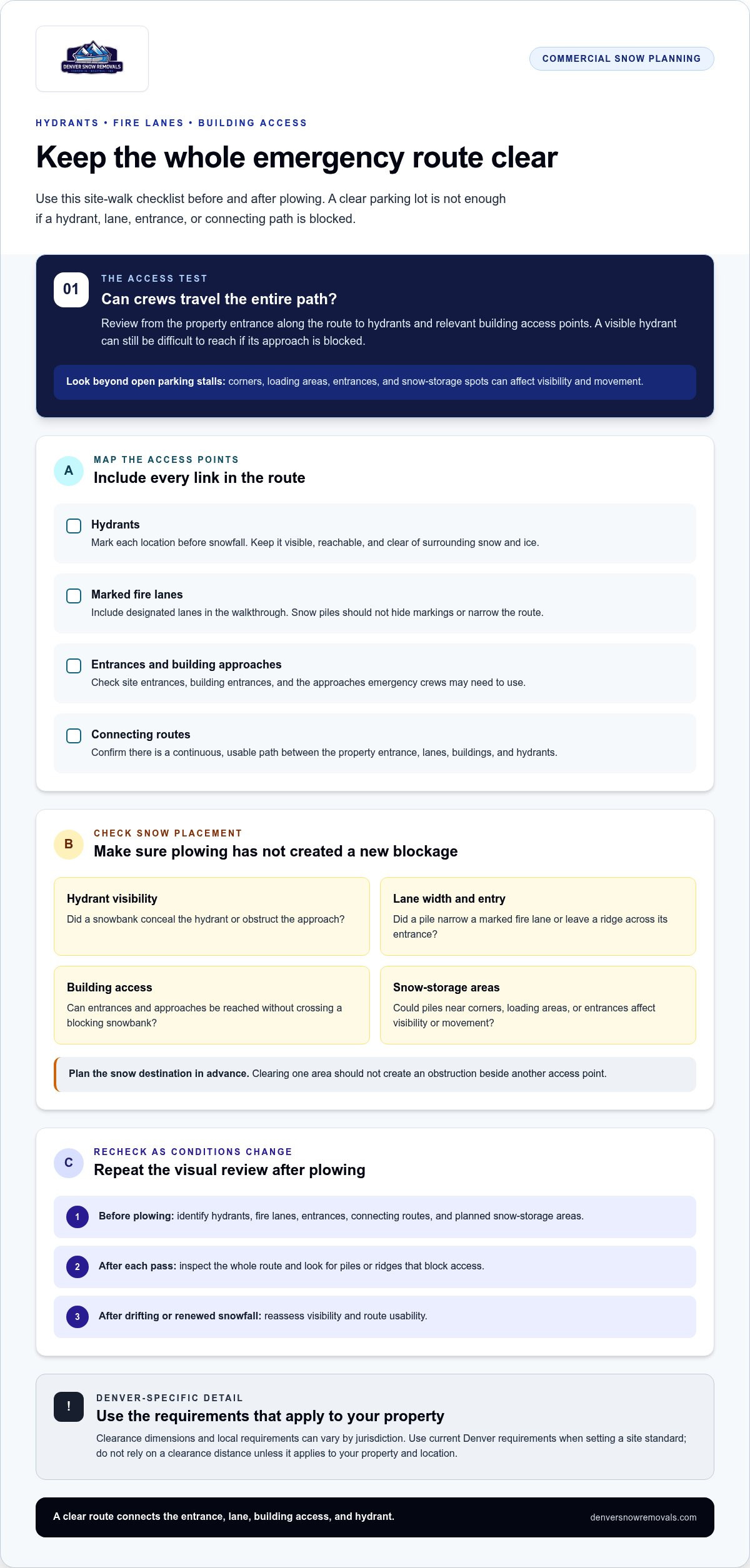
Include marked fire lanes, site entrances, building approaches, and connecting routes in the same review. Snow placement should not narrow or block designated access areas. For example, clearing a lane but leaving a ridge across its entrance can undermine the work. A post-plow visual check helps reveal these gaps and shows whether another pass or a change in snow placement is needed.
Use this checklist before and after plowing:
- Hydrants: Can each one be seen, and is snow or ice obstructing the area around it or the approach?
- Fire lanes: Are marked lanes visible and free of snow piles that narrow the route?
- Entrances: Can site and building entrances be reached without crossing a blocking snowbank?
- Connecting routes: Is there a continuous, usable path between the property entrance, lanes, buildings, and hydrants?
- Snow placement: Did the latest plowing pass leave piles that obstruct any of these areas?
Repeat the review after each plowing pass, especially if snow has been moved near an access point. A lot can look clear from the main drive while a hydrant or connecting route remains hidden from view. For commercial properties in Denver County and the surrounding Denver Metro area, commercial snow plowing can be coordinated with a site plan that accounts for emergency access as well as parking.
How should commercial properties prioritize snow clearing during a storm?
A commercial snow plan works best when it gives crews a clear order of work, not just a list of areas to plow. Parking may be a major part of the job, but snow clearing for fire hydrants and emergency access also depends on keeping priority routes open as conditions change. A simple sequence helps property teams coordinate decisions and catch situations where plowing has shifted snow into an access area.
Set site priorities before snowfall
Before a storm, mark hydrants, fire lanes, entrances, and the routes connecting them on a property map. Note where plowed snow could collect near those points, such as lot edges, loading areas, or routes to buildings. Share these priorities with the people coordinating site operations and include them in the property’s existing snow-management plan.
Identify access priorities, clear the routes, place snow away from them, then reassess after conditions or plowing change. Use this sequence to guide decisions throughout the event:
- Identify priority areas. Use the site map to locate hydrants, marked fire lanes, entrances, and connecting routes. Include the full path across the property, rather than focusing only on areas nearest the buildings.
- Clear access first. Keep the identified routes and approaches usable as snow is removed from the site. Coordinate the work so clearing a parking area does not leave a pile across a lane or route that was already opened.
- Place snow with access in mind. Direct piles to planned storage areas that do not block hydrants, entrances, fire lanes, or connecting routes. If a usual storage spot is filling up, consider how the next plowing pass could affect nearby access.
- Reassess the result. Review the site after clearing and look for newly concealed hydrants, narrowed routes, or blocked approaches. Repeat the review if more snow or another plowing pass changes the layout.
Recheck access as conditions change
A route that was clear earlier may not stay that way. Renewed snowfall, drifting, or a later plowing pass can cover a hydrant or push snow into an entrance. Recheck visibility and access after clearing and significant new accumulation. Include sidewalks and building entries in the broader snow and ice review. Denver Snow Removals applies commercial ice melt to sidewalks and entries during its visits.
Consistent review also helps property teams keep snow work aligned across parking areas and building access. For a broader look at commercial planning, the Denver commercial snow removal guide covers how plowing fits into keeping a business accessible during winter weather.
What common snow-clearing mistakes can block emergency access?
A parking lot can look cleared while emergency access remains obstructed. The difference is continuity: hydrants, marked fire lanes, entrances, and the routes connecting them all need to remain visible and usable. Snow work focused only on open driving or parking space can leave gaps that are easy to miss from the middle of the lot.
Snow placement that hides or narrows access
Pushing snow toward a hydrant can conceal it or leave a bank between the hydrant and the route crews would use to approach it. A similar problem occurs when a plow clears the main lot but stacks snow along a marked lane. The parking stalls may be open, yet the lane is narrower or its entrance is blocked. Plan snow storage so piles do not cover hydrants or encroach on designated access areas, and use clearance requirements that apply in Denver.
Look beyond the first obstruction. A pile beside an entrance can limit the route into a lot, while a ridge across a connecting drive can interrupt access between a fire lane and a building. As snow is moved, review the result from the route itself, not just from where the plowing equipment began. This makes it easier to spot a clear-looking lot that still has a blocked approach.
Treating one clearing pass as the final check
One pass does not account for everything a changing storm can leave behind. Continued snowfall or drifting may cover a previously visible hydrant, and another plowing pass can push snow into a lane that was open earlier. Build a follow-up visual review into the site routine. Check hydrants, routes, marked lanes, sidewalks, and entrances again after clearing or renewed accumulation.
Keep the review practical. Walk or view the access routes from the property entrance toward key buildings and hydrants. Note what changed, then make sure the next snow-clearing pass does not recreate the obstruction. For ice concerns on sidewalks and entries, the Denver ice management guide explains how ice management fits into broader winter property care.
Denver Snow Removals documents each visit with photos and applies commercial ice melt to sidewalks and entries. The company’s no slip-and-fall liability guarantee includes photo documentation of each visit and commercial ice melt application to sidewalks and entries. These steps give property teams a record to review and help identify areas that need another look as conditions change. For commercial snow plowing in Denver County and the surrounding Denver Metro area, coordinate your snow-clearing plan with Denver Snow Removals.
How Denver Snow Removals supports commercial emergency access
Commercial snow plowing works best as part of a site access plan. Parking areas matter, but hydrants, fire lanes, building approaches, entrances, and connecting routes also need attention as snow is cleared. Denver Snow Removals provides commercial snow removal across Denver County and the surrounding Denver Metro area, helping property teams include these priorities in their snow plan.
Dispatch is staffed 24/7, crews operate around the clock during snow events, and on-call personnel are available 7 days and nights. This ongoing response supports sites when snowfall or drifting changes conditions after an initial pass. Each visit is documented with photos, and commercial ice melt is applied to sidewalks and entries. Denver Snow Removals is fully insured and provides a no slip-and-fall liability guarantee.
Commercial snow response across the Denver Metro area
Denver Snow Removals serves commercial lots, industrial parks, warehouses, office campuses, retail properties, and HOA communities. Its equipment includes newer Chevrolet 2500HD trucks with commercial-grade Boss plows, along with heavy equipment for commercial snow work. Site priorities can be built into the plan alongside parking areas, so plowing decisions account for more than open pavement.
For example, a retail property may need accessible entrances and routes between the lot and its buildings, while an industrial site may need access lanes considered alongside loading and circulation areas. Snow clearing for fire hydrants and emergency access is most useful when those points are identified before the storm and reviewed as plowing and snowfall alter the site.
A clear plan gives property teams and snow crews a shared understanding of which areas need attention. It can identify where piles should be placed to avoid obscuring hydrants or narrowing marked routes, and which sidewalks and entries need ice management. A visual review after a visit can help the team identify changes that may require further attention.
Request a commercial site estimate
Denver Snow Removals offers free, on-site estimates for commercial properties. Seasonal snow contracts run from September through May. During an estimate, property teams can outline hydrants, fire lanes, entrances, and routes that should be considered as part of the site’s snow-clearing priorities.
Before requesting an estimate, note the access points that matter most and where snow has been stored in past storms. This gives the planning conversation a practical starting point. To discuss commercial snow plowing for a property in the Denver area, request commercial snow removal.
Make emergency access part of your next storm plan
Before the next Denver storm, turn your site’s access priorities into a plan your property team can use. Mark hydrants, fire lanes, entrances, and connecting routes on a property map. Note where snow can be stored without obscuring those areas, and decide how the team will review access after plowing or changing conditions. A clear plan makes snow clearing for fire hydrants and emergency access an ongoing part of site operations, not a task left to chance.
Commercial snow plowing can support that plan by coordinating lot clearing with the access points that matter to your property. Denver Snow Removals serves commercial properties across Denver County and the surrounding Denver Metro area. Share your site priorities and request an on-site commercial estimate to discuss a snow plan shaped around your property.
Request a free on-site commercial estimate for your Denver property.
Frequently Asked Questions
Who is responsible for clearing snow around fire hydrants in Denver?
Responsibility depends on the property, the hydrant’s location, and applicable local requirements. Do not assume that rules from another municipality apply in Denver. For a commercial site, include hydrant visibility and access in the site’s documented snow-clearing walkthrough, using applicable Denver requirements. The record can note who reviewed the area, whether snow was moved nearby, and whether follow-up attention is needed.
How much space should be cleared around a fire hydrant in Denver?
Use the clearance dimensions required by the applicable Denver authority, rather than assuming a distance published by another municipality applies locally. Keep the hydrant visible and approachable, and use current Denver guidance when setting a property standard. A site plan can identify each hydrant and the applicable clearance requirement without relying on an unverified number.
Can snow be piled near a fire hydrant or fire lane?
Do not place snow where it hides a hydrant or obstructs a fire lane or emergency route. Before plowing, identify suitable snow-pile locations on the property map, then review those areas after snow is moved. A pile can grow or shift during later clearing, changing visibility or reducing usable access even if it began in a suitable spot. If the planned storage area becomes unsuitable, adjust the site plan to keep access open.
What should a commercial property manager include in a hydrant-clearing checklist?
Include hydrant locations, visibility, surrounding snow and ice, marked fire lanes, entrances, connecting routes, and planned snow-storage areas. Add a visual review after plowing and a way to record issues for follow-up. For example, staff can note whether a pile has shifted toward a hydrant or narrowed a route since the previous review. Use applicable Denver guidance for required measurements and local access standards.
Should fire hydrants be checked again after a snowplow pass?
Yes. A plow can push snow toward a hydrant or route, and continued snowfall can change conditions after the initial clearing. Recheck priority areas after a pass and again when conditions change. A checklist or site record can help staff compare observations, such as whether the hydrant remains visible or a snowbank has shifted toward its approach. Do not assume one clearing pass keeps access clear for the rest of a storm.
Does Denver Snow Removals provide 24/7 commercial snow response?
Yes. Denver Snow Removals staffs dispatch 24/7 during every storm, with crews operating around the clock and on-call personnel available 7 days and nights. The company is fully insured and serves Denver County and the surrounding Denver Metro area. Each commercial visit is documented with photos, and commercial ice melt is applied to sidewalks and entries. Its no slip-and-fall liability guarantee is part of this documented commercial snow service.