
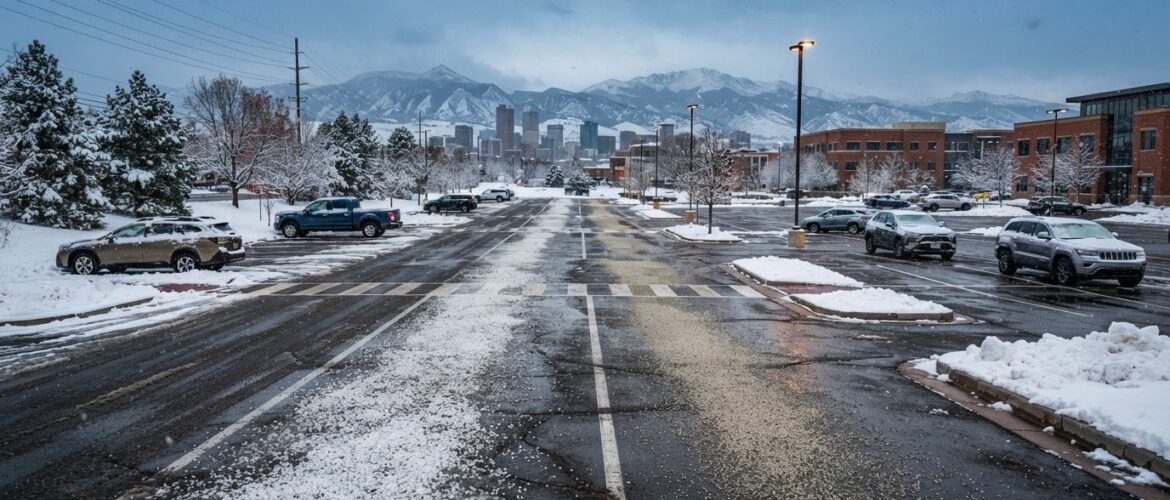
The de-icer that works better in one part of a parking lot may not be the right choice across the entire site. Choosing rock salt vs magnesium chloride for parking lots means weighing more than ice-melting power. Pavement condition, expected temperatures, nearby vehicles and landscaping, and pedestrian routes all affect how a treatment performs and what risks it may create.
It’s understandable to want one dependable product for changing winter conditions. But neither material is best for every lot, and applying more than needed can create its own problems. A reliable plan starts with site conditions, product label directions, and a clear sequence for plowing and ice management.
This guide compares how rock salt and magnesium chloride perform, explains the practical factors that shape the choice, and outlines how to build a consistent de-icing plan for a commercial parking lot. Use it to assess each area, protect access routes, and coordinate treatment with snow removal as conditions change.
Key Takeaways
- Rock salt and magnesium chloride are different chloride de-icers, and neither is automatically the better choice for every parking lot.
- For rock salt vs magnesium chloride for parking lots, compare surface conditions, product formulation, and label directions before selecting a treatment.
- Use a repeatable process: inspect conditions, check product instructions, coordinate de-icing with snow clearing, then reassess and document each decision.
- Snow Removal Denver coordinates commercial snow plowing and ice management across Denver County and the surrounding Denver Metro area. Dispatch is staffed 24/7, and on-call personnel are available 7 days and nights during snow events.
- Snow Removal Denver is fully insured. Each visit is documented with photos, and commercial ice melt is applied to sidewalks and entries under its no slip-and-fall liability guarantee.
Rock Salt vs. Magnesium Chloride for Parking Lots: What Is the Difference?
Choosing between rock salt and magnesium chloride for parking lots starts with a clear distinction: rock salt is sodium chloride, while magnesium chloride is a different chloride-based de-icer. Both can dissolve in moisture and form brine, which helps loosen ice from pavement. But chemistry alone doesn’t predict the result. Product formulation, application, and conditions across the lot all affect performance.
The goal is not simply to melt ice. A commercial lot needs a plan that supports access, accounts for pavement conditions, and fits the way vehicles and pedestrians move through the site. Neither material is a universal choice. The practical question is which product and treatment approach suit the conditions in each area.
For a general overview of rock salt and ice-melt products, watch this video:
What does each material do on an icy parking lot?
Once a de-icer dissolves, the resulting brine can work between ice and pavement, helping break the ice’s bond so it can be cleared more effectively. Rock salt and magnesium chloride differ in chemical composition, but both are used to manage ice through this basic process. The material’s name alone doesn’t tell you exactly how it will behave on a specific lot.
Chemistry and product form are separate considerations. A product may be granular or liquid, and its form affects how it is placed and incorporated into a site plan. For background on the compound, see Magnesium Chloride on Wikipedia. Always follow the product label. Don’t assume every formulation will melt ice at the same rate or produce the same result.
Why parking lot conditions change the decision
Start by looking at the surface. Loose snow, packed snow, and established ice call for different operational steps, and pavement condition can affect treatment decisions. Pay particular attention to pedestrian access points, including sidewalks, crossings, and building entries, where people need a clear route between the lot and the property.
Layout matters too. A large lot may have distinct zones, while traffic lanes and parking areas can have different use and clearing needs. In Denver, winter conditions can vary from one event to another, so base the plan on what is happening on site rather than a fixed assumption. Inspect each area, prioritize access, and follow the selected product’s directions before treatment.
How Rock Salt and Magnesium Chloride Work in Changing Conditions
A de-icer’s name can suggest how it works, but it can’t predict exactly how it will perform on a particular lot. Pavement temperature, available moisture, the amount and condition of snow or ice, and the product’s formulation all matter. The specific product label is the practical guide to where and how it should be applied.
Consider a parking area with damp pavement and a thin layer of ice. Its treatment needs may differ from a lot where packed snow remains after plowing. A product must be able to dissolve and spread under the conditions present. Surface condition and moisture influence that process, so the same material may perform differently across areas or events.
No de-icer has one guaranteed performance range; results depend on the product, pavement, moisture, accumulation, and application conditions. Broad temperature figures can be misleading when presented as universal cutoffs. Formulations and label directions vary, so don’t assume every rock salt or magnesium chloride product performs alike. Use the operating guidance for the exact product rather than relying on a general comparison.
Form also affects how a de-icer reaches the surface. Granular material must be distributed across the pavement, while a liquid is applied in liquid form. Neither form guarantees uniform coverage on its own. Spread patterns, pavement layout, and application method matter. Don’t rely on vehicle traffic as a substitute for deliberate, even application.
Timing changes the job. Anti-icing means applying a treatment before snow or ice accumulates, with the aim of making it harder for ice to bond to pavement. It can support later clearing, but it does not prevent all bonding or replace monitoring and snow removal. Check the product label to determine whether it’s suitable for pre-treatment and how to use it.
De-icing takes place after snow or ice has accumulated. The treatment must work with the material left on the surface. Plowing or other clearing removes snow and may expose ice or wet pavement that needs reassessment. Applying de-icer before clearing without considering the resulting surface can leave the treatment poorly matched to conditions. A practical sequence is to inspect, clear what can be removed, then assess whether and where further treatment is needed.
- Check pavement and surface conditions, not just the air temperature.
- Identify whether snow is loose, packed, or cleared, and whether ice remains.
- Confirm the product is intended for the task and follow its label directions for application.
- Reassess after clearing and treatment, especially at pedestrian routes and entries.
For commercial properties in Denver County and the surrounding Denver Metro area, coordinating snow plowing with ice management makes these steps part of a consistent site plan. Commercial snow and ice management in Denver brings clearing and pedestrian access needs into the same operational picture.
Parking Lot Comparison: When Rock Salt or Magnesium Chloride May Fit
For a commercial lot, the useful comparison is not simply which material melts ice faster. Managers need to consider how a product is applied, which surfaces it reaches, and how it fits with plowing and pedestrian access. Rock salt and magnesium chloride performance varies by formulation and application conditions, so broad claims about either material can obscure the decisions that matter on site.
The comparison below focuses on operational trade-offs. Treated salt and liquid products are not interchangeable with untreated granular rock salt or magnesium chloride. Check the exact product label for application instructions, limitations, and surface guidance.
Decision factor
Rock salt
Magnesium chloride
Form
Often encountered as granular sodium chloride, though product offerings can vary.
Available in different product forms, including granular or liquid formulations.
Operating considerations
Granules must be distributed across the target area. Fit depends on site conditions and label directions.
Application and coverage depend on the specific formulation and how it is intended to be used.
Surface concerns
Don’t assume it is harmless to concrete, metal, vehicles, or nearby plants. Consider exposure and cleanup.
It is not automatically safe for concrete, metal, vehicles, or landscaping. Consider the same site-specific risks.
Label guidance
Use the product’s directions for appropriate surfaces, application, and limitations.
Follow the product’s directions; don’t apply general material claims to every formulation.
Which trade-offs matter most on a commercial lot?
One property may prioritize protecting a concrete entry area, while another needs to manage vehicle lanes, pedestrian routes, or landscaped edges. Those priorities can affect where a material is used and how the site is monitored. Granular products require attention to distribution; liquid products have different handling and coverage considerations. Neither form guarantees even treatment, and traffic alone shouldn’t be relied on to spread material uniformly.
Keep the material and product type distinct. Untreated rock salt is not the same as rock salt treated with another agent, and a liquid magnesium chloride product is not equivalent to granular magnesium chloride. Performance claims should apply to the specific formulation and conditions, not be transferred from one product type to another.
What should property managers avoid assuming?
Don’t treat magnesium chloride as universally safe for concrete, plants, pets, or vehicles, or assume rock salt poses no surface concerns. Chloride-based products can affect materials and surrounding areas, and exposure can vary with use and site conditions. A temperature figure from a general comparison is not a guaranteed specification for every product.
Choose by site conditions, product directions, and maintenance priorities, not by material name alone. Read the manufacturer’s label before use, then match the product and application to the surfaces and access areas being managed. That is the sounder approach to rock salt vs magnesium chloride for parking lots.

A Practical Process for Choosing and Applying Parking Lot De-Icer
A reliable de-icing plan turns a material choice into a repeatable site procedure. The right approach to rock salt vs magnesium chloride for parking lots depends on what’s happening on the ground, which surfaces and routes need attention, and how treatment fits with snow clearing. Use this sequence to guide decisions and record each visit.
How to make a site-level material decision
- Inspect the property. Identify pavement types and known surface concerns, then note where snow or ice is present. Mark high-priority areas such as entrances, pedestrian routes, crossings, and accessible paths. Include vehicle lanes and parking areas in the site plan.
- Match the product to the conditions. Review the manufacturer’s directions for the specific product, including its intended use, application instructions, and limitations. Compare those directions with the surface and conditions you observed. Don’t rely on a generic material comparison instead of label guidance.
- Coordinate treatment with clearing. Decide what should be cleared first and where a de-icer may be needed afterward. Plowing can expose remaining ice or wet pavement, so don’t treat the whole lot as if every area has the same condition.
- Reassess and document. After clearing and treatment, review pedestrian access and any areas where snow, ice, or moisture remains. Record the selected material, locations treated, observed conditions, and reason for the application decision. This history helps staff apply a consistent plan when conditions change.
Make entrances and pedestrian routes explicit parts of the inspection, not an afterthought. A drive lane may be clear while an entry path or crossing still needs attention. Recording these areas separately helps the team track whether the routes people use to reach the building have been assessed.
How de-icing fits with plowing and site safety
Plowing and de-icing work best as coordinated tasks. Clearing snow changes what remains on the pavement, which may change where treatment is useful. After plowing, check for residual ice and moisture, then follow product directions for any additional application. Reassess conditions rather than assuming an earlier decision will remain appropriate.
A broader ice-management plan can define how teams inspect, clear, treat, and document different parts of a property. For commercial sites in Denver County and the surrounding Denver Metro area, Denver Snow Removals coordinates commercial snow plowing and ice management. The company is fully insured, with staffed 24/7 dispatch and on-call personnel 7 days and nights during snow events. Each visit is documented with photos, and commercial ice melt is applied to sidewalks and entries under its no slip-and-fall liability guarantee.
Details about free on-site commercial estimates are available for properties planning commercial snow and ice management.
Denver Parking Lot Ice Management: Put the Material Choice Into a Service Plan
Choosing between rock salt and magnesium chloride is only one part of managing a commercial parking lot in winter. The material decision needs to fit a coordinated plan for plowing, ice management, and pedestrian access. Denver Snow Removals provides commercial snow plowing and ice management for properties in Denver County and the surrounding Denver Metro area.
What commercial customers can expect from Denver Snow Removals
Commercial service brings parking lot plowing and ice management into one operational plan. Crews use newer Chevrolet 2500HD trucks with commercial-grade Boss plows, supported by heavy equipment. During snow events, Denver Snow Removals has staffed 24/7 dispatch and on-call personnel 7 days and nights, with crews operating around the clock.
Service planning considers the property as a whole. Parking areas, vehicle routes, sidewalks, and building entries each have different access needs. The company is fully insured. Every visit is documented with photos, and commercial ice melt is applied to sidewalks and entries under its no slip-and-fall liability guarantee. The visit record gives property managers a way to review completed work and document site activity.
This coordination matters whether a property’s ice plan uses rock salt, magnesium chloride, or another material selected for the site. A snow service plan should align treatment decisions with clearing work and access priorities, without assuming one de-icer suits every surface or event. Material selection should reflect site conditions and the applicable product directions.
How to take the next step before winter weather
Before the season begins, commercial property managers can map the areas that need attention and identify where plowing and ice management should be coordinated. Seasonal contracts run September through May. An on-site review gives the service plan a property-specific starting point, including lot layout, pedestrian access, and areas that need clear operational priorities.
For a broader look at how plowing fits into a commercial winter plan, consult the commercial snow removal guide. Pairing that planning with a site-specific review helps managers prepare instructions for parking areas, sidewalks, and entries before changing conditions create urgent decisions.
Denver Snow Removals serves commercial properties across Denver County and the surrounding Denver Metro area. A free on-site commercial estimate can help establish a coordinated plan for snow plowing and ice management.
Put Your Winter Plan in Place Before Conditions Change
The best time to settle your parking lot’s winter priorities is before a storm makes every choice urgent. Use the rock salt vs magnesium chloride for parking lots comparison as a starting point, then turn it into a property-specific plan: identify the routes that must stay accessible, note areas with particular surface concerns, and decide how the site will be reassessed after clearing. That preparation gives your team a consistent reference when conditions shift.
A site review can connect those priorities to commercial plowing and ice management. Denver Snow Removals serves commercial properties in Denver County and the surrounding Denver Metro area. Request a free on-site commercial estimate to start planning around your property’s layout and access needs.
With a clear plan in place, your team can approach winter decisions with greater confidence and keep attention focused on safe, managed access.
Frequently Asked Questions
Is magnesium chloride better than rock salt for a parking lot?
Not universally. The best fit for rock salt vs magnesium chloride for parking lots depends on the specific product, site surfaces, expected conditions, and access needs. For example, a property manager may prioritize protecting a sensitive concrete entry, while another may focus on treating broad vehicle lanes efficiently. Compare product labels and site priorities rather than choosing by material name alone. Neither option is damage-free or ideal for every lot.
Can rock salt damage concrete in a commercial parking lot?
Yes, rock salt can contribute to concrete deterioration, particularly when concrete is already in poor condition or exposed to repeated freeze-thaw cycles and de-icer use. Scaling, cracking, or surface flaking can also have other causes, so don’t assume salt is the only factor. Check the pavement condition before winter, follow the product label, and avoid applying more than directed. Give extra attention to older or visibly damaged concrete.
Does magnesium chloride work at lower temperatures than rock salt?
Generally, magnesium chloride products may remain effective in colder conditions than standard rock salt, but there isn’t one temperature cutoff that applies to every formulation. Product composition, pavement temperature, and moisture can change results. Use the operating range and directions on the exact product label. If a cold snap is forecast, don’t rely on a generic comparison chart to decide whether an application will work on your lot.
How much de-icer should you apply to a parking lot?
Apply the amount specified on the product label, not an estimated blanket dose for the entire lot. The right quantity depends on the product, treated area, and surface conditions. A calibrated spreader can help control distribution; check its settings and coverage before applying material across traffic lanes or pedestrian areas. If ice remains, assess the surface and label instructions before deciding whether another treatment is appropriate. More product isn’t automatically more effective.
Can magnesium chloride and rock salt be used together?
Only combine them if the product instructions explicitly allow it. A treated salt blend may contain more than one ingredient, but that doesn’t mean separately packaged products can be mixed safely or applied at the same rate. Combining products without label guidance can make application difficult to control and may conflict with use directions. Keep products identifiable during storage and application, and follow the instructions for the specific blend or material in use.
Should you apply de-icer before or after plowing a parking lot?
It depends on the task. A product labeled for anti-icing may be applied before accumulation, while post-plow treatment addresses ice left behind after snow clearing. For example, if plowing exposes a slick patch near a building entrance, reassess that spot rather than automatically treating every cleared lane. Follow label timing and directions, and keep pedestrian access routes in the inspection plan. Pre-treatment does not eliminate the need to monitor and clear the lot.
Is magnesium chloride safe for nearby landscaping and vehicles?
It shouldn’t be treated as harmless to plants or vehicles. Chloride de-icers can affect vegetation, and residues may contribute to corrosion on metal surfaces. Avoid unnecessary application near planting beds, vehicles, and drainage paths, and follow the product label for use and cleanup. For a landscaped edge beside a parking stall, apply only as directed and check whether material has accumulated beyond the pavement. No de-icer guarantees zero impact.