
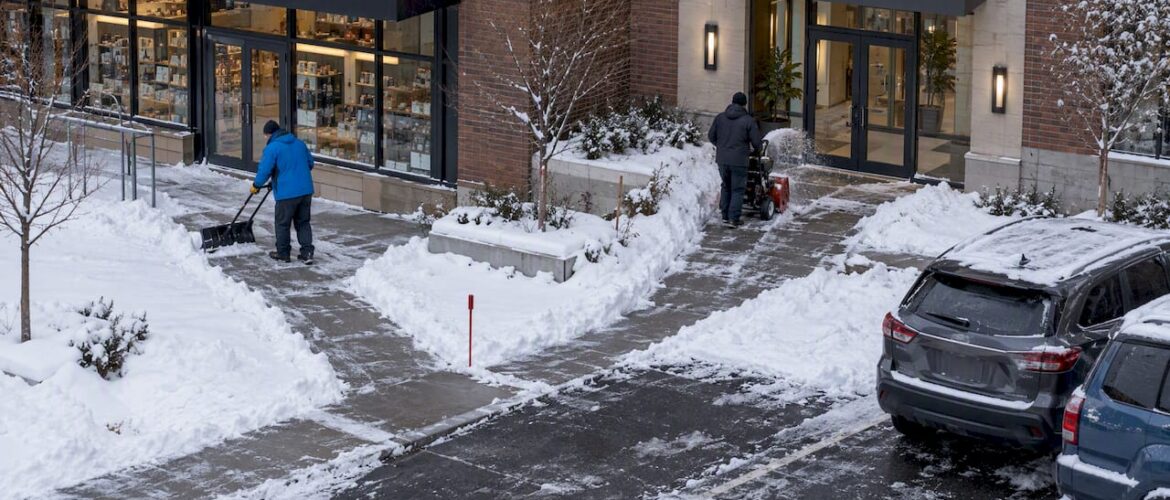
A mixed-use property has two sets of snow rules at once. Residents need clear walks at 6 a.m. Customers need open entrances by the time the shops unlock. Delivery trucks, accessible stalls and fire lanes need clear paths all day. The way to handle it is one written plan for the whole site, one contractor accountable for it, and clear priorities for what gets cleared first. This guide explains how to build that plan for a Denver property, from the city’s sidewalk rules to the contract language that keeps service documented.
TL;DR
- In Denver, the owner or tenant is responsible for the public sidewalk and ADA ramps next to the property, and businesses must start clearing immediately after snowfall, while residences have until the next day.
- Mixed-use sites work best with one site map, one contractor and a priority order: emergency access, entrances and accessible routes first, then parking, then secondary walks.
- Anti-icing before the storm, early mechanical removal during it and targeted deicing afterward cost less than chasing ice later. Denver’s sun-then-freeze pattern makes the last step matter.
- The contract should name triggers, completion timeframes, priority areas, communication and documentation. Start the bid process in spring, not after the first storm.
Table of Contents
- Why mixed-use sites are harder to plow than single-use ones
- Who is responsible for snow removal in Denver
- Start with a site map and a written plan
- Set priorities: what gets cleared first
- Plowing, shoveling and deicing: the right order
- Keeping residents, customers and employees safe
- What the contract should say
- What drives cost, and when to plan
- Our perspective on mixed-use snow work
- Get a quote for your property
- FAQ
- Sources
Why mixed-use sites are harder to plow than single-use ones
An apartment complex has one main user group and one rhythm: people leave in the morning and return in the evening. A shopping center has the opposite pattern. A mixed-use building combines both and adds friction between them.
- Residents and customers share parking. Cars parked overnight block plows. Vehicles in daytime retail stalls block them again. Complete lot clearing is difficult when vehicles stay put, so communication about moves matters as much as equipment.
- Entrances differ in purpose. A residential lobby, a restaurant door, a medical suite and a loading dock each need a different clearing standard and a different time of day.
- Snow has fewer places to go. Ground-floor retail, plazas and podium parking leave little room for stacking, which is why approved pile locations belong on the site map before winter.
- Liability is layered. Residents, customers, employees and delivery drivers can all slip on the same walk.
If your building sits downtown, our mixed-use parking lot snow removal guide for downtown Denver covers site conditions specific to that area.
Who is responsible for snow removal in Denver
Denver’s Snow & Ice Build-Up Fact Sheet puts the duty on the property owner or tenant to clear public sidewalks and ADA ramps adjacent to the property. The timing differs by user: businesses must begin clearing immediately after a snowfall, and residents have until the next day.
The same sheet describes the enforcement path. If a city inspector finds an un-shoveled sidewalk, a business has four hours and a residence has 24 hours to clear it before a potential $150 fine.
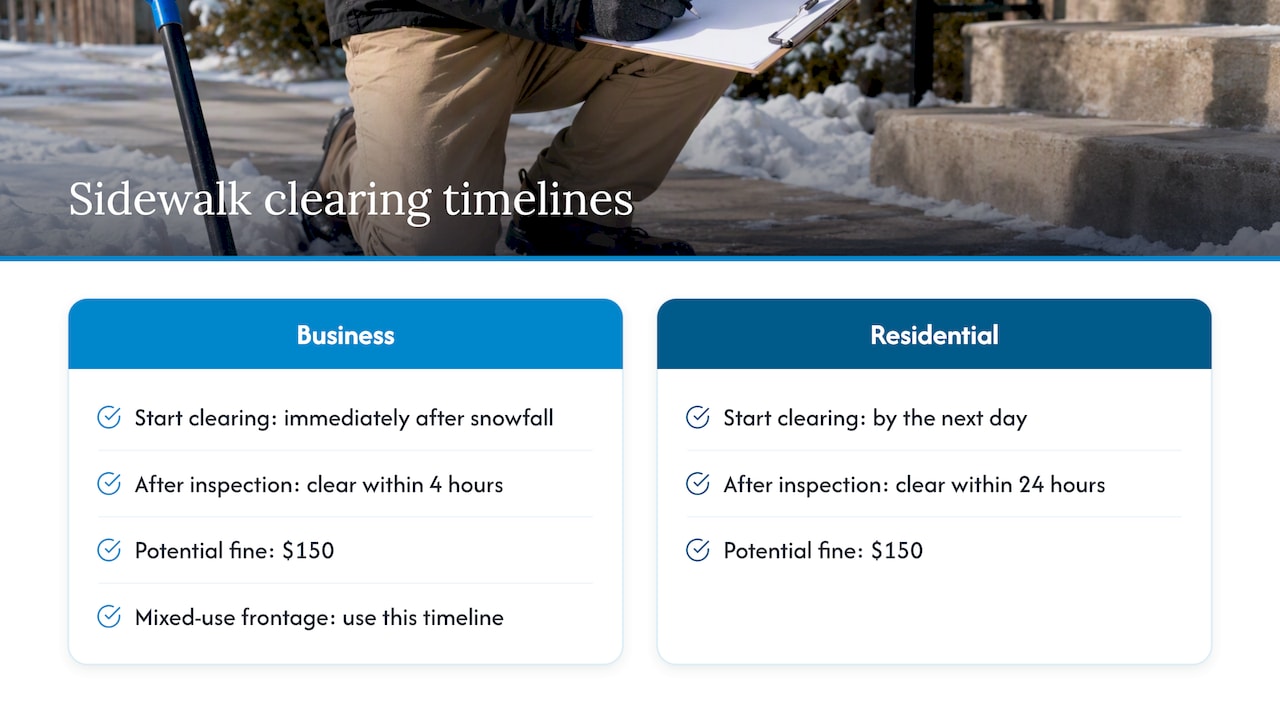
A mixed-use building does not fit neatly into either column. Our advice is to hold the whole frontage to the business timeline. Retail customers and residents use the same concrete, and the stricter clock is the safer one to design a service plan around. If you are unsure how the city classifies your building, confirm with the city before you write the contract.
There is also a legal background worth knowing. Under Colorado common law, as set out in the 1988 Colorado Supreme Court decision Bittle v. Brunetti, an owner has no duty to remove naturally accumulating snow and ice from the public sidewalk abutting the property unless a specific municipal ordinance imposes it. Denver’s ordinance does impose it. For anything beyond the public sidewalk, such as private plazas, lots and stairs, you are managing your own premises and your own exposure. For a plain-language breakdown by area, see our page on who clears what in Denver and our downtown sidewalk shoveling rules.
Start with a site map and a written plan
The Snow and Ice Management Association’s 2025 U.S. procurement standard recommends a written, site-specific plan with mapped service areas, measurable outcomes, dispatch triggers, timeframes and priorities. It also calls for mapping emergency ingress and egress, sidewalks, entrances and exits, accessible parking stalls and delivery ramps, assigning monitoring and communication responsibilities, and identifying approved snow-stacking areas.
For a mixed-use property, a useful site map marks:
- Property boundaries and the public sidewalk frontage you must clear.
- Fire lanes and emergency routes.
- Residential lobbies, retail entrances and loading docks.
- Accessible stalls, ramps and curb cuts.
- Parking areas, split by who uses them and when.
- Approved stacking areas, plus salt bins and equipment staging.
- High-priority areas, meaning the spots where a fall is most likely or most costly.
Do a walk-through before the first storm. The same standard says property management and contractors should inspect and document hazards such as broken curbs, potholes, clogged downspouts, overhangs, car stops and water directed into pedestrian areas. A downspout that drains onto a walkway is a refreeze problem waiting for a cold night.
Set priorities: what gets cleared first
One crew cannot clear everything at once, so the contract should say what comes first. A University of Massachusetts Lowell winter-maintenance procedure offers a workable order: roads, open accessible routes, entrances and fire lanes first, then parking lots, then walkways and sidewalks. It keeps primary walking routes maintained during the storm and clears secondary routes within 24 hours after snow stops.
Adapted to a mixed-use building, the order looks like this:
| Priority | Area | Why it comes first |
|---|---|---|
| 1 | Fire lanes, emergency access, accessible routes | Life safety and legal access |
| 2 | Residential lobby and retail entrances, public sidewalk frontage | Highest foot traffic, and the area the city inspects |
| 3 | Loading docks and delivery ramps | Keeps tenant businesses operating |
| 4 | Parking lots and drive aisles | Cleared around vehicle availability |
| 5 | Secondary walks, side doors, trash enclosures | Lower traffic, cleared after the primary routes |
Your property may reorder rows 3 and 4. A restaurant row with early deliveries may need the dock cleared before the lot. Put that decision in writing so the crew is not guessing at 4 a.m.
Trigger depths
The same UMass procedure says roads are generally plowed at about 2 inches and parking lots at 2 to 4 inches, with overnight parking surfaces cleared after vehicles leave. These are one institution’s numbers, not a Denver standard. Your trigger should reflect your tenants. A property with a coffee shop and a clinic may want a lower trigger on the walks than on the back lot. Our HOA trigger depth and service level guide shows how those numbers are usually structured for residential communities.
Plowing, shoveling and deicing: the right order
The Maryland Department of the Environment’s 2026 Smart Salting manual lays out a sequence that applies well to mixed-use sites:
- Anti-ice before the storm when conditions warrant it.
- Remove snow mechanically, early and repeatedly. The manual recommends one pass for light snow and a two-pass method for heavy snow.
- Plow lots around vehicle availability, then shovel or blow sidewalks after bulk removal.
- Apply only the deicer you need, choosing the lowest effective product for the pavement temperature.
- Monitor melt and refreeze and retreat hazards after the storm ends.
The manual also advises against plowing or blowing snow into water, wetlands, traffic or streets. That matters on tight urban sites, where the easy place to push snow is often the wrong one.
Anti-icing is cheaper than ice removal
A risk-control guide from CNA recommends treating walking surfaces with an anti-icing or pre-wetting agent before a snow or ice event, and using a deicing agent on existing ice so it can be broken up and removed and refreezing prevented. We offer anti-icing pre-treatment and ice management as part of our parking-lot work, and our commercial anti-icing guide explains timing and product choices in more detail.
Denver’s refreeze problem
The city’s fact sheet notes that Denver’s roughly 300 days of annual sunshine can cause partial daytime melting and nighttime refreezing, particularly in shaded areas. On a mixed-use building, shade is everywhere: north-facing entrances, the lee of a tower, the corner of a plaza. Those spots stay icy after the open lot is dry.
Meltwater needs a place to go as well. The University of Connecticut’s parking-lot and sidewalk guide recommends placing snow on downhill sides, clearing catch basins and drainage leak-offs, and keeping roof gutters from discharging onto walkways. Poorly placed piles or blocked drains send water back across surfaces, where it refreezes.
Roof edges are part of this too. Water that backs up under shingles and refreezes creates hazards above the entrance as well as below it. If you manage buildings with sloped roofs, this explanation of why ice dams form and how to prevent them pairs well with a ground-level plan. For a pre-freeze routine on walks, see our sidewalk salting checklist.
Keeping residents, customers and employees safe
Clearing is the main control, but it is not the only one. Two risk-control guides, one from CNA and one from an insurance trade source, suggest several additions that suit mixed-use buildings:
- Designated pedestrian snow lanes between parking areas and the nearest sidewalk, so nobody climbs over a berm.
- Carpet or rubber runners on entrance stairs and in pedestrian lanes.
- Pavement heating or heated mats at high-traffic entrances.
- Lighting across every walking surface, since winter dusk arrives before the workday ends.
Wet shoes also carry slush indoors, so lobbies and corridors matter too. Interior floor care is part of the same slip-risk picture, and this piece on floor maintenance in commercial buildings is a useful companion to the outdoor plan. Entry mats and a janitorial schedule that follows the storm close the gap between the curb and the elevator.
Parking structures and ramps
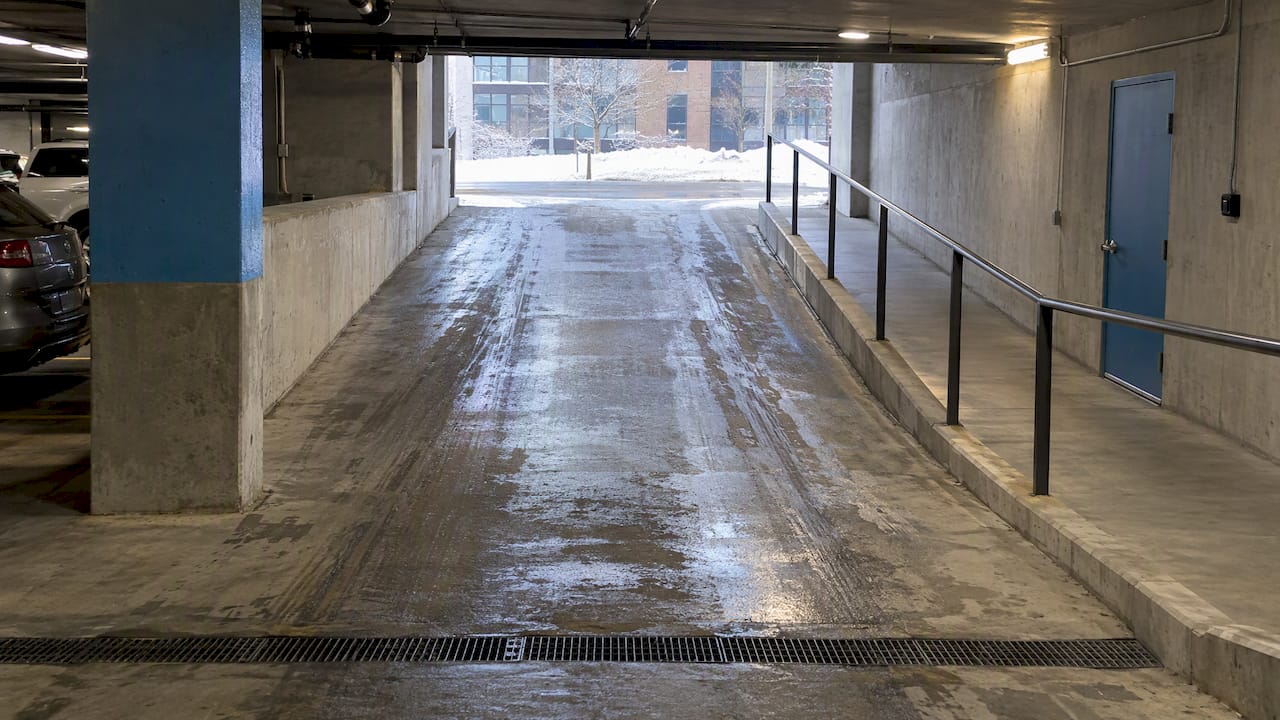
Many mixed-use buildings include a garage. THA Consulting’s guidance on parking structures recommends preserving code-required pedestrian egress, evaluating traffic patterns and parking demand, monitoring closed areas for melt and refreeze, and consulting a structural engineer so snow-removal choices do not exceed structural capacity. Do not pile snow on a deck without that engineering input. Our page on garage ramp ice control in downtown Denver covers the ramp side of the problem.
What the contract should say
Most disputes between managers and contractors come from vague language. The SIMA standard says a signed contract should define the level of service, scope of work and site plan, including the desired outcome, dispatch triggers, completion timeframes, priority areas, post-storm work, decision authority, monitoring and communications. SIMA’s RFP guidance defines level of service as the expected outcome, typically the surface condition at a specific time or within a timeframe.
For a mixed-use property, check that your contract covers:
- Triggers. The snow depth or ice condition that sends a crew, with separate triggers for walks and lots if needed.
- Timeframes. How soon after the trigger, and how soon after snow stops, each priority area must be done.
- Scope by zone. Residential entrances, retail entrances, docks, lots, garage ramps and the public sidewalk frontage listed separately.
- Stacking. Where snow goes, and when it gets hauled off if the site fills up.
- Communication. Who calls whom, and how a tenant reports an icy door.
- Documentation. The RFP guidance says records may include photos and GPS or other verification. The standard lists site name, operator names, service dates and times, conditions before and after, weather, services rendered, equipment used, materials applied and notes on special circumstances.
That last item is your defense if someone alleges a fall. Records showing when a crew was on site, what it applied and what the surface looked like afterward are far more useful than a memory. Our article on snow removal contract essentials for property managers walks through the liability language, and our seasonal versus per-push comparison helps with the pricing structure.
If you want a ready format to fill in, our snow removal RFP form covers scope and pricing for property managers.
What drives cost, and when to plan
We do not publish one price for a mixed-use property, because the site decides it. These are the factors that move a quote:
- Paved area and layout. Open lots plow faster than courtyards, podium decks and tight drive aisles.
- Sidewalk length. Frontage on two streets means twice the hand work and twice the deicing.
- Service level. A lower trigger and faster completion window need more crew time on standby.
- Material use. Anti-icing and deicing applications are counted by event.
- Hauling. Sites without stacking room need snow trucked out.
- Contract type. A seasonal contract spreads cost across the winter. Per-push billing follows each storm.
Timing matters as much as scope. SIMA’s RFP guidance says the bidding process should begin no later than May so contracts can be awarded by September 1. The reason is practical: good contractors fill their routes before the first storm, and properties that call in October take what is left. If you are reading this mid-season, same-day service is still possible for new clients, but you will have fewer options on terms.
Our perspective on mixed-use snow work
After 44 years of plowing in the Denver area, our view is that most mixed-use failures are coordination failures, not equipment failures. A crew arrives at 3 a.m., the lot is full of resident cars, the retail entrance is clear and the residential side door is not, and nobody was told which one mattered more.
We push managers toward three habits. First, agree the priority list before the season and write it into the contract. Second, tell residents and tenants in advance where to park during a storm, because a plow cannot clear under a car. Third, insist on documented visits. We keep records of each service visit because a manager should be able to show what happened on a given night.
We also keep a dedicated team available 24/7, because snow does not follow a business schedule. If a heavy overnight storm leaves the residential walks and the shop fronts both buried, one dispatch line is better than three vendors pointing at each other.
— Jesse
Get a quote for your property
We plow and clear parking lots, sidewalks and entrances for commercial, HOA, apartment and mixed-use properties in Denver, with ice management, de-icing, anti-icing pre-treatment, snow hauling and 24-hour emergency response. Seasonal contracts run September through May, and estimates are free. If one of your tenants also needs a driveway or walkway cleared, our residential service starts from $41.25 per visit. See our commercial snow removal services or review how emergency plowing works during a storm.
FAQ
Who is responsible for snow removal at a mixed-use building in Denver?
Denver’s city fact sheet makes the property owner or tenant responsible for the public sidewalk and ADA ramps next to the property. Who pays between landlord and tenants depends on your lease and management agreement, so write it down. Private lots, plazas and stairs are your own premises to maintain.
How fast do I have to clear a sidewalk in Denver?
Businesses must begin clearing immediately after snowfall, and residents have until the next day. After an inspector notices an un-shoveled walk, a business has four hours and a residence has 24 hours before a possible $150 fine. For a mixed-use site, we recommend working to the business timeline.
Should I use a seasonal contract or pay per push?
A seasonal contract gives you set cost and guaranteed priority, which suits a property with constant foot traffic. Per-push billing can cost less in a mild winter but leaves you exposed in a heavy one. Either way, make sure triggers, response windows and documentation are in writing.
When should I hire a snow contractor?
Industry guidance says the bid process should begin no later than May, with contracts awarded by September 1. Starting early gives you more choice and time to walk the site with the contractor. If you are past that point, ask about same-day start for new clients.
Sources
- Snow & Ice Build-Up Fact Sheet, City and County of Denver
- Bittle v. Brunetti, Colorado Supreme Court, 1988
- Procuring and Planning Snow and Ice Management Services, SIMA, 2025
- Purchasing Snow & Ice Management, SIMA RFP guidance
- Winter maintenance procedure, University of Massachusetts Lowell
- Smart Salting Training Manual, Maryland Department of the Environment, 2026
- A Guide for Parking Lots and Sidewalks, University of Connecticut, 2023
- Snow and Ice Maintenance Programs, CNA
- Managing slip, trip, and fall risks in snow and ice prone areas
- Snow removal practices for parking structures, THA Consulting