

A usable snow removal RFP delivers comparable bids by specifying scope, dispatch triggers, a pricing form, evaluation weights, and required contractor deliverables up front. Without those five elements, you get quotes that can’t be measured against each other. Attach a site map and a pricing spreadsheet before you post the RFP. That single step eliminates most of the confusion that turns bid comparison into guesswork.
TL;DR:
- Precise scope language should include specific surface types, operational triggers, and authorization procedures to avoid misunderstandings and unauthorized work.
- The pricing form must be standardized with clear line items such as per event, per inch, or flat seasonal rates to enable fair bid comparison.
- Evaluating proposals fairly requires published scoring criteria emphasizing scope compliance, responsiveness, equipment, safety, references, and price, with clear evidence of past performance.
- Contractors should submit complete packages with signed proposals, equipment inventories, proof of insurance, references, and safety plans to ensure accurate comparison and compliance.
- Attachments like detailed site maps, scope descriptions, and evaluation criteria before posting mitigate disputes, streamline evaluation, and reinforce contractual clarity.
Table of Contents
- What Should a Snow Removal RFP Include?
- Scope of Work: Sample Language You Can Copy
- How Should Pricing Be Structured in a Snow Removal RFP?
- How Do You Evaluate Snow Removal Proposals Fairly?
- What Documents Should Contractors Submit With Their Bid?
- What Safety and Insurance Requirements Belong in the RFP?
- What Belongs on the Site Map and Push Instructions?
- Pre-Issue Checklist: What to Attach Before You Post the RFP
- What Does a Strong Response Actually Look Like?
- Author perspective: Procurement pitfalls we’ve seen and how to avoid them
- How Denversnowremovals Can Help With Your RFP
- Sources
- FAQ
What Should a Snow Removal RFP Include?
Before you post a snow removal request for proposal, run it against a checklist. A rushed RFP is the single biggest reason property managers and municipal buyers end up with mismatched bids that can’t be scored fairly. If a bidder has to guess what you mean by “clear the lot,” you’ve already lost control of the comparison.
Think of the checklist in three buckets: what gets cleared, how performance is measured, and what paperwork protects you.
Concrete service items to spell out:
- Every site address and the specific surfaces at each one (main lot, overflow lot, sidewalks, entrances, ADA ramps, loading docks, fire lanes)
- Whether hand clearing is required at stairs, doorways, and ramps where plows can’t reach
- De-icing and anti-icing responsibilities, including product type if you have a preference
- Snow hauling and off-site disposal, and where the piles get relocated on-site if hauling isn’t triggered
- Explicit exclusions: rooftop snow load, tenant-specific requests, or areas maintained by another vendor
Operational rules that make service levels measurable:
- The trigger depth that starts service (commonly 1 to 2 inches for commercial lots)
- A commencement window after the trigger is met. Public agencies often specify service commencing within 2 hours of a qualifying snowfall, and copying that structure gives you an enforceable standard rather than a vague promise.
- A passability standard defining “cleared” (for example, no more than half an inch of accumulation on primary drive lanes)
- Who is authorized to approve extra work, and how that gets documented before the invoice arrives
Administrative items that protect the contract:
- Contract term and renewal options, including whether pricing is locked for multi-year terms
- Which pricing form bidders must use (more on that below)
- The process for addenda, questions, and clarifications during the bid window
- Submission rules: format, deadline, and point of contact
- Minimum insurance requirements and proof of coverage
Skip any of these and you invite change orders later. A property manager we’ve seen in Denver once accepted a bid that never mentioned hauling. The first heavy storm buried the lot in snow piles with nowhere to go, and the “savings” from the low bid disappeared within a week.
Scope of Work: Sample Language You Can Copy
The scope of work is where most snow removal RFPs fall apart. Vague language like “clear the parking lot as needed” invites wildly different interpretations, and wildly different prices to match. Specific scope language, on the other hand, lets every bidder price the identical job.
Here’s modular language you can adapt site by site.
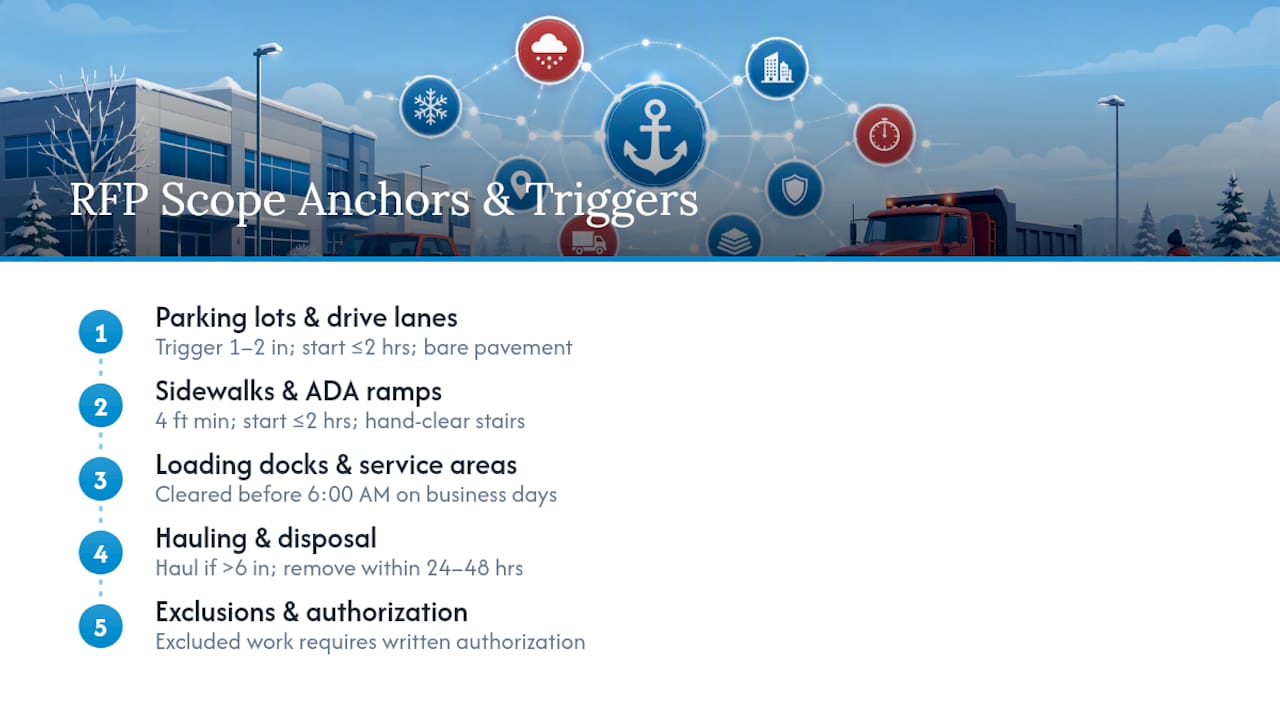
Parking lots and drive lanes:
“Contractor shall plow all designated parking areas, drive lanes, and fire lanes to bare pavement where possible upon accumulation of [1–2] inches of snow. Service shall commence within [2] hours of the triggering snowfall and continue until all designated areas meet the passability standard defined in Exhibit B.”
Sidewalks and pedestrian routes:
“Contractor shall clear all sidewalks, entrances, and ADA-compliant ramps to a minimum width of 4 feet, removing snow and applying ice-melt product within [2] hours of the trigger event. Hand clearing is required at stairs and areas inaccessible to plow or skid steer equipment.”
Loading docks and service areas:
“Loading dock aprons and designated truck routes shall be cleared prior to 6:00 AM on business days to maintain uninterrupted delivery access, weather permitting.”
Hauling and disposal:
“Snow accumulation exceeding the on-site storage capacity, as identified on the attached site map, shall be hauled to [designated location] within [24–48] hours of a snow event exceeding [6] inches.” Providence’s approach to municipal contracting treats hauling and mobilization as distinct billable line items, rather than folding them into a flat seasonal rate. This keeps your budget honest when a single storm dumps more than your lot can absorb.
Exclusions and authorization language:
“This scope excludes rooftop snow removal, tenant balcony clearing, and any work not identified on Exhibit A. Any work outside this scope requires written authorization from [Owner Representative] prior to performance.”
That exclusion clause matters more than it looks. Without it, contractors either skip ambiguous areas entirely or perform unauthorized work and bill for it after the fact. Neither outcome serves you.
Pro Tip: List every surface type separately, even ones that seem obvious, like “front entrance” versus “side entrance.” Bidders price what’s written, not what you assumed was implied. A missing line item on the scope sheet becomes a missing line item on the invoice dispute six weeks into the season.
For a deeper breakdown of how commercial properties structure multi-site scope language, the Denver commercial snow removal proposal guide walks through separating routine plowing from surge-event hauling in more detail.
How Should Pricing Be Structured in a Snow Removal RFP?
Pricing confusion is the number one reason bid comparisons fail. A bidder who quotes “per push” and one who quotes “seasonal flat rate” aren’t competing on the same terms, and you can’t score them side by side without converting both into a common unit.
Five pricing structures dominate the snow removal contractor request landscape, and each fits a different situation:
- Per event — a flat fee for each qualifying snowfall, regardless of depth. Works well for predictable sites with consistent storm patterns.
- Per inch — pricing scales with accumulation, often in tiers (0 to 3 inches, 3 to 6 inches, 6-plus inches). Useful when storm severity varies widely across a season.
- Per push — billed per plow pass rather than per event, common for large lots needing multiple clearings during one storm.
- Equipment hourly — time-and-materials billing for skid steer work, hauling trucks, or de-icer application. Best reserved for unpredictable, ad hoc work.
- Seasonal flat rate — one fixed price covering the entire season regardless of snowfall total. Predictable for budgeting, but riskier for the contractor in a heavy year.
A pricing form forces every bidder into the same structure so you’re comparing dollars, not concepts. A simple version includes:
| Line Item | Unit | Bidder Rate |
|---|---|---|
| Parking lot plowing (per event, 1–3 in.) | Per event | $______ |
| Parking lot plowing (per event, 3–6 in.) | Per event | $______ |
| Sidewalk clearing and de-icing | Per event | $______ |
| Hauling and off-site disposal | Per load | $______ |
| Mobilization fee (surge/emergency dispatch) | Flat | $______ |
| Skid steer / loader hourly rate | Per hour | $______ |
| Liquid or granular de-icer material | Per application | $______ |
| Seasonal contract (full-season, all sites) | Flat total | $______ |
To sanity-check what comes back, benchmark against published market ranges. Most snow removal pros charge $30 to $75 per residential visit, with seasonal residential contracts running $350 to $600, while commercial per-push and per-event pricing varies far more depending on lot size and equipment needed. A bid that comes in dramatically below these ranges for comparable scope deserves a follow-up question before it deserves a signature. For a closer look at how seasonal contract pricing tends to break down for Denver properties specifically, see this pricing and contracts guide.
How Do You Evaluate Snow Removal Proposals Fairly?
Publish your scoring method before you collect a single bid. Buyers who wait to decide “what matters most” after proposals arrive tend to gravitate toward whichever bidder feels most reassuring in person, not whichever one actually meets the scope. A weighted scorecard shared in the RFP itself removes that bias and gives every bidder a fair shot at understanding what wins.
A workable weighting model looks like this:
- Scope compliance: 30% — did the bidder price every line item exactly as requested, with no substitutions or omissions?
- Responsiveness and availability: 20% — dispatch times, communication protocol, and stated capacity during multi-day storms
- Equipment and staffing: 15% — fleet size, backup equipment, and crew availability relative to your site’s size
- Safety and insurance: 10% — proof of coverage, safety plans, and training documentation
- References: 10% — verifiable, named clients with similar site profiles
- Price: 15% — deliberately not the largest category, since scope compliance and responsiveness predict actual performance better than the number on the page
Municipal buyers like the Village of Oak Park publish weighted evaluation criteria that go beyond price, factoring in responsiveness and financial stability alongside cost, and that approach also permits sectional bidding. If your property spans multiple sites, you don’t have to award the whole contract to one vendor. Splitting sidewalk clearing from parking lot plowing, or splitting sites geographically, can produce better overall pricing than forcing a single contractor to cover everything.
Watch for these red flags during evaluation:
- A bid missing required signed forms or insurance certificates
- Reference contacts who don’t answer or can’t confirm the scope described
- Equipment lists that don’t match the fleet size needed for your site’s square footage
- Pricing that’s dramatically below the benchmark range with no explanation
Requiring proof of performance rather than just a fleet list on paper is one of the more overlooked evaluation habits. A contractor with three trucks listed on a spreadsheet isn’t the same as a contractor with three trucks and a documented history of servicing a lot your size.
What Documents Should Contractors Submit With Their Bid?
A clean submission package is what makes side-by-side comparison possible at all. Public snow removal RFP templates are consistent about what they demand, and property managers benefit from copying that rigor rather than accepting whatever format a contractor prefers to send.
- Signed proposal form acknowledging the scope, pricing, and terms exactly as issued
- Completed pricing schedule using your provided form, not a substitute format
- Equipment inventory listing make, model, and quantity of plows, skid steers, and hauling trucks
- Proof of insurance, current and naming the property owner as an additional insured where applicable
- Non-collusion affidavit or equivalent certification, standard in most public-sector snow removal bid packages
- Named references from similar-sized sites, with contact information
- Emergency contact information for after-hours dispatch
- Acknowledgement of addenda, confirming the bidder reviewed any updates issued during the bid window
Public agency templates, including the Rock Island Public Library snow removal RFP, require signed special provisions and a completed bid form as a condition of a bid being considered at all. Adopt that same standard, even for a private commercial contract. A bid missing a signed form or current insurance certificate should be set aside for clarification, not evaluated as complete. That’s not bureaucratic stubbornness. It protects you if a dispute arises mid-season and you need to prove the contractor agreed to your exact terms.
Ask for sample daily service logs from a prior season, too. A contractor who can produce real logs showing timestamps, site conditions, and completed work has a system in place. One who can’t is telling you something important before the contract is even signed.
What Safety and Insurance Requirements Belong in the RFP?
Snow removal work carries real injury risk, and your RFP should require contractors to manage it, not just carry insurance in case something goes wrong. OSHA’s winter-weather hazard guidance advises employers to evaluate snow removal hazards before work begins and to avoid sending workers onto roofs when other methods exist. If your property has any rooftop snow load concerns, your RFP should require a written fall-protection plan before any contractor accesses a roof, or better yet, exclude rooftop work from the base scope entirely and handle it as a separate authorized task.
Minimum items to require:
- Certificate of general liability insurance, with minimum coverage limits stated in the RFP
- Workers’ compensation coverage for all personnel on site
- A written safety plan covering slip, fall, and vehicle-related hazards specific to winter operations
- Training records for equipment operators
- Daily service logs documenting time on site, conditions observed, and work completed
Pro Tip: If rooftop snow load is a concern for your building, don’t bury it in general scope language. Require a separate fall-protection plan as a submission exhibit. A contractor who can’t produce one shouldn’t be doing that work regardless of price. For sidewalk-specific safety and hand-clearing standards, this guide on sidewalk snow management covers the operational side in more detail.
What Belongs on the Site Map and Push Instructions?
A site map turns abstract scope language into something a plow operator can actually follow at 4:00 AM during a storm. It’s also the single most common source of billing disputes when it’s missing.
Mark the following on every site map you attach:
- Push zones and the direction snow should be moved
- No-stack areas, including fire lanes, hydrant clearances, and dumpster access
- Critical access routes that must stay open at all times (main entrances, ambulance bays, delivery routes)
- Designated haul points or off-site disposal locations
- Tenant-specific constraints, like reserved parking or restricted operating hours
Include measured square footage for each surface type rather than leaving bidders to estimate from a satellite photo. A GIS-based measurement removes guesswork and keeps every bid grounded in the same numbers. The site map is often the hidden failure point in snow removal contracts. Without clearly marked no-stack zones and haul routes, disputes over “who moved snow where” become inevitable by midwinter.
Pre-Issue Checklist: What to Attach Before You Post the RFP
Before publishing your snow removal RFP, confirm you have every attachment ready. A missing exhibit at posting time means addenda later, and addenda slow down your entire timeline.
- Scope of work with site-by-site surface detail
- Pricing form in your preferred structure
- Site map with push zones, no-stack areas, and haul points marked
- Published evaluation weights and scoring criteria
- Submission instructions: format, deadline, and delivery method
- Full RFP timeline with key dates
Package the whole thing as a single PDF with clearly named exhibits (Exhibit A: Scope, Exhibit B: Pricing Form, Exhibit C: Site Map), and link a separate spreadsheet version of the pricing form so bidders can fill it out digitally rather than retyping a table from a PDF.
Your calendar should include a pre-bid meeting or site walk, a deadline for written questions, a date for issuing addenda based on those questions, the submission deadline itself, and an estimated evaluation and award notification window. Most public snow removal RFPs run four to six weeks from posting to award, giving contractors enough time to visit the site and price accurately.
What Does a Strong Response Actually Look Like?
Reviewing bids gets easier once you know what readiness looks like on the vendor side. A contractor with decades in the business, like a provider with over 44 years of Denver-area experience, should be able to produce documented service logs from prior seasons without scrambling to create them for the occasion. True 24/7 dispatch capability shows up as a named on-call protocol, not a vague promise of availability.
Ask vendors to commit specific deliverables in writing: dated service logs from comparable properties, a named equipment list with backup units identified, and a documented emergency dispatch chain with phone numbers, not just a general statement of availability. Free estimates are common in the industry and worth requesting before you commit to a full contract. During evaluation, call the references yourself and ask them directly whether response times matched what was promised during a real storm, not a calm afternoon walkthrough.
Author perspective: Procurement pitfalls we’ve seen and how to avoid them
Vague scope language is the mistake I see most often. A one-line description like “clear parking lot as needed” invites five different interpretations from five different bidders, and none of them are wrong exactly. They’re just answering different questions. The fix is boring but effective: attach a site map with every surface labeled.
The second mistake is accepting a weak pricing form. If you let bidders format their own quotes, you’ll spend more time normalizing spreadsheets than evaluating actual capability. Require line-item pricing in your format, not theirs.
The third is having no backup plan when a contractor’s equipment fails mid-storm. Require an equipment commitment with named backup units in the contract, not just a fleet list on a proposal page. When I review a bid, the one-line test I apply is simple: could I hand this document to a plow operator at 2:00 AM and have them know exactly what to do? If the answer is no, the scope isn’t finished yet.
— Jesse
How Denversnowremovals Can Help With Your RFP
There are vendors with extensive Denver Metro service history and equipment prepared for same-day dispatch who offer direct services without going through unverified contractors. If you’re drafting an RFP right now, we’ll review your scope and pricing form and flag anything that’s likely to produce mismatched bids before you post it. Some service providers offer seasonal snow contracts, commercial parking lot plowing, sidewalk clearing and de-icing, and snow hauling for HOAs, business owners, and property managers in the Denver area, along with 24/7 emergency dispatch.
If your property needs a straightforward quote instead of a full procurement process, request a free estimate for commercial parking lot plowing and get pricing benchmarked against what your RFP should expect to see. For a broader look at what a full-service commercial contract includes, visit the Denversnowremovals homepage to see current service options and request a site visit.
Sources
The examples referenced throughout this guide come from real public procurement documents worth reviewing directly. The St. Louis Board of Police Commissioners RFP demonstrates measurable service-level language and required submission exhibits. The Providence on-call heavy snow clearing IFB shows how to separate hauling and mobilization into distinct billable items.
For municipal-style templates with published evaluation weights, the Village of Oak Park RFP and Rock Island Public Library template are both worth downloading as structural references. Pair those with OSHA’s winter-weather guidance for safety language and the Housecall Pro pricing guide for benchmarking rates. If contractor verification is part of your process, this guide on vetting contractors before signing covers due diligence steps worth applying before award.
- ST. LOUIS BOARD OF POLICE COMMISSIONERS Request for Proposal (RFP) for Snow Removal Services
- Village of Oak Park snow-ice removal RFP (2026 example)
- City of Providence on-call heavy snow clearing IFB (2026)
- OSHA winter-weather hazards guidance
- Snow removal price guide (Housecall Pro)
FAQ
What Is a Good Price to Charge for Snow Removal?
Pricing depends heavily on site size, region, and service structure, but published benchmarks put residential visits at $30 to $75 per event, with seasonal residential contracts running $350 to $600. Commercial pricing varies more widely based on lot size, equipment needed, and whether hauling is included, which is why a detailed pricing form matters more than a single flat number.
How Do You Bid on Snow Removal Jobs?
Start by reading the scope of work carefully and pricing every line item exactly as the RFP requests, using the buyer’s own pricing form rather than a custom format. Include all required submission exhibits, such as proof of insurance, equipment inventory, and references, since an incomplete package is often disqualified before pricing is even reviewed.
Is a Snow Removal Business Profitable?
Profitability depends on equipment utilization, contract mix, and how well pricing accounts for surge events like heavy hauling or multi-day storms. Businesses that separate routine plowing from surge capacity billing, as recommended in municipal procurement models like Providence’s on-call structure, tend to protect margins better during unpredictable winters.
How Do You Get Clients for Snow Removal?
Responding to published RFPs and seasonal contract bids is one of the most direct paths to commercial and municipal clients, provided your submission package meets every requirement listed in the request. Property managers and HOAs also frequently award seasonal contracts directly; Denversnowremovals works with commercial properties, HOAs, and homeowners across the Denver area on seasonal snow contracts that run from September through May.
What Should a Snow Removal RFP Template Include at Minimum?
At minimum, a snow removal RFP template needs a detailed scope of work by site and surface, measurable triggers and commencement times, a standardized pricing form, published evaluation criteria, and a list of required contractor submission documents. Attaching a site map with push zones and no-stack areas marked prevents the majority of disputes that surface mid-season.