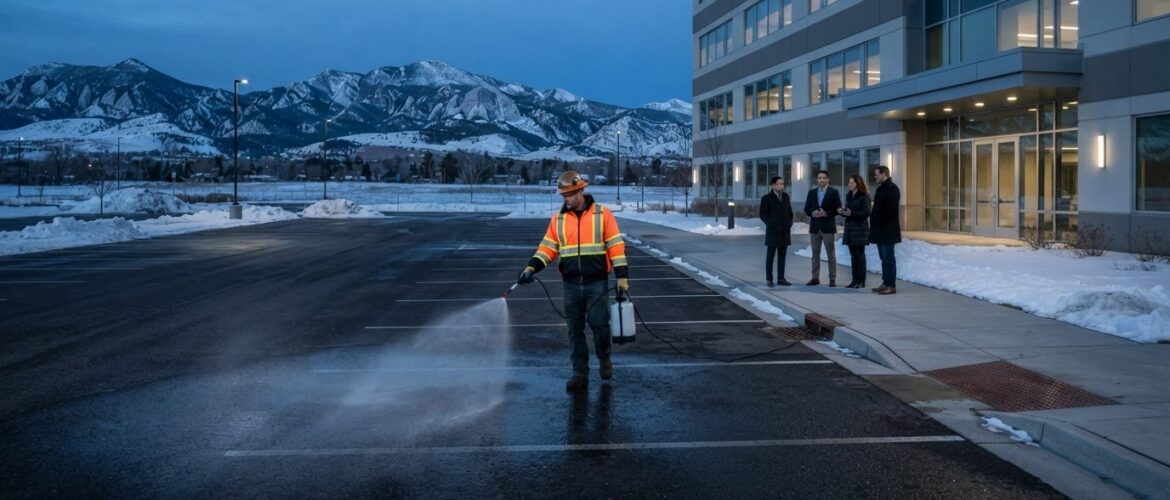
With average slip-and-fall bodily injury claims exceeding $101,000, waiting until snow coats your lot before taking action is an expensive gamble. Every Denver commercial property manager knows how quickly unpredictable Front Range temperature drops transform damp pavement into invisible black ice. Spreading dry rock salt after a storm hits rarely solves the underlying problem. It scatters across parking bays, tracks into interior flooring, damages concrete surfaces, and fails to stop hard-packed snow from fusing directly to asphalt. Implementing proactive pre-treatment for ice prevention denver businesses rely on stops this dangerous bond before winter precipitation ever starts falling.
In this guide, you will discover how commercial anti-icing eliminates hazardous freeze bonds before storms arrive, cutting post-storm chemical cleanup while safeguarding your paved surfaces. We break down the critical pre-treatment timing windows needed for Colorado freeze cycles, evaluate high-performance liquid brine solutions, and outline reliable procedures to ensure continuous safe passage for your tenants, employees, and visitors all winter long.
Key Takeaways
- Discover why applying anti-icing solutions before winter weather creates a crucial chemical barrier that stops snow and ice from bonding to commercial pavement.
- Learn how liquid brine applications outperform traditional dry rock salt by adhering directly to surfaces and resisting displacement from vehicle traffic.
- Master application timing by tracking actual pavement surface temperatures rather than ambient air forecasts to avoid chemical washouts before storms hit.
- See how professional pre-treatment for ice prevention Denver properties rely on helps fulfill local sidewalk clearance ordinances and mitigate slip-and-fall liability.
- Identify high-risk property zones, drainage corridors, and automated weather triggers to establish a dependable commercial winter safety plan.
Understanding Pre-Treatment for Ice Prevention in Denver’s Volatile Climate
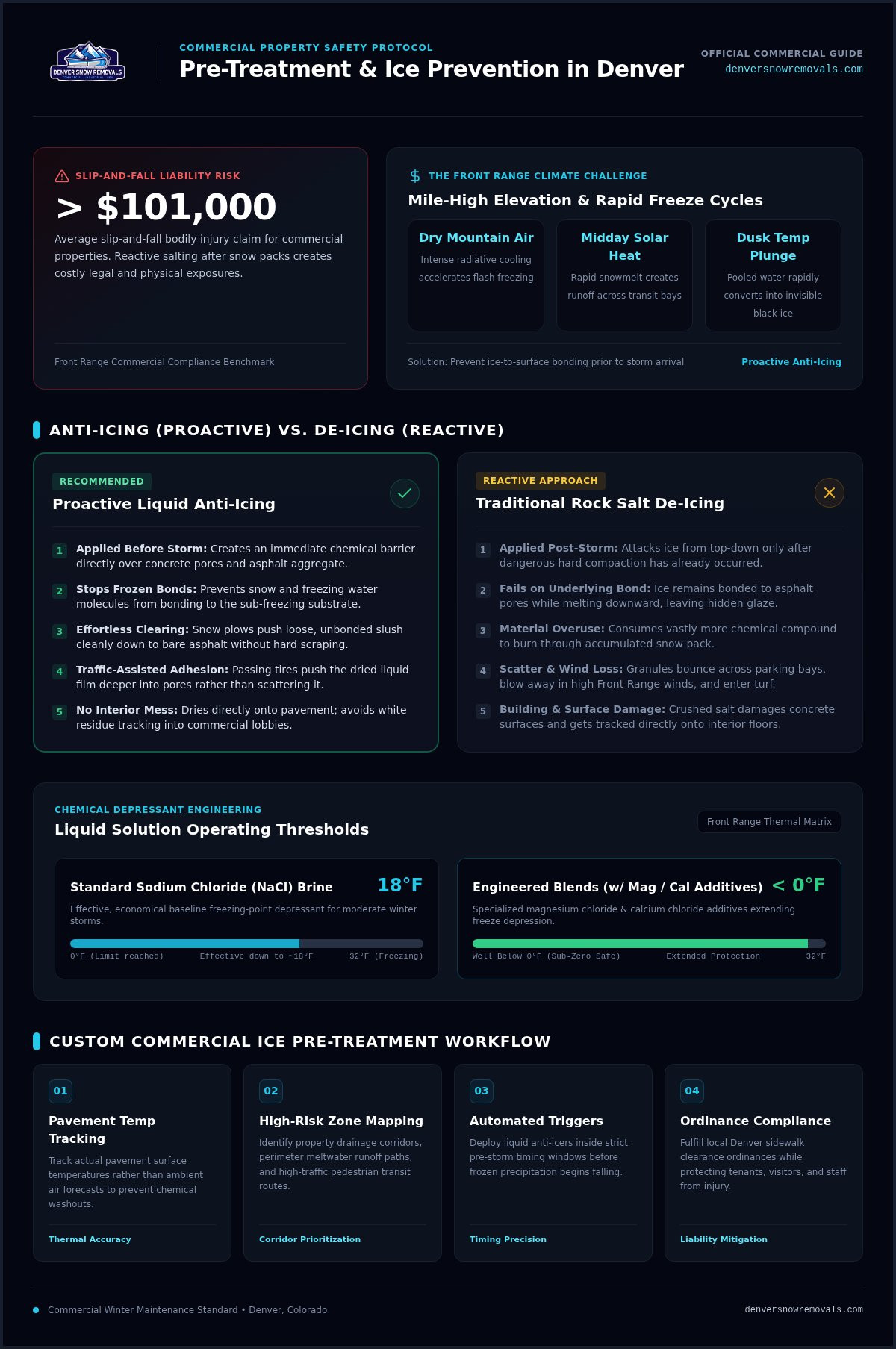
Managing winter safety on Front Range commercial properties requires a clear operational distinction between proactive anti-icing and reactive de-icing. Pre-treatment is the proactive application of liquid freezing-point depressants directly to pavement surfaces before snow or freezing rain begins falling. Unlike standard de-icing that attacks ice from the top down after hard compaction occurs, anti-icing creates an immediate chemical barrier directly over concrete pores and asphalt aggregates. Exploring standard de-icing and anti-icing methods reveals that preventing this initial frozen bond fundamentally changes mechanical clearing efficiency. When winter storms hit, snow plows push unbonded slush away effortlessly down to bare asphalt.
Because Denver sits at a mile-high elevation, dry mountain air and intense radiative cooling accelerate freeze events. Damp pavement can transition into continuous black ice within minutes as surface temperatures dip. Using liquid pre-treatment before frozen weather hits dramatically improves property safety and helps prevent unnecessary material overuse during subsequent mechanical clearing passes. Explore our comprehensive guide to Denver ice management services for commercial sites to understand complete property protection protocols.
To see how incorrect material choices and reactive treatments behave in freezing weather, watch this helpful video demonstration:
The Science of Anti-Icing vs. Reactive De-Icing
Anti-icing applies liquid brine that coats sub-freezing asphalt pores and stays in place. When frozen precipitation hits the treated surface, the liquid layer prevents water molecules from bonding to the substrate. Snow plows push the resulting loose matrix cleanly away without heavy scraping. Conversely, reactive de-icing forces solid granules to melt downward through existing pack ice, which consumes vastly more material, increases cleanup time, and leaves underlying glaze intact during active commercial traffic hours.
Why Denver Freeze-Thaw Cycles Demand Proactive Care
Denver experiences intense solar radiation during midday, frequently driving daytime pavement temperatures well above freezing even during cold snaps. Runoff from melting perimeter snow piles streams across parking bays and pedestrian walkways. As the sun drops behind the Front Range mountains at dusk, surface temperatures plunge rapidly, transforming pooled meltwater into severe glaze. Proactive liquid barriers applied as pre-treatment for ice prevention Denver facilities depend on maintain depressed freezing thresholds across high-traffic transit routes, preventing flash freezing during these sharp evening shifts.
Comparing Pre-Treatment Solutions: Liquid Brines vs. Granular Compounds
Selecting the right product configuration determines whether winter surface hazards disappear or multiply. Traditional dry rock salt scatters across driving lanes, bounces into turf borders, and blows away in high Front Range winds before melting begins. In contrast, specialized liquid brines dry directly onto concrete and asphalt surfaces. Passing vehicle tires crush dry granules, but traffic actually helps spread dried liquid film deeper into pavement pores. Choosing the right pre-treatment for ice prevention Denver properties require depends on weather forecasts, surface temperatures, and traffic volume.
Liquid Anti-Icing Brines and Engineered Blends
Standard sodium chloride brine serves as an effective, economical baseline down to roughly 18 degrees Fahrenheit. When temperatures drop lower, engineered blends with magnesium chloride or calcium chloride additives extend freezing depression well below zero. Because liquid anti-icers dry directly onto the pavement, tenants and visitors won’t track white residue into interior lobbies. Uniform distribution requires dedicated spray rigs with calibrated ground-speed controllers to ensure exact application rates across parking bays and loading docks.
Treated Solid Compounds and Pre-Wetted Rock Salt
Solid de-icers still play a specific operational role when used correctly. Pre-wetted rock salt combines solid granules with an active liquid brine coating. This coating accelerates chemical activation while stopping material from bouncing off driving lanes. Pure dry salt struggles in Denver’s low-humidity climate because it requires ambient moisture to dissolve and begin melting. For multi-day storms, pre-wetted and treated solid compounds provide sustained residual melting power after heavy accumulations start.
Protecting Concrete Infrastructure and Surrounding Landscapes
Excessive chloride runoff corrodes decorative masonry, causes concrete surface spalling, and damages landscape plantings. Precision liquid pre-treatment dramatically reduces overall chemical volume, curbing corrosive runoff into municipal Denver storm drainage systems. Snow Removal Denver brings over 44 years of family-owned experience protecting commercial parking assets with modern equipment. Partner with our team to secure safe passage and integrate targeted anti-icing into your ongoing commercial snow removal Denver program.
Critical Application Timing Windows for Front Range Winter Storms
Timing determines whether anti-icing succeeds or washes down the drain. Applying chemical barriers too early risks tracking losses from vehicular traffic, while applying them too late permits hard ice bonding. Successful pre-treatment for ice prevention Denver properties need follows a strict operational sequence:
- Step 1: Monitor pavement surface temperature. Asphalt and concrete retain radiant heat differently than ambient air, dictating chemical melt behavior.
- Step 2: Track precipitation start times and moisture type. Radar monitoring identifies whether the storm begins as rain, sleet, or dry snow.
- Step 3: Apply liquid pre-treatment within 2 to 24 hours. This window allows the liquid carrier to evaporate, leaving active crystalline anti-icing protection bonded to the pavement.
- Step 4: Inspect high-traffic pedestrian transition points. Ramps, shaded walkways, and exterior entrance aprons require early verification before freezing starts.
Pavement Temperature vs. Ambient Forecast Monitoring
Standard smartphone weather apps display ambient air temperatures, not actual pavement conditions. On sunny winter afternoons, black asphalt can measure 15 degrees warmer than the surrounding air. Conversely, shaded concrete remains sub-freezing long after air temps rise. Field technicians use infrared surface thermometers to measure ground temperatures directly. If pavement drops into single digits, crews must integrate specialized low-temperature accelerator additives to maintain chemical reactivity before precipitation starts.
Managing Denver Upslope Weather and Rain-to-Snow Transitions
Front Range winter weather regularly produces upslope wind patterns that push moisture against the foothills. These storms often start as cold rain before temperatures collapse into snowfall. Spraying liquid anti-icing chemicals during active rainfall washes the brine directly into gutters, completely wasting the application. Commercial crews must time deployments to target the narrow crossover window right before rainfall shifts into freezing precipitation. Prepare your commercial site ahead of volatile weather using our winter storm preparedness for Denver business continuity checklist.
Surface Preparation and Pavement Sweeping Requirements
Direct contact between the anti-icer and the pavement surface is non-negotiable. Accumulated gravel, trash, leaves, and parking lot grit intercept spray droplets and prevent chemicals from entering asphalt micro-pores. Sweeping commercial lots prior to winter weather ensures direct chemical bonding. Most importantly, never spray anti-icing liquids over existing hard-packed ice. Anti-icing works strictly as a preventative barrier; applying it on top of glaze creates a dangerously slick liquid film without providing anti-bonding benefits.
Commercial Slip-and-Fall Liability and Denver Regulatory Compliance
Premises liability cases in Colorado place a heavy legal burden on commercial property managers. Under state law, business owners owe invitees, including shoppers, office tenants, and delivery personnel, the highest duty of care. If someone slips on an icy walkway, proving that your facility took reasonable steps before the storm began becomes your primary legal defense. Proactive pre-treatment for ice prevention Denver facilities use establishes documented proof of care against predictable freeze hazards. Denver municipal codes also mandate clear, accessible paths of travel along all public sidewalk frontages, backed by municipal fines for non-compliance.
Mitigating Colorado Premises Liability Risk
Colorado courts examine whether a property manager knew, or reasonably should have known, that hazardous surface ice would form. Freezing temperatures following snow melt are entirely foreseeable along the Front Range. When property owners skip preventative measures and wait for injuries to occur, liability exposure spikes dramatically. Applying anti-icing barriers prior to freezing conditions proves an established standard of care, showing that ownership actively worked to prevent hazardous glaze before pedestrians set foot on the property.
Targeting High-Risk Pedestrian Pathways and ADA Ramps
Slip-and-fall incidents concentrate around specific architectural vulnerability zones. Pavement pre-treatment must prioritize the following commercial areas:
- ADA Access Ramps and Curb Cuts: Sloped surfaces double the risk of slip incidents. ADA regulations require accessible routes to remain consistently safe and usable.
- Shaded Northern Building Exposures: Shadowed concrete receives zero radiant solar heating, allowing refrozen meltwater to persist throughout working hours.
- Parking Garage Thresholds: The transition point where covered parking structures meet exposed outdoor driving ramps creates sudden, unexpected freeze lines.
- Primary Building Entrances: Exterior steps, pavers, and high-traffic vestibule walkways demand uninterrupted chemical coverage before morning business hours.
Documentation, Timing Logs, and Service Verification
Should a slip incident occur, contemporaneously recorded operational data serves as your strongest legal shield. Snow Removal Denver equips its commercial fleet with digital tracking tools to record precise dispatch times, surface temperature readings, application volumes, and weather conditions. Backed by over 44 years of family-owned experience, our teams deliver dependable ice management across Denver, Aurora, and Lakewood. Review comprehensive risk mitigation strategies in our proactive ice management services in Denver guide. To protect your commercial facility from winter liability risks, request a professional winter service consultation today.
Developing a Custom Commercial Ice Pre-Treatment Plan
Every commercial facility presents unique structural challenges during winter weather. Crafting an effective safety strategy requires assessing property topography, drainage patterns, and pedestrian bottlenecks before storms develop. Establishing an ongoing seasonal program for pre-treatment for ice prevention Denver commercial facilities rely on transforms chaotic emergency calls into a dependable, automated site defense.
Site Hazard Mapping and Drainage Assessment
A comprehensive site assessment uncovers dangerous drainage hazards before freeze events happen. Site mapping addresses specific operational vulnerabilities across your property:
- Low-Lying Asphalt Depressions: Pavement dips collect melted runoff, creating deep sheets of black ice during evening refreezes.
- Rooftop Downspout Discharge: Roof drainage routed directly onto pedestrian sidewalks creates continuous freeze zones that need structural redirection or dedicated treatment lines.
- Strategic Snow Storage Zones: Designating perimeter snow storage areas away from high-traffic pedestrian paths prevents melting snowdrifts from weeping back across driving lanes.
Commercial Service Triggers and Storm Thresholds
High-turnover retail complexes, medical offices, and industrial distribution centers cannot afford operational shutdowns. Successful winter management relies on automated dispatch triggers. Rather than waiting for snow accumulation thresholds, commercial systems deploy crews whenever pavement temperature models and precipitation forecasts indicate freeze risks. Combining proactive liquid anti-icing barriers with scheduled mechanical clearing keeps surfaces accessible and prevents compacted pack ice from gripping the pavement.
Over 44 Years of Dedicated Denver Metro Reliability
Dependable field execution requires commercial equipment and seasoned local insight. Snow Removal Denver operates a specialized fleet including heavy trucks, front-end loaders, and calibrated liquid spreaders designed for commercial coverage. With over 44 years of family-owned experience, our crews monitor conditions across Denver, Aurora, and Lakewood to provide uninterrupted safe passage. Eliminate winter anxiety by partnering with local winter specialists. Contact Snow Removal Denver for reliable commercial snow plowing and professional ice management today.
Secure Your Commercial Property with Proactive Ice Defense
Waiting for winter weather to coat your parking lot creates unnecessary hazard exposure and inflated cleanup costs. Proactive anti-icing breaks the freeze cycle before it starts. By preventing snow and ice from bonding to paved surfaces, precision liquid applications keep pedestrian corridors clear and make mechanical plowing significantly more efficient. Implementing dependable pre-treatment for ice prevention denver commercial properties require protects delicate concrete infrastructure, curtails interior lobby mess, and shields your business against premises liability claims.
Snow Removal Denver delivers dependable winter protection backed by over 44 years of family-owned experience. Our heavy equipment fleet, including commercial trucks, front-end loaders, and calibrated liquid spreaders, remains ready to ensure safe passage across the Denver Metro. Take control of Front Range winter storms before the next freeze arrives. Request a Commercial Snow and Ice Pre-Treatment Estimate today and keep your commercial facility accessible, compliant, and safe all season long.
Frequently Asked Questions
How far in advance should pre-treatment be applied before a Denver snowstorm?
Pre-treatment should be applied between 2 and 24 hours before winter weather begins. This timing window allows liquid anti-icing solutions to dry onto the pavement surface, leaving behind active crystalline protection. Applying liquid brine too early increases the risk of loss from continuous vehicle friction, while applying it too late prevents proper bonding before frozen precipitation covers asphalt pores.
Can liquid brine wash away if it rains before turning to snow?
Yes, steady rainfall can dilute and wash away liquid brine solutions into storm sewers. In Denver, upslope weather patterns frequently produce a transition from rain to snow. Experienced commercial crews monitor radar models to identify this exact transition point, spraying liquid pre-treatment for ice prevention denver properties require just as precipitation changes from liquid rain to frozen sleet or snow.
What is the primary difference between anti-icing pre-treatment and de-icing?
Anti-icing is a proactive measure applied before a storm to stop ice from sticking to the pavement. De-icing is a reactive process performed after snow accumulates, where crews apply solid rock salt or chemical compounds to burn through existing ice layers from the top down. Anti-icing uses significantly less chemical volume and prevents dangerous hard-packed glaze beneath accumulated snowfall.
Does pre-treatment damage concrete sidewalks and asphalt parking lots?
Properly calibrated liquid pre-treatment causes far less surface deterioration than heavy, reactive rock salt applications. Liquid anti-icers reduce total chloride exposure and eliminate the mechanical grinding effect of dry salt crystals underfoot. However, newly poured concrete should be protected with specialized, non-corrosive chemical blends during its first year of curing to prevent flaking and spalling.
Is ice pre-treatment effective against Denver black ice formations?
Pre-treatment provides exceptional protection against recurring black ice hazards. In Denver, intense afternoon sunlight melts snow piles, sending water across parking stalls before dusk brings rapid freezing. Applying proactive liquid barriers depresses the freezing threshold of that runoff, preventing dangerous, invisible glaze from bonding to shaded pedestrian ramps, drive lanes, and outdoor commercial walkways.
Will pre-treatment eliminate the need for snow plowing during a heavy storm?
No, pre-treatment does not melt heavy snow accumulations on its own. Instead, it prevents fallen snow from bonding to the sub-freezing pavement beneath. When heavy snowfall accumulates, commercial snow plows clear the unbonded snow down to bare asphalt much faster and cleaner, eliminating residual hard-packed ice ridges that create severe slipping hazards for visitors.