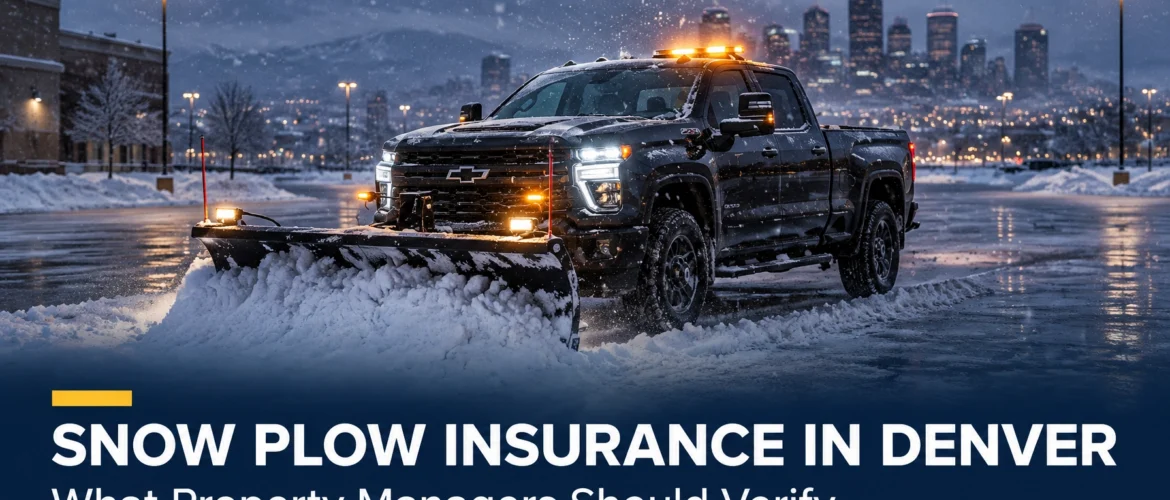
At 2 AM, a plow truck is backing through your Downtown lot while tenants are due in at 6. You have a signed service agreement, but do you know whether the contractor’s insurance actually covers snow and ice work, or whether your property is named on the policy?
When considering a contractor for snow removal denver, it’s crucial to ensure they have adequate insurance coverage.
Choosing the right contractor for snow removal denver is vital for maintaining safety and accessibility during the winter months.
Snow plow insurance is not one policy. It is a combination of coverages and policy endorsements that may apply to different parts of a commercial snow contractor’s work, including snow removal denver. Before hiring, check the coverage types, request the endorsements that support your contract, and confirm the paperwork is current. A certificate of insurance (COI) is a useful starting point, but it is not the coverage itself.
Understanding the specifics of snow removal denver will help you make informed decisions about your service provider.
What snow plow insurance should cover
A commercial snow contractor should be prepared to explain how its insurance applies to plowing, de-icing, equipment, vehicles and employees. The main coverages to review are general liability, commercial auto and workers’ compensation; an umbrella or excess policy may also be required by your contract.
In addition, ask for examples of past snow removal denver projects to gauge the contractor’s experience.

Commercial general liability
Commercial general liability (CGL) may respond to certain third-party injury or property-damage claims tied to the contractor’s work. But don’t assume a standard policy automatically covers snow operations. Ask the contractor or its insurance agent to confirm, in writing, that the policy covers snow and ice management, including the services you are hiring them to perform.
Ensure that the contractor has experience with snow removal denver, specifically focusing on high-traffic areas.
Ask whether the policy includes both ongoing operations and completed operations coverage. The latter may matter if an incident is reported after the crew has finished its visit. The actual policy wording and endorsements control, not a sales description or a checked box on a certificate.
Commercial auto
Commercial auto coverage applies to vehicles used for work, including plow trucks. Ask whether the policy covers the contractor’s owned vehicles and whether hired or non-owned vehicles are included if they may be used on your property.
Also ask the agent to confirm that the plowing work and any equipment mounted to the trucks are addressed appropriately. A policy covering a truck does not, by itself, answer every question about the work the truck is doing.
It’s crucial that the contractor’s commercial auto policy specifically covers vehicles used for snow removal denver.
Workers’ compensation
Workers’ compensation generally covers eligible work-related injuries to a contractor’s employees. Colorado’s Department of Labor and Employment provides information on employer coverage requirements; ask the contractor for current proof and verify what applies to its workforce. If the contractor says it has no employees or claims an exemption, ask for documentation and confirm it with your risk adviser.
Workers’ compensation is especially important when hiring for snow removal denver, as it protects both parties involved.
This coverage matters to your property, too: a contractor’s injured worker can create complicated questions about who is responsible and which policies may apply.
Umbrella or excess liability
An umbrella or excess policy may provide additional limits above certain underlying policies. Some commercial property contracts require it; the amount depends on your contract, site, and risk requirements. Ask whether it follows the relevant underlying coverage and whether any additional-insured requirements extend to it.
Having an umbrella policy can be beneficial for larger snow removal denver projects that carry higher risks.
There is no single limit that fits every Denver site. A large retail center, an office campus and a small commercial lot can have different contract requirements. Set limits with your broker or attorney rather than relying on a generic number.
Why the paperwork protects your property, not just the contractor
Verified coverage can give your property another potential source of defense and payment if a claim involves the contractor’s work. Without appropriate coverage, or if a relevant exclusion applies, you may have to rely more heavily on your own insurance and resources.
Proper verification of snow removal denver coverage can save you from potential liabilities.
A written contract and insurance policies do different jobs. The contract sets responsibilities and requirements; the policies determine whether and how an insurer responds. Having a contractor’s name on a service agreement does not automatically make you an insured under its policy.
When the contract requires it, ask to be named as an additional insured on the contractor’s general liability policy. The endorsement, not just a note on the COI, should identify the correct legal entity and cover the relevant work. Ask your broker whether you also need completed-operations protection or additional-insured status on other applicable policies.
“Primary and noncontributory” wording may also be required by your contract. It generally addresses how the contractor’s coverage relates to your own, but the exact effect depends on the policy language. Have your broker or attorney review it before you rely on it.
Confirm that the contractor’s insurance covers the snow removal denver services you require.
How to verify a snow contractor’s insurance
To ensure smooth operations, verify the contractor’s snow removal denver credentials before severe weather hits.
A COI summarizes insurance information, but it does not change the policy or guarantee that a particular claim is covered. Request the supporting documents and verify them before work starts.

Reusable property-manager checklist
Before signing, or before the first storm, check:
Additionally, inquire about their snow removal denver process and how they handle sudden weather changes.
-
- Named insured: Does the legal business name match the name in your contract?
- Certificate holder: Is your ownership or management entity listed correctly?
Documentation of past snow removal denver performance can also be helpful in your decision-making process.
-
- Dates: Will the policies remain in force for the full service period? Record renewal dates.
- Coverage types: Are general liability, commercial auto and workers’ compensation shown, as required?
- Snow operations: Has the contractor’s agent confirmed that the relevant liability coverage applies to the snow and ice work in your scope?
Clarify if the contractor’s policy includes specific coverage for snow removal denver operations.
-
- Limits: Do the limits meet your contract and risk-management requirements?
- Additional insured: Have you received the actual endorsement naming the correct entity, not only a checked box or a description on the certificate?
- Other contract terms: Have your broker or attorney checked any primary/noncontributory or waiver-of-subrogation requirements against the policy?
Understanding any additional insured requirements for snow removal denver is also essential.
-
- Subcontractors: If the contractor may use subs, have you confirmed how their work and coverage are handled?
- Verification: Have you contacted the agent or insurer using independently confirmed contact information?
- Renewal tracking: Is there a process to obtain updated documents when policies renew during the season?
Keep records of all snow removal denver agreements and communications for future reference.
If the contractor or agent cannot provide an endorsement immediately, ask when it will be available and hold off on authorizing work until your requirements are confirmed. Keep the certificate, endorsements, contract and renewal records together. Recheck them when the policies renew, not just once in September.
For optimal performance, ensure your contractor is well-versed in snow removal denver best practices.
Denver conditions make current coverage and documentation important
Denver’s snow season typically runs from September through May, and conditions can change quickly. A warm afternoon followed by an overnight freeze can affect a lot differently than a steady snowfall. Upslope storms may bring heavier accumulations, while Downtown, Cherry Creek, Central Park and Washington Park properties can have different access patterns, traffic and clearing priorities.
Denver’s unique weather demands a reliable approach to snow removal denver to maintain safety.
Insurance does not replace a clear scope of work or reliable service records. Confirm which areas the contractor handles (such as parking lanes, loading docks, entrances and sidewalks) and how visits are recorded. Photo-documented visits can help establish what work was performed and when; they do not guarantee coverage or a particular claim outcome.
We have served Denver businesses since 1979, with commercial plowing, sidewalk clearing and de-icing, snow hauling and skid steer services. For an overview of our work, see our commercial snow removal services or 24-hour emergency snow removal in Denver.
For comprehensive solutions, check out our dedicated snow removal denver services listed on our website.
Insurance and legal disclaimer: This article is general information, not legal or insurance advice. Policy terms and requirements vary. Check your contract, city code and policy documents, and ask your attorney, insurance broker or insurer to review your specific situation.
Get a quote for your Denver property
Requesting a quote should include specifics about our snow removal denver capabilities and service expectations.
A useful quote starts with accurate site information and a clear service plan. Share your property address, a site map, preferred trigger depth and opening hours. Include any special priorities, such as loading-dock access, early tenant arrivals or areas that need de-icing. Tell us what insurance documents and endorsements your organization requires so we can discuss them during the quoting process.
We provide commercial snow removal for large parking lots, industrial properties, office campuses, retail centers, warehouses and HOA communities in Denver County. We do not service residential driveways. To discuss your site, request a quote or call 303-591-2089.
Contact us today for expert snow removal denver services tailored to your property needs.
Frequently asked questions
What insurance should a commercial snow plow contractor have?
Ask about commercial general liability that applies to snow and ice operations, commercial auto for work vehicles, and workers’ compensation as applicable to the contractor’s workforce. Your contract may also require umbrella or excess coverage. Confirm the details with the contractor’s agent and your own broker.
Is a certificate of insurance enough to verify snow plow insurance?
No. A COI is a summary, not a policy endorsement or guarantee of coverage. Review the required endorsements and ask the issuing agent or insurer to confirm that the coverage is active and fits your contract requirements.
Should a property manager be an additional insured?
If your contract requires it, ask to be named on the contractor’s policy by an actual additional-insured endorsement. Confirm the correct legal entity and review the endorsement with your broker or attorney. Being listed as a certificate holder alone does not provide the same status.
What should I do if a snow contractor uses subcontractors?
Ask who will perform work on your site and how each subcontractor is insured. Your contract and risk adviser should clarify whether you require each subcontractor to provide its own proof of coverage and endorsements, or whether the prime contractor’s policies address their work.
When should I verify a snow contractor’s insurance?
Verify coverage before signing or authorizing work, then track renewal dates and request updated documents when policies renew. For a September-to-May season, a mid-season policy expiration deserves particular attention.