
The storm ends at 9 p.m. By midnight the slush on your community’s walks has refrozen, and by 6 a.m. a resident is on the ground near the mail kiosk. The first question the board hears is simple: whose walk was that, and who was supposed to treat it?
Key takeaways
- A snow contract protects the board only when each promise can be checked in the bids, in the contract terms, and in the post-storm record.
- A bid reading “seasonal, as needed” is low because its scope is blank: no trigger depth, no walks, no de-icing, and no way to prove service.
- Send every bidder the same clause sheet and score any blank line as excluded, not as included at no cost.
- Require the insurance certificate with the bid, showing general liability, commercial auto, and workers’ compensation, with the association named as additional insured where the carrier allows.
- Each storm log entry should record trigger reading, times, areas by contract name, passes, materials, and crew signature, and be filed with that storm’s invoice.
A snow contract answers that only if the board can check every promise in it. “Seasonal, as needed” can’t be checked. After 47+ years clearing lots across the Denver Metro, we have watched boards sign on a low total and find out what it left blank after the first claim.
This article is for the board that wants to avoid that. It covers what goes into an HOA snow removal contract in Denver, how to line bids up fairly, and what record to keep after each storm.
Build the HOA Snow Removal Contract Around Promises You Can Check
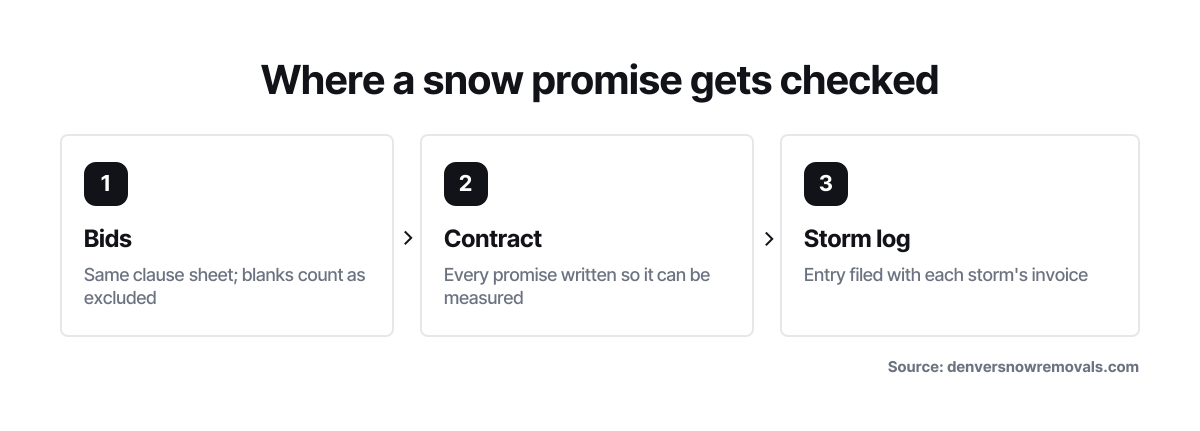
A clause protects the board only when someone can verify it three times: in the bids before signing, in the contract terms, and in the record after each storm. If a promise fails any of the three, it is a hope, not protection.
Take a typical townhome association. It has a shared drive loop, front walks that meet the common sidewalk, a guest lot where piled snow eats parking spaces, and a path to the mail kiosk. The board asks for bids and gets three.
The lowest reads “seasonal, as needed.” It sets no trigger depth, so nobody can say when the crew must show up. It names no walks and includes no de-icing. The middle bid plows the drive and the guest lot, leaves the walks out, and bills de-icing separately. The highest names every area, states a trigger depth and where it is measured, starts the response clock from that trigger, and commits to a storm log and an insurance certificate.
On a spreadsheet, the lowest total wins. But it is low because its scope is blank, not because the contractor is more efficient. Nothing under it lets the board prove that anyone cleared the kiosk path at 4 a.m. after a refreeze. The middle bid looks fuller, yet it leaves the walks, where most falls happen, as someone else’s problem. The board is close to signing on the total before anyone asks what the total covers.
The highest bid is not automatically the right one. But it is the only one the board can hold to a standard, and the other two can be fixed by asking for the same detail.
What to Write Into an HOA Snow Plowing Contract in Denver
Start with the declaration and bylaws. They decide which clearing duties sit with the association and which sit with owners. In many communities the association handles common walks, drives, and guest lots, while owners handle their own front walks and driveways. Others split it differently. Whatever your documents say, the contract should mirror them, so the board is not paying for areas it does not own or leaving out areas it does.
Here are the terms this example forces the board to write. They are the core HOA snow plow contract terms, and each one can be checked:
- Service map. Every area by its own name: common walks, drives, guest lots, the mail-kiosk path, and any frontage sidewalk. Each is tied to who owns it under the declaration.
- Contract model and pricing structure. Read the per-push or seasonal contract structure comparison first, because the model decides how much the scope has to spell out.
- Trigger depth and measurement point. A depth in inches, and the spot where someone takes the reading.
- Response start. The clock runs from the trigger, not from whenever the contractor is ready. Who answers an overnight storm call matters here, because the clause is tested at 3 a.m. not at noon.
- De-icing. Which materials, where, and re-treatment after a refreeze.
- Pass limits. How many passes the price covers and how extra passes are billed.
- Hauling. Who removes piled snow when the guest lot fills, and what triggers it.
- Log format and delivery. What each entry holds and when the board gets it (more on that below).
- Insurance on file before the first storm. General liability, commercial auto, and workers’ compensation, with the association named as additional insured where the carrier allows it.
- Term, renewal, and termination. Including your right to end the contract for missed service.
- City deadlines. Any clearing deadline tied to sidewalk rules.
That last item needs care. Sidewalk and driveway clearing rules in Colorado are set mostly at the city and county level, not by one statewide standard, and the owner or occupant is usually the one the rule reaches. Denver’s requirement and the requirement of any other metro city your community sits in can change. Confirm the current rule with counsel before any deadline goes into the contract, so you don’t promise a standard the ordinance no longer uses.
Ask for the insurance certificate itself, not a verbal assurance. A contractor that says it is fully insured should hand over a certificate showing each coverage type, and your board should read the lines instead of assuming them.
Managers who sign for owners on apartment community snow removal in Denver face the same contract logic, so the same list applies.
How to Compare HOA Snow Removal Bids on Equal Terms
Price nothing until every bid answers the same clause sheet. Use the terms above: trigger, response start, areas by name, materials, passes, hauling, log, and insurance certificate. Send that sheet out with the request, so every contractor fills in the same blanks.
Then treat a blank line as excluded, not as included at no cost. If a bid says nothing about hauling, the board should score hauling as not offered and ask for a price. A bid that stays silent is not offering a free service.
Headline price ranges tell you little on their own. You can only compare bids when each one is priced against the same written scope, and one total built on a blank is not the same product as a total built on a named service map. For how structures differ once the scope is fixed, read how contract pricing is built for Denver lots.
Ask for the insurance certificate with the bid, not after award. A contractor who cannot produce it before you choose will not produce it faster once you’ve signed.
Have the board minute the comparison. The minutes should list each bid and the scope it was scored against, so a later reader can see why one was chosen and what the board knew.
Timing helps you here. The 2026–27 season is already underway, and a board that signed for this winter can carry the same clause sheet into the 2027–28 bid cycle. If you haven’t signed yet, you can still add the missing terms by amendment before the next heavy storm.
This does not make the cheapest compliant bid the best contractor. A clause sheet shows what is promised, not whether the crew shows up, which is why the record after each storm matters.
Keep a Service Log for Community Snow Removal That Protects the Board
A log is proof of the community snow removal service the board is paying for. Without it, the board has an invoice and someone’s word. With it, the board can show what was cleared, when, and by whom.
Each storm entry should capture:
- the trigger reading and where it was taken
- the time the contractor was called
- the time the crew started
- the time the crew finished
- the areas cleared, by their contract names
- the number of passes
- the materials applied
- the crew lead’s signature
File each entry with that storm’s invoice. The board then sees the charge and the proof side by side, and it can question a bill before paying it.
A storm entry that shows when the trigger was met, when the crew arrived and finished, which areas it cleared, and who signed is a record a board can produce after a claim. A verbal report that the lot was plowed is not.
The log has limits. It documents what was done and when, and it supports the board’s position. It does not prevent falls, and it does not settle a claim by itself. Have counsel review any liability wording before you publish a log format or put it in a resident notice.
If your board is ready to compare bids on one written scope, request a bid for your community and include the service map, trigger and response terms, materials, a sample log, and the insurance certificate you expect to see.
Frequently asked questions
Does an HOA pay for snow removal?
It depends on what the declaration and bylaws say. In many communities the association pays for common walks, drives, and guest lots out of dues, while owners clear their own front walks and driveways. Read your documents first, then write the contract so it matches that split.
How much is a typical HOA snow removal contract?
A single figure says little, because the price depends on the areas covered, the trigger depth, the number of passes, de-icing, and hauling. Two totals are only comparable when both are priced against the same written scope. Send every bidder one clause sheet and compare the answers.
What are the snow removal rules for driveways and sidewalks in Colorado?
Rules are set mostly by cities and counties, not by one statewide standard, and they usually reach the owner or occupant. Check the current Denver requirement, or that of your own city, with counsel before putting any deadline in the contract.
What insurance should a snow contractor show the board?
Ask for a certificate listing general liability, commercial auto, and workers’ compensation. Also ask whether the association can be named as additional insured, where the carrier allows it. Get the certificate with the bid, before the first storm.