
Snow stops falling, the sun comes out, and a property manager assumes the city’s 24-hour rule gives them the day. For a residential sidewalk, that’s roughly right. For a retail center, an office campus or an apartment community with long street-facing walks, it’s the wrong clock.
Key takeaways
- Denver’s 24-hour sidewalk rule applies to residences; commercial and non-residential properties face a much tighter window, so managers shouldn’t treat 24 hours as theirs.
- Enforcement runs on complaints: a notice, a short window to comply, a re-inspection, and only then a fine, reported at about $150.
- The fine is the smallest exposure, because slip-and-fall liability is separate and can follow an injury on an uncleared walk.
- Hiring a snow contractor moves the labor but not the responsibility, so the contract should state response triggers, a clear-by hour and sidewalk scope.
- Service logs with timestamps and de-icing records help document that a property met its duty after a fall.
We’ve plowed commercial lots in Denver County for 47+ years, and the same misunderstanding comes up every winter. This article walks through how the Denver sidewalk snow removal rule works for a commercial property, who the city holds responsible, and where the real money is at risk. None of this is legal advice. For the exact wording of the ordinance, check the City and County of Denver’s current rules.
How the Denver Sidewalk Snow Removal 24-Hour Rule Works in Practice
Take a typical case. You manage a mid-size retail center or an apartment community with a few hundred feet of sidewalk along a busy street. Snow stops falling at 6 PM on a Tuesday.
Here’s how the evening and next morning play out:
- Tuesday, 6 PM: The snow ends, and the clock starts from that moment, not from when the storm began.
- Tuesday night: Pavement temperatures drop, and anything left on the walk gets packed down by foot traffic and refreezes into ice.
- Wednesday, 7 AM: Tenants leave for work and customers show up at the first open door. Nobody checks a legal deadline before they step onto your sidewalk.
- Wednesday, 6 PM: This is when a residential property’s 24 hours would run out.
That last line is the one managers get wrong. The 24-hour window belongs to residences. Commercial and non-residential properties are held to a much tighter standard under the city’s rules, so you can’t treat Wednesday evening as your deadline. Read the city’s current language for the exact commercial window, and plan well inside it.
When the clock starts and how fines actually get triggered
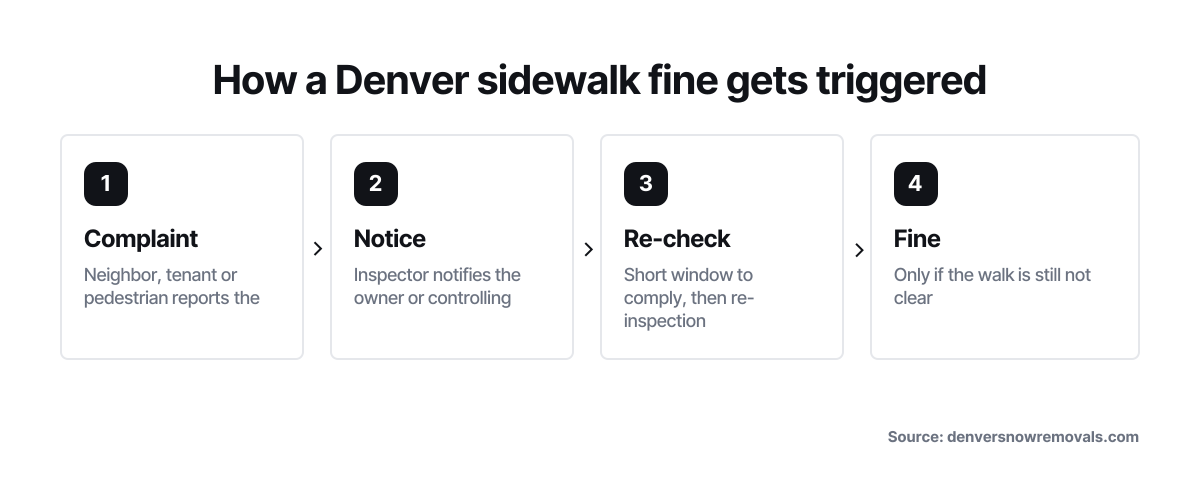
The clock starts when snowfall ends, and enforcement is largely reactive. Denver doesn’t send inspectors down every street looking for uncleared walks. It responds to complaints.
Here is the path, as it’s generally reported:
- A neighbor, a tenant or a pedestrian reports your sidewalk.
- An inspector issues a notice to the owner or the party in control of the property.
- You get a short window to comply: hours for a business, about a day for a residence.
- The inspector comes back and re-checks.
- If the walk is still not clear, a fine follows. Coverage puts it at about $150, but treat that as a reported figure and look at the city’s current fine schedule before you budget around it.
Notice what has to go wrong for you to be fined. Someone has to complain, you have to ignore the notice, and the walk has to still be bad when the inspector returns. So yes, it’s hard to get fined.
That is exactly why the fine is the smallest part of your risk.
A fine is a one-time cost you can see coming. An injury claim is not. Most sidewalk falls happen well before any complaint becomes a notice, and the person who falls doesn’t wait for an inspector’s second visit.
“Cleared” also has a meaning, and it isn’t “mostly clear.” We read it as a usable path down to the pavement, wide enough for two people to pass. A dusting left on top of ice doesn’t count, and neither does a shoveled strip that ends at an uncleared curb. Curb ramps and crosswalk corners are part of the walk, and they’re the spots where plows push snow back in, so they’re the spots we check last and hardest.
Here’s the practical takeaway. The legal clock is the maximum, not the target. Your tenants and customers walk the sidewalk at 7 AM, so that’s the deadline you actually work to, and any contractor you hire should be working to it too.
Who Has to Shovel: Owner, Tenant, HOA or Contractor
The duty falls on the owner or the person in control of the adjacent property. It does not fall on the city, and Denver doesn’t shovel sidewalks along private frontage. If your property touches a public sidewalk, you’re the one who clears it.
A lease or an HOA covenant can push the task onto a tenant or an association. That helps internally, but the owner stays the party the city looks to unless the paperwork is clear about who controls the walk. If you’re a manager, read your lease language before the first storm, not after the first notice.
Hiring a contractor moves the labor. It does not move the responsibility. If our crew misses a walk, the notice still lands on your desk, and a good contract has to say so plainly. Yours should spell out three things:
- the snowfall depth that triggers a response.
- the hour by which sidewalks must be clear, and
- exactly which walks, ramps and corners are in scope.
Sidewalk scope is where vague contracts fail. “Parking lot plowing” doesn’t automatically mean the public walk along your frontage, so write it down.
Don’t assume Denver’s clock follows you across the metro, either. Other Front Range jurisdictions run on their own rules. Some counties have no shoveling ordinance at all, and some towns allow 48 hours. If you manage properties in more than one city, check each one separately, because a portfolio-wide “24-hour policy” will be wrong somewhere.
Then there’s the question we hear from HOA boards: can you be sued for not shoveling? Yes. Liability for an injury is separate from a city fine, and it can follow from a neglected walkway whether or not anyone ever filed a complaint. A paid fine doesn’t settle an injury claim, and a clean inspection record doesn’t prevent one. Your attorney and your insurer can tell you how that works for your property specifically.
Beyond the Fine: Slip-and-Fall Liability and Getting Sidewalks Cleared on Time
Your real exposure is an injured person, not a citation. When someone falls on your walk, the questions that follow are about what you knew, when you knew it and what you did about it.
That’s where documentation earns its keep. Service logs with timestamps, records of when the crew arrived, what was cleared and when de-icing went down, give you a record that the property met its duty. It doesn’t guarantee you win a claim, and it can’t fix a walk that was never cleared. But a property with a dated record of timely response is in a far better position than one relying on someone’s memory.
We built our operation around that. We run commercial equipment, not pickup trucks: a newer Chevy 2500HD fleet with commercial Boss plows, skid steers and de-icing equipment. We are actually 24/7, with staffed dispatch from September to May, so a storm that ends at 2 AM gets the same response as one that ends at 2 PM. If you want to know who actually shows up at 2 AM, that’s the difference between a dispatcher who answers and a voicemail box. The aim is walks cleared before your opening hours, not at the edge of the legal window.
We work on large lots, industrial parks, office campuses and HOA communities, not residential driveways. If you’re after a one-off driveway clear, we’re not the right call.
Your contract choice affects timing more than most managers expect. A per-push or seasonal contract decides how quickly your property gets into the queue and what triggers a visit, and that bears directly on whether sidewalks are clear inside the window. We also price up front, so you know the number before the first flake. Our guide to what commercial snow removal costs in Denver lays out how those figures come together.
If your sidewalks have sat uncleared on a Wednesday morning even once, that’s your cue. Call us for a sidewalk and lot walkthrough, and we’ll walk the frontage, flag the ramps and corners, and give you an up-front quote before the next storm.
Frequently asked questions
Can I be sued if I don’t shovel my sidewalk?
Yes. Injury liability is separate from city fines, and it can follow from a neglected walkway even if no one ever complained to the city. Documented service logs help, but they don’t guarantee the outcome of a claim. Talk to your attorney and insurer about your specific property.
Who is responsible for snow removal on a city sidewalk?
In Denver, the owner or the party in control of the adjacent property is responsible, not the city. The city doesn’t shovel sidewalks along private frontage. A lease or HOA covenant can assign the task to a tenant or association, but the owner is still who the city looks to unless the paperwork is clear.
Does Denver’s 24-hour rule apply in Aurora, Lakewood or other nearby cities?
Don’t assume it does. Front Range jurisdictions set their own rules: some counties have no shoveling ordinance, and some towns allow 48 hours. Check each city’s current ordinance for every property you manage.
Can a 70-year-old man shovel snow?
Some can, but heavy, wet snow puts real strain on the heart and back, and age raises that risk. Anyone with a heart condition or other health concern should ask a doctor first. For a commercial property, this is a job for a crew with equipment, not a person with a shovel.