
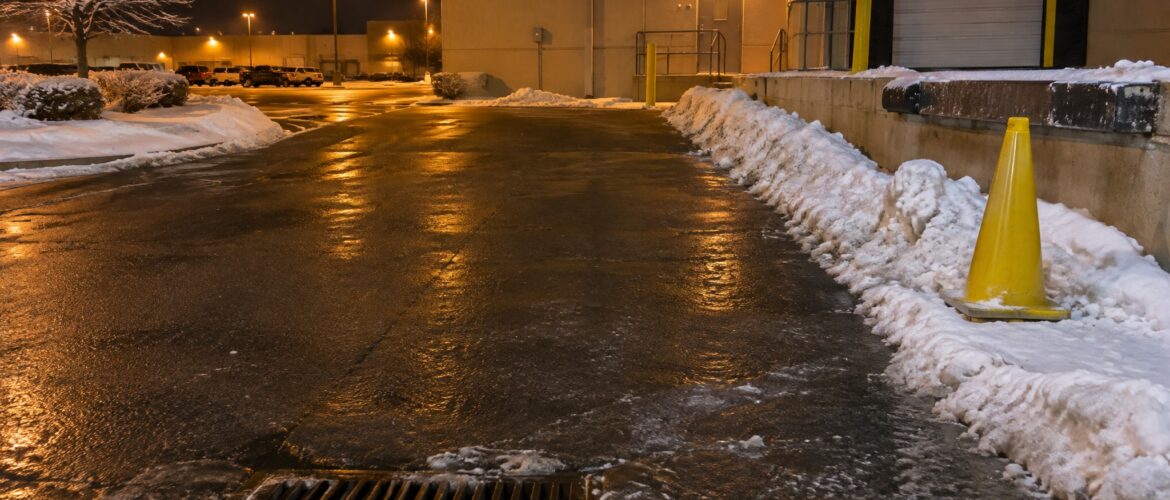
The snow stopped around midnight. The temperature is dropping, the melt on your lot is turning to glaze, and your tenants arrive in a few hours. This is the moment a snow contract either works or doesn’t.
Most contractors say they cover emergencies. Fewer can show you who answered the phone, when the crew arrived, and what the entrance looked like before and after. We wrote this guide for property managers, HOA boards and owners of industrial parks, warehouses, office campuses and retail centers who want emergency snow removal in Denver that holds up under scrutiny.
What Emergency Snow Removal in Denver Actually Means
Emergency snow removal is a call-out outside the normal plan. It happens mid-storm, overnight or before opening, when accumulation or ice threatens access and safety on a private commercial lot.
City plows don’t solve this. Public crews work public streets, and they don’t clear your parking lot, your loading docks or your sidewalks. Your lot is your responsibility, and so is the condition of every walkway on it at 6 AM.
Emergency call-out vs. a routine scheduled push
A routine push follows a plan. The snow hits an agreed trigger, the crew comes through on schedule, and the lot is cleared in the order you set up beforehand.
An emergency call-out breaks that rhythm. Maybe heavy drifting buried an entrance after the first pass. Maybe meltwater refroze across a walkway, or a late band of snow arrived an hour before your doors open. Either way, you need a crew now, not at the next scheduled window.
That difference is why emergency coverage needs its own dispatch, its own equipment readiness and its own paper trail. A contractor built only for scheduled pushes will struggle when the schedule stops mattering.
Why “24/7” Claims Fall Apart at 2 AM
Every snow contractor’s website says 24/7. Very few of them mean that a person with authority over a crew is awake, at a desk, and ready to send a truck.
We are actually 24/7. From September to May, our dispatch is staffed around the clock, and that includes the hours when nobody else is picking up.
The answering-service problem
A phone number is not a dispatch. If your call lands in voicemail, or with a third-party answering service that takes your name and promises a callback, nothing is moving yet. The crew doesn’t know about you, and the clock keeps running while ice forms on your front walk.
You can test a contractor’s claim before you sign. Call at an awkward hour, such as 2 AM on a weeknight, and note what happens. Then ask three things:
- Who answered, and do they work for the contractor or for a call center?
- Can that person reach a crew supervisor directly?
- Where are the trucks and equipment while you wait for a callback?
A real dispatcher can answer all three without putting you on hold.
Pickup trucks vs. commercial equipment
The second way a “24/7” claim falls apart is the equipment. A pickup with a blade can handle a small residential driveway. It is the wrong tool for a large lot with islands, loading zones and snow that has been packed down by morning traffic.
We run commercial equipment, not pickup trucks with a hobby blade. Our fleet is newer Chevy 2500HD trucks fitted with commercial Boss plows, backed by skid steers for tight corners, docks and entrances, plus de-icing equipment for the ice that plowing leaves behind.
If you manage a large lot, ask what machines will actually arrive, because the answer decides whether the job takes one visit or three.
How Photo Proof Works and Why Property Managers Need It
A plowed lot looks the same to everyone by noon. What matters later is what happened at 2 AM, and whether anyone can show it.
Photo documentation turns a snow visit into a record. When a tenant complains, a board member asks questions or an insurer requests details, you hand over facts instead of memories.
What a good proof record includes
Each visit should leave a log you can read in two minutes. Ours covers:
- Dispatch time: when the call came in and when a crew was sent.
- Arrival time: when the crew reached your property.
- Timestamped before photos: the lot, entrances and walkways as the crew found them.
- Areas cleared: which lots, drive lanes, entrances and walkways were worked.
- De-icing applied: where treatment went down and when.
- Timestamped after photos: the same views once the work was done.
- Confirmation to you: a message to the property manager that the job is complete.
Here is how that looks on a typical 2 AM call-out. A property manager calls after refreezing ice shows up on a retail center’s entrances. Dispatch logs the call and sends a crew. The crew photographs the entrances on arrival, plows and uses the skid steer where space is tight, applies de-icer, and photographs the finished work. The manager gets a confirmation before the first employee arrives, with photos attached.
Photos without timestamps are weak evidence. A crew can take a hundred pictures, but if nothing ties them to a time and place, they prove very little.
Photo documentation and slip-and-fall liability
Slip-and-fall risk is highest on untreated ice at entrances and walkways before opening hours. That is when foot traffic starts, lighting is poor, and refrozen melt is hard to see.
A documented, timely response shows you took reasonable steps. If someone does fall and files a claim, a record of when the lot was treated, where, and what it looked like afterward gives you and your insurer something concrete to work from.
We want to be straight about the limits. Records support a defensible response; they don’t guarantee how a claim turns out, and they don’t replace treating the surface in the first place. Whether a claim succeeds depends on the facts and the law, and this isn’t legal advice. Talk to your attorney and insurer about your own exposure.
Using records with tenants, boards and insurers
Different audiences want different things from the same record.
Tenants want to know the lot was safe at opening. The after photos and confirmation message answer that quickly. HOA boards want accountability, so a log of dated visits shows residents what the association paid for. Insurers want a timeline, so the dispatch, arrival and de-icing entries give them one.
Keep every confirmation in a single folder for the season, and you will never scramble to reconstruct a January night in March.
What a Real Emergency Response Looks Like, Step by Step
Emergency work should be boring to watch. Every step has an owner, and nothing depends on someone remembering to follow up.
From the 2 AM call to the cleared lot
- You call dispatch. A staffed dispatcher answers, logs the time and confirms your address and the problem.
- A crew is sent. Dispatch assigns a truck and, where the lot needs one, a skid steer.
- The crew arrives and photographs. Before any work starts, they record the lot as they found it.
- Plowing and skid steer work. Trucks with commercial Boss plows clear the lanes and the skid steer handles docks, corners and entrances.
- De-icing. The crew treats the surfaces where ice is the hazard, especially entrances and walkways.
- After photos and confirmation. The crew photographs the finished work and you receive a confirmation.
We don’t promise a specific arrival time in an article, because storm conditions, road closures and the number of lots in the queue change the real answer. What we do promise is that someone is awake to start the clock.
Priorities: entrances, fire lanes, ADA routes, then the rest
A lot can’t be cleared everywhere at once, so order matters. We work through the areas that carry the most risk first:
- Entrances, where people arrive on foot and where slips are most likely.
- Fire lanes, so emergency vehicles can reach the building.
- ADA routes, including accessible parking and the paths from it to the doors.
- The rest of the lot, including general parking and secondary drive lanes.
If your property has special priorities, such as a loading dock that must open early or a medical tenant, tell us before the storm. We can’t rearrange the order in the middle of a call-out if we don’t know what matters to you.
Vetting an Emergency Snow Contractor Before the Storm
The best time to question a contractor is when the sky is clear. During a storm you take whoever picks up.
Questions to ask and proof to request
Put these in front of every contractor you consider, and ask for answers in writing:
✓ Is dispatch staffed around the clock, and who answers the phone?
✓ What are the written response terms for emergency call-outs?
✓ What documentation comes with every visit, and how is it delivered?
✓ Can you speak to references from properties like yours?
✓ How are emergency call-outs priced, and who authorizes them?
A contractor who gets vague on any of these is telling you something.
Insurance, equipment and experience
Ask for a certificate of insurance and check it yourself. A contractor should be fully insured, and you should confirm that the coverage matches the work they will do on your property. We are fully insured, and we’ll send proof when you ask.
On equipment, look for commercial plows, skid steers and de-icing gear, not a single pickup with a blade. Our fleet is newer Chevy 2500HD trucks with commercial Boss plows, skid steers and de-icing equipment.
On experience, we have 47+ years of commercial plowing in Denver County and across the Denver Metro. We focus on large parking lots, industrial parks, office campuses and HOA communities, not residential driveways. If you manage a single-family home, we are not the right fit.
Pricing and Contract Structure for Emergency Call-Outs
Emergency coverage costs less and works better when you arrange it before the first storm. Once the snow is falling and every lot in the metro is calling at once, you have no leverage and no time to compare.
That is where surprise surge quotes come from. A contractor who names a price at 2 AM, after your lot is already a hazard, can charge whatever they like. We price up front, so you know the terms before the call, and you can budget instead of reacting.
Settle these points before the storm:
- What counts as an emergency call-out versus part of the routine service.
- How call-outs are billed, and what is included in that price.
- Who on your team can authorize a call-out at any hour.
- What photo documentation and confirmation you will receive.
- How the call-out fits with your regular plan.
The last item matters more than most managers expect. Decide whether a per-push or seasonal contract suits your property, then build emergency terms into it. If you want a sense of the numbers, we’ve laid out what commercial lot contracts cost in Denver.
Getting Emergency Coverage Lined Up for the 2026-2027 Season
It is November 2026, and the season is already underway. Every week you wait, you are betting that the next storm will hold off until you get around to it.
Lots, HOAs and industrial parks that want emergency coverage should lock it in now, while crews still have room for new properties. See our page on 24-hour emergency snow removal in Denver for how it works, or call our dispatch and tell us about your property.
We will go over your lot, your priorities and your opening hours, and set up documented service before the next storm hits.
Frequently asked questions
Does the city plow my commercial parking lot?
No. City crews plow public streets, not private lots, driveways or sidewalks. Clearing your lot is your responsibility, so you need a contractor who covers it, including overnight and pre-opening call-outs.
What should a snow removal photo record show?
It should show timestamped before and after photos, the crew’s arrival time, the areas cleared and where de-icing was applied. A confirmation sent to the property manager completes the record. Keep it filed for the season so you can produce it for tenants, a board or an insurer.
Will photo documentation protect me from a slip-and-fall claim?
It doesn’t guarantee an outcome. A documented, timely response supports your position and gives your insurer a clear timeline. It doesn’t replace treating the surface, and your attorney and insurer can tell you how it applies to your situation.
How can I check that a contractor is really available 24/7?
Call at an odd hour before you sign and see who answers. Ask whether it’s their own staffed dispatch or an answering service, and whether that person can reach a crew supervisor directly. Our dispatch is staffed around the clock from September to May.
Should I set up emergency snow coverage before the storm?
Yes. Terms agreed up front are clearer and cheaper than a quote negotiated at 2 AM, when you have no time to compare. Settle what counts as an emergency, how it’s billed and who can authorize it before the snow falls.