
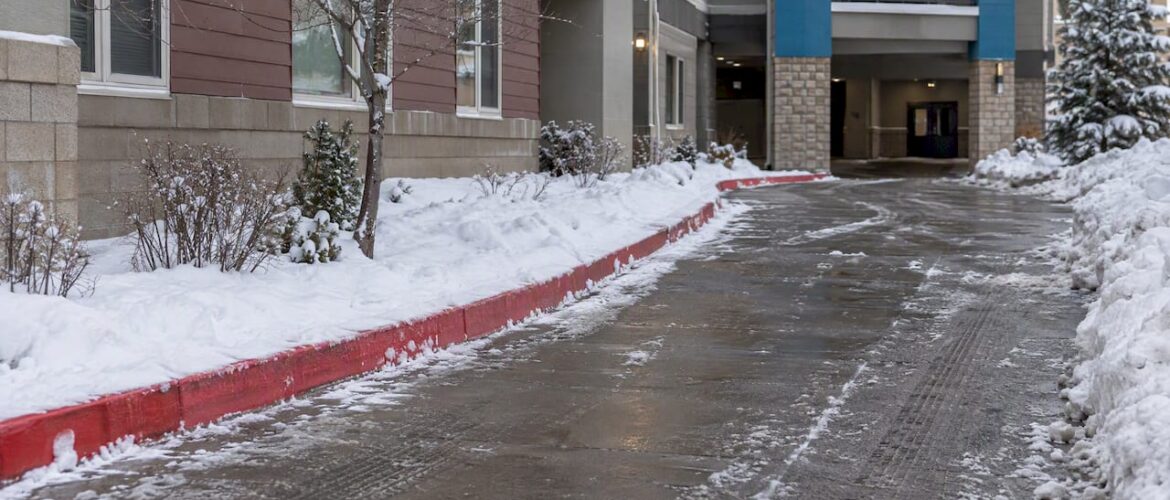
A fire lane is only a fire lane if a fire engine can use all of it. In Denver, that means at least 20 feet of marked, unobstructed width, clear of snow, windrows and parked vehicles, at all times. If you manage a commercial property, an HOA or an apartment community, the clock starts ticking when the first inch falls, not when the storm ends.
This guide covers what “clear” means for fire lanes, hydrants, fire department connections, emergency exits and accessible parking. It also covers how to write those priorities into a snow contract so they get done first.
TL;DR
- Denver’s fire inspection checklist calls for fire lanes at a minimum of 20 feet wide and unobstructed at all times. A plowed lane narrowed by a windrow can still fail.
- Hydrants and fire department connections need 36 inches of clear space on all sides and 78 inches of vertical clearance.
- Accessible parking spaces and access aisles must stay usable. Piling snow in them is an obstruction, not a storage option.
- Put fire lanes, hydrants, FDCs and exits on a site map as top-priority zones in your contract, so they are cleared with the main lane.
- We can plow and de-ice these areas around the clock. Call 303-591-2089 for a free estimate.
Table of Contents
- What counts as a fire lane, and what “clear” means
- Hydrants and fire department connections
- Emergency exits and building entries
- Handicap parking and access aisles
- The mistakes that fail inspections
- Why it matters beyond the fine
- How to write fire access into your snow contract
- Our perspective: fire access is the first job, not the last
- Getting help before the next storm
- FAQ
- Sources
What counts as a fire lane, and what “clear” means
A fire lane is the route fire apparatus uses to reach a building and set up. It is marked, usually with curb paint or signs, and it is kept open year-round. Winter is when it most often fails, because snow hides the markings and plows push material toward the edges, exactly where the lane runs.
The Denver Fire Department inspection checklist sets the working standard most commercial properties are measured against: a 20-foot minimum width, marked and kept unobstructed. Required widths are not identical for every site. The 2025 Denver Fire Code amendments list different minimum unobstructed widths by building type, including 14 and 16 feet for some single-family and townhouse settings. For a commercial lot, confirm your own number with the fire marshal or your property’s approved site plan.
The key point is the word effective. A lane can be plowed to a drivable path and still be too narrow. Three common ways that happens:
- Windrows. The plow blade pushes a ridge of snow toward the curb, and the ridge eats three or four feet of lane.
- Piles at the end of a pass. Operators drop snow at the end of a lane because it is the quickest place to put it.
- Refreeze. Meltwater from a pile runs back across the lane overnight and turns it to ice.
A useful rule for any operator: “clear” means the full legal width, not a path wide enough for a sedan. A fire engine is far wider than a sedan and needs room for outriggers and turning.
Hydrants and fire department connections
The lane gets the engine to the building. The hydrant or fire department connection (FDC) gets water into the fight. Denver’s inspection checklist calls for 36 inches of clear space around hydrants and FDCs, plus 78 inches of vertical clearance.
This is where a plowed lane can still trap a crew. Firefighters arrive, the lane is open, and the FDC on the wall is buried behind a pile. The National Fire Protection Association makes a related point in its guidance on maintaining access for the responding fire department: building owners tend to think only about the lane, but access covers more than that.
A practical routine for each storm:
- Clear a 3-foot ring around each hydrant and FDC, then a path from it to the lane.
- Knock down any snow overhead, such as drifts on a canopy, so the vertical clearance holds.
- Re-check after plowing. A pass through the lot can bury a hydrant that was clear an hour earlier.
- Treat the cleared area for ice, since a shoveled patch that refreezes slows a crew too.
If a public hydrant sits on or beside your property, we cover how that works in our guide to snow clearing for fire hydrants and emergency access in Denver.
Emergency exits and building entries
Exits are the other half of emergency access. Occupants need a path from every exit door to open ground, and responders need a way in. Snow drifts against exit doors easily, especially on the north and west sides of Denver buildings, where wind loads it overnight.
What to check on every storm:
- The door can swing fully open, and the snow has not built up against the threshold.
- The path from the door leads to a safe area, not into a pile or a dead-end of plowed snow.
- Exit paths are treated for ice, since a person leaving in a hurry has no time to be careful.
- Stairs, landings and ramps at exit doors are clear, not only the main entrance.
Office campuses and high-rises add complexity: many doors, plazas and loading areas. Our pieces on high-rise entrances and plazas and office campus lot layouts show how to plan the work.
Handicap parking and access aisles
Snow management plans often fail here. A site manager wants to keep the most spaces open, so the plow pushes snow to the back corner or into the striped aisle beside the accessible spaces. That is a violation, not a shortcut.
Under ADA Title III regulations, businesses must maintain in operable working condition the features required to be accessible. The Northeast ADA Center addresses the question directly: snow plowed into accessible spaces is a problem. The Minnesota Council on Disability, in its snow removal guidance, says the same about access aisles and curb ramps, and notes that fines in some jurisdictions can reach $500 per incident. That figure is from other jurisdictions, so check what applies in yours.
For your plan:
- Mark accessible spaces and aisles on the site map.
- Instruct operators never to stack snow there, even temporarily.
- Keep the route from those spaces to the accessible entrance clear, including curb ramps.
- Designate a snow storage area elsewhere and write it into the contract. See where the piles go in downtown Denver lots.
If snow is too heavy for the lot to hold, hauling is the answer. We offer snow hauling and pile removal for exactly this situation.
The mistakes that fail inspections
| Mistake | Why it fails | Fix |
|---|---|---|
| Plowing a single drivable track | Effective width falls below the required minimum | Plow the full marked width, wall to wall |
| Windrow along the curb | Narrows the lane and can bury hydrants | Push windrows to storage areas, not the lane edge |
| Hydrant cleared before the storm ends, never revisited | Later snow buries it again | Re-check after each pass |
| Markings hidden by snow | Cars park in the lane, and no one can tell where it is | Keep signs and curb paint visible, and enforce no parking |
| Pile stored in accessible aisle | Blocks accessibility features | Name a storage zone and haul when it fills |
| FDC and exits treated as “extras” | Lane is open but the building is not reachable | List them as priority zones in the contract |
The common thread is that no one defined “done” before the storm. A written scope does that.
Why it matters beyond the fine
The fire code consequence is an inspection failure. The bigger exposure is what happens if something goes wrong on a day when the lane was blocked. The Denver checklist notes that failing to maintain these areas can lead to inspection failure and potential legal liability. Documentation is your protection: dated service records, photos of cleared hydrants and lanes, and a contract that names these zones.
It also helps to think about the building as a whole during winter. Frozen systems, blocked access and slippery surfaces all come from the same gap in planning, and a guide to winterization in commercial buildings covers the indoor side of that checklist. For the outdoor side, our winter risk management checklist for Denver commercial properties is a good starting point, and our snow risk assessment page explains how property managers can structure one.
How to write fire access into your snow contract
Most standard snow contracts say “parking lots and drive aisles” and stop. That leaves fire access to chance. Ask for these terms:
- A site map. Mark fire lanes, hydrants, FDCs, emergency exits and accessible spaces. Label them top priority, cleared at the same time as the main lane.
- A width standard. State that the fire lane is cleared to its full marked width, not a drivable path.
- Trigger depth. Define the accumulation that starts service. Fire lanes should not wait for a deep trigger if ice is present.
- A storage plan. Name where snow goes, and say it never goes in fire lanes, accessible aisles or within the clearance of a hydrant.
- Ice treatment. Anti-icing before a storm and de-icing after, in the same priority zones.
- Service records. Time-stamped visits, with photos for the priority zones.
- Emergency response. A number that reaches a dispatcher at 2 a.m., not a voicemail.
Seasonal and per-push structures handle these differently. Our comparison of seasonal and per-push snow contracts lays out the trade-offs, and for associations, the HOA snow contract terms boards need apply the same ideas to community roads and fire access. Property managers can also look at the five contract essentials for avoiding liability.
Our perspective: fire access is the first job, not the last
We have been plowing in the Denver metro area for more than 44 years, and the pattern is consistent. Sites that struggle with fire access rarely lack a plow. They lack a priority order. The crew clears the biggest spaces first because that is what the property manager hears complaints about, and the hydrant or the FDC waits.
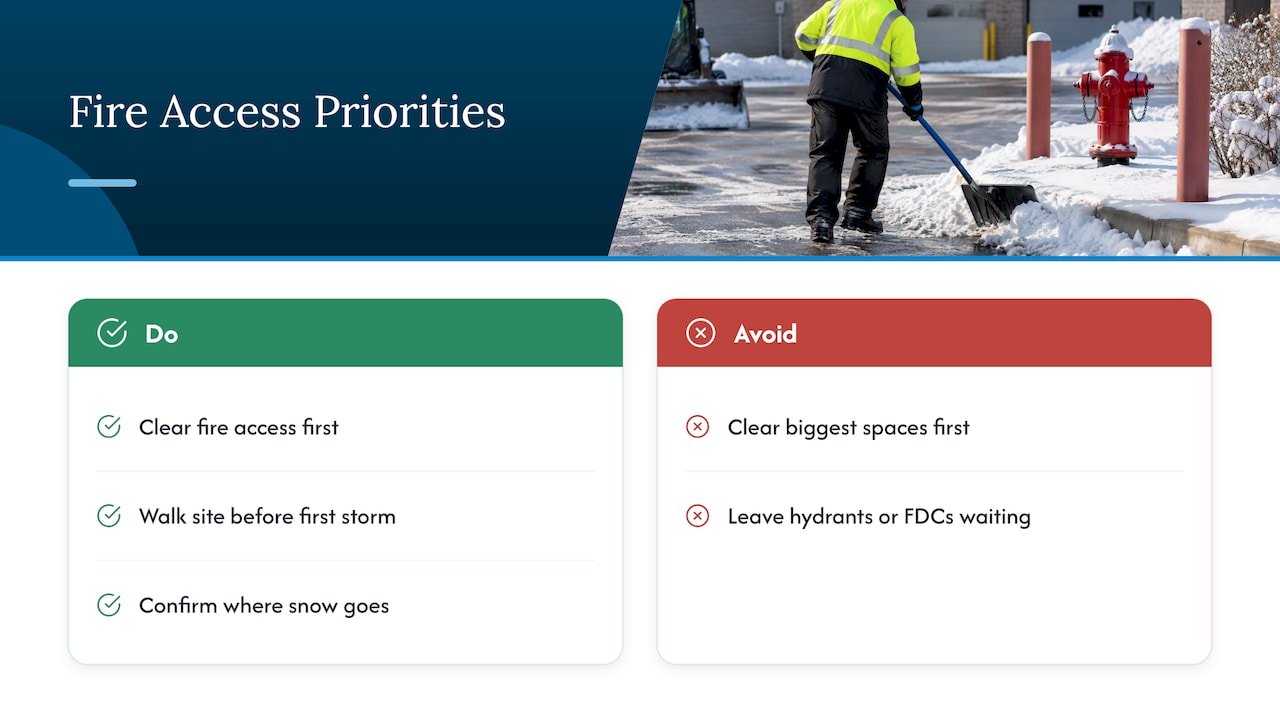
Our approach is to reverse that. Fire lanes, hydrants, FDCs, exits and accessible spaces go first, and the rest of the lot follows. We use commercial-grade equipment meant to clear a lot in one pass, so there is no second visit to widen a lane. We keep documented service visits, because a record of what was cleared and when is the first thing a property manager needs after an incident or an inspection.
Our advice to any manager: walk the site with your contractor before the first storm. Point at every hydrant, every FDC, every exit and every accessible space. If the crew can’t tell you where the snow goes, the plan isn’t finished.
— Jesse
Getting help before the next storm
If you want fire access written into a plan, we offer commercial parking lot plowing, 24-hour emergency commercial plowing, sidewalk de-icing, snow hauling, and seasonal contracts that run September through May. We give free estimates and tailor the scope to your site map. For the full list, see our commercial snow removal services, or read the property manager’s guide to commercial lot plowing. Homeowners can book driveway and walkway clearing from $41.25 per visit through our residential service page.
And if a storm is already on its way, our page on what to expect from emergency plowing in Denver explains how dispatch works.
FAQ
How wide does a fire lane have to be in Denver?
Denver’s fire inspection checklist sets a minimum of 20 feet for marked fire lanes, kept unobstructed at all times. Some building types, such as single-family and townhouse settings, have different minimums in the 2025 Denver Fire Code amendments. Confirm the figure for your site with the Denver Fire Department or your approved site plan.
How much space do I need to keep clear around a fire hydrant?
The Denver checklist calls for 36 inches of clear space around hydrants and fire department connections, with 78 inches of vertical clearance. Clear a path from the hydrant to the street or lane as well. Check again after plowing, because a pass through the lot can bury it.
Can I pile snow in handicap parking spaces?
No. Accessible spaces and access aisles must stay usable, and snow plowed into them is treated as an obstruction under ADA guidance. Choose a storage area away from them, and haul snow off site if the lot runs out of room.
Who is responsible for clearing fire lanes, the owner or the contractor?
The property owner carries the duty, and a contract can assign the work but not the responsibility. That is why the scope should name fire lanes, hydrants, FDCs and exits, and why service records matter. If your situation involves a lease or a dispute, ask an attorney who handles property liability.
Sources
- Denver Fire Department inspection checklist
- 2025 Denver Fire Code amendments
- NFPA: maintaining access for the responding fire department
- Northeast ADA Center: snow in accessible parking spaces
- Minnesota Council on Disability: snow removal