
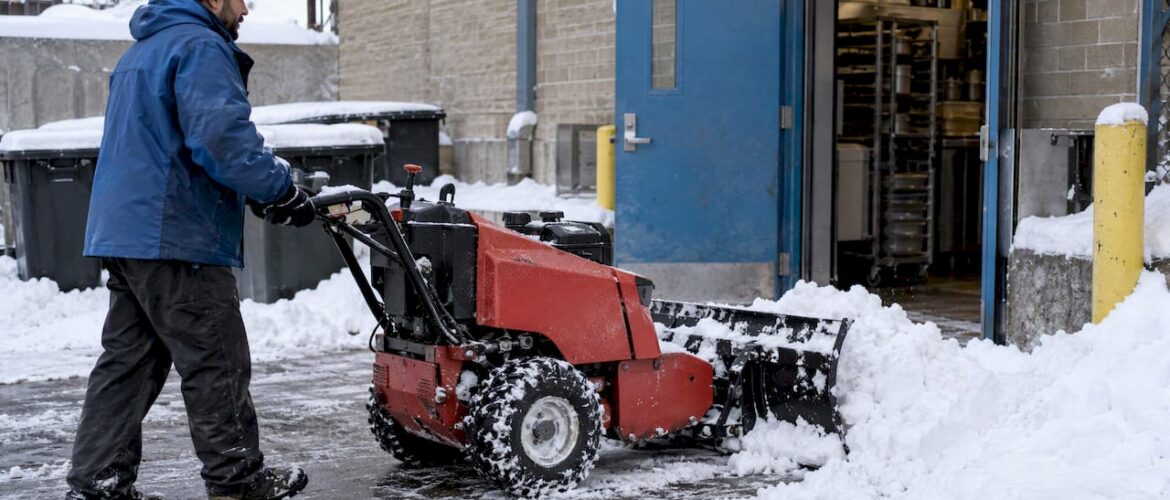
A restaurant with an unplowed lot loses customers, delivery drivers and staff before the first order is placed. In Denver, it also takes on legal exposure: businesses must clear adjacent sidewalks right after snowfall ends, and a customer who falls on ice in your lot can make a negligence claim. The best setup is a written contract with a plow and de-icing contractor who responds on a set clock and documents every visit. This guide covers what to clear, when, what it costs, and what to put in the contract.
TL;DR
- Denver requires businesses to clear sidewalks immediately after snow stops, and a notice can lead to a $150 fine if the walk is not cleared within four hours.
- Restaurants have a tougher job than most businesses: evening and weekend peaks, delivery access, dumpster enclosures, and a front door that must be safe at closing time.
- Commercial pricing is usually per push or seasonal. Published ranges start around $150 per push for a small retail lot and rise with acreage.
- A good contract names a trigger depth, a response time, insurance, a snow stacking location and timestamped photo logs.
- Ask for a free estimate before the first storm, not during it.
Table of Contents
- Why restaurants are harder to plow than other businesses
- What Denver requires of restaurant owners
- Liability: why snow removal is risk management
- Plowing, hauling, de-icing: what a restaurant actually needs
- What restaurant snow removal costs
- What to put in a restaurant snow contract
- Our perspective: treat the lot like part of the dining room
- Getting set up before the next storm
- A simple pre-season checklist
- FAQ
- Sources
Why restaurants are harder to plow than other businesses
An office lot can wait until 6 a.m. A restaurant often cannot. Most of your traffic arrives at dinner, many of your guests are older or have kids in tow, and some of them have had a drink. You also close late, which means the lot that was clear at 5 p.m. can be icy by 11 p.m. when your staff walk to their cars.
Three features of a restaurant site cause most of the trouble:
- Tight lots. Small lots with few places to put snow. If the plow pushes it into your parking stalls, you lose seats with every storm.
- Multiple entrances. The front door, the patio, the back kitchen door, the delivery area and the takeout pickup spots all need clear, treated surfaces.
- Grease and melt cycles. Meltwater from piles runs across the lot during the day and refreezes after sundown, especially near the dumpster and drive-through lanes.
If you own or manage a restaurant in Denver, plan for all three before October ends, not after the first six-inch storm.
What Denver requires of restaurant owners
The city’s snow and ice build-up fact sheet says property owners must clear snow and ice from their sidewalks, including adjacent ADA ramps. According to Denver’s snow program page, the process works like this for businesses:
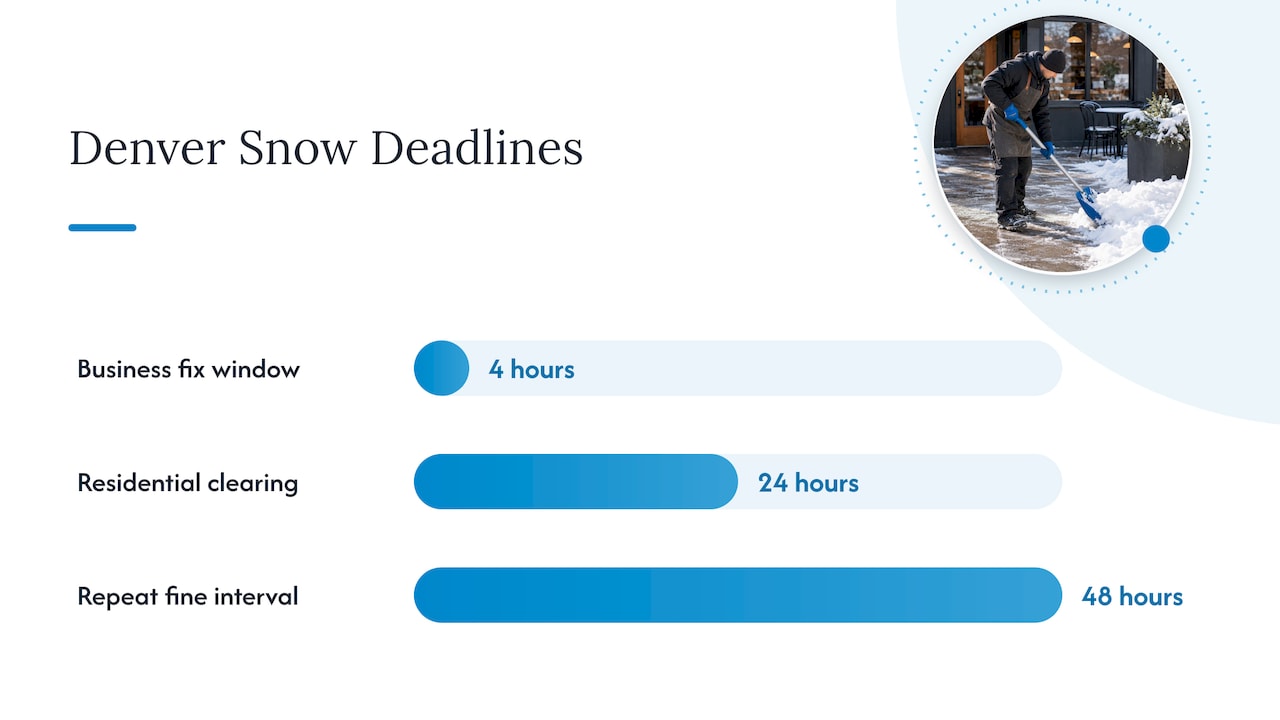
- Snow stops falling. The clock starts ticking right away, because businesses are expected to clear sidewalks immediately.
- An inspector, or a 311 report, leads to a time-stamped notice at the property.
- A business then has four hours to fix it. Residences get 24 hours.
- If it is not cleared in time, a $150 fine can follow.
Denver7’s overview of the rules adds that the fee can be imposed again after 48 hours if the snow is still there. Rules also differ between Denver and neighboring suburbs such as Aurora, so if you operate in more than one city, check each one.
The fine is the small part of the risk. The larger one is a customer injury claim.
Liability: why snow removal is risk management
A CNA risk-control guide on snow and ice programs notes that snow and ice during a weather event, or when temperatures fall to freezing, cause most slips and falls on exterior walking surfaces. It also says building owners have a legal responsibility to reduce those hazards.
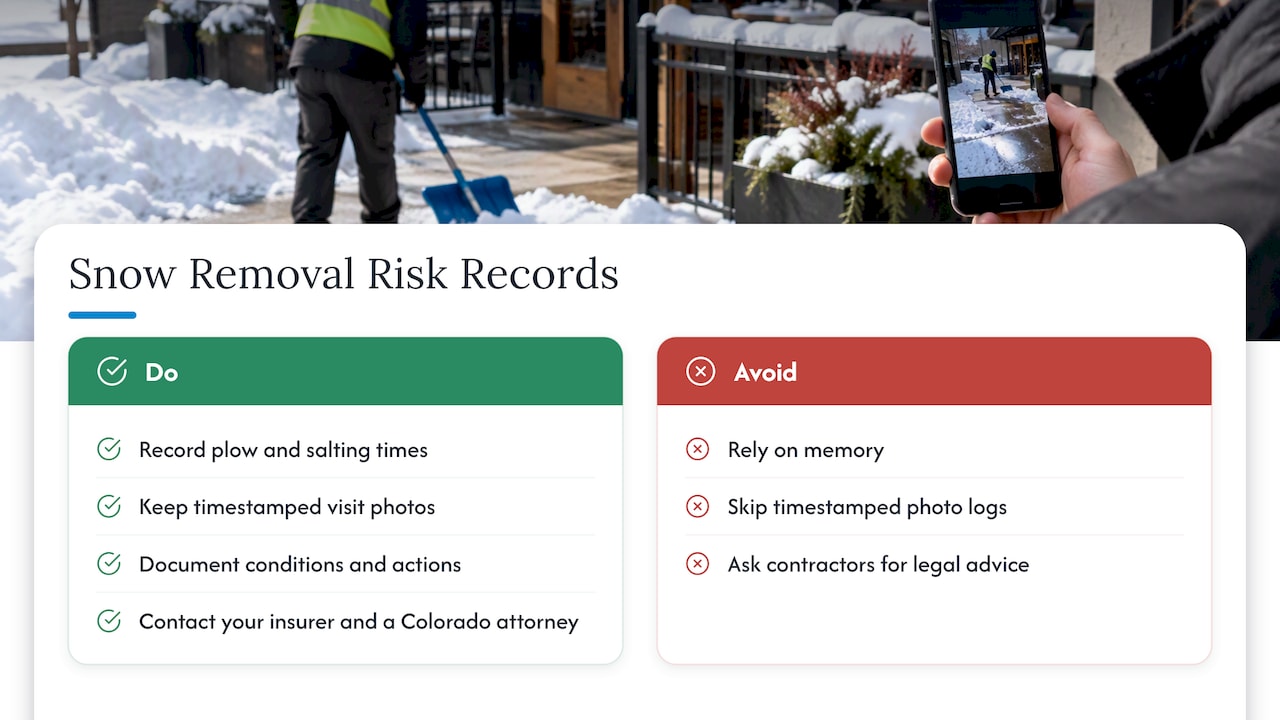
In practice, if someone falls in your lot, the question becomes whether you used reasonable care. That is hard to answer from memory. It is much easier to answer with a log showing when the plow arrived, when the walkway was salted and what the conditions were. A commercial snow contract checklist from Clintar makes the same point: a contract is incomplete without timestamped photo logs of every visit, kept somewhere you can reach them.
This is the same logic that applies to other storm damage. A roofing company that works with facility managers explains documenting storm-related negligence risks in terms any restaurant owner can follow: record what happened, when, and what you did about it.
If you have already had an incident, talk to your insurance agent and a licensed attorney in Colorado about how to respond. A snow contractor can supply visit records, but it cannot give legal advice.
Plowing, hauling, de-icing: what a restaurant actually needs
People use “snow plowing” and “snow removal” interchangeably, but they are different jobs.
| Service | What it does | When a restaurant needs it |
|---|---|---|
| Plowing / push | Moves snow off lanes and stalls to the edges of the lot | Any storm that reaches your trigger depth |
| Pile management | Stacks snow so it does not block sightlines, fire lanes or entrances | Multi-storm winters, small lots |
| Snow hauling | Trucks snow off the property entirely | When piles take up parking spaces |
| Sidewalk clearing | Shovels or blows walks, ramps and entrances | After every snowfall, per city rule |
| De-icing / ice melt | Melts or breaks up ice on walkways and pavement | Freeze-thaw nights, after clearing |
| Anti-icing pre-treatment | Applies product before the storm so ice bonds less to pavement | Forecast storms, especially evening snow |
For most restaurants, the right mix is plowing plus sidewalk work plus de-icing, with hauling as an add-on when piles have eaten parking.
Trigger depth and timing
A trigger depth is the snowfall at which the contractor comes. The pricing page we reviewed shows 1 inch as a common starting point. For a restaurant, ask whether the contract also covers freezing rain, black ice and an on-call visit, since those cause falls without any measurable accumulation.
The Clintar checklist also recommends a response-time commitment, for example within four hours of a triggering event, and a stronger one for high-traffic businesses. For restaurants, define the window by service hours: for example, “lot and front walk clear before opening and again before dinner service.” Contractors can only promise what they have written down.
Don’t forget the odd spots
Walk your property with the contractor before the season. Mark the dumpster enclosure, the delivery door, the patio gate, curb ramps, storm drains and any sidewalk grates. OSHA has warned that sidewalk surface grates over vaults and pits can be a hazard, and in a 2003 incident it describes a skid-steer loader clearing snow was involved. If your building has grates or vault covers, have the crew know where they are, and ask your landlord or an engineer about load limits before heavy equipment goes near them.
What restaurant snow removal costs
We publish one snow price: residential driveway and walkway clearing starts from $41.25 per visit. Commercial work is quoted by site, because a 12-space strip-mall restaurant and a freestanding restaurant with a 60-car lot are very different jobs.
For context, here is how the market structures commercial pricing, according to one published pricing guide. These are general ranges, not our quotes:
| Model | Typical range | How it works |
|---|---|---|
| Per push | $150 to $700+ | You pay each time the crew plows. Cost scales with acreage. |
| Monthly seasonal | $300 to $1,500+ per month | Fixed monthly payment based on property size and service tier. |
| Full-season, full-service | $2,500 to $50,000 per season | Includes plowing, walks, salting and monitoring. |
Which one fits? Per-push pricing suits a small lot and a tight budget, but a heavy winter can cost more than expected. A seasonal contract gives predictable budgeting and, usually, priority in the queue. If you are comparing how service plans are priced and scoped across commercial properties, this overview of commercial service costs shows how property size and scope shape the budget.
The cheapest quote is not always the best one. The CNA guide cited above warns that the lowest bidder is often the one missing the right liability insurance. A contractor who lacks coverage leaves you holding the bill after an accident.
What to put in a restaurant snow contract
If you are wondering how to make a snow removal contract, start from this list, drawn from the Clintar checklist:
- Trigger depth. For example 1 inch, plus separate terms for ice events.
- Response time. A written window, such as within four hours of the trigger.
- Service hours tied to your hours. Before opening and before dinner, not just “after the storm.”
- Insurance. A certificate of insurance naming your business as an additional insured.
- Snow stacking location. Defined in writing so piles do not block fire lanes, sightlines or customer stalls.
- Documentation. Timestamped photo logs of each visit, delivered to you.
- Scope. Lot, drive lanes, walks, entrances, ramps, patio access, and the delivery door.
- Pricing basis. Per push, per month, or per season, and what counts as an extra, such as hauling or a second visit in one storm.
- Term. The season dates. Ours run September through May.
Also ask about certification. The Accredited Snow Contractors Association, per the checklist, recommends hiring certified contractors, because they understand both site safety and the records needed to defend a claim.
Our perspective: treat the lot like part of the dining room
We have plowed Denver lots for more than 44 years, and the restaurants that do best in winter do one thing: they think of the lot as the first table a guest sits at. If the lot is bad, the meal starts badly.
Here is what we tell restaurant owners:
- Call before the first storm. We offer free estimates and flexible service plans. A site walk in October is easier than an emergency call in a blizzard, and it lets us note your grates, dumpster pad, patio and delivery door.
- Pick a plan that matches your hours. A restaurant is not an office. Tell us when you open, when you close, and when the lot is busiest.
- Ask about equipment. We run commercial-grade equipment meant to clear lots in one pass, and a skid steer for tight corners and pile work.
- Insist on proof. We document service visits, because a record is your best protection if someone says they slipped.
- Expect dispatch at any hour. Our team is available 24/7, including for same-day service for new and existing clients.
No contractor can promise that no one will ever fall. What a good one can do is clear and treat the site on time, and show you that it did.
— Jesse
Getting set up before the next storm
We handle commercial plowing, parking lot clearing, sidewalk de-icing, anti-icing pre-treatment, snow hauling and seasonal contracts across Denver. You can see our parking lot snow removal and de-icing services or start from our Denver snow removal home page to ask for a free estimate. Tell us your lot size, your hours and your entrances, and we will build the plan around them.
A simple pre-season checklist
Before the first measurable snow, take an hour and do this:
- Walk the lot with your phone and photograph the current condition of every entrance, ramp and drain.
- Mark grates, curbs, bollards, hydrants and sprinkler heads so a plow does not hit them.
- Decide where snow can go and where it can never go.
- Confirm who is responsible for which area if you lease. Some landlords handle the lot, and tenants handle the front walk.
- Ask your insurance agent what your policy requires from contractors.
- Give staff a plan: who checks the front door at closing, and who to call if ice shows up.
OSHA also reminds employers of their duty to protect workers during winter weather, including clearing walking surfaces promptly. That covers your own staff shoveling by hand: train them, give them the right gear, and keep roof work to professionals.
FAQ
How much does restaurant snow removal cost?
It depends on the lot size, the trigger depth and how many storms hit. Published ranges run from about $150 per push for a small lot to $700 or more for larger ones, with seasonal contracts billed monthly or for the whole season. We quote commercial properties individually, with a free estimate.
Who is responsible for clearing snow at a restaurant, the owner or the landlord?
It comes down to your lease. Denver’s rules apply to the property owner, but many leases pass sidewalk and lot duties to the tenant. Read the lease, and if it is unclear, ask your landlord in writing and talk to an attorney.
What is the difference between snow plowing and snow removal?
Plowing pushes snow to the edges of a lot. Removal, or hauling, trucks it away. A restaurant with a small lot may need both after big storms, so piles do not take over parking spaces.
How fast do I have to clear a sidewalk in Denver?
Businesses are expected to clear sidewalks immediately after snowfall ends. After a time-stamped notice, the city gives businesses four hours before a $150 fine can apply.
Sources
- Snow & Ice Build-Up Fact Sheet, City and County of Denver
- Snow Removal, City and County of Denver
- Denver snow removal: Sidewalk rules, fines and where to get help, Denver7
- Snow and Ice Maintenance Programs, CNA
- The Commercial Snow Removal Contract Checklist, Clintar
- Standard commercial snow removal pricing
- Hazards of Unintended Release of Buckets from Quick Couplers, OSHA
- Winter weather hazards, OSHA