
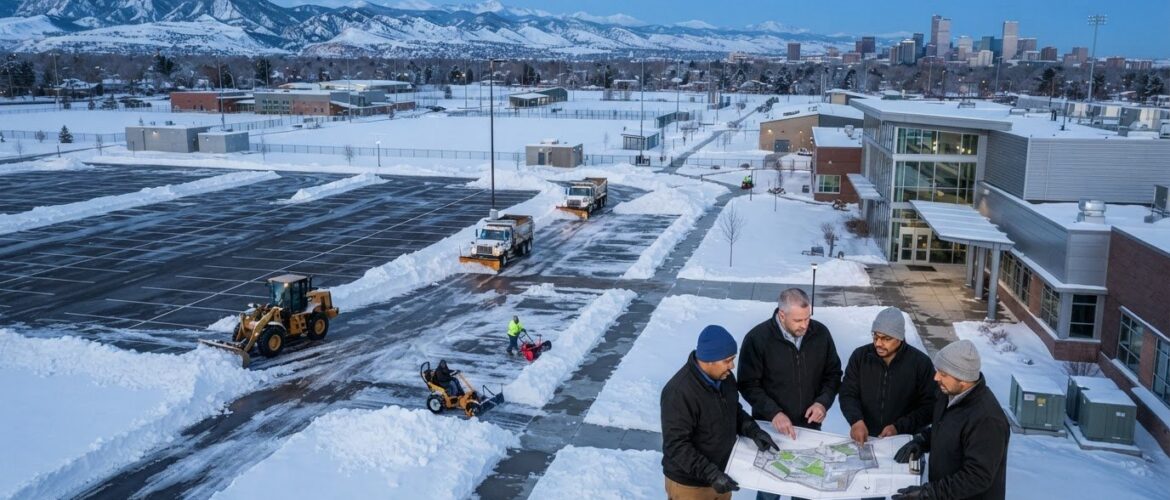
What happens when a Denver snowstorm clears the parking lot but leaves a busy entrance, walkway, or facility access route blocked? For sports complexes, snow and ice can disrupt games, practices, staff access, and visitor arrival. Commercial snow removal for sports complexes therefore needs a coordinated plan, not a one-size-fits-all approach.
Choosing a provider can feel complicated when different parts of the property have different priorities. Set clear expectations for which routes and high-use areas come first, what work is included, and how the contractor will communicate as conditions change.
This guide explains how to assess your complex’s snow and ice needs, compare providers, and prepare a practical plan before winter weather arrives. You’ll learn what to include in the site scope and what to ask about equipment, communication, and service coverage. Snow Removal Denver is a family-owned business with over 44 years of snow-plowing and removal experience in the Denver Metro area, supported by trucks, front-end loaders, and snow blowers. Planning ahead helps facility managers make informed decisions and coordinate winter operations.
Key Takeaways
- Map the complex and rank parking, entrances, pedestrian routes, and service access according to how the facility operates.
- Build a practical snow and ice plan by setting priorities, agreeing on action triggers, clarifying communication, and reviewing the plan after events.
- When comparing providers for commercial snow removal for sports complexes, assess the site-specific approach, equipment, communication, and written service scope.
- Prepare before winter by sharing site maps, decision-makers, event-calendar contacts, and recurring access constraints with potential providers.
- Choose a partner whose written plan fits your property and operating priorities, and verify commitments before relying on them.
Why commercial snow removal for Denver sports complexes needs a site-specific plan
A sports complex isn’t one open lot. It’s a network of spaces with different users, access needs, and operating schedules. A sports-complex snow plan coordinates clearing across vehicle access, pedestrian routes, entrances, parking, and other areas needed to keep the facility usable. This site-specific approach matters because clearing one area can affect how people move through another.
A cleared parking area won’t help visitors if the route from their cars to the entrance remains snow-covered. A staff or service entrance may also need a different priority from a public drop-off zone. Identify the routes that support access and daily operations, then discuss with a contractor how those priorities fit the property and written service scope. General snow removal methods include plowing and blowing, but the right approach depends on the surface and site conditions.
Which sports-complex areas should be included in the service scope?
Walk the property and mark each area that may need snow or ice attention. Distinguish vehicle routes from pedestrian routes, and note where those paths intersect.
- Parking areas and drop-off zones
- Public entrances and pedestrian routes
- Accessible paths, with applicable requirements verified for the property
- Loading, emergency, staff, and maintenance access routes
Ask whether these routes need separate priorities. Fields and courts also need a site-specific decision. Before including them in a clearing plan, confirm the surface, its care recommendations, and whether snow removal is appropriate. Don’t assume equipment or methods suitable for a parking lot are suitable for a playing surface.
How do winter conditions affect Denver-area facility operations?
Weather, site layout, snow accumulation, and scheduled use can all affect which areas matter most at a given time. A practice schedule may make one entrance or pedestrian route more urgent, while a delivery or maintenance need can change the priority for service access. Check current National Weather Service forecasts as conditions develop, and agree in advance on how event timing will affect service sequencing and access decisions.
A written priority plan gives staff and contractors a shared reference. It can identify the first routes to address, areas that need separate review, and who communicates changes when conditions or schedules shift. This clarity helps coordinate movement and reduce avoidable disruption without assuming every part of the complex needs the same response.
How a sports-complex snow and ice plan works in practice
A workable plan turns a site map into shared decisions. For commercial snow removal for sports complexes, the process is straightforward: map the property, rank areas, agree on action triggers, set communication expectations, and review what worked after a weather event. This gives facility staff and the contractor a common reference instead of leaving details to assumption during a busy day.
Mark vehicle routes separately from pedestrian routes. Parking lanes and service drives have different uses from entrance paths, drop-off points, and routes between facilities. Note crossings and bottlenecks where those flows meet. Then rank the areas with facility decision-makers, considering access, scheduled activities, and the needs of staff, visitors, and service teams. List conditional or lower-priority areas separately so they aren’t mistaken for first-response priorities.
How should managers rank access routes and activity areas?
Place entrances, pedestrian routes, and other areas needed for access near the top of the priority list. Add event-day routes, drop-off points, staff areas, and service access according to the facility’s actual schedule and operations. Keep areas that may be addressed later, or only under certain conditions, in a separate category. That distinction helps set realistic expectations while work is underway.
Next, agree on triggers that prompt a decision or update. These might relate to observed site conditions or a change to the event schedule. Define who can adjust priorities and how the decision will reach the contractor. Triggers support coordination, but they aren’t promises about a particular response time or outcome. For broader considerations, see this guide to commercial snow removal in Denver.
What should the snow-removal communication process cover?
Keep the process direct. Name the facility contacts who receive updates, identify who can approve priority changes, and decide where decisions will be recorded. If weather changes or an event is rescheduled, staff should know whom to notify and how the contractor will receive the revised information. Written notes help everyone follow the same plan as facility operations shift.
- List primary and backup facility contacts.
- Document who can change area priorities.
- Agree how weather and schedule updates will be shared.
- Record completed work, open issues, and any plan adjustments for review.
The written service scope should identify priority areas and communication expectations. After an event, review whether the work sequence matched the site’s needs and update the map or contact process where necessary. Facility managers looking to discuss their property’s commercial snow-plowing needs can learn more at Snow Removal Denver.
How to compare commercial snow-removal providers for a sports complex
A broad label such as “commercial snow removal” doesn’t show whether a provider’s proposed service fits a sports complex. Compare the written scope and site-specific approach instead. Ask each provider how they assess the property, prioritize areas, select equipment, communicate changes, and document relevant commercial experience. For commercial snow removal for sports complexes, details matter: an approach that suits a parking area may not suit a narrow pedestrian route or a busy drop-off zone.
| Comparison area | What to ask |
|---|---|
| Site assessment | How will you review the property and document priority areas and constraints before winter? |
| Equipment | Which equipment is available, and how do route width, parked vehicles, surfaces, and access affect selection? |
| Service scope | Which areas and tasks are included, excluded, or conditional? |
| Communication | Who receives updates, who can change priorities, and how are decisions recorded? |
| Relevant experience | What commercial property experience is relevant to the size and operating needs of this site? |
What questions should a facility manager ask a snow contractor?
Ask how the provider assesses a large property and turns that assessment into a site map or written priority list. Find out which equipment is available and how the contractor decides whether trucks, front-end loaders, or snow blowers suit different areas. Ask how narrow routes, parked vehicles, pedestrian bottlenecks, and sensitive surfaces may affect the plan. Clarify how event changes, site hazards, and service updates will be communicated and recorded.
Request specific, verifiable examples of relevant experience, but don’t assume a contractor has served sports venues unless that’s confirmed. Apply the same standard to operational commitments: ask what can be documented rather than relying on general assurances.
How can you compare service scope and ice management?
Ask each provider to state whether snow clearing and ice management are included together, offered separately, or governed by specific scope terms. Find out how pedestrian routes and vehicle areas are assessed, and whether the plan accounts for their different surfaces and uses. Don’t assume one method or treatment fits every part of the facility. For additional context, review these proactive ice management services in Denver.
Snow Removal Denver is a family-owned company with over 44 years of snow-plowing and removal experience in the Denver Metro area. Facility managers can explain their property’s needs and clarify the proposed commercial snow-plowing and ice-management scope, without assuming unverified venue experience or service commitments.
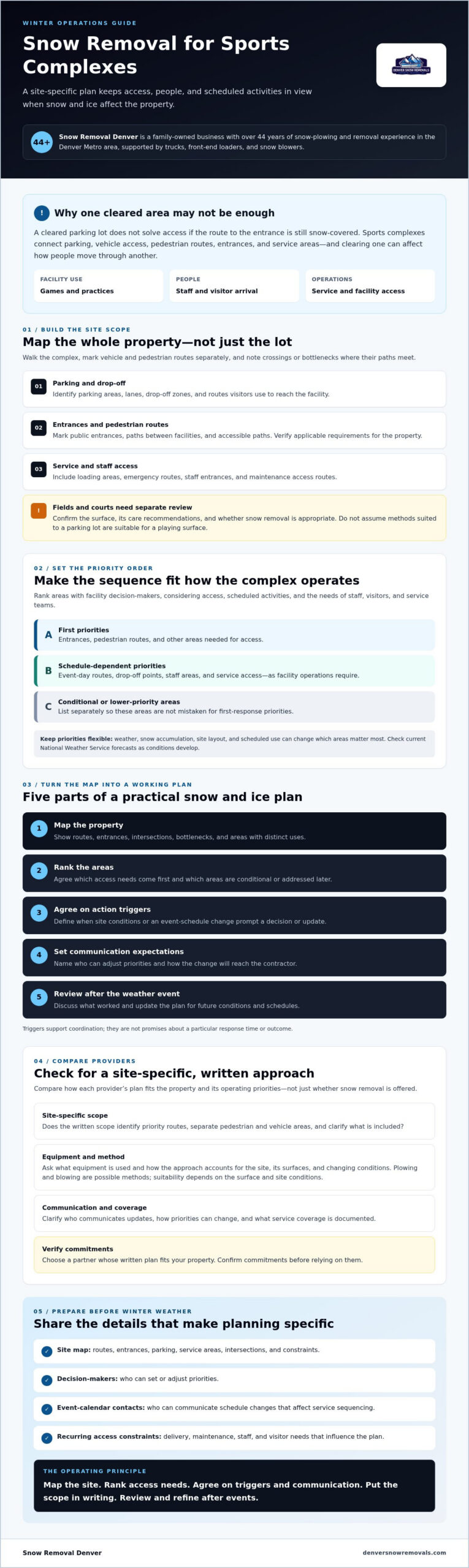
How to prepare a Denver sports complex before the first snow event
Pre-season preparation gives facility staff and a snow-removal provider time to clarify the site, operating priorities, and decision process before weather disrupts normal routines. For commercial snow removal for sports complexes, accurate property information is useful: a current map and event calendar help turn broad expectations into a clear, site-specific scope.
What site information should you give a snow-removal provider?
Share a current property map and flag details that may affect access or equipment movement. Include entrances, parking, pedestrian routes, restricted areas, and narrow passages. Note recurring constraints such as vehicles that remain parked during events or pedestrian bottlenecks near entrances. Identify accessible routes and emergency access for special review, and verify applicable requirements with qualified advisers rather than assuming a general checklist covers your facility.
A practical pre-season checklist can include:
- A property map showing entrances, parking, pedestrian routes, and restricted areas
- Priority routes, recurring obstructions, and areas needing site-specific review
- Event schedules, expected access windows, and facility operating constraints
- Primary and backup on-site contacts, including event-calendar decision-makers
- A process for sharing schedule changes or temporary access restrictions
These details help a provider assess the site and discuss which equipment and service scope fit its layout. They also reduce confusion when staff, visitors, or deliveries use different parts of the property at the same time.
How should snow operations fit around events and facility use?
Set priorities with facility decision-makers before the season begins. Consider scheduled activities, public arrival, staff access, and the routes needed after an event. Agree on how event changes will be sent to the contractor, who can report newly restricted areas, and how updates will be recorded. These are coordination steps, not guarantees about timing or outcomes.
After a significant winter event, review the written plan with staff and the provider. Identify any route that was difficult to access, any bottleneck that needs clearer direction, and whether event communications reached the right contacts. Then update the map, priorities, or contact list as needed. For wider continuity-planning ideas, see the Denver business winter storm preparedness guide.
Snow Removal Denver is a family-owned company with over 44 years of snow-plowing and removal experience serving commercial and residential customers throughout the Denver Metro area. Discuss your sports complex’s snow-plowing and ice-management needs to start clarifying the property scope and winter priorities.
Choosing a commercial snow-removal partner for your sports complex
The right partner is the one whose proposed plan fits your facility, not simply the one offering the broadest service label. For commercial snow removal for sports complexes, assess whether the provider understands your site layout, defines the work in writing, can explain its equipment approach, and has a clear communication process. Make sure any service commitments are specific and verified before relying on them.
Use this decision framework to compare providers:
- Facility fit: Does the proposed plan reflect your parking, entrances, pedestrian routes, and operating priorities?
- Written scope: Are included, excluded, and conditional areas clearly identified?
- Equipment: Can the provider explain how available equipment fits your site conditions?
- Communication: Are contacts, priority changes, and updates clearly discussed?
- Experience and commitments: Can relevant experience and any stated service terms be verified directly?
Snow Removal Denver is a family-owned company with over 44 years of snow-plowing and removal experience, serving commercial and residential customers throughout the Denver Metro area. Its commercial fleet includes trucks, front-end loaders, and snow blowers. These capabilities provide a basis for a site-specific discussion, but don’t assume unverified sports-complex experience or particular response terms. Confirm that the proposed scope addresses your facility’s needs.
When is a commercial snow-removal provider a good fit?
A provider may be a good fit if its proposed equipment and service scope match your property layout and clearing needs, and if it can explain how priority areas will be handled. Check that communication responsibilities are understood before selecting a contractor. Verify any claimed sports-complex experience, availability, and service commitments directly, and ensure agreed details appear in the written scope.
What are the next steps for requesting a site-specific discussion?
Before contacting a provider, gather your site map, operating schedule, priority list, and questions about snow plowing and ice management. This preparation keeps the conversation focused on facility requirements rather than general promises. Discuss the property and clarify what the provider can include without assuming terms that haven’t been confirmed.
Discuss your sports complex’s snow-removal needs with Snow Removal Denver and start defining a plan around your site and winter operating priorities.
Set Your Sports Complex Up for a More Prepared Winter
A dependable winter plan starts with your site, not a generic service label. Map priority access routes, clarify what’s included in the written scope, and agree on how facility staff and the provider will communicate when weather or event schedules change. These steps help you compare options for commercial snow removal for sports complexes based on your operating needs.
Snow Removal Denver is a family-owned business with over 44 years of experience serving commercial and residential customers throughout the Denver Metro area. Its commercial snow and ice removal work is supported by a fleet that includes trucks, front-end loaders, and snow blowers. Discuss your facility’s layout, priorities, and service needs before winter arrives.
Discuss your sports complex’s snow-removal needs with Snow Removal Denver. A clear plan can help your team approach winter operations with greater confidence.
Frequently Asked Questions
What does commercial snow removal for sports complexes include?
Commercial snow removal for a sports complex can include coordinated clearing of parking lots, entrances, walkways, and other agreed access areas. The exact service depends on the property and written scope, so identify priority vehicle and pedestrian routes before hiring a provider. Fields and courts need separate review because the right approach depends on their surfaces. Confirm which areas are included, excluded, or conditional rather than relying on a broad service label.
How do sports complexes prioritize snow removal during an event?
Prioritize areas according to access needs and the event schedule. Facility managers can identify public entrances, pedestrian routes, drop-off points, staff access, and service routes, then agree which areas take priority if conditions or timing change. Separate vehicle paths from pedestrian paths because each serves different users. Assign someone to communicate schedule changes to the provider, and record revised priorities so staff and contractor are working from the same plan.
What should I ask a commercial snow-removal contractor before hiring them?
Ask how the contractor assesses your property, documents priority areas, and matches available equipment to site conditions. Request a written list of included, excluded, and conditional work. Clarify who receives updates, who can change priorities, and how decisions are recorded. Ask about relevant commercial experience, then verify any sports-complex claims and stated availability or service commitments directly. Clear answers help you compare practical scope, not just general descriptions.
Can one snow-removal plan cover parking lots, walkways, and fields?
One site plan can coordinate these areas, but it shouldn’t assume the same clearing method suits every surface. Parking lots and walkways have different uses and access needs, while fields and courts may need special review based on their surface and facility guidance. Mark each area on the site map and specify its priority and scope. Before including a field or court, confirm whether snow removal is appropriate and which methods are suitable.
How can a sports complex prepare for snow removal before winter?
Prepare a current site map showing entrances, parking, pedestrian routes, restricted areas, and routes requiring special review. Share event schedules, access windows, operating constraints, and primary facility contacts with the provider. Document narrow routes, parked vehicles, and pedestrian bottlenecks that could affect access or equipment selection. Agree on how schedule changes will be communicated. Verify applicable local or accessibility requirements with qualified advisers instead of assuming a general plan covers them.
Does commercial snow removal include ice management?
It depends on the provider’s written scope, so confirm whether ice management is included, separate, or subject to specific terms. Ask how the provider assesses vehicle areas and pedestrian routes, and whether the proposed approach accounts for different surfaces and uses. Snow Removal Denver offers commercial snow and ice removal for Denver Metro properties, as well as ice management. Discuss the areas you need addressed and confirm the exact scope before making a decision.
How do I choose a snow-removal company for a Denver sports complex?
Choose a provider whose written plan fits your site layout, priority routes, equipment needs, communication process, and operating schedule. Verify relevant experience and any service commitments directly rather than assuming a provider has served sports complexes. Snow Removal Denver is a family-owned company with over 44 years of snow-plowing and removal experience in the Denver Metro area. Its fleet includes trucks, front-end loaders, and snow blowers. Discuss your property’s needs to assess fit.