

Most U.S. homeowners pay a moderate amount per visit for driveway snow removal, with seasonal contracts typically priced to cover multiple visits for a standard residential property. The quick budget rule: if your area gets more than eight to ten significant snowfalls per winter, a seasonal contract almost always beats per-visit pricing on both cost and peace of mind.
A few things to factor in from the start:
- Per-visit pricing suits homeowners in regions with light, infrequent snowfall (fewer than six to eight storms per season).
- Seasonal contracts make more financial sense where storms are frequent and unpredictable, locking in a flat rate and securing priority dispatch during peak events.
- Common add-ons that raise your bill: walkway and step clearing ($25–$75 extra), salting or de-icing ($20–$50 per application), and snow haul-away for large accumulations ($100–$300+).
- Regional note: Northeast and Midwest markets run roughly 20% higher than the national average due to heavier equipment needs and local labor rates.
Table of Contents
- What does driveway snow removal cost on average?
- How contractors decide what to charge: pricing models explained simply
- Key factors that raise or lower your driveway snow removal bill
- How do prices vary by region and city across the U.S.?
- DIY costs vs hiring a pro: true break-even factors for homeowners
- How to get an accurate driveway snow removal quote: what to ask and red flags to watch
- Sample pricing scenarios: what three driveway types actually cost
- How these price ranges were estimated: sources and methodology
- Key Takeaways
- Why homeowners consistently underestimate what snow removal actually costs
- Denversnowremovals: free estimates and priority service for Denver homeowners
- Sources and further reading
- FAQ
What does driveway snow removal cost on average?
The national average per-visit cost is moderate, but the range is wide because driveway size, surface type, and local labor rates all pull the number in different directions. Here is how each pricing unit breaks down.
Per-visit pricing by driveway size:
- Single-car driveway (one to two cars): $35–$75 per visit
- Two-car driveway: $75–$150 per visit
- Long or oversized driveway: $150–$203+ per visit
Per-hour billing appears when a job is complex or when snow depth makes standard flat-rate pricing impractical. Expect $50–$100 per hour for residential work, depending on equipment type and region.
Per-inch rates typically run $8–$25 per inch of snowfall. Contractors use this model when storm totals are unpredictable and they want to tie compensation directly to workload.
Per-square-foot pricing is less common but appears on larger or commercial-adjacent residential jobs: $0.20–$0.65 per square foot is the standard range.
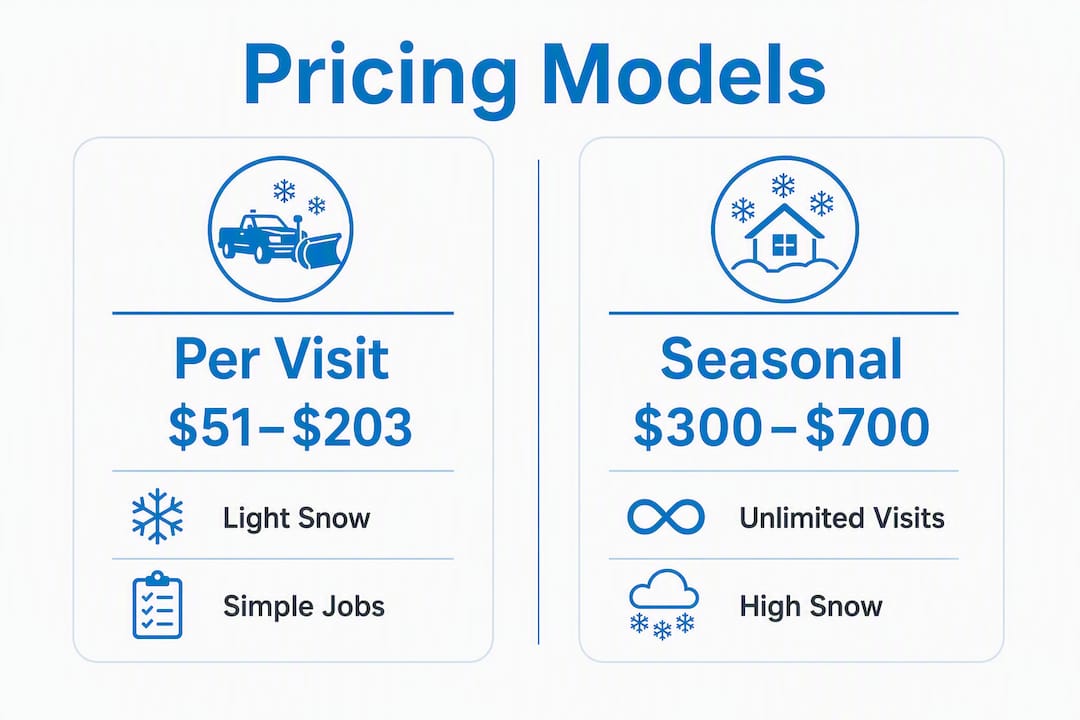
Seasonal contracts for a typical home run $300–$700 total, covering unlimited visits above a defined trigger depth (usually 2 inches). Some providers cap the season at a set number of visits; others offer truly unlimited service. Read that language carefully before signing.
| Pricing Model | Typical Range | Best For |
|---|---|---|
| Per visit | $51–$203 | Light snowfall regions |
| Per hour | $50–$100/hr | Complex or deep-snow jobs |
| Per inch | $8–$25/inch | Variable storm totals |
| Per square foot | $0.20–$0.65/sq ft | Large driveways |
| Seasonal contract | $300–$700 | Frequent-storm regions |
Understanding how equipment affects pricing helps explain why two quotes for the same driveway can differ by $40 or more.

How contractors decide what to charge: pricing models explained simply
Contractors choose a pricing model based on what protects their margins during unpredictable storms. Knowing their logic helps you compare quotes on equal footing.
Per-push (per-visit) is the most common residential model. The contractor shows up after a qualifying snowfall and charges a flat fee for that single clearing. Simple and transparent, but costs can stack up fast during a heavy winter.
Hourly billing gives contractors flexibility on difficult jobs: steep slopes, tight access, or wet heavy snow that takes twice as long to move. If a contractor quotes hourly, ask for an estimated time range so you are not signing a blank check.
Per-inch pricing ties the fee directly to storm intensity. A 3-inch storm costs less than a 10-inch storm under this model, which feels fair but can produce unpredictable monthly totals.
Per-square-foot is more common on commercial properties but occasionally appears for large residential driveways. It rewards accuracy: the contractor measures your driveway once and prices accordingly.
Seasonal flat-rate contracts are the most predictable option for homeowners in high-snowfall areas. You pay one lump sum (or monthly installments) and the contractor handles every qualifying storm. The catch is the trigger clause.
Pro Tip: Ask every contractor how they define the service trigger. A 2-inch trigger means they show up after 2 inches accumulate. A 3-inch trigger means you are shoveling the first 3 inches yourself every storm. That one number can change your season total by two or three visits.
For a deeper look at why seasonal pricing often wins on value, the benefits of seasonal snow removal pricing are worth reviewing before you commit to a model.
Key factors that raise or lower your driveway snow removal bill
No two driveways price the same. These are the variables contractors weigh when building your quote.
Driveway size and shape are the biggest drivers. A single-car concrete pad takes 10–15 minutes to clear; a long gravel driveway with a curved approach can take 45 minutes or more. Square footage and linear footage both matter.
Surface type affects both technique and cost. Gravel driveways require the plow blade to be raised slightly to avoid scattering stone, which means more manual finishing work after the machine pass. That extra labor carries a gravel surface premium that can add $15–$30 per visit compared to concrete or asphalt.
Slope and access constraints matter more than most homeowners expect. A steep driveway requires slower, more controlled passes and increases equipment wear. Narrow entries, low-hanging branches, gates, and tight turning radii all slow the job and raise the price. Shared driveways add coordination complexity; see how shared driveways get cleared safely for what that means for scheduling and cost.

Snow depth and type multiply the base rate. Wet, heavy snow is physically harder to move and harder on equipment. Depth-based pricing bands reflect this directly: up to 6 inches typically runs $50–$100; 6–12 inches, $100–$200; over 12 inches, $200 and up.
Timing and emergency calls carry a premium. A storm that drops overnight and needs clearing by 7 AM costs more than a daytime job. Emergency or same-day service during a major storm can push per-visit rates to the top of the range or beyond.
Common add-ons and their typical costs:
- Walkway and step clearing: $25–$75
- Salting or de-icing: $20–$50 per application
- Snow haul-away (large accumulations): $100–$300+
- Roof or ice-dam work: priced separately, often $150–$500+
- Damage repair fees: vary by contractor; always clarify the damage policy upfront
Regional premium: Northeast and Midwest markets average roughly 20% above national rates due to heavier equipment requirements and higher local wages.
How do prices vary by region and city across the U.S.?
Where you live shapes your snow removal budget as much as your driveway size does. Snowfall frequency, local labor costs, and the density of service providers all shift the numbers.
Northeast (high-cost region): Boston, Buffalo, and Hartford homeowners typically pay at the upper end of national ranges. Per-visit rates of $100–$200 are common, and seasonal contracts often run $500–$900 for a standard two-car driveway. Heavy, wet coastal snow and dense urban markets drive both demand and price.
Midwest (moderate-to-high cost): Chicago, Minneapolis, and Cleveland sit in the middle-to-upper tier. Per-visit rates generally run $75–$150, with seasonal contracts at $400–$700. The sheer volume of storms in these markets makes seasonal contracts the dominant model.
Mountain West, including Denver: Denver’s snowfall is frequent but often lighter and drier than Midwest or Northeast storms, which keeps per-visit rates in the $75–$150 range for a standard driveway. Seasonal contracts at $350–$600 are common. Elevation and access constraints on hillside properties can push costs higher.
West Coast and South (lower-cost region): Seattle, Portland, and most Southern cities see infrequent snowfall. Per-visit pricing dominates here, often running $60–$120, and seasonal contracts are rare because the storm frequency does not justify them.
Quick city reference:
- Boston, MA: $100–$200 per visit
- Chicago, IL: $75–$150 per visit
- Minneapolis, MN: $80–$160 per visit
- Denver, CO: $75–$150 per visit
- Seattle, WA: $60–$120 per visit
- Atlanta, GA: $60–$100 per visit (rare events)
DIY costs vs hiring a pro: true break-even factors for homeowners
Buying a snowblower feels like a one-time investment that pays for itself. The math is more complicated than that.
A quality two-stage snowblower requires a significant upfront investment plus ongoing maintenance costs. Storage space has a real cost too, whether that is a dedicated shed or square footage in your garage. A basic snow shovel costs $30–$60 but demands physical labor that carries genuine health risks: the U.S. Consumer Product Safety Commission consistently flags snow shoveling as a leading cause of winter injuries, particularly cardiac events in adults over 45.
Break-even example for a two-car driveway in Denver:
A seasonal contract at $450 covers roughly 10–15 visits. At $100 per professional visit, that same coverage would cost $1,000–$1,500 on a per-visit basis. A snowblower at $900 upfront plus $100/year in maintenance breaks even against a $450 seasonal contract in about two years, assuming you do all the work yourself and never miss a storm.
The hidden costs that shift that math: your time (30–60 minutes per clearing), the physical toll, and the fact that a snowblower does not call ahead, show up at 5 AM, or haul snow away from a tight turnaround. For homeowners with health concerns, limited time, or a long or gravel driveway, hiring a professional often wins even when the raw dollar comparison looks close.
Pro Tip: Before you calculate the break-even on equipment, assign an honest dollar value to your time and physical risk. If clearing your driveway takes 45 minutes and you value your time at $30/hour, that is $22.50 per storm before you count the Advil. Over a 12-storm winter, the math shifts fast.
Unsure whether your situation warrants professional help? The 9 clear signs you need snow removal help this winter lays out the decision criteria plainly.
How to get an accurate driveway snow removal quote: what to ask and red flags to watch
A vague quote leads to a surprise bill. Arrive at every contractor conversation with the right information and the right questions.
Information to have ready before you call:
- Driveway dimensions (approximate square footage or length and width)
- Surface type (concrete, asphalt, gravel, pavers)
- Slope: flat, moderate incline, or steep
- Access constraints: gate width, overhead clearance, tight turns
- Parking situation: is the driveway clear of vehicles during storms?
- Primary access point and any secondary areas (walkways, steps, apron)
Must-ask contract terms:
- What is the trigger depth, and how is it measured?
- What is the guaranteed response time after the trigger is reached?
- Are seasonal customers prioritized over on-demand calls during major storms?
- What are the payment terms: upfront, monthly, or per-visit?
- What is the damage policy, and how are claims handled?
- Can you provide proof of liability insurance and any required local licensing?
- Are walkways, steps, and de-icing included or billed separately?
Red flags to watch for:
- “Per push” language with no defined trigger depth
- No written contract or a contract with blank pricing fields
- Inability or refusal to provide proof of insurance
- Open-ended haul-away language (“extra charges may apply” with no cap or estimate)
- No clear response-time commitment for seasonal clients
Before the first service: photograph your driveway, curb, and any landscaping near the plow path. Note any existing cracks, edging, or decorative elements in writing and share that documentation with the contractor. This protects both parties if a damage claim arises later.
For guidance on setting clear expectations with your provider, how to set snow clearing expectations for residents covers response times, priority dispatch, and what a well-written contract should guarantee.
Sample pricing scenarios: what three driveway types actually cost
These worked examples use the pricing formula that most contractors apply: labor time × hourly rate + overhead + equipment wear + profit margin.
Scenario 1: Small single-car concrete driveway (approx. 200 sq ft)
- Clearing time: 10–15 minutes
- Labor + overhead: $40–$60
- Per-visit estimate: $50–$75
- Seasonal estimate (10 visits): $350–$500
- Likely add-ons: walkway clearing ($25), salting ($20)
- Full-season budget with add-ons: $395–$595
Scenario 2: Medium two-car asphalt driveway (approx. 400–500 sq ft)
- Clearing time: 20–30 minutes
- Labor + overhead: $70–$100
- Per-visit estimate: $90–$130
- Seasonal estimate (10 visits): $450–$650
- Likely add-ons: walkway clearing ($30), salting ($25)
- Full-season budget with add-ons: $505–$755
Scenario 3: Large gravel driveway (approx. 800–1,000 sq ft, moderate slope)
- Clearing time: 40–55 minutes (gravel premium applies)
- Labor + overhead: $120–$175
- Per-visit estimate: $150–$210
- Seasonal estimate (10 visits): $600–$900
- Likely add-ons: walkway clearing ($40), salting ($30), occasional haul-away ($150)
- Full-season budget with add-ons: $820–$1,080
| Driveway Type | Per-Visit Cost | Seasonal Cost | Add-Ons (typical) |
|---|---|---|---|
| Small single-car concrete | $50–$75 | $350–$500 | Walkway, salting |
| Medium two-car asphalt | $90–$130 | $450–$650 | Walkway, salting |
| Large gravel (sloped) | $150–$210 | $600–$900 | Walkway, salting, haul-away |
How these price ranges were estimated: sources and methodology
The ranges in this article draw from several industry pricing platforms and regional guides, cross-referenced to produce realistic national and local estimates.
Primary sources used:
- Angi’s national residential snow removal data, which reports a per-visit range of $51–$203 and seasonal contracts of $300–$700
- Thumbtack’s national plowing average of $90–$212, with a median around $138
- Well Built Florida’s compiled regional guide covering per-event, per-inch, and per-square-foot ranges
- Housecall Pro’s contractor pricing formula (labor × hourly rate + overhead + equipment + profit)
- ServiceAgent’s tiered driveway size tables and line-item job breakdowns
The calculation formula applied in sample scenarios:
Labor time (hours) × regional hourly rate ($50–$100) + overhead (15–20%) + equipment wear allowance + profit margin (10–20%) = per-visit price
Caveats to keep in mind:
- Storm severity spikes: during major regional storms, on-demand rates can jump 30–50% above normal ranges as demand outpaces available crews.
- Local labor variation: Bureau of Labor Statistics wage data for grounds maintenance workers shows meaningful variation by metro area, which flows directly into contractor pricing.
- Gravel and slope adjustments: the scenario estimates above include a gravel premium; flat concrete driveways in the same size class will price at the lower end of each range.
- These figures reflect typical residential jobs. Commercial, HOA, and multi-property contracts are priced differently and are not represented here.
Key Takeaways
Most homeowners can budget confidently once they know their driveway size, surface type, and local snowfall frequency: per-visit rates of $51–$203 cover most residential jobs, while seasonal contracts at $300–$700 deliver better value and priority service in high-snowfall markets.
| Point | Details |
|---|---|
| Per-visit vs seasonal | Seasonal contracts ($300–$700) beat per-visit pricing when your area sees more than 8–10 storms per winter. |
| Surface type adds cost | Gravel driveways carry a premium of $15–$30 per visit over concrete or asphalt due to extra manual finishing. |
| Regional premium | Northeast and Midwest markets run roughly 20% above national averages; adjust your budget accordingly. |
| Get the trigger in writing | A 2-inch vs 3-inch trigger can change your season total by two or three visits; always confirm it in the contract. |
| Denversnowremovals | Offers free estimates, written contracts with defined triggers, and 24/7 priority dispatch for seasonal clients in the Denver Metro area. |
Why homeowners consistently underestimate what snow removal actually costs
The sticker price on a per-visit quote is rarely the number that matters. What actually determines your winter budget is the combination of visit frequency, add-ons, and whether you have priority access to a crew when the storm that matters most hits.
Homeowners who focus only on the per-visit rate often end up paying more than seasonal contract holders by February, not because they made a bad decision, but because they did not account for how quickly costs stack during a heavy winter. A 10-storm season at $120 per visit is $1,200. A seasonal contract covering the same period at $550 is less than half that.
The other underestimated factor is service reliability. During a major storm, contractors with full seasonal rosters prioritize those clients first. On-demand customers often wait hours longer, which matters when you need to get to work or clear a path for emergency access. Seasonal contracts are not just a pricing model; they are a service-priority product.
That said, seasonal contracts are not right for everyone. If you are in a low-snowfall market like Atlanta or coastal Seattle, locking into a flat-rate contract for a winter that produces two storms is a poor investment. Know your local averages before you commit. Checking snow removal discount programs before signing can also reduce the seasonal total meaningfully.
The homeowners who budget most accurately are the ones who treat snow removal like any other home service contract: they get three written quotes, confirm the trigger depth, verify insurance, and photograph their property before the first plow arrives.
Denversnowremovals: free estimates and priority service for Denver homeowners
If you own a home in the Denver Metro area, Denversnowremovals offers a straightforward path from quote to cleared driveway. With over 44 years of experience handling everything from compact single-car pads to long gravel driveways on sloped lots, the team knows what Denver winters actually demand. Seasonal contracts come with a written trigger clause, proof of liability insurance, and guaranteed priority dispatch so your driveway is cleared before the morning commute, not after it.
Every estimate is free, whether done on-site or virtually, and there is no pressure to commit before you have compared your options. For homeowners who need immediate help during a storm, 24/7 emergency service is available for both new and existing clients. Get your free snow removal estimate and see what a seasonal contract would cost for your specific driveway before the first storm of the season arrives.
Sources and further reading
The price ranges and methodology in this article draw from the following industry sources:
- Angi: How Much Does Snow Removal Cost? — National residential per-visit and seasonal contract ranges, widely cited across the industry.
- CPSC: Winter Safety Tips — Consumer Product Safety Commission guidance on shoveling injury risks.
- Denversnowremovals.com — Primary contact and booking resource for Denver Metro homeowners seeking a free estimate.
FAQ
How much should I pay to have my driveway plowed?
Most homeowners pay $51–$203 per visit for a standard residential driveway, with a national average around $126–$138. Driveway size, surface type, and your region are the biggest variables.
What is a fair price for a seasonal snow removal contract?
Seasonal contracts for a typical home run $300–$700, covering unlimited visits above a defined trigger depth. Homeowners in the Northeast and Midwest often pay toward the higher end of that range.
How do you remove heavy snow from a driveway safely?
A two-stage snowblower handles heavy, wet snow most efficiently; shoveling in layers (removing the top half before the bottom) reduces strain. For accumulations over 12 inches, hiring a professional is the safest and fastest option.
How much should I charge to shovel 12 inches of snow?
At 12 inches of accumulation, professional rates typically start at $200 per visit and rise from there depending on driveway size and surface type. That depth falls into the highest pricing band because of the physical effort and time involved.
At what age should someone stop shoveling snow?
There is no universal age cutoff, but the CPSC highlights elevated cardiac risk from snow shoveling for adults over 45 with any cardiovascular history. If health is a concern at any age, hiring a professional or using a snowblower is the safer choice.
Recommended
- Are Snow Removal Services Worth the Cost? A Homeowner’s Guide – Snow Removal Denver 303-591-2089
- What Determines Snow Removal Service Cost in 2026 – Snow Removal Denver 303-591-2089
- How Equipment Drives Affordable Snow Removal Costs – Snow Removal Denver 303-591-2089
- Why Hire a Snow Removal Service: 2026 Guide – Snow Removal Denver 303-591-2089