
Round-the-clock commercial snow removal is defined as continuous, proactive snow and ice management that activates automatically whenever a storm hits, day or night. The benefits of 24/7 commercial snow service go well beyond simple convenience. Weather-related access issues cause a 30% increase in winter absenteeism during major snow events. That number alone tells you what is at stake when a parking lot or entrance sits uncleared at 6:00 AM. Denversnowremovals has spent over 44 years managing exactly this problem for commercial properties across the Denver Metro area.
1. Benefits of 24/7 commercial snow service: liability and slip-and-fall prevention
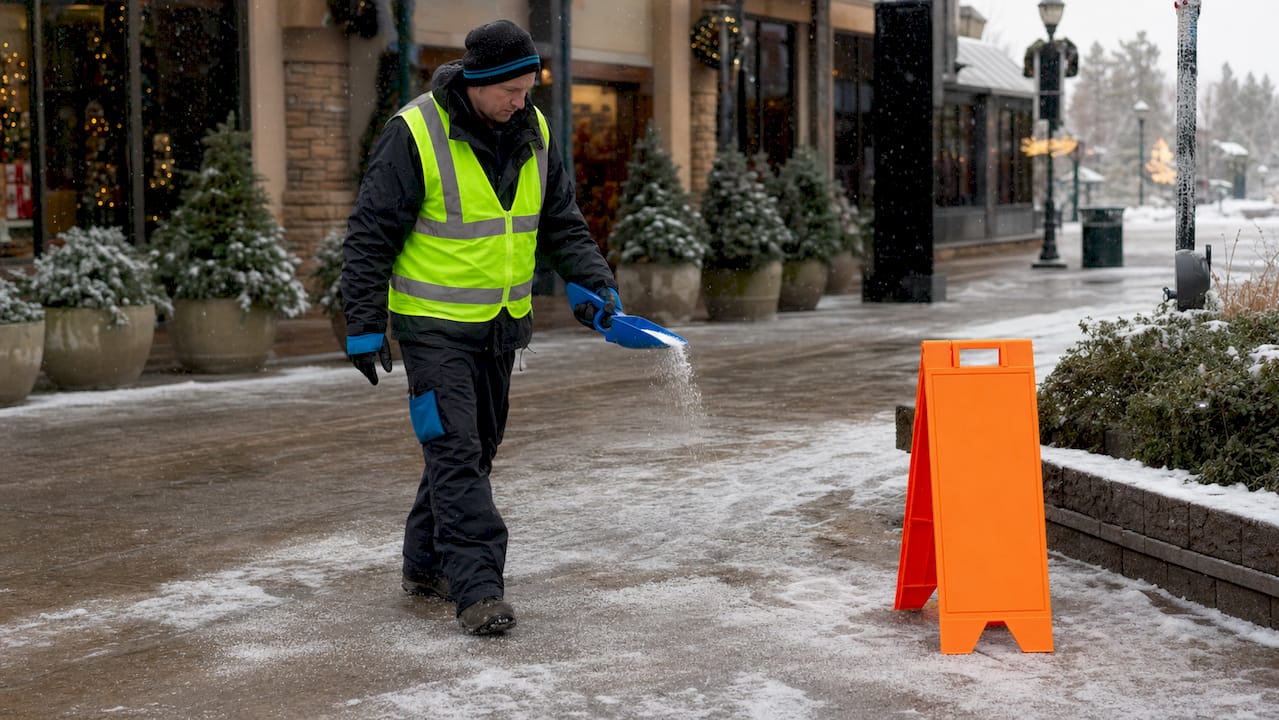
Slip-and-fall accidents are the leading source of winter liability claims on commercial properties. Untreated snow compacts into ice overnight, and black ice from residual snow causes the majority of those claims. A crew that arrives at 3:00 AM removes that hazard before your employees and customers ever set foot on the property.
Professional 24/7 snow service addresses two distinct hazards:
- Snow accumulation on walkways, loading docks, and parking lots creates immediate fall risk.
- Ice formation from melt-and-refreeze cycles is harder to see and more dangerous than fresh snow.
- Black ice on traffic lanes and pedestrian paths forms when residual moisture refreezes after incomplete clearing.
- Compacted snow from foot and vehicle traffic bonds to pavement and requires aggressive mechanical removal.
Ice control, including deicing and anti-icing treatments, is not optional. Professional ice control complements plowing to reduce risk at a level that plowing alone cannot achieve. Documented service records from each visit also provide legal protection if a claim is ever filed against your property.
Pro Tip: Request timestamped service logs from your snow removal provider after every visit. These records are your primary defense in a slip-and-fall liability case.
2. How 24/7 availability keeps your business accessible around the clock
A storm that drops six inches overnight does not wait for business hours. Without round-the-clock coverage, your property manager arrives at 7:00 AM to find blocked entrances, impassable lots, and employees who cannot safely reach their workstations. That scenario directly cuts into productivity and revenue.
Overnight coverage ensures properties are cleared before business hours begin, avoiding operational disruption. The practical impact is significant for several types of operations:
- Distribution hubs and warehouses depend on truck access at all hours. A blocked loading dock stops shipments.
- Manufacturing facilities run shift schedules that begin before dawn. Employees need safe parking and walkways at 5:00 AM.
- Retail properties lose foot traffic and revenue when customers cannot safely enter a parking lot.
- Medical offices and urgent care clinics face patient safety and regulatory obligations when access is blocked.
Businesses dependent on continuous operations gain the greatest protection from round-the-clock snow removal. The 30% absenteeism increase tied to weather access issues is not a minor inconvenience. It represents real labor hours lost, deadlines missed, and customer commitments broken.
3. Cost savings and operational efficiency from professional snow management
Early clearing prevents snow compaction, which is significantly more expensive and difficult to remove than fresh accumulation. Snow compaction overnight increases removal difficulty and costs. A 24/7 service model prevents compaction by clearing snow promptly, before vehicle and foot traffic press it into the pavement.
Professional contractors also use GPS-tracked routes and pre-season site maps to plow efficiently and avoid property damage. That planning reduces time on site and protects curbs, landscaping, and pavement markings from equipment contact.
Pro Tip: Ask your provider for a copy of your site map before the season starts. Confirm that snow stacking zones are placed away from drainage areas and fire hydrants.
The table below compares the cost profile of reactive versus proactive snow management:
| Factor | Reactive (on-demand) clearing | Proactive 24/7 service |
|---|---|---|
| Snow compaction risk | High. Crews arrive after compaction sets in. | Low. Snow cleared before traffic compacts it. |
| Emergency call-out fees | Common during peak storms. | Eliminated with automatic dispatch. |
| Property damage risk | Higher without pre-season site mapping. | Reduced with GPS-guided routes. |
| Budget predictability | Variable. Invoices spike after heavy storms. | Fixed with seasonal contracts. |
Seasonal contracts with fixed pricing and priority scheduling remove surprise invoices and guarantee rapid response during peak winter events. For property managers overseeing multiple sites, fixed pricing simplifies budget planning across an entire portfolio.
4. How 24/7 snow crews are dispatched using technology and planning
Professional snow removal does not rely on a phone call from a property manager at midnight. Automatic dispatch triggers send crews once snowfall reaches 1–2 inches, based on real-time weather monitoring. That system eliminates the gap between storm onset and service response.
A reliable 24/7 emergency snow removal plan includes several non-negotiable components:
- Continuous weather monitoring tracks temperature drops and precipitation forecasts to position crews before a storm peaks.
- Crew readiness protocols keep trained operators on-call with equipment inspected and fueled throughout the season.
- Pre-season site mapping documents every property’s layout, including stacking zones, drainage points, and obstacles.
- GPS-tracked plowing routes confirm that crews follow efficient, damage-free paths across each site.
- Communication protocols notify property managers when service begins and when the property is cleared.
A reliable emergency plan outlines precise response times, weather monitoring procedures, crew readiness standards, and equipment inspection schedules. That level of planning is what separates a professional 24/7 service from a crew that shows up when conditions allow.
Professional contractors also designate dead zones for snow stacking to preserve parking stalls and prevent meltwater from refreezing in traffic lanes. That detail matters more than most property owners realize. Poorly placed snow piles melt into drive lanes, refreeze overnight, and create exactly the black ice hazard that 24/7 service is designed to prevent.
Pro Tip: Confirm that your provider’s site map marks designated stacking zones away from drainage inlets. Meltwater that pools and refreezes in traffic lanes is a liability that outlasts the original storm.
5. Consistent snow plowing schedules reduce long-term property wear
Irregular or delayed clearing accelerates pavement damage. When snow sits and compacts, the freeze-thaw cycle forces water into existing cracks and widens them. A consistent clearing schedule, tied to automatic dispatch triggers, keeps that cycle from repeating across your pavement surface.
Pre-season mapping and GPS-tracked routes also protect landscaping from equipment contact. Curb stakes, marked islands, and documented obstacle locations prevent plow blades from damaging irrigation heads, curb edges, and planted areas. You can learn more about protecting landscaping during plowing to understand what site preparation looks like in practice.
Consistent service also builds a documented maintenance record for your property. That record supports insurance claims, demonstrates due diligence to inspectors, and provides evidence of proactive management if a liability issue arises.
6. Why fixed seasonal contracts outperform per-event billing
Per-event billing creates a conflict of interest. When a storm is severe, your costs spike at exactly the moment your need is greatest. Seasonal contracts invert that dynamic. You pay a fixed rate regardless of storm frequency or intensity.
Seasonal contracts avoid surprise invoices and guarantee priority service during peak winter events. Priority scheduling means your property moves to the front of the dispatch queue when multiple sites compete for crews during a major storm. That guarantee is worth more than the cost difference between contract types in a heavy snow year.
Fixed contracts also create a long-term relationship with your provider. Crews learn your site layout, your priorities, and your communication preferences. That familiarity reduces errors and speeds service over the course of a season. For a deeper look at why hiring a professional service pays off across multiple dimensions, the case is consistent: reliability compounds over time.
Key Takeaways
Round-the-clock commercial snow service is the most effective way to prevent liability, protect property, and maintain operations during winter storms.
| Point | Details |
|---|---|
| Liability prevention | 24/7 ice control and plowing eliminates black ice before employees and customers arrive. |
| Operational continuity | Overnight clearing prevents the 30% absenteeism spike tied to weather access issues. |
| Cost control | Fixed seasonal contracts and early clearing prevent compaction costs and emergency fees. |
| Technology-driven dispatch | Automatic triggers deploy crews at 1–2 inches of snowfall without manual requests. |
| Property protection | GPS-mapped routes and designated stacking zones prevent pavement and landscaping damage. |
What I’ve learned after watching businesses handle winter the hard way
After years of observing how commercial properties respond to winter storms, one pattern stands out clearly. The businesses that treat snow removal as a reactive expense always pay more in the end. They pay in emergency call-out fees, in compaction removal costs, in slip-and-fall settlements, and in the quieter cost of employees who simply do not show up because the parking lot looks impassable.
The property owners who get this right share a common approach. They sign seasonal contracts before the first storm, confirm their site maps are current, and verify that their provider uses automatic dispatch rather than waiting for a call. They also ask for timestamped service logs and review them. That last step surprises people, but it is the one that matters most if a claim ever reaches a lawyer’s desk.
The other thing I would tell any business owner evaluating commercial snow service: do not evaluate providers on price alone. Evaluate them on response time guarantees, equipment readiness, and whether they can show you a documented emergency plan. A provider who cannot produce those details is not running a 24/7 operation. They are running a daytime operation that answers the phone at night.
— Jesse
Denversnowremovals: 24/7 commercial snow protection for Denver businesses
Denversnowremovals has served commercial and residential properties across the Denver Metro area for over 44 years. The company operates a true 24/7 model, with automatic dispatch triggered by snowfall depth, GPS-guided plowing routes, and trained crews on-call throughout the season.
Seasonal contracts include pre-season site mapping, priority scheduling during peak storms, and documented service records after every visit. Whether you manage a single commercial property or a portfolio of sites, Denversnowremovals offers free estimates and flexible service plans built around your operational schedule. Visit Denversnowremovals.com to request your estimate and confirm your property is covered before the next storm arrives. You can also review affordable removal cost factors to understand how equipment and planning affect your seasonal rate.
FAQ
What are the main benefits of 24/7 commercial snow service?
The primary benefits include continuous liability protection, guaranteed property access before business hours, and prevention of snow compaction that raises removal costs. Automatic dispatch and ice control are the two features that separate true 24/7 services from standard on-call providers.
How do 24/7 snow crews get dispatched during a storm?
Professional services use automatic trigger systems that deploy crews once snowfall reaches 1–2 inches, based on real-time weather monitoring. No manual request from the property manager is needed.
Does a seasonal contract guarantee priority service during heavy storms?
Seasonal contracts include priority scheduling, which places your property at the front of the dispatch queue when multiple sites compete for crews during peak events. That guarantee is the most valuable feature of a fixed contract during a severe winter.
How does 24/7 snow removal reduce slip-and-fall liability?
Round-the-clock service removes snow and applies ice control treatments before employees and customers arrive, eliminating black ice and compacted snow. Timestamped service logs from each visit provide documented evidence of proactive management if a claim is filed.
What should I look for when choosing a commercial snow removal provider?
Prioritize providers who offer automatic dispatch, documented emergency response plans, GPS-tracked routes, and pre-season site mapping. Fixed seasonal contracts with priority scheduling are a strong indicator of a provider who operates at a professional standard.
Recommended
- Emergency Snow Removal Business Setup: 2026 Guide – Snow Removal Denver 303-591-2089
- Why Hire a Snow Removal Service: 2026 Guide – Snow Removal Denver 303-591-2089
- How Equipment Drives Affordable Snow Removal Costs – Snow Removal Denver 303-591-2089
- Seasonal Snow Preparation Step for Homeowner Denver Colorado