What if the “guy with a truck” you hired to save your budget actually costs your property millions in a single slip-and-fall lawsuit? In Denver, hiring an underinsured contractor isn’t just a risk; it’s a liability time bomb that can explode the moment the first snowflake hits the pavement. We understand the anxiety of managing commercial sites during a storm, which is why meeting strict denver commercial snow removal insurance requirements is non-negotiable for your 2026 operations. You need to know that your sidewalks are safe and your business is protected from aggressive premises liability laws.
This guide provides total peace of mind by outlining the essential verification steps every property manager needs. You’ll learn exactly how to vet contractor coverage, from the $1 million general liability minimum to the critical “Additional Insured” status. We’ll provide a clear checklist to ensure you remain compliant with Denver’s 24-hour clearance ordinances and successfully transfer all risk to your service provider. By the end of this article, you’ll have a professional standard to hold your contractors to, ensuring your property is protected all winter long.
Key Takeaways
- Understand how Denver’s municipal code and premises liability laws make comprehensive insurance a necessity for 2026 property management.
- Learn the specific denver commercial snow removal insurance requirements, including the $1 million general liability minimum and mandatory workers’ compensation.
- Master a step-by-step checklist for auditing a Certificate of Insurance (COI) to verify that your contractor’s coverage is active and accurate.
- Discover how to shift legal burdens away from your property by requiring “Additional Insured” status and robust indemnification clauses in every contract.
- See how partnering with a seasoned, family-owned provider like Snow Removal Denver takes the anxiety out of winter liability.
Why Denver Commercial Snow Removal Insurance Requirements Matter in 2026
Commercial snow removal insurance isn’t a single document. It’s a specialized protective suite. This package must include general liability, workers’ compensation, and specific endorsements like “completed operations” to be effective. In 2026, these policies are the only thing standing between your business assets and a predatory lawsuit. Professional snow removal services must provide proof of these specific coverages before they ever drop a plow blade on your lot. Without them, you’re not just hiring a service; you’re inheriting their risk.
Denver’s weather is unpredictable, but the legal consequences aren’t. Failing to meet denver commercial snow removal insurance requirements leaves you personally vulnerable. Property managers often feel a false sense of security after signing a contract. However, if that contractor is underinsured, the legal burden rolls right back to you. The 2026 legal landscape in Colorado is increasingly focused on premises liability. This makes denver commercial snow removal insurance requirements your most important winter checklist item. Do you need a contractor who carries the right coverage? Snow Removal Denver provides the fully insured professional service you need to stay protected.
To better understand how these policies protect you, watch this helpful video:
Denver’s Snow Removal Ordinance and Your Liability
Denver municipal code is very clear. You must clear snow and ice from public sidewalks adjacent to your property within 24 hours after a storm ends. This isn’t a suggestion; it’s a strictly enforced mandate. While city inspectors may issue fines, the real danger is civil litigation. If a pedestrian slips 25 hours after a storm, your legal defense is gone. The “Anxiety Gap” happens when you realize your contractor’s policy doesn’t cover “completed operations,” leaving you liable for falls that happen after the crew leaves. Snow Removal Denver closes this gap by maintaining the highest insurance standards in the industry. You can learn more about staying compliant in our article on Commercial Snow Removal Denver: Keep Your Business Safe & Open.
The True Cost of Uninsured Snow Plowing Denver
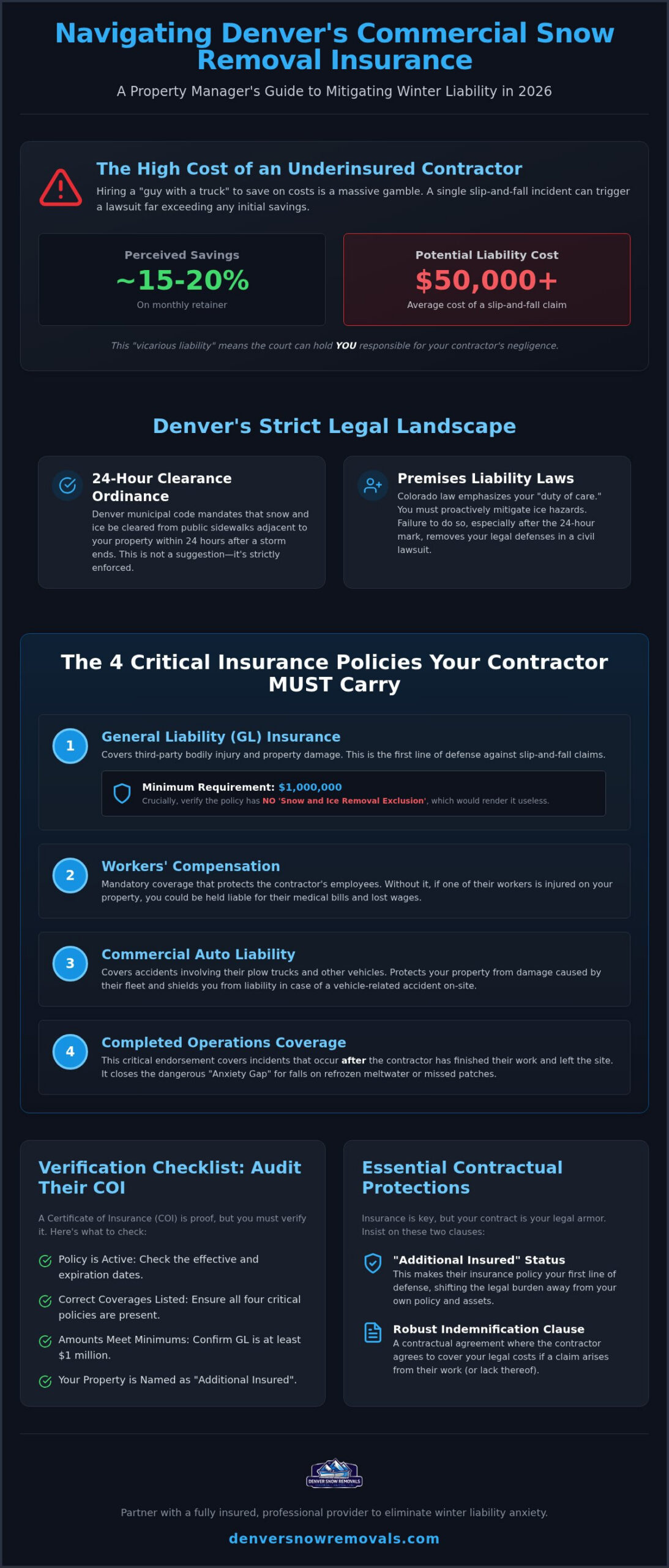
Choosing a cheap, uninsured provider for snow plowing Denver is a massive gamble. You might save on the monthly retainer, but you risk “vicarious liability.” This means the court can hold you responsible for the contractor’s negligence. With the average slip-and-fall claim now topping $50,000, that “budget” plow becomes the most expensive mistake you’ll ever make. In 2026, Colorado law dictates that your “duty of care” requires proactive, documented efforts to mitigate ice hazards for every person who sets foot on your property. While Colorado’s “Natural Accumulation Rule” offers some protection during a storm, that shield vanishes once the snow stops. You must have a contractor who understands these timelines. Snow Removal Denver ensures your property meets these standards so you never have to worry about a lawsuit.
The 4 Critical Insurance Policies Your Snow Removal Contractor Must Carry
Hiring a contractor without verifying denver commercial snow removal insurance requirements is a massive gamble for your property. A standard business policy is rarely enough for the high-risk work of clearing Colorado ice. You need to ensure your provider carries four specific types of coverage to fully transfer liability. Snow Removal Denver maintains all of these essential policies to give our clients total peace of mind during every storm. If your current “guy with a truck” can’t produce these documents, your property is at risk.
General Liability and the Deadly ‘Snow Exclusion’
Many property managers don’t realize that standard General Liability (GL) policies often contain a “Snow and Ice Exclusion.” This clause specifically removes coverage for any claims related to snow plowing operations. You must ask your contractor for a “Snow Plowing Endorsement” to ensure the policy is valid. Additionally, verify they have “Completed Operations” coverage. This protects you if a slip-and-fall occurs hours after the crew has left the site. Without this, the insurance company can deny the claim because the “operation” was finished. Snow Removal Denver ensures every contract is backed by a $1 million GL minimum that explicitly covers snow and ice management.
Workers’ Comp: Protecting Your Business from Injury Claims
Colorado law requires any business with employees to carry Workers’ Compensation insurance. For HOAs and commercial hubs, “ghost policies” or sole proprietor waivers are dangerous shortcuts. If a contractor’s employee is injured by a front-end loader or slips while shoveling on your property, you could be held responsible for their medical bills and lost wages. This is why screening your vendors is so critical for long-term safety. You can find more details on vetting providers in our guide on How to Choose a Snow Removal Company.
Beyond GL and Workers’ Comp, your contractor must carry Commercial Auto Insurance. Personal auto policies do not cover vehicles used for commercial snow plowing Denver. If a plow truck hits a parked car or a light pole on your lot, a personal policy will likely deny the claim. Finally, for high-traffic Denver properties, a standard $1 million limit is often insufficient. In 2026, many property managers now require an Umbrella or Excess Liability policy of $2 million to $5 million. This extra layer of protection is vital for retail centers and medical facilities where foot traffic is constant. If you want a partner who understands these risks, Snow Removal Denver is ready to provide the professional, fully insured service your property deserves.
Verification Checklist: How to Audit a Snow Removal Certificate of Insurance (COI)
Receiving a Certificate of Insurance (COI) is only half the battle. You must audit that document to ensure it meets every one of the denver commercial snow removal insurance requirements for 2026. A Certificate of Insurance is a snapshot in time, not a guarantee of future coverage. If a contractor stops paying their premiums in December, that paper in your file becomes worthless. Snow Removal Denver provides transparent, up-to-date documentation because we believe in gaining your professional trust through total accountability. We take the anxiety out of the verification process by providing everything you need upfront.
- Step 1: Verify the Insured Name. It must match the legal name on your service contract exactly. If the contract says “Professional Plowing” but the COI says “John’s Landscaping,” your liability protection may be void.
- Step 2: Check the Policy Dates. Ensure the coverage spans the entire 2026 winter season. Many policies expire on December 31st. If yours does, you need a renewal certificate before the January storms hit Denver.
- Step 3: Confirm the Boxes. Look for the “Additional Insured” (AI) and “Waiver of Subrogation” boxes. These must be checked to ensure your property is protected first in the event of a lawsuit.
- Step 4: Call the Agent. Don’t just look at the paper. Call the insurance agency listed at the top. Ask them to confirm the policy is currently active and has no pending cancellations for non-payment.
Reading the ACORD 25 Form for Snow Services
The ACORD 25 is the industry standard form for insurance verification. Look closely at the ‘Description of Operations’ box at the bottom. It must contain specific keywords like “Snow Removal” or “Ice Management.” If it only mentions “General Landscaping,” the carrier will likely deny a slip-and-fall claim. You also want an ‘Occurrence’ based policy rather than ‘Claims-Made.’ Occurrence policies provide much broader protection for incidents that happen during the policy period, even if the claim is filed years later. Snow Removal Denver and Snow Plowing Denver always maintain high-tier occurrence-based coverage for every client.
Red Flags in Snow Plowing Denver Insurance Certificates
Watch out for handwritten changes or blurry, low-quality logos. These are classic signs of document fraud. Another major red flag is a policy that expires in the middle of January. This often indicates a contractor who is struggling with cash flow or using a short-term policy to bypass denver commercial snow removal insurance requirements. Finally, be wary of generic descriptions. If the certificate doesn’t explicitly mention snow work, the contractor hasn’t paid for the necessary endorsements. Choosing a family-owned business like Snow Removal Denver eliminates these risks. We have 44 years of experience providing reliable, fully insured snow removal and snow plowing Denver.
Essential Contractual Protections: Beyond the Insurance Policy
A Certificate of Insurance is only one piece of the puzzle. To truly satisfy denver commercial snow removal insurance requirements, your written contract needs specific legal language to shift risk effectively. Indemnification and “Hold Harmless” clauses are non-negotiable. These provisions ensure the contractor accepts the legal defense costs if their negligence leads to a slip-and-fall injury. A clearly defined “Scope of Service” is also essential. It identifies exactly which sidewalks, entryways, and parking stalls the contractor is responsible for, leaving no room for legal ambiguity when a heavy storm hits.
The ‘Additional Insured’ Endorsement Explained
You must require “Additional Insured” status on a primary and non-contributory basis. This specific wording gives you direct access to the contractor’s policy limits. It ensures their insurance pays out first before your own property insurance is ever triggered. This protects your loss history and keeps your own commercial premiums stable. Implementing professional snow plowing techniques helps prevent the icy patches that lead to these claims in the first place. Snow Removal Denver and Snow Plowing Denver always prioritize these contractual safeguards to protect property managers from unnecessary financial exposure.
Documentation: The Insurance Company’s Best Friend
In a Denver courtroom, if it isn’t documented, it didn’t happen. Your contractor must maintain meticulous logs of every site visit. These records should include salt application rates, exact plow times, and time-stamped photos of the finished work. We utilize GPS tracking and digital logs to provide an airtight defense against fraudulent slip-and-fall allegations. This commitment to detail comes from over 44 years of experience in the Denver Metro area. You can prepare your site for the upcoming season using our Winter Storm Preparedness Guide. For reliable service that meets all denver commercial snow removal insurance requirements, request a quote from Snow Removal Denver today.
Partnering with a Fully Insured Professional: The Snow Removal Denver Standard
Snow Removal Denver has provided fully insured service in the Denver Metro area for over 44 years. We understand the anxiety and diligent work required to keep a commercial property safe. Our family-owned business takes this responsibility seriously. We meet and exceed all denver commercial snow removal insurance requirements to ensure your liability is fully transferred. You don’t have to worry about underinsured operators or “guys with trucks” when you work with us. We provide a level of calm competence that only comes from decades of experience in the field.
We encourage every property manager to request a sample Certificate of Insurance (COI) during the bidding process. A professional contractor will always have this document ready for your review. It proves they are prepared for the season and have invested in the necessary endorsements. Snow Removal Denver and Snow Plowing Denver provide these documents transparently to every client. We also maintain on-call personnel 7 days and nights to respond to any emergency. This 24/7 readiness is essential for meeting Denver’s 24-hour clearing ordinance and reducing your window of liability.
Safe Passage for Your Employees and Clients
Our primary goal is keeping your business open and your people safe. Safe passage is not just a phrase; it is our operational standard. We use heavy equipment like front-end loaders and snow blowers for precision clearing. These tools allow us to clear tight spaces and sidewalks where large plow trucks cannot reach. This precision prevents the icy patches that lead to slip-and-fall lawsuits. Professional snow plowing Denver is a partnership in risk management. We provide the meticulous documentation and reliable service you need to stay compliant with local laws. You can trust our seasoned veterans to handle the most difficult winter conditions.
Get a Reliable, Insured Estimate Today
Don’t wait for the first blizzard to find out your contractor is underinsured. You need to know your property is protected before the snow starts falling. Call us today for a free estimate for your commercial property. Snow Removal Denver and Snow Plowing Denver are ready to handle any snow removal task, no matter the size. We have over 44 years of experience in the Denver Metro area. This long history is your best insurance against the risks of winter. We are a serious, well-equipped expert you can count on in any emergency. Experience is the best insurance of all. We are here to gain your professional trust through quality and reliability. Contact Snow Removal Denver today to secure your property for the 2026 season.
Secure Your Property for the 2026 Winter Season
Managing winter liability in Denver requires more than just hiring a plow. You must audit certificates of insurance, confirm specific endorsements like “Completed Operations,” and ensure your contracts include robust indemnification clauses. These steps are essential to meeting denver commercial snow removal insurance requirements and protecting your business from the high costs of slip and fall litigation. Taking these precautions now ensures you aren’t left vulnerable when the first major storm hits.
Snow Removal Denver and Snow Plowing Denver take the anxiety out of this process. We are a family owned and operated business with over 44 years of experience in the Denver Metro area. Our team is fully licensed and insured for commercial operations, providing you with the professional documentation and safe passage your clients expect. We maintain on-call personnel 7 days and nights to ensure your property remains safe and compliant throughout the winter months.
Request a Free Estimate from Snow Removal Denver—Fully Insured for 44+ Years
Don’t leave your property’s safety to chance when the next storm hits. Partner with a veteran team that understands the local landscape and keeps your liability protected all season long.
Frequently Asked Questions
What is the minimum general liability limit for Denver commercial snow removal?
The standard minimum for denver commercial snow removal insurance requirements is $1 million per occurrence. For properties with high foot traffic, such as retail centers or medical offices, we recommend requiring $2 million to $5 million in coverage. Snow Removal Denver maintains high limits to ensure every property manager has total peace of mind during the winter season.
Do I need to be listed as ‘Additional Insured’ on my snow plow contractor’s policy?
Yes, you must be named as an “Additional Insured” to receive direct protection under the contractor’s policy. This status allows the insurance company to defend you directly if a slip and fall lawsuit occurs on your property. It is a vital step in transferring liability away from your business and onto the service provider.
What does ‘Primary and Non-Contributory’ mean in a snow removal contract?
This clause ensures the contractor’s insurance pays out first before your own property insurance is ever touched. The “non-contributory” part means your insurance company won’t have to pay any portion of the claim. This is a standard requirement for professional snow plowing Denver contracts to protect the property owner’s loss history and premiums.
Can I be held liable if my snow removal contractor isn’t insured?
You can absolutely be held liable under the legal principle of vicarious liability. If your contractor lacks proper denver commercial snow removal insurance requirements, the financial burden of an injury claim falls directly on you. Hiring an uninsured “guy with a truck” is a major risk that can lead to expensive legal battles and settlements.
How do I verify if a snow removal company has valid workers’ compensation in Colorado?
You should request a Certificate of Insurance and call the insurance agent listed on the form to confirm the policy is active. Colorado law requires any business with employees to carry this coverage. Snow Removal Denver and Snow Plowing Denver always provide verified proof of workers’ compensation to ensure our clients are never at risk.
Why do some insurance companies exclude snow plowing from general liability?
Insurance carriers often exclude snow work because the high frequency of slip and fall claims makes it a high-risk operation. Contractors must pay an extra premium for a specific “Snow Plowing Endorsement” to have these activities covered. If this endorsement is missing, the policy will not pay for any accidents related to snow or ice.
What documentation should I ask my snow removal provider to keep for insurance purposes?
Your provider must keep detailed service logs including salt application rates, exact plow times, and time-stamped photos of the work. These records are the most effective defense against fraudulent injury claims. Snow Removal Denver uses 44 years of experience to provide meticulous documentation that satisfies insurance adjusters and legal teams alike.
Is it okay to hire a snow removal company with a ‘ghost’ workers’ comp policy?
No, hiring a company with a “ghost policy” is extremely dangerous for property managers. These policies cover zero employees and exist only to provide a certificate of insurance without actual protection. If a worker is injured on your site, you could be responsible for their medical bills and lost wages. Always insist on a standard workers’ compensation policy.