Denver Snow Shoveling Service | Reliable Residential & Commercial Recently updated !
Denver averages about 57 inches of snowfall each winter, a number that sounds manageable until you are the one gripping a shovel at 6 a.m. while the temperature hovers in the teens. The city’s snow removal laws add another layer of pressure: property owners must clear sidewalks within a set window after the snow stops falling, or they risk fines and liability. A professional snow shoveling service Denver CO residents can count on is not a luxury. It is the difference between a safe, compliant property and a season of stress, ice buildup, and potential lawsuits. This article explains exactly what a dedicated local provider offers, what you should expect to pay, how Denver’s snow laws work in 2026, and what separates a surface-safe, insured operation from a crew with a truck and a metal blade.

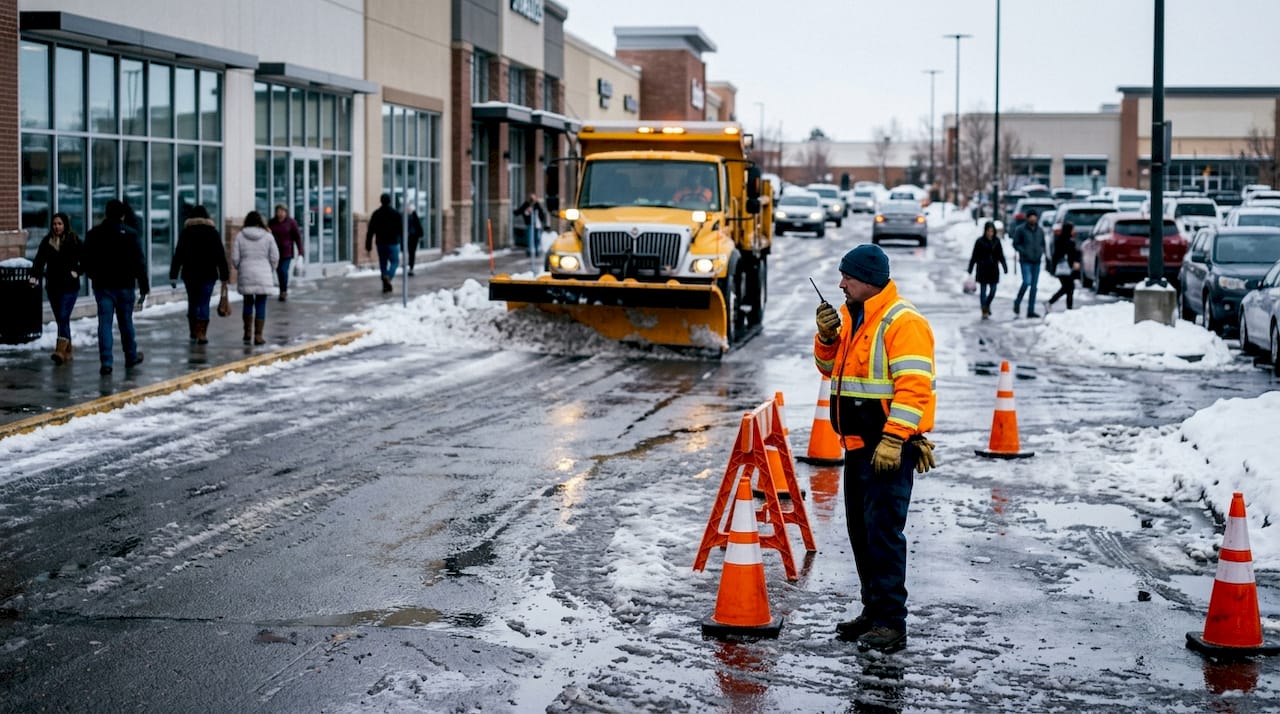
Snow plowing parking lot in Denver, Colorado
Table of Contents
- Why You Need a Professional Snow Shoveling Service in Denver, CO
- Our Snow Shoveling Services for Denver Properties
- How Much Does Snow Shoveling Service Cost in Denver, CO?
- Denver Snow Shoveling Laws You Need to Know (2026 Update)
- How to Choose the Best Snow Shoveling Service in Denver, CO
- Frequently Asked Questions About Snow Shoveling in Denver, CO
- Get a Free Quote for Denver Snow Shoveling Service
Why You Need a Professional Snow Shoveling Service in Denver, CO
Denver’s sidewalk shoveling laws are among the strictest in the region, and they apply to every property owner. Businesses must begin clearing sidewalks, ADA ramps, and bus stop boarding areas immediately after snow stops. Residential owners have until the following day. The city’s Department of Transportation and Infrastructure sends inspectors who leave time-stamped notices on noncompliant properties. Businesses get four hours to correct the issue before a re-check and citation. Residences get 24 hours.
See the Best Snow Plows of 2026 ❄️
Ignoring these timelines means fines that compound with each storm.
Safety and liability are equally urgent concerns. A slip-and-fall accident on an uncleared walkway can trigger a lawsuit that far exceeds the cost of a seasonal snow removal contract. Professional services carry general liability insurance and workers’ compensation, which means you are not left exposed if a worker gets injured on your property or if a plow blade catches an edge of decorative concrete. That coverage is something a neighbor’s teenager with a shovel cannot offer.
Surface protection is another reason to hire a specialist. Many Denver homes feature stamped concrete driveways, flagstone walkways, and brick pavers that metal shovels and standard plow blades can gouge and scar. A professional crew uses rubber-edged blades and plastic shovels designed to clear snow without leaving behind a season’s worth of scratches and chips. The same care extends to asphalt lots, where aggressive plowing can peel away sealcoating and create potholes.
Residential Snow Plowing in Denver →
Finally, there is the matter of timing. After a heavy storm, snow that sits on pavement compacts and bonds with the surface as temperatures fluctuate. What starts as a quick shovel job becomes a chipping-and-chopping ordeal once ice sets in. A dedicated service dispatches crews as soon as accumulation hits a defined threshold, clearing the property before that freeze-thaw cycle takes hold.
Our Snow Shoveling Services for Denver Properties
Residential Driveway and Walkway Shoveling
Residential snow clearing goes far beyond running a plow down the driveway. A complete service includes the full length of the driveway, front walkways, side paths, steps, and any ADA ramps that connect to the public sidewalk. Hand-shoveling crews handle tight areas where a plow blade cannot reach: around mailboxes, along fence lines, and near garage doors where piled snow can block access.
The equipment matters as much as the technique. Crews use plastic shovels and rubber-edged pushers that clear snow efficiently without scarring stamped concrete, exposed aggregate, or brick surfaces common in neighborhoods like Washington Park, Hilltop, and Cherry Creek. For properties with steep driveways or shaded north-facing exposures that stay icy long after the sun comes out, deicing application keeps surfaces safe. The product used is a calcium magnesium acetate blend, similar to Sno Plow by MorGro, which is less corrosive to concrete than rock salt and safer for pets, plants, and the groundwater that feeds into the South Platte basin.
Homeowners can choose between seasonal contracts and per-visit service. A seasonal contract locks in a flat rate for the winter and guarantees priority dispatch during major storms. Per-visit pricing works for those who travel frequently or want coverage only during the heaviest months. Both options include deicing on request and a defined snow depth trigger, typically two inches, that automatically prompts a crew visit.
Commercial Parking Lot and Sidewalk Shoveling
Commercial properties face a stricter compliance timeline and a larger surface area to manage. Denver requires businesses to clear sidewalks, bus stops, and ADA ramps immediately after snow stops. For a retail center, office park, or restaurant with morning hours, that means crews must be on-site before the first employee or customer arrives.
Commercial service combines heavy-duty equipment with hand-crew precision. Skid steers and plow trucks clear large parking lots, loading zones, and access drives. Hand crews follow to clear entryways, dumpster pads, fire hydrants, and the narrow strips between parked cars that plows cannot reach. The goal is a fully operational property by opening time, with no ice patches near doorways and no snow piles blocking sightlines at exit points.
Emergency storm response is built into commercial contracts. During back-to-back snow events, crews remain on call 24/7 and return as needed to keep lots clear and sidewalks compliant. Bulk deicing and sanding applications provide traction on slopes and in high-foot-traffic zones. Property managers can choose standard rock salt or an eco-friendly blend that reduces corrosion on concrete and protects landscaping beds from salt burn.
Specialized Services: Roof Ice Dams and Snow Hauling
Some snow problems require solutions beyond shoveling and plowing. Ice dams form when heat escapes through a roof and melts the bottom layer of snow, which then refreezes at the colder eaves. The result is a ridge of ice that traps water, forcing it under shingles and into the structure. One effective prevention method is deicing cable installation along rooflines and in gutters. Heated cables create channels for meltwater to drain, preventing the freeze-thaw cycle that causes dams. This is a niche service that most snow removal companies do not offer, and it can save Denver homeowners thousands in roof and interior repairs.
Snow hauling addresses a different problem: limited stacking space. On tight urban lots or commercial properties with small landscape islands, there is simply nowhere to push the snow. Hauling crews load accumulated snow into trucks and transport it to approved dump sites, preventing the melt-and-refreeze cycle that turns piled snow into an ice hazard that lingers for weeks.
How Much Does Snow Shoveling Service Cost in Denver, CO?
Pricing is the question most people ask first, and it is the one least often answered clearly online. The cost of a snow shoveling service Denver CO depends on several variables, but understanding the ranges helps you evaluate quotes without guesswork.
For a standard two-car residential driveway with a front walkway and steps, per-visit pricing typically falls between $45 and $100. The lower end applies to light snow events of two to four inches with straightforward access. The higher end reflects deeper snow, longer or steeper driveways, and the inclusion of deicing. A large driveway with a detached garage, multiple walkways, and a patio area can push per-visit costs to $120 or more.
Commercial pricing scales with square footage and complexity. A small office lot might run $150 to $300 per visit. A large retail center or industrial property with multiple access points, loading docks, and pedestrian walkways can range from $500 to over $1,000 per event, especially during heavy storms that require multiple passes and hand-crew hours.
Several factors influence where your property falls within these ranges. Snow depth is the most obvious: a two-inch dusting requires far less time and labor than a foot of wet, heavy snow. Property size and layout matter equally. A long, winding driveway with retaining walls takes longer than a short, straight one. Frequency of service also affects cost. A seasonal contract spreads the risk across the entire winter, lowering the per-visit rate compared to calling for individual storms. Deicing adds a material and labor cost per application, typically $15 to $40 for a residential driveway depending on the product used.
Seasonal contracts offer the best value during a heavy winter. You pay a fixed amount upfront or in installments, and the crew responds to every qualifying storm without additional charges. Per-visit pricing offers flexibility but can become expensive during an active season with frequent snow. Most reputable providers offer free, no-obligation quotes with transparent pricing that spells out exactly what is included: the snow depth trigger, whether deicing is part of the base rate, and how back-to-back storms are handled.
Denver Snow Shoveling Laws You Need to Know (2026 Update)
Denver’s snow removal regulations have not changed dramatically in recent years, but enforcement has become more consistent, and the expectations placed on property owners are worth reviewing every season.
The core rule is straightforward: property owners are responsible for clearing snow and ice from sidewalks adjacent to their property, including ADA ramps and bus stop boarding areas. Businesses must begin clearing immediately after snow stops falling. Residential owners have until the next day. The city defines “next day” practically: if snow stops at 3 p.m. on a Tuesday, the sidewalk must be clear by Wednesday morning.
Enforcement follows a specific process. A DOTI inspector who finds an uncleared sidewalk leaves a time-stamped notice on the property. For businesses, the re-check happens after four hours. For residences, it happens after 24 hours. If the sidewalk remains uncleared at the re-check, the city issues a citation. Fines vary but increase with repeat offenses within the same season.
One common misunderstanding is the relationship between the city’s plow program and private responsibility. Denver’s DOTI maintains approximately 2,050 lane miles of main streets using a fleet of 70 large plows. The residential plow program, created after the blizzards of 2006 and 2007, covers about 1,260 center lane miles of residential streets using 4×4 pickup trucks with plows. Protected bikeways are cleared at least once every 24 hours, and off-street trails are plowed within 12 hours after snowfall ends. None of these municipal services clear private driveways, private sidewalks, or the sidewalk in front of your home or business. That obligation remains with the property owner, regardless of whether a city plow has pushed snow from the street back onto the sidewalk.
How to Choose the Best Snow Shoveling Service in Denver, CO
Selecting a snow removal provider involves more than picking the lowest quote. A few specific questions separate reliable, professional operations from underprepared crews.
First, verify insurance and licensing. Ask for a certificate of general liability insurance and confirmation of workers’ compensation coverage. Without both, you assume the risk if a worker slips on your property or a plow damages your driveway. A reputable company provides this documentation without hesitation.
Second, check reviews and references with a focus on recency and relevance. Look at Google and Yelp reviews from the past two winters. Ask the provider for references from properties similar to yours: a neighbor with a stamped concrete driveway, a business owner with a lot the same size, or someone in a neighborhood with the same microclimate. Denver’s snow varies significantly by elevation and proximity to the foothills, and a provider who performs well in one area may struggle in another.
Third, ask about equipment. If your property has decorative concrete, brick pavers, or a recently sealcoated asphalt driveway, confirm that the crew uses rubber-edged plow blades and plastic shovels. Metal blades are standard for heavy commercial lots but can cause expensive damage on residential surfaces. A provider who cannot answer this question clearly is not one you want on your property.
Fourth, read the contract carefully. Understand the snow depth trigger: most services dispatch at two inches of accumulation, but some use one inch or three inches. Know the cancellation policy and whether you are locked in for the full season. Clarify what happens during back-to-back storms: does the crew return automatically, or do you need to call each time? A good contract answers these questions in plain language.
Finally, prioritize local experience. A provider who has worked Denver winters for multiple seasons knows which neighborhoods get heavier snow, which streets the city plows first, and how enforcement patterns vary across the city. That institutional knowledge translates to faster response times and fewer surprises.
Frequently Asked Questions About Snow Shoveling in Denver, CO
Do I need to shovel my sidewalk if I have a plow service?
Yes. Plow services clear driveways, parking lots, and private walkways, but sidewalk shoveling is a separate service required by Denver law. Confirm that your contract explicitly includes sidewalk clearing, including ADA ramps and bus stop areas if they abut your property.
What happens if it snows again before my scheduled service?
Most seasonal contracts include unlimited visits triggered by each qualifying snow event. If snow falls, stops, and falls again, the crew returns without an additional charge. Per-visit customers typically pay for each dispatch, so a seasonal contract offers better protection during active weather patterns.
Do you offer eco-friendly deicing?
Yes. The standard deicing product used is a calcium magnesium acetate blend that is less corrosive to concrete than rock salt and safer for pets, plants, and local waterways. It performs effectively at Denver’s typical winter temperatures and provides traction without leaving a sticky residue.
How quickly do you respond after a storm?
Crews begin dispatching as soon as snow accumulation reaches the contract threshold, typically two inches. Commercial properties with early-morning access requirements receive priority routing. Residential properties are cleared on a scheduled route, with most driveways and walkways completed within four to eight hours after snow stops, depending on storm severity and route density.
What areas do you serve?
Service covers Denver proper and the surrounding metro suburbs, including Littleton, Lakewood, Arvada, Thornton, and Aurora. Properties in foothills communities with steeper terrain and heavier snow loads are evaluated on a case-by-case basis.
Get a Free Quote for Denver Snow Shoveling Service
A Denver winter without a reliable snow removal plan means waking up anxious every time the forecast calls for accumulation. It means rushing home to shovel before the 24-hour deadline, chipping ice off a sidewalk you swore you would treat yesterday, and hoping no one slips on the walkway leading to your front door. A professional snow shoveling service Denver CO property owners trust eliminates that cycle. With insured crews, surface-safe equipment, transparent pricing, and a clear contract that spells out exactly what you are getting, you can let the snow fall without the stress.
Ready to secure your property for the 2026 winter season? Call today for a free, no-obligation quote on a seasonal contract or per-visit service. We serve Denver, Littleton, Lakewood, Arvada, Thornton, Aurora, and the surrounding metro area with upfront pricing and crews who know Denver snow.