



Why Snow Plowing Strategy Matters For Denver Strip Malls
For a Denver strip mall, a slow or sloppy snow response is not just inconvenient. It can shut tenants down on peak days, trigger slip‑and‑fall claims, and anger national brands that expect strict compliance with lease standards. At the same time, overpaying for premium service on every dusting can crush an already tight CAM budget.
This guide is designed for owners and managers of retail strip malls and centers in the Denver metro area, along with property managers responsible for multiple small retail sites. It explains how snow plowing services for strip malls in Denver really work, what service levels you should expect, and how to evaluate contractors using objective criteria, not just “who is cheapest.”
By the end, you will know how to compare proposals, match service levels to tenant mix and risk tolerance, and structure a snow contract that keeps your parking lots open, safe, and on budget all winter.
Unique Snow Removal Challenges For Denver Strip Malls
Snow management at a strip mall has different stakes and logistics than a single office or residence. Understanding those differences helps you choose the right provider and levels of service.
High‑traffic patterns and small site constraints
Strip malls combine tight parking fields with heavy turn‑over traffic. That creates specific issues:
- Concentrated pedestrian zones directly in front of storefronts
- Angled parking that traps windrows along curbs
- Limited stacking areas for pushed snow
- Shared access drives with neighboring properties or public streets
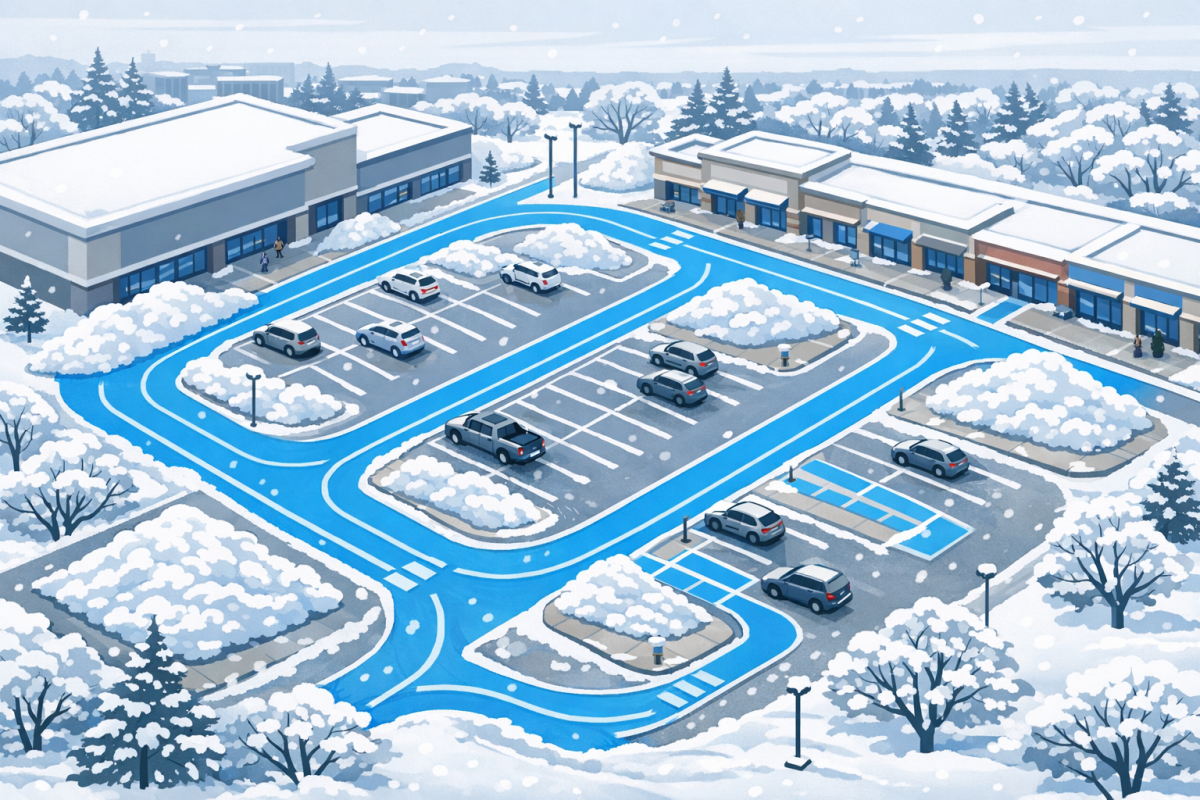
The plow plan needs to map traffic flows and identify where snow can safely be stored or when it must be hauled away after large storms.
Tenant mix and operating hours
A center anchored by a grocery store, pharmacy, and quick‑service restaurants has very different needs than a center with daytime professional services.
Typical patterns:
- Grocery anchored: Need plows out before 5 a.m., often multiple passes per day
- Medical clinics: Zero tolerance for ice around accessible parking and ramps
- Restaurants and bars: Evening and late‑night treatment, especially for refreeze
Key Takeaway: Always align your trigger depths, timing commitments, and de‑icing levels with your anchor tenants’ busiest hours and lease obligations.
Legal, risk, and brand considerations
In Denver, variable freeze‑thaw cycles create black ice hazards. Slip‑and‑fall claims, especially near handicapped stalls and walkways, are a serious risk. For strip malls, additional concerns include:
- National retailers that require detailed snow and ice documentation
- CAM pass‑through expectations and audit rights
- Local ordinances on sidewalk snow clearance timing
You need a contractor that not only plows, but also documents conditions, treatments, and response times in a way that will stand up to insurance and tenant scrutiny. You can learn more about key snow and ice risks many Denver properties overlook.
Core Service Types To Compare For Strip Malls
When you request quotes for snow plowing services for strip malls in Denver, you will usually see a combination of several components. Understanding what is included, and what is extra, helps you compare apples to apples.
Plowing and clearing vehicular areas
This covers:
- Main parking areas and traffic lanes
- Loading and delivery zones
- Entry and exit drives to public streets
Clarify these points:
- Trigger depth for plowing, often 1 or 2 inches
- Service window after trigger is met, for example, within 4 hours
- Handling of storms that keep producing snow through the day
In Denver, many centers benefit from event‑based passes, for example, a clean‑up after 4 inches plus a final pass when snowfall stops, rather than only one plow at the end.
Sidewalks, curbs, and storefront areas
Do not assume sidewalk clearing is included in a plowing quote. Ask specifically about:
- Storefront walks in front of each tenant
- Public sidewalks along street frontage
- Steps, ramps, and landings at key doors
For mixed‑use or institutional campuses that include retail, schools, or churches, sidewalk priorities can be as critical as the lot. Review Denver timing requirements for public walks to avoid fines.
De‑icing, anti‑icing, and refreeze management
Salting and liquid de‑icers are often a separate line item. Differences to compare:
- De‑icer type (treated salt, magnesium, calcium, or liquids), which affects performance in sub‑zero events
- Automatic service versus “call‑out only”
- How they address refreeze overnight or during temperature swings
For high‑liability areas, such as handicap stalls and crosswalks, specify that they must be treated on each event, even during small dustings.
Snow hauling and on‑site stacking
Denver’s larger storms can quickly overwhelm small sites. Key questions:
- Where will snow be stacked, and who approves stacking areas
- At what depth or pile size will the contractor recommend hauling
- Hauling pricing structure and mobilization timelines
For tight urban strip centers and small shopping plazas, you may want a pre‑set threshold for hauling, rather than a last‑minute negotiation after cars are already blocked.
Pricing Models For Snow Plowing Services In Denver
Cost structures vary widely among Denver snow contractors. Choosing the right model for your strip mall depends on risk tolerance, cash flow, and your view of long‑term weather averages.
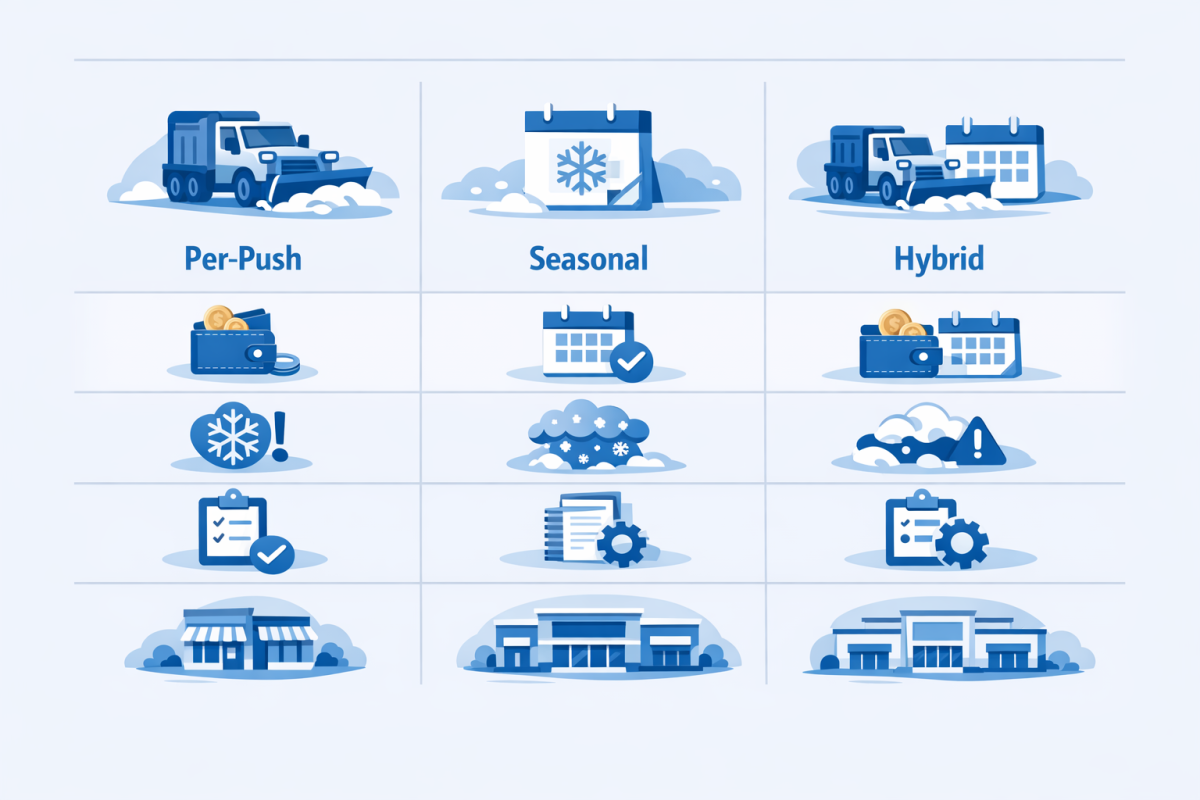
Per‑push or per‑event pricing
You pay each time the contractor plows or treats. Good for:
- Smaller centers with modest traffic
- Owners who prefer to pay only when it snows
Pros:
- Easy to understand and reconcile
- Lower cost in very light winters
Cons:
- Budgets can spike in heavy snow years
- Temptation for contractors to “push” more often if definitions are vague
To avoid disputes, specify what counts as an event, for example, continuous snow over 24 hours, and how partial plows or return visits are billed.
Seasonal or all‑inclusive contracts
You pay a fixed price for a defined winter season, for example, November through March. These often include:
- Plowing for all events up to a certain depth
- A defined number of return visits per storm
- Some level of de‑icing
Best for:
- Multi‑tenant centers that cannot risk budget surprises
- Owners who manage multiple commercial or HOA sites and want predictable CAM billing
Pros:
- Predictable costs, easier pass‑through to tenants
- Aligned incentives to perform efficiently
Cons:
- May pay more in very light winters
- Need clear caps on extreme snow seasons and hauling exclusions
Hybrid or tiered models
For many strip malls, a hybrid approach works best. Common strategies:
- Seasonal base contract with per‑push for storms over a set depth, for example, over 8 inches
- Seasonal plowing with de‑icing billed by application
- Tiered pricing for different trigger depths at different parts of the property
This allows you to protect your budget from typical Denver winters while sharing risk with the contractor for extreme events.
Pro Tip: When you evaluate proposals, normalize them into an estimated “typical winter” total using 10‑year average snowfall. That way you can compare very different pricing models on common ground.
How To Evaluate Snow Plowing Providers For Strip Malls
Once you understand services and pricing, the next step is choosing a contractor that can actually deliver under Denver’s storm patterns.
Response time, equipment, and routing
Ask for specifics, not general promises:
- Maximum response time after trigger depth is reached
- Type and number of plows, skid steers, and sidewalk crews assigned to your area
- How routes are structured, in particular whether your center is early or late in the route
For high‑profile strip malls or mixed retail / industrial centers, you may want dedicated equipment on site or at least assigned to a very tight route.
Experience with similar properties
Look for vendors that actively manage:
- Retail strip malls or shopping centers of similar size
- HOA or campus‑style sites with complex pedestrian flows
- Industrial facilities that require clear truck docks and turn‑arounds
Request references from at least two Denver‑area properties that operate on similar hours and have similar anchor tenants.
Documentation, technology, and communication
For risk management and tenant relations, strong documentation is as important as plowing speed. Ask about:
- GPS and time‑stamped service logs
- Event reports that list timing, services provided, and conditions
- Online portals or apps your team can use for real‑time status
You can learn more about modern snow reporting tools and how they reduce liability on commercial sites.
Insurance, safety, and contracts
Non‑negotiables include:
- Adequate general liability and auto coverage, verified with certificates naming you as additional insured
- Written safety procedures for drivers and sidewalk crews
- A clear contract that defines scopes, triggers, damage responsibilities, and indemnification
Important: Never award a snow contract based solely on lowest price. In Denver, one serious incident, such as a major slip‑and‑fall or blocked fire lane, can wipe out years of savings.

Matching Service Level To Your Specific Strip Mall
The best snow plowing program for a Denver strip mall is not “max service at any cost.” It is the right combination of response, coverage, and price for your actual risk profile.
Tenant profile scenarios
Consider these common scenarios:
- Grocery anchored neighborhood center: Needs near‑zero downtime. Choose a low trigger depth, fast response guarantee, robust de‑icing, and likely a seasonal or hybrid contract.
- Service‑oriented professional strip (salons, insurance, gyms): Moderate traffic spread through the day. A slightly higher trigger depth with targeted de‑icing may be sufficient.
- Value retail with restaurants: Push hard on opening and evening hours. Emphasize storefronts, crosswalks, and pedestrian routes more than remote parking corners.
Map where your highest‑value and most vulnerable customers park and walk, then ensure those areas are first‑priority in every event plan.
Property layout and shared access
For retail centers connected to:
- Adjacent strip malls
- Big box anchors
- Shared access roads or roundabouts
Coordinate with neighboring owners or the master association. Fragmented snow services can create confusing and unsafe conditions at entrances. A single contractor for all parcels, or strong coordination between vendors, is usually safer and yields cleaner site lines.
Balancing budget, risk, and expectations
Use a decision matrix that weighs:
- Tenant expectations and lease requirements
- Injury and vehicle accident risk
- Exposure to municipal enforcement on sidewalks
- Available CAM budgets and reserve capacity
Assign each factor a weight, then score different service packages, for example, premium seasonal versus mid‑range hybrid. This makes the decision more objective and defensible with ownership groups or HOA boards.
When To Upgrade To Professional Commercial Service
Some smaller owners are tempted to handle snow with an in‑house truck or a residential‑focused vendor. There are situations where this is viable, and others where it becomes risky.
Suitable for light, low‑risk use
In‑house or residential crews might be acceptable for:
- Very small, single‑tenant pads with limited hours
- Private driveways or small church lots with flexible schedules
- Low‑traffic office condos with tolerant occupants
These sites can often wait for mid‑day clear‑ups and can live with a little packed snow in low‑use corners.
Red flags that you need a dedicated commercial provider
You should strongly consider a professional commercial snow contractor if:
- National or regional tenants occupy the center
- There are more than 60 to 80 parking stalls
- Medical, grocery, or 24‑hour operations occupy any part of the site
- The site has complex grades, retaining walls, or hidden obstacles
Commercial specialists are set up for Denver’s heavier events, complex documentation, and larger liability exposures in a way that residential crews are not.
You can learn more about what differentiates true commercial snow services from residential contractors that “also plow some lots.”
CTA: Partnering With The Right Denver Snow Team
If you manage a Denver strip mall or retail center, you need a snow partner who understands tenant mix, risk, and CAM pressures, not just someone with a plow on a pickup.
Snow Removal Denver and Snow Plowing Denver focus on commercial and multi‑site properties in the Denver metro area. Their teams design site‑specific plow maps for strip malls, coordinate with your tenants’ hours, and provide detailed event documentation that supports both insurance and lease compliance.
They can help you:
- Select the right trigger depths and pricing model for your budget
- Prioritize storefronts, sidewalks, and crosswalks based on actual traffic
- Plan stacking and hauling strategies for Denver’s biggest storms
If you want a tailored plan instead of a one‑size‑fits‑all bid, visit Snow Removal Denver and Snow Plowing Denver at https://denversnowremovals.com/ and Learn more about solutions specifically for retail strip centers.
Your Next Steps For A Safer, More Predictable Winter
To move from reactive snow scrambling to a reliable program for your Denver strip mall:
- Map your property: identify high‑risk zones, stacking areas, and shared access.
- Clarify tenant expectations and lease language about snow and ice.
- Decide which pricing model best matches your budget stability needs.
- Shortlist contractors that specialize in commercial and retail properties.
- Request detailed, apples‑to‑apples proposals and compare them using a typical‑winter scenario.
With a structured approach, you can secure snow plowing services for your Denver strip mall that keep your tenants open, customers safe, and budgets under control all winter.
Frequently Asked Questions
What trigger depth is best for a Denver strip mall?
Most Denver strip malls choose a 1 to 2 inch trigger for plowing. High‑traffic centers with grocery or medical tenants often prefer 1 inch, especially for early morning hours. Smaller or lower‑traffic strips sometimes select 2 inches to control costs. For liability, you can still require de‑icing and spot treatment for dustings below the plow trigger, especially around handicap stalls and main walkways.
Should sidewalk clearing be included in my snow plowing contract?
Yes, for a retail strip mall, sidewalks and storefront walks should always be clearly included. They are where most slip‑and‑fall incidents occur. Your contract should specify which walks, ramps, and steps are covered, the clearing trigger, and whether crews automatically treat for ice. Excluding sidewalks to “save money” usually shifts risk and complaints back to the property manager or HOA board.
How can I compare different snow plowing bids fairly?
First, standardize assumptions. Use a 10‑year average Denver snowfall and estimate how many events would trigger service. Apply each contractor’s pricing model to that same scenario. Confirm which services are included, such as sidewalks, de‑icing, and hauling, and which are extra. Finally, weigh intangible factors such as response time guarantees, documentation quality, and experience with similar retail centers, not just the bottom‑line number.
When do I need snow hauling instead of just stacking?
You need hauling when on‑site piles interfere with parking, sightlines, or drainage. Tight strip malls with small lots often hit this point after a few larger storms, even if individual storms are manageable. Common triggers are piles that block more than a few stalls near entrances, piles that obstruct tenant signage, or mounds that funnel meltwater across walkways where it refreezes. It helps to define hauling thresholds in your contract.
Is a seasonal snow contract worth it for a small shopping center?
It can be, if you value budget predictability and consistent service. Smaller neighborhood centers with regular traffic often benefit from a seasonal or hybrid contract. You avoid cost spikes in heavy winters and can set clear service expectations with tenants. If your site is very small, has low traffic, and can tolerate slower response in big storms, a per‑push model may be sufficient, but review past winters before deciding.