
Why Commercial Snow Removal Choices Matter In Denver
If you manage property in the Denver metro area, snow is not just a weather event, it is a liability and business continuity issue. A single storm can shut down a retail center, create slip‑and‑fall claims at a multifamily community, or halt deliveries at an industrial facility. Yet not all commercial snow removal services in Denver are built for the same type of site, snow load, or risk tolerance.
This guide is written for property and facility leaders who must balance safety, budget, and operational uptime. You will learn how different service models work, what they really cost over a full winter, and how to compare contractors on more than price. By the end, you will have a decision framework you can use to choose the right provider for your HOAs, campuses, shopping centers, industrial facilities, and institutional properties.
Understanding Denver’s Snow Patterns And What They Mean For You
Denver snowfall is highly variable, which makes contract decisions tricky. You might get several light events in November, then a heavy, wet spring storm in March that dumps more than a foot in a day.
Key Denver Snow Realities That Affect Contracts
- Average annual snowfall for Denver is roughly 50–60 inches, but some winters spike much higher.
- Spring storms often bring heavy, wet snow that is harder on equipment and takes longer to clear.
- Temperature swings mean daytime melt and overnight refreeze, which increases black ice risks in parking lots and walkways.
This volatility means that a “cheap” per‑push contract can explode your budget in a high‑snow year, while an expensive‑looking seasonal contract might save you tens of thousands over time.
Key Takeaway: In Denver, you are not buying “X pushes per winter,” you are buying risk management for a very unpredictable climate. Choose contract structures that match your risk tolerance, not just your last season’s snowfall.
How Property Type Changes Your Risk Profile
Different properties experience weather risk very differently:
- Multifamily and HOA communities: High pedestrian traffic, high slip‑and‑fall risk, lots of stairs and narrow drives.
- Retail centers and strip malls: Early morning opening deadlines, constant vehicle turnover, critical visibility of parking stalls and crosswalks.
- Industrial and production facilities: Truck access, loading docks, and wide yards are mission‑critical. Downtime can mean lost production.
- Schools, churches, and campuses: Fixed schedules, lots of children or elderly visitors, and reputational risk if walks are not safe.
Knowing your risk profile will inform how aggressive your trigger depths, service timelines, and de‑icing standards need to be.
Core Service Models For Commercial Snow Removal In Denver
Every reputable Denver commercial snow removal company will package its services in one of a few common ways. The right model depends on your budget predictability needs and risk tolerance.
Seasonal (Flat Rate) Contracts
You pay a fixed amount for the entire snow season, typically November through March or April.
Best for:
- Larger properties that hate budget surprises, like HOAs, multifamily portfolios, and institutional campuses.
- Owners who prioritize uptime and safety over minimizing cost in light winters.
Pros:
- Predictable monthly cost, easier budgeting and CAM reconciliation.
- Contractor has incentive to perform proactively, not to generate more “pushes.”
- Often includes pre‑treatment, clearing, and return visits for refreeze.
Cons:
- You may overpay in light winters.
- Contractor may build a large risk margin into the price.
Per‑Push or Per‑Event Pricing
You pay each time the contractor plows, shovels, or salts, with rates by depth range, equipment type, and area size.
Best for:
- Smaller properties with limited budgets, like independent businesses with mid‑size lots.
- Owners who closely track each service and are comfortable with variable winter costs.
Pros:
- Pay only for what you use in low‑snow years.
- Easier to compare multiple bids line by line.
Cons:
- Budget exposure in heavy winters can be significant.
- Incentive sometimes shifts to maximizing pushes instead of optimizing outcomes.
Hybrid Contracts
A base seasonal fee that covers a defined number of events or inches, plus per‑push charges beyond that.
Best for:
- Portfolios that need budget predictability but want protection if snowfall is far below average.
- Properties transitioning from per‑push to flat‑rate and testing the waters.

Pro Tip: When you compare bids, normalize them to a “typical Denver winter.” Ask each contractor to model total cost for 40, 60, and 80 inches of snow so you can see how each contract behaves in light, average, and heavy years.
For more detail on how seasonal and per‑push contracts are structured in Denver, learn more.
Service Scope: What A Complete Commercial Snow Plan Should Include
The cheapest proposal is usually missing critical scope that you will pay for later, either in add‑ons or in accidents. Use the checklist below to define a complete commercial snow removal scope for Denver.
Typical Service Components
| Service Component | Description | Must‑Have For… |
|---|---|---|
| Parking lot plowing | Clearing travel lanes, stalls, and drive lanes | All commercial sites |
| Sidewalk and entry shoveling | Handwork or small machines at pedestrian routes | Multifamily, retail, schools, campuses |
| De‑icing (salt, treated ice) | Application on lots and walks to prevent ice formation | All, critical for high‑foot‑traffic properties |
| Hauling and off‑site removal | Trucking snow away when on‑site piles are unsafe or too big | Tight sites, retail with limited sight lines |
| Loader and stacking | Using loaders to move and stack large accumulations | Industrial yards, large parking lots |
| Ice monitoring and return visits | Checking refreeze and treating as needed | HOAs, multifamily, retail, campuses |
Important: Require your contractor to clearly map “who owns what” in writing. For example, city sidewalk vs private walk, roof drains that dump onto walks, or shared access drives between parcels.
Trigger Depths, Response Times, And Priorities
Have the contractor spell out:
- Trigger depth for plowing and shoveling, such as 1 inch for sidewalks, 2 inches for lots.
- Response time after snow stops, for example “all lots cleared within 4 hours after end of storm.”
- Open‑by commitments, such as “primary entrances and drives open by 6:00 a.m. for weekday operations.”
- Priority areas, including accessible routes, loading docks, fire lanes, and steep grades.
Sites like schools, medical offices, and production facilities often need more aggressive standards than self‑storage or low‑traffic office flex buildings.
For a more detailed checklist of snow removal scope items specific to Denver codes and standards, learn more.
Comparing Contractors: Beyond The Price Per Push
Once you define your scope, you can compare commercial snow removal services in Denver in a meaningful way. Price matters, but it is only one of many decision factors.
Evaluation Criteria That Actually Predict Performance
Consider scoring vendors across the following dimensions:
| Criterion | What To Ask Or Check | Why It Matters |
|---|---|---|
| Fleet size & type | How many plows, loaders, and skid steers are dedicated to my area? | Determines whether they can handle overlapping storms |
| Staffing & routes | How many properties per route driver? Shift overlap plan? | Overloaded routes mean slow response |
| Pre‑season planning | Will you walk and map the site and identify hazards? | Reduces property damage and improves efficiency |
| Insurance & limits | Current COI, GL and auto limits, workers comp? | Protects you when something goes wrong |
| Documentation & tech | Time‑stamped photos, site logs, GPS tracking? | Critical for slip‑and‑fall defense and transparency |
| Experience with your type | Do you maintain similar properties nearby? | Domain knowledge cuts down on learning curve |
Expert Insight: A contractor that can quickly produce time‑stamped service logs and photos after a claim will often help your insurer get cases dismissed or settled faster. This can keep your premiums lower over time, which matters more than saving a few dollars per push.
Red Flags To Watch For
Be cautious if you see:
- Vague scopes without trigger depths, response times, or prioritization.
- Extremely low bids compared to the field, especially in high‑labor scopes like hand shoveling.
- No site visit before bidding on complex properties.
- Limited proof of similar properties under management in Denver’s microclimates.
If you want a structured way to evaluate bids and vendor fit, including sample scoring sheets, learn more.

Matching Service Types To Property Use Cases
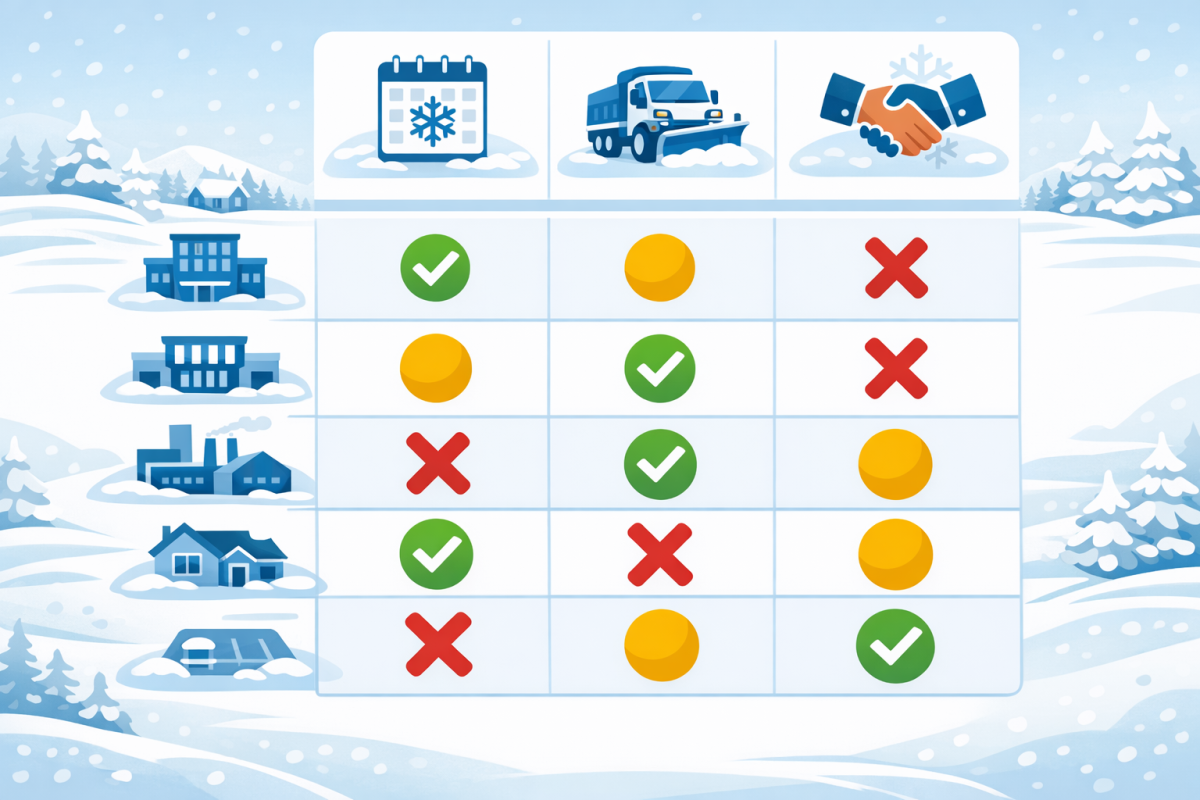
Not every commercial snow removal provider in Denver is ideal for every property type. Below is a high‑level matrix that you can adapt to your portfolio.
Best‑Fit Service Approaches By Property Category
| Property Type | Best Contract Model | Key Priorities | Watch Outs |
|---|---|---|---|
| Apartment complexes & HOAs | Seasonal or hybrid | Sidewalk safety, stairs, parking stall clearing | Under‑scoped handwork, insufficient ice monitoring |
| Retail strip malls & shopping centers | Seasonal with open‑by times | Early morning access, high visibility, hauling | Piles blocking sight lines or signage |
| Industrial & production facilities | Hybrid or per‑push | Dock access, drive lanes, wide‑area plowing | Inadequate loader capacity, lost production time |
| Churches, schools, institutional | Seasonal with strict triggers | Weekday and weekend schedules, pedestrian safety | Gaps between school/church event schedules and service windows |
| Commercial office and mixed‑use | Hybrid | AM commute clearing, garage entrances, ADA routes | Overpaying for underused weekends or holidays |
| Independent businesses & small lots | Per‑push | Budget control, reliable opening for customers | Slow response during region‑wide events |
You can further refine this by:
- Ranking individual properties by risk (high, medium, low) and operational impact.
- Assigning more robust contracts to high‑risk, high‑impact sites and budget‑sensitive models to low‑risk locations.
- Bundling multiple properties with one provider to improve pricing and consistency.
Key Takeaway: There is no single “best” commercial snow removal service in Denver, only a best fit for each property type, risk profile, and budget strategy. Treat each site as a unique scenario, not copy‑paste from last year.
Cost Drivers, Budgeting, And How To Avoid Surprise Invoices
Price is usually a combination of area size, complexity, snow patterns, and service standards. Understanding these drivers helps you negotiate smarter.
Main Cost Drivers In Denver Contracts
- Site size and layout: Wide open industrial yards cost less per square foot than tight urban mixed‑use developments with underground garages and stair towers.
- Handwork intensity: Walkways, stairs, ramps, and tight courtyards require labor‑heavy shoveling or small machines, which drive up cost.
- Trigger depths and service windows: Lower triggers and shorter response times increase the number of visits and night work premiums.
- Equipment requirements: Need for loaders, push boxes, or hauling equipment adds to base cost but may cut long‑term risk.
- Material types: Treated salt or specialized ice melt for sensitive surfaces costs more than bulk rock salt, but can protect concrete and landscaping.
A mid‑size retail center with ample lot space might see seasonal contracts in a wide band, while a dense multifamily community with heavy handwork can cost more per square foot despite less total area.
Structuring A Realistic Snow Budget
Actionable steps:
- Take your last 3–5 years of snow invoices and calculate an average annual spend per property.
- Add 10–20 percent contingency for outlier winters, especially if you stick with per‑push.
- Align internal expectations. Communicate that snow is a risk management expense, not just a line‑item to minimize.
- Consider multi‑year contracts with trustworthy providers to lock in pricing and smooth out volatility.
Pro Tip: Ask vendors to propose at least two pricing options per site, for example, a lower‑cost, higher‑risk per‑push option and a higher‑cost, low‑risk seasonal option. Present this menu to your ownership or board so they explicitly choose their risk posture.
When To Start Planning And How To Implement Smoothly
Many Denver properties wait until the first forecast snow to scramble for service, which usually leads to higher pricing and weaker coverage.
Ideal Timeline For Contracting
- July–August: Gather historical invoices and incident reports. Define service standards and site priorities.
- August–September: Solicit proposals from targeted vendors who match your property types. Conduct site walks.
- September–October: Select vendor, finalize contract language, and require pre‑season site mapping and staking.
- Winter in progress: Hold at least one mid‑season review for performance, billing anomalies, and any scope adjustments.
Implementation Best Practices
- Standardize expectations across your portfolio, but allow property‑specific nuances where needed.
- Require a single point of contact from the contractor with 24/7 escalation options during storms.
- Set up a clear reporting process for site staff, so they know how to request extra attention or report hazards.
- After each season, review claim history, tenant feedback, and vendor responsiveness to refine your next RFP.
How Snow Removal Denver And Snow Plowing Denver Can Support Your Portfolio
For property managers and owners who want a partner that understands Denver’s unique winter patterns and commercial property demands, Snow Removal Denver and Snow Plowing Denver offers tailored service models for multifamily, retail, industrial, and institutional sites.
Their team focuses on:
- Pre‑season site assessments for HOAs, shopping centers, and campuses.
- Right‑sized fleets of plows, loaders, and sidewalk crews to meet strict open‑by deadlines.
- Detailed documentation, including time‑stamped photos and logs that support slip‑and‑fall defense.
- Flexible contract options, from per‑push for independent businesses to seasonal models for large portfolios.
If you want to evaluate whether their service mix, coverage zones, and contract types are a fit for your properties, you can explore details and request a site review at https://denversnowremovals.com/ – Learn more
Putting Your Denver Snow Strategy Into Action
Your goal is not simply to “hire a plow.” It is to protect people, property, and cash flow through an unpredictable Denver winter. Start by clarifying your risk tolerance and service standards, then choose contract structures and providers that align with your specific property types and operational needs.
Use this season to:
- Map and prioritize each property’s critical routes and high‑risk areas.
- Shortlist vendors who specialize in your asset classes and can document performance.
- Pilot improved contracts at one or two locations, then scale what works across your portfolio.
With an intentional approach, commercial snow removal becomes a strategic advantage instead of a recurring emergency.
Frequently Asked Questions
How far in advance should I secure commercial snow removal in Denver?
Ideally, you should finalize contracts by early fall, around September or October. This allows time for site walks, risk assessments, and staking before the first storm. Late contracting often means your property ends up on an overloaded route, which can delay service during big weather events and reduce your options for favorable pricing.
What trigger depth is recommended for Denver commercial properties?
For most commercial and multifamily sites, 1 inch for sidewalks and 2 inches for parking lots is a solid starting point. High‑risk environments such as medical facilities, senior communities, and schools may need lower thresholds or more proactive de‑icing. Discuss site‑specific hazards like slopes, shaded areas, and heavy foot traffic to fine‑tune triggers.
Is seasonal pricing or per‑push better for HOAs and apartment communities?
Seasonal pricing is often better for HOAs and apartments because it creates budget predictability and encourages proactive service. These communities have high pedestrian traffic and many walkways, so inconsistent clearing can quickly lead to complaints and injuries. Per‑push can work for very small or low‑risk communities, but it exposes the association to higher costs in heavy winters.
How should I compare quotes from different Denver snow removal companies?
First, normalize scope: confirm that trigger depths, response times, and included services are comparable. Then ask each vendor to model total cost for light, average, and heavy snowfall seasons. Evaluate their experience with your property type, available fleet, staffing plans, insurance limits, and documentation practices. Do not anchor only on the lowest unit rate per push or per inch.
What documentation should I expect from a professional snow removal contractor?
You should expect time‑stamped service logs, site maps, and, ideally, before‑and‑after photos for each visit, especially during major events. Many quality contractors also use GPS on equipment to verify presence on site. This documentation is critical for defending against slip‑and‑fall claims and verifying invoices, and it helps you evaluate performance at the end of the season.