
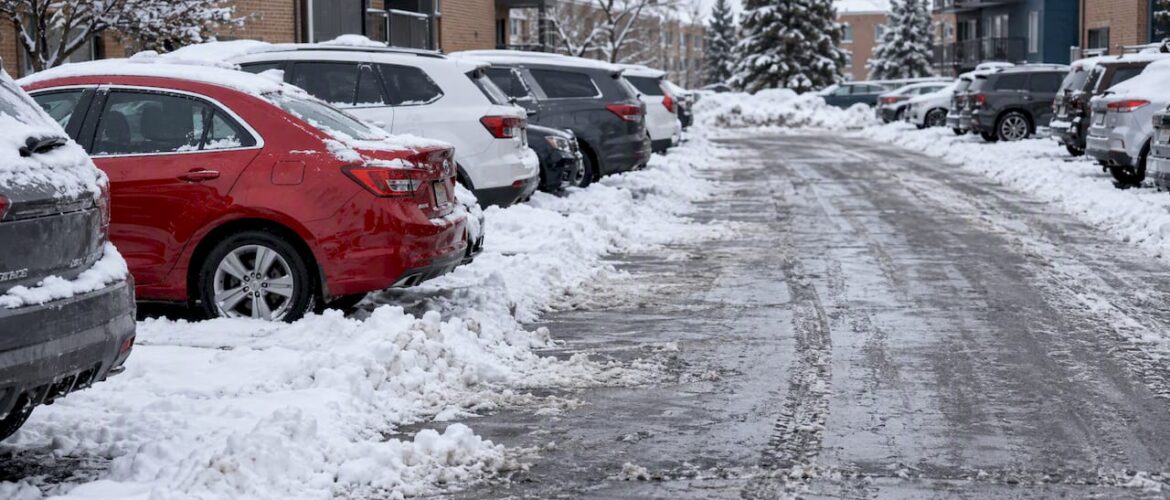
If you rent in Denver, your snow parking rules come from three places: your lease, Colorado law and Denver’s city code. The lease decides most day-to-day questions, such as whether you must move your car for plowing or shovel your own space. State and city rules set the floor, especially for shared areas and sidewalks. This guide explains what each source covers, what to check before the next storm, and what to do when a lot stays buried.
We plow and clear ice for Denver homes, apartment communities and commercial lots, so we see these rules play out on real properties every winter.
TL;DR
- Your lease is the first place to look. It should say whether you have an assigned space, whether you must move your car for plowing, and who clears what.
- Colorado’s habitability law makes landlords responsible for keeping common areas reasonably clean and free of debris, and it gives you a way to report dangerous conditions in writing.
- In Denver, residential sidewalks must be cleared by the next day after snow stops. A notice can lead to a $150 fine if the problem is not fixed within 24 hours.
- Parking on grass, dirt or other unapproved surfaces is a code violation, which matters when a buried lot pushes cars onto the lawn.
- Keep proof of every request you make: dates, photos and written messages.
Table of Contents
- Start with your lease: the rules that apply to your parking space
- Who is responsible for clearing snow in Denver
- Can you park on the street during a Denver snowstorm?
- Parking on grass and dirt: the winter trap
- What to do when the lot or walkways are not cleared
- Berms, gutters and the ice you do control
- A checklist for renters before the first storm
- Our perspective: what we see on the ground
- For landlords and managers: keeping tenants’ parking usable
- FAQ
- Sources
Start with your lease: the rules that apply to your parking space
There is no single statewide rule that says “tenants must move their cars when it snows.” Most of those requirements are contractual. A landlord or property manager usually writes them into the lease, a parking addendum or a community rules sheet, then enforces them with notices.
The Federal Trade Commission’s consumer education materials include a sample rental agreement that shows the kinds of vehicle terms leases tend to contain: limits on the number of vehicles, assigned-space requirements, registration or condition rules, and restrictions on other vehicles or trailers. Read your own lease for the same items.
What to look for
| Lease or notice item | Why it matters in snow |
|---|---|
| Assigned or numbered space | A plow crew cannot clear around a car it cannot move. Assigned spaces tell you where your car should be. |
| Vehicle registration and condition rules | Cars that are unregistered or inoperable are often the first ones flagged for removal, and they block plowing. |
| Move-your-car clause | Some communities require vehicles out of the lot during plowing hours and let you return when it is done. |
| Towing language | Look for who may order a tow, what notice you get and where the car goes. |
| Who clears what | Many leases give the landlord the common areas and the tenant a private patio, porch or driveway. |
| Other vehicles and trailers | Guest cars, boats and trailers can be restricted, which limits where you can put an extra vehicle during a storm. |
If any of this is unclear, ask for the answer in writing before winter. A one-line email saying “Please confirm whether residents must move vehicles during plowing, and how we will be notified” costs nothing and gives you a record.
A typical move-your-car notice
Property managers handle plowing in different ways. One common pattern is a posted window, for example mornings after a storm, when every car must be out of the lot until the crew finishes. Another is a rolling approach where the crew plows around parked vehicles and the manager asks owners to move when needed. The arrangement should be written down. If you only learn about it from a sticky note on the door, ask the office to put it in an email or the resident portal.
For property managers reading this, the way the lot is laid out changes how well either approach works. Our guide to apartment community snow removal from entrances to lots covers how entrances, fire lanes and parking rows are usually sequenced.
Who is responsible for clearing snow in Denver
Three different areas get treated differently: the public sidewalk, the shared parking lot and walkways, and any private space that belongs only to you.
Sidewalks
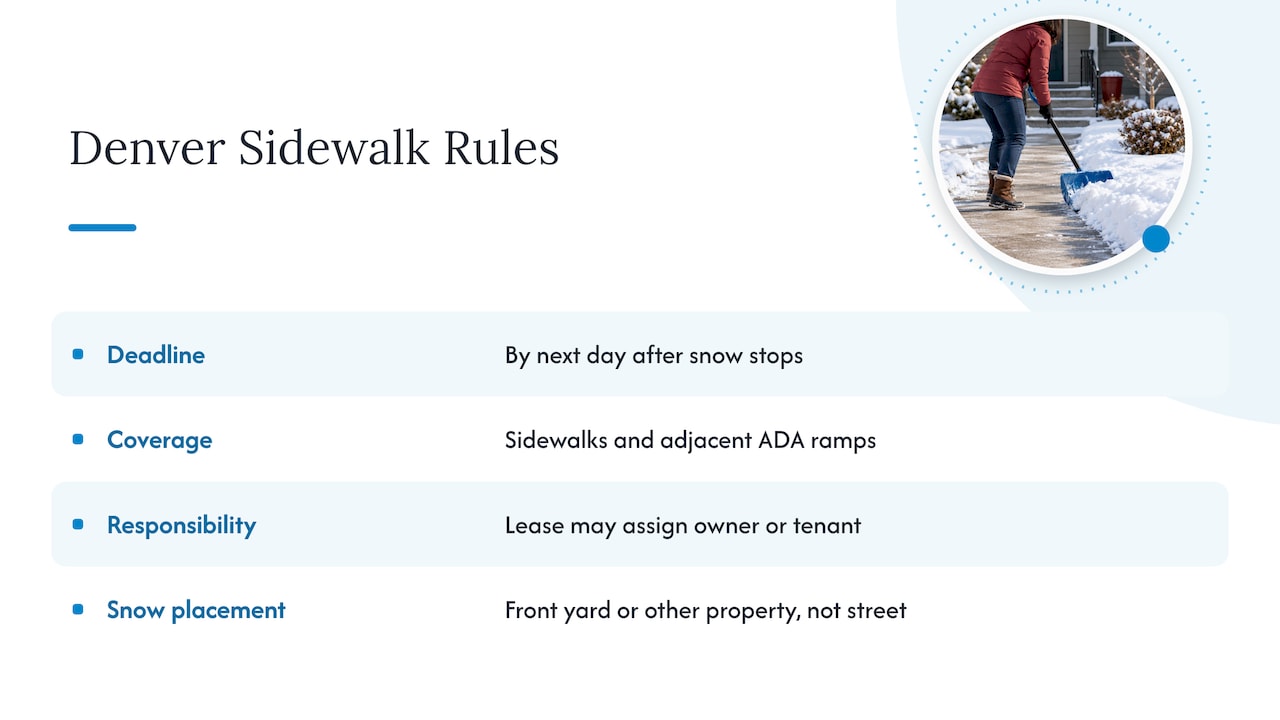
The city is clear on sidewalks. Under Denver’s snow removal rules, property owners must clear snow and ice from sidewalks next to their property, including adjacent ADA ramps. Residential sidewalks must be cleared by the next day after the snow stops falling.
The city’s snow and ice fact sheet says owners or tenants may be responsible for this work. In practice, that means your lease usually decides whether the shoveling falls to you or to the landlord. If you rent a single-family home or a duplex with its own frontage, expect the lease to hand you the sidewalk. If you live in a complex, the landlord or management company normally keeps it.
Owners also have a rule about where the snow goes. CDOT’s guidance says snow from sidewalks should be placed on the front yard or another part of your own property, not in the street. CDOT warns that snow pushed onto or beside public roads can create frozen ruts, drainage problems and sight obstructions. If you are shoveling a rented house, stack the snow on the lawn or beside the walk, not in the gutter.
For downtown buildings and storefronts, our breakdown of sidewalk shoveling rules for downtown property owners goes deeper.
Shared lots and common areas
Colorado’s Warranty of Habitability, in C.R.S. 38-12-505, requires landlords to keep common areas reasonably clean, sanitary and free of accumulated debris, filth, rubbish and garbage. Those common areas include grounds, areas and facilities held out for the use of tenants generally. The statute does not use the words “snow plowing,” so we won’t tell you it guarantees a plowed lot by a certain hour. What it does give you is a basis for raising a hazard with your landlord in writing, and a landlord who ignores an icy shared stairway is taking a real risk.
For a fuller view of how obligations split between owners and tenants, see our guide on Denver property owner snow obligations.
Private spaces
A garage, carport or driveway reserved to your unit is usually yours to clear if your lease says so. If the lease is silent, ask. Do not assume.
Can you park on the street during a Denver snowstorm?
This is the part many renters search for, and it is easy to get wrong. Parking rules do not switch off because it is snowing. In a news report after a heavy storm, Denver Public Works said that parking rules are enforced even during a storm and that drivers could be ticketed. That report is several years old, so check the city’s current street parking page before relying on it, but the lesson holds: posted limits, no-parking zones and two-hour signs still apply under a foot of snow.
Some practical habits help:
- Read the signs on your block before a storm, not after. Snowbanks can hide curb paint and make signs the only clue.
- If your street is posted for street sweeping or time limits, move the car as the sign directs, even if it means digging out first.
- Do not block hydrants, driveways or crosswalks to make a gap for yourself.
- Leave room for the plow. Denver’s residential streets are prioritized after major snow events, but trucks make one pass down the center to keep the street passable. They do not use de-icing materials and do not aim for bare pavement. A car parked tight into a narrow street may get buried by the pass or may block it.
You can also see where plows have been. The city lists a Plow Tracker tool in its online services hub, which is worth checking before you decide whether to move the car.
Parking on grass and dirt: the winter trap
When the lot is full of snow piles, tenants sometimes pull onto the lawn or a dirt strip beside the building. Denver’s Neighborhood Inspections page says vehicles must be parked on compliant, all-weather surfaced areas. Parking on grass, dirt or other unapproved surfaces is a code violation.
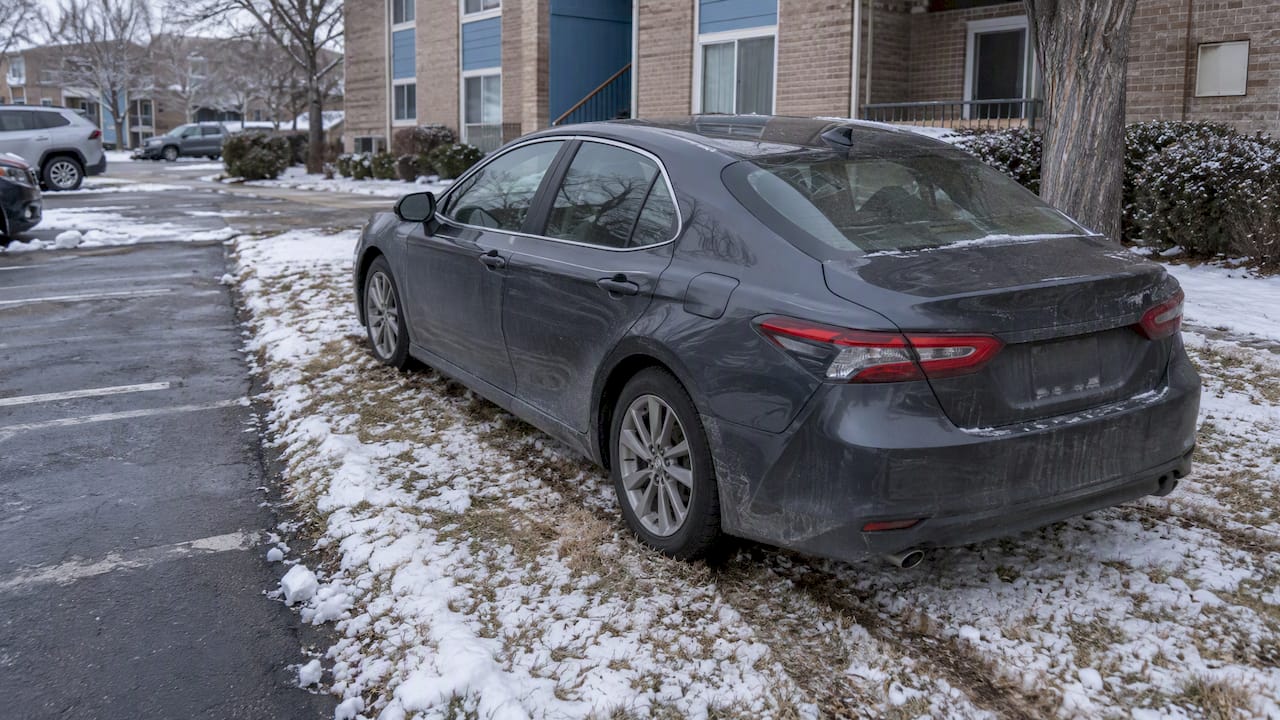
What happens next matters for renters. Code enforcement first tries to contact the tenant or owner. If it cannot reach anyone, it posts a notice on the front door and mails one to the property owner. So a violation you cause on a rented property can land on your landlord, and your landlord may pass the consequences on under your lease.
If the only open space is turf, don’t gamble. Call the office and ask where to put the car.
What to do when the lot or walkways are not cleared
Start with the most practical step and escalate only as needed.
Step 1: Report it in writing
Email or message the landlord or property manager. Give the date, the location (for example “north stairs to Building C”), the condition and a photo with a timestamp. Ask when it will be cleared.
Step 2: Use the statutory notice for dangerous conditions
Under C.R.S. 38-12-503, a tenant may notify a landlord of a condition that is materially dangerous to life, health or safety. The landlord must respond within 24 hours with a plan for remediation. A sheet of ice over the only route to your door is the sort of situation worth documenting this way. For anything beyond routine notices, a tenant attorney or a local tenant-rights organization can tell you how the statute applies to your facts.
Step 3: Call 311 for unshoveled sidewalks
For public sidewalks, the city says that after more than 24 hours following a snow event, residents can contact Denver 311 with the address of an unshoveled sidewalk. For residential properties, inspectors may leave a time-stamped notice, and if the issue is not resolved within 24 hours of that notice, a fine of $150 is possible.
This route is for sidewalks, not for the interior of a private parking lot. For the lot, your leverage is the lease and the habitability statute.
Step 4: If someone is hurt
Seek medical care first. Then document the location, the weather and any earlier complaints, and speak with an attorney about your options. Don’t try to assign fault in a message to the landlord before you have advice.
Berms, gutters and the ice you do control
Tenants often get frustrated by the wall of snow a plow leaves across a driveway. CDOT encourages owners to clear the area near the driveway and roadway before plows arrive, which gives the plow a place to put snow and may reduce large berms across driveway entrances. If you rent a house and the lease makes the driveway yours, that is a useful tip.
Meltwater matters too. The city warns that freeze-thaw cycles cause dangerous ice build-up in gutters and advises owners to keep gutters free of obstructions so water drains. If you see a downspout draining across a walkway and freezing, report that to your landlord. It will not fix itself.
A checklist for renters before the first storm
- Find your lease’s parking and snow clauses and screenshot them.
- Confirm your assigned space and where overflow or guest cars go.
- Ask how plowing notices are delivered: text, email, portal or door tag.
- Learn the posted rules on your street.
- Register and keep your car in running condition so it is not flagged.
- Keep a shovel and a small bag of ice melt in your trunk or entryway.
- Save the property manager’s after-hours number.
Our perspective: what we see on the ground
Most snow parking disputes we hear about are communication problems that began before the storm. A lot is plowed at 4 a.m., residents wake up to a notice nobody read, and cars are stuck behind a pile. The properties that run smoothly share a few traits: a written snow plan, clear notice to residents, a defined place to push or haul snow, and a contractor that documents each visit.
That documentation is not paperwork for its own sake. A dated record of when the lot was plowed and when ice melt went down protects the owner, and it answers a tenant who asks what was done and when. We offer 24/7 emergency dispatch and service visits that are recorded, because the clock starts ticking the moment a walkway ices over and everyone involved is better off with facts.
For tenants, our advice is simple. Do not wait for the second day of a storm to ask about the plan. Ask in October. And if you manage a property, build room into the lot for a pile. A lot with nowhere to put snow forces residents onto lawns and fire lanes, and that creates the violations this article describes.
— Jesse
For landlords and managers: keeping tenants’ parking usable
If you own or manage rental property, the best way to cut tenant complaints is to plan the lot around snow. That includes marking where plows can stack, setting move-your-car windows you can actually enforce, and arranging hauling when piles start to eat parking spaces. Our team handles parking lot plowing, anti-icing pre-treatment and residential driveway and walkway clearing, with seasonal contracts running September through May and free estimates. Residential driveway and walkway clearing starts from $41.25 per visit. Commercial, HOA and apartment pricing is quoted after a look at the site. You can also see the full list of services or read our property manager’s guide to apartment snow removal.
Homeowners who rent out a single-family house can start with our guide to choosing residential sidewalk clearing.
FAQ
Are landlords legally required to shovel snow in Denver?
Denver requires property owners to clear sidewalks next to their property, and the city’s fact sheet says owners or tenants may be responsible. Colorado law also requires landlords to keep common areas reasonably clean and free of debris. The lease often assigns private walks and driveways to the tenant, so read it closely.
Can my landlord make me move my car for snow removal?
If your lease or community rules include a move-your-car clause, yes, the landlord can enforce it according to its terms and any notice requirements it sets. Check your lease for towing language and how notice is given. If there is no such clause, ask the office to confirm the rule in writing.
Can I park on the street while it is snowing in Denver?
Only where the posted signs allow it. Denver Public Works has said that parking rules are still enforced during storms. Look for time limits, no-parking zones and street-sweeping signs, and stay clear of hydrants, crosswalks and driveways.
Can I park on the grass if the lot is full of snow?
No. Denver code treats parking on grass, dirt or other unapproved surfaces as a violation. Code enforcement contacts the tenant or owner, and if no one answers, it posts a notice on the door and mails one to the property owner.
What can I do if the sidewalk or lot is still icy?
Report it to your landlord in writing with a photo. For a dangerous condition, you can use the written notice under C.R.S. 38-12-503, which requires a response within 24 hours. For a public sidewalk that is still unshoveled more than 24 hours after a snow event, call Denver 311.
Sources
- Snow Removal, City and County of Denver
- Neighborhood Inspections, City and County of Denver
- Snow & Ice Build-Up Fact Sheet, Denver City Council
- Online Services Hub, City and County of Denver
- Colorado’s Snow Removal Law, CDOT
- Colorado session law on residential warranty of habitability
- Sample rental agreement, Consumer.gov
- Digging Out: Don’t Get Stuck With A Ticket After Snowstorm, CBS Colorado