

Winter weather management for commercial properties has evolved significantly beyond basic plowing services. A comprehensive snow commercial strategy now encompasses risk mitigation, environmental compliance, operational continuity, and measurable return on investment. Property managers, facility directors, and business owners face increasingly complex decisions when protecting their assets and stakeholders from winter weather hazards while balancing budget constraints and sustainability goals.
Understanding Commercial Snow Management Requirements
Commercial properties face distinct challenges that residential services cannot address. Large-scale operations demand specialized equipment, 24/7 responsiveness, and documented performance metrics that stand up to scrutiny during liability claims or insurance reviews.
Property-Specific Service Scoping
Every commercial site requires a customized snow commercial approach based on traffic patterns, accessibility requirements, and operational hours. Office campuses with daytime-only operations differ dramatically from hospital emergency entrances or retail centers that maintain round-the-clock access.
Key factors that determine service scope include:
- Total paved surface area requiring clearance
- Traffic volume during and immediately after snow events
- Critical access points such as loading docks, emergency exits, and ADA-compliant pathways
- Stacking areas where plowed snow can be relocated without obstructing operations
- Drainage considerations to prevent ice formation during melt cycles
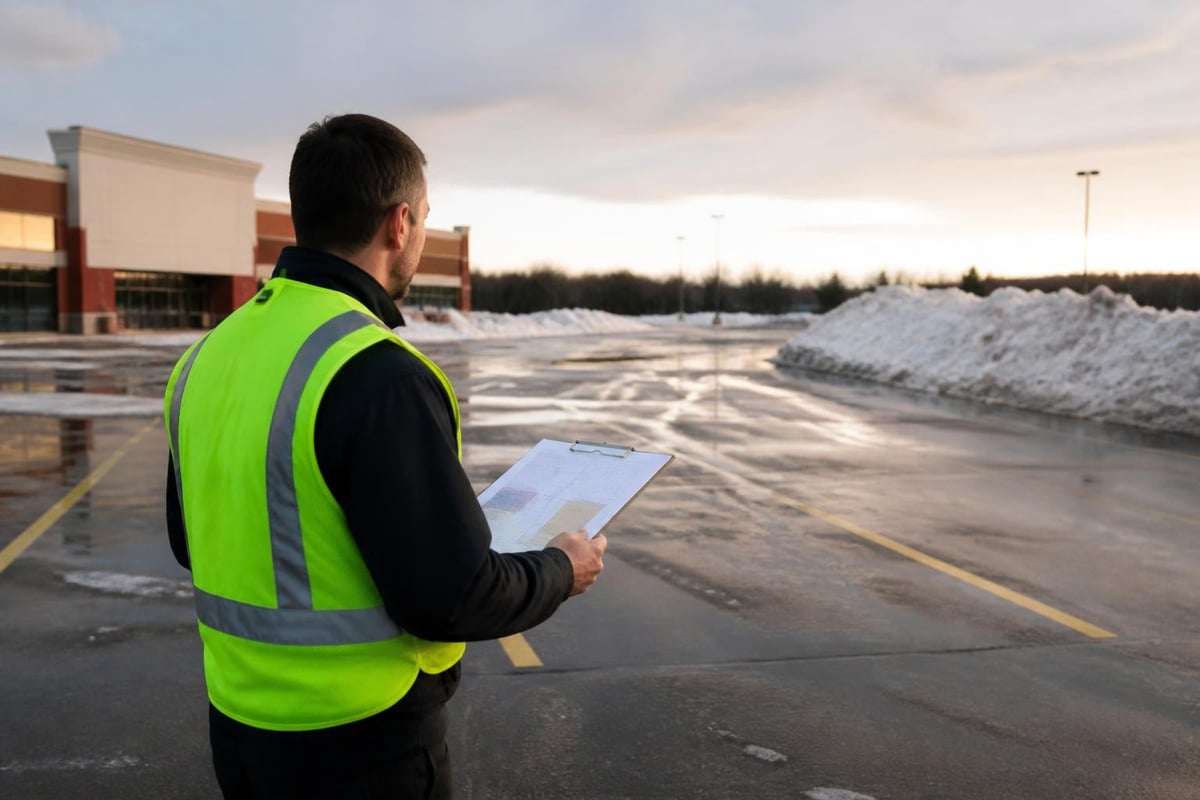
Understanding Denver’s average snowfall patterns by month helps property managers anticipate seasonal demand and budget accordingly. The Denver Metro area experiences significant variability, with October through April representing the primary service season.
| Property Type | Average Response Time | Frequency Per Event | Special Requirements |
|---|---|---|---|
| Office Parks | 2-4 hours | 1-2 visits | Pre-business hours clearance |
| Retail Centers | 1-2 hours | 2-4 visits | Continuous clearing during operating hours |
| Industrial Facilities | 3-6 hours | 1-2 visits | Loading dock priority, heavy equipment access |
| HOA Communities | 4-8 hours | 1-2 visits | Residential street width constraints |
Liability Management Through Professional Snow Removal
Commercial property owners bear significant legal responsibility for maintaining safe conditions during winter weather. Understanding premises liability obligations helps clarify why professional snow commercial services represent risk management investments rather than discretionary expenses.
Slip-and-fall incidents create substantial financial exposure. Documentation of proactive snow removal efforts provides critical evidence in liability defense. Professional contracts establish clear performance standards, trigger depths for service activation, and photographic documentation of completed work.
Contract Components That Protect Your Business
A well-structured snow commercial contract should specify trigger depths (typically 1-2 inches for commercial properties), response time guarantees, and area-specific priorities. Many property managers underestimate the importance of deicing protocols, which often prevent more incidents than snow removal alone.
Essential contract elements include:
- Defined service triggers – specific snow accumulation or ice conditions requiring response
- Response time commitments – maximum elapsed time between trigger and service initiation
- Service area maps – color-coded priority zones with sequence specifications
- Material application rates – deicing product quantities and placement guidelines
- Documentation requirements – time-stamped photos, application logs, weather condition records
- Insurance verification – general liability and workers' compensation coverage confirmation
The Federal Highway Administration’s anti-icing guidance provides technical standards that commercial contractors should reference when developing application protocols. While designed for public roadways, these principles translate directly to commercial parking lots and access drives.
Environmental Considerations in Commercial Snow Operations
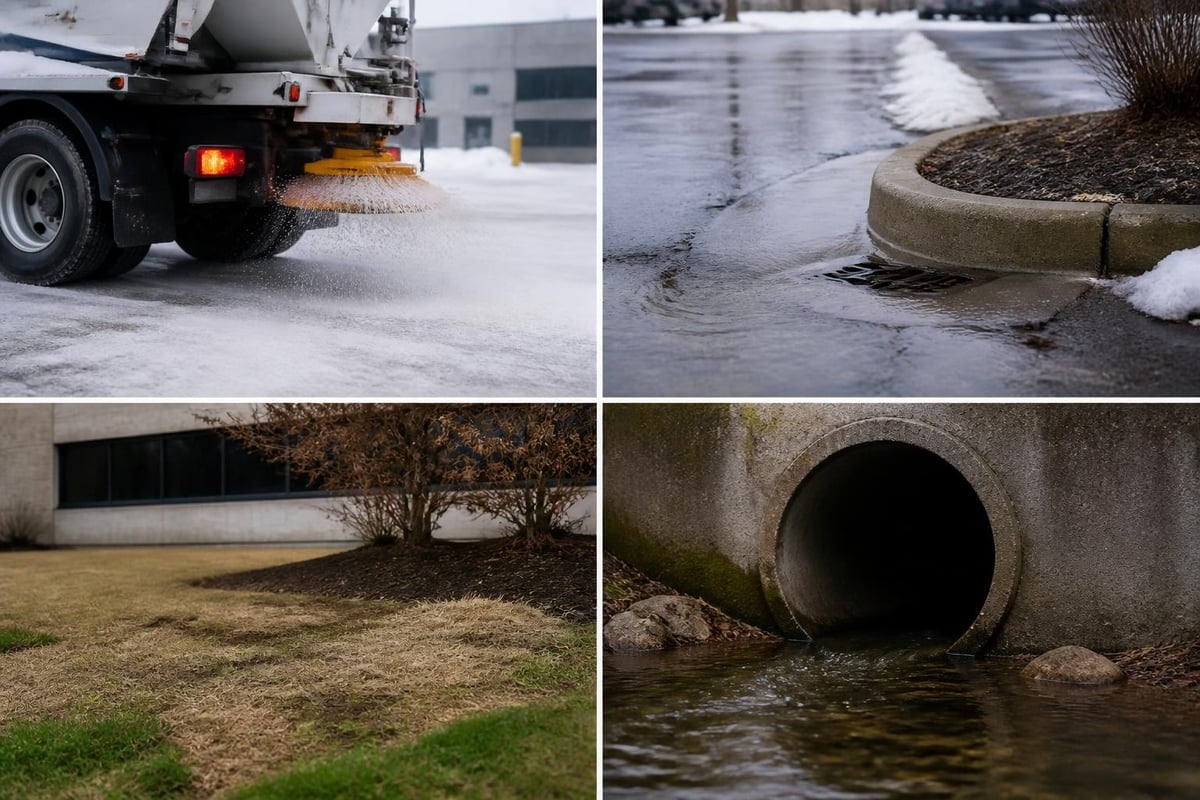
Sustainable snow commercial practices balance safety requirements with ecological responsibility. Chloride-based deicers create long-term environmental impacts that property owners must address through stormwater permits and watershed protection requirements.
Alternative Deicing Strategies
Traditional rock salt (sodium chloride) dominates the commercial market due to low cost and effectiveness. However, environmental concerns and infrastructure damage have driven innovation in alternative products and application methods.
Research from the University of Minnesota on chloride-free winter treatments demonstrates viable alternatives for properties near sensitive waterways or with extensive landscaping investments. Abrasives, beet juice blends, and magnesium chloride products offer reduced environmental impact at varying price points.
The EPA’s guidance on snow and ice management outlines best practices for material storage, application rates, and runoff mitigation. Commercial properties with MS4 (Municipal Separate Storm Sewer System) permits face regulatory requirements that snow commercial contractors must understand and accommodate.
| Deicing Material | Temperature Effectiveness | Environmental Impact | Cost Multiplier | Best Application |
|---|---|---|---|---|
| Rock Salt (NaCl) | 15°F and above | High chloride load | 1.0x (baseline) | High-traffic areas, moderate temps |
| Magnesium Chloride | -13°F and above | Moderate chloride load | 2.5x | Extreme cold, reduced application rates |
| Calcium Chloride | -25°F and above | Moderate chloride load | 3.0x | Severe cold events, fast action needed |
| Potassium Acetate | -15°F and above | Low environmental impact | 5.0x | Environmentally sensitive sites |
| Sand/Abrasives | All temperatures | Sediment concerns | 0.8x | Traction without melting, extreme cold |
A peer-reviewed study on deicing salt impacts reveals significant damage to streetside vegetation, a concern for commercial properties with substantial landscaping investments. Strategic material selection preserves long-term property aesthetics and plant health.
Technology Integration in Modern Snow Services
Advanced snow commercial operations now incorporate weather monitoring systems, GPS tracking, and real-time communication platforms that transform service delivery from reactive to proactive.
Road Weather Information Systems
The FHWA’s Road Weather Information Systems guidance details how predictive data enables pre-treatment strategies. Commercial contractors increasingly deploy anti-icing treatments before precipitation begins, preventing snow bonding to pavement surfaces and reducing total material requirements.
Pre-event anti-icing reduces labor costs by 10-30% compared to traditional post-storm plowing. Pavement temperature sensors, precipitation forecasts, and atmospheric modeling combine to optimize treatment timing.
Technology benefits for commercial clients:
- GPS fleet tracking confirms service completion and provides dispute resolution documentation
- Automated alerts notify property managers when triggers activate and services commence
- Weather integration enables proactive scheduling and staff preparation
- Photo documentation creates timestamped evidence of conditions and completed work
- Material tracking monitors deicing product consumption and cost per event
Budgeting and Cost Management Strategies
Snow commercial expenses represent one of the most volatile budget line items for property managers. Service contracts typically follow per-push pricing, seasonal contracts, or hourly rate structures, each with distinct advantages depending on property characteristics and regional snow patterns.
Contract Structure Comparison
Per-push pricing provides cost certainty per event but creates budget unpredictability in high-snowfall years. Seasonal contracts cap total expenses but may result in overpayment during mild winters. Hybrid models combine base seasonal fees with per-push charges above specified event counts.
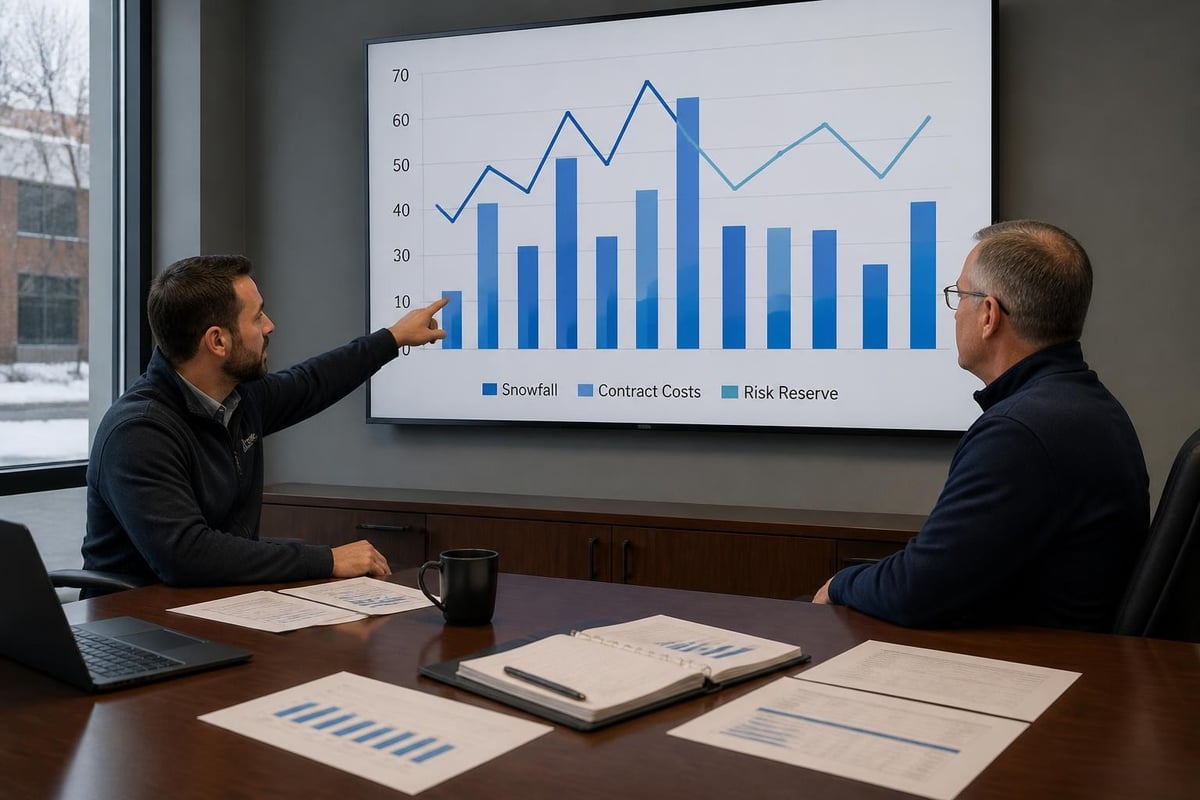
Smart budgeting examines historical snowfall data alongside long-term climate trends. Denver's snow patterns show significant year-to-year variability, making 5-10 year averaging essential for accurate forecasting.
Property managers should request detailed commercial snow removal services proposals that itemize equipment, labor, materials, and administrative costs. Transparency enables accurate comparison across vendors and reveals potential hidden charges.
Vendor Selection and Performance Management
Choosing the right snow commercial provider requires evaluation beyond price comparison. Equipment capacity, experience with similar property types, insurance coverage, and client references provide crucial selection criteria.
Critical Evaluation Criteria
A contractor's equipment fleet must match your property's scale and complexity. Small residential-focused operators lack the loader capacity and dump truck access required for large commercial lots. Conversely, municipal-scale contractors may not provide the responsiveness and detailed attention that smaller commercial sites demand.
Vendor qualification checklist:
- Equipment inventory matching property requirements (loaders, skid steers, salt spreaders)
- Insurance certificates with limits appropriate for property value and liability exposure
- Client references from similar property types and square footage
- Years in business demonstrating stability through multiple winter seasons
- Subcontractor disclosure identifying any third-party service providers
- Material sourcing confirming reliable salt and deicer supply chains
Performance monitoring throughout the season ensures contract compliance. Site inspections following service events verify completion quality, material application accuracy, and damage prevention. Digital monitoring systems now enable remote verification through cameras and sensors at critical property locations.
Regional Considerations for Denver Commercial Properties
Denver's unique climate and geography create specific challenges for snow commercial operations. The region experiences rapid temperature fluctuations, intense sun exposure that accelerates melting, and occasional extreme cold snaps that limit deicing effectiveness.
Altitude and Weather Pattern Impacts
Properties at higher elevations within the Denver Metro area receive significantly more snow than lower-elevation locations. A comprehensive winter maintenance program must account for microclimate variations across different facility locations.
Denver's famous sunshine accelerates daytime melting even during cold periods. This creates refreeze risk during evening temperature drops, making late-afternoon and overnight deicing applications critical for morning safety.
Denver-specific best practices include:
- Afternoon anti-icing treatments before overnight refreezes
- Enhanced drainage attention due to rapid melt-refreeze cycles
- Equipment positioning for quick deployment during fast-moving storm systems
- Material stockpiling accounting for periodic supply chain disruptions
Insurance and Risk Transfer Mechanisms
Commercial insurance policies typically require documented snow removal efforts as a condition of slip-and-fall coverage. Certificates of insurance from snow commercial contractors should name the property owner as an additional insured party, transferring certain liability exposures to the service provider.
Documentation Requirements
Maintaining comprehensive service records protects against fraudulent claims and provides evidence of reasonable care. Digital platforms now automate documentation through GPS timestamps, photographic evidence, and weather condition logging synchronized with service events.
Property managers should archive season-long records including contracts, service logs, material application rates, weather data, and any incident reports. This documentation proves invaluable during litigation or insurance claim investigations.
Professional commercial snow removal contractors maintain their own comprehensive records as standard practice, but property owners bear ultimate responsibility for site safety and should independently verify service completion.
Service Level Agreements and Performance Metrics
Quantifiable performance metrics transform subjective service quality into measurable contract compliance. Snow commercial agreements should specify trigger depths, response times, completion standards, and material application rates with precision that eliminates interpretation disputes.
Defining Measurable Standards
Trigger depth specifications determine when service automatically activates. Most commercial properties set 1-2 inch accumulation triggers for plowing, with lighter accumulations addressed through deicing only. Ice conditions often trigger service regardless of snow depth.
Response time commitments specify maximum elapsed time between trigger activation and equipment arrival on site. High-priority properties such as medical facilities or emergency services typically require 1-2 hour response guarantees, while office parks may accept 4-6 hour windows.
| Performance Metric | Measurement Method | Acceptable Range | Consequence of Non-Compliance |
|---|---|---|---|
| Response Time | GPS timestamp of arrival | ±30 minutes of contract commitment | Service credit, contract termination clause |
| Snow Clearance Depth | Post-service inspection | ≤0.5 inches remaining | Re-service requirement |
| Deicing Coverage | Visual inspection + freeze testing | 100% of designated areas | Material reapplication |
| Damage Incidents | Property walk-through | Zero tolerance | Repair cost reimbursement |
Emergency Response and Business Continuity
Severe weather events test snow commercial provider capabilities and reveal operational weaknesses. Properties requiring continuous access during extreme conditions need contractors with deep equipment reserves, experienced personnel, and proven 24/7 dispatch systems.
Contingency Planning Components
Business continuity during winter weather requires coordination between snow removal contractors, facility management, and operational leadership. Predetermined escalation protocols ensure appropriate response when standard procedures prove insufficient.
Critical facilities should maintain backup contractor relationships to address primary vendor failures or capacity limitations during extreme events. Equipment breakdowns, personnel shortages, or overwhelming regional demand can compromise even well-established providers during severe weather.
Regular pre-season planning meetings between property managers and snow commercial contractors review site changes, update priority areas, confirm contact information, and test communication systems before winter weather arrives.
Quality Control and Ongoing Optimization
Continuous improvement processes enhance snow commercial service delivery season over season. Post-event debriefs identify operational inefficiencies, communication gaps, and site-specific challenges that inform future contract refinements.
Material consumption analysis reveals over-application waste or under-treatment risks. Tracking deicing product quantities against snow accumulation totals and temperature conditions establishes baseline efficiency metrics for comparison across events and seasons.
Client feedback mechanisms, including tenant surveys and visitor incident reports, provide ground-level perspective on service effectiveness. Front-line building occupants often identify problem areas that overhead photography and management inspections miss.
Seasonal wrap-up reviews conducted each spring document lessons learned, quantify total costs against budget projections, and guide contract negotiations for the upcoming season. Professional snow removal providers value this collaborative approach and use client feedback to refine service protocols.
Effective snow commercial management combines technical expertise, proactive planning, and strategic vendor partnerships to protect property values and ensure stakeholder safety throughout Denver's unpredictable winter seasons. Property managers who invest time in comprehensive contract development, performance monitoring, and continuous improvement create resilient operations that maintain business continuity regardless of weather severity. Denver Snow Removals brings 47 years of commercial experience to help property managers develop customized winter maintenance programs that balance safety, sustainability, and cost-effectiveness across the Denver Metro area.