
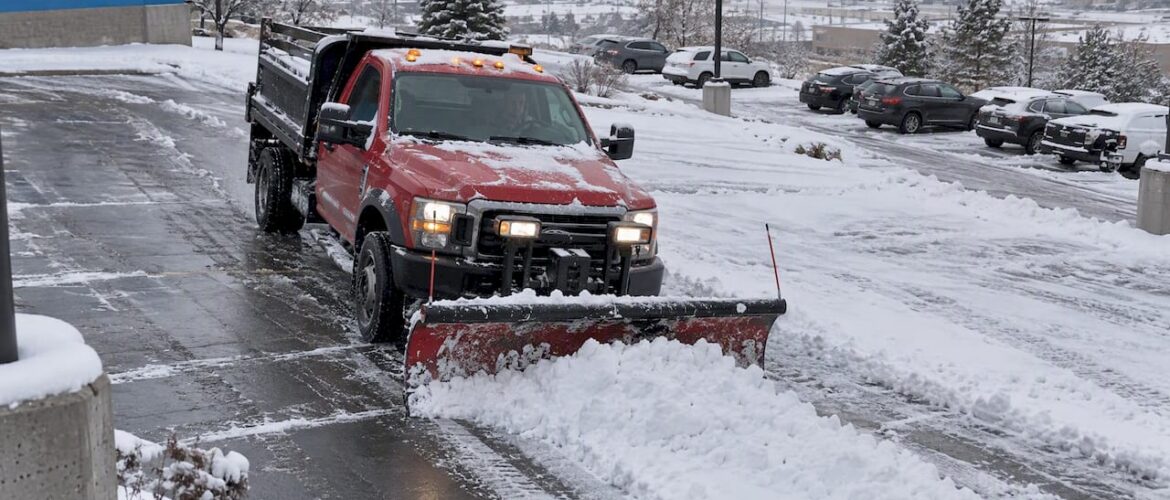
A sloped parking lot is harder to clear than a flat one for three reasons. Snow has to be pushed with the grade, not against it. Meltwater runs downhill and refreezes where cars and people walk. Traction runs out fast on the steepest stretch. The fix is a plan made before the first storm: a set plow direction, a snow storage area, anti-icing ahead of the storm, and a contractor who treats the slope as its own line item. This guide covers each of those for Denver property managers, HOA boards and business owners.
TL;DR
- Plow with the slope when you can, and move snow to storage areas on the uphill or flat side of drive lanes so meltwater does not run across traffic paths.
- Never push snow into the street or right-of-way. Colorado law and local rules prohibit it, so every sloped lot needs an on-site storage plan or hauling.
- Anti-icing before a storm and de-icing after it matter more on a slope than on flat pavement, because meltwater drains to the low point and refreezes there.
- Lots steeper than the usual design range need specialized equipment and extra friction control, so tell your contractor about the grade up front.
- Denver requires sidewalks to be cleared on a tight clock, and a slope next to a sidewalk makes that clock harder to meet.
Table of Contents
- Why slope changes the job
- Know your lot before the first storm
- How to plow a sloped parking lot
- Ice control on a slope: anti-ice first, de-ice second
- Where the snow can and cannot go
- Sidewalks, deadlines and liability
- Our perspective: what we watch on a sloped lot
- What to ask a contractor about your slope
- Sloped lots in the Denver area
- Work with us on your lot
- FAQ
- Sources
Why slope changes the job
Every paved lot has a grade, because water has to go somewhere. Engineering guidance for asphalt lots, such as Utah State University’s facilities standards, typically recommends a slope between 1% and 5% to balance drainage and vehicle safety. That document also notes that slopes above 5% in parking areas make snow removal considerably more complex, calling for specialized equipment and more friction to stay safe.
In practice, a slope creates problems a flat lot never has:
- Plow traction. A loaded plow truck pushing uphill on packed snow can lose grip. Pushing downhill, it can be hard to stop before a curb, catch basin or parked car.
- Meltwater migration. Daytime sun in Denver melts snow on the lot even when the air is cold. That water flows to the low point, then freezes overnight. A sheet of ice often forms at the bottom of the grade, at a ramp, or across a drive lane exit.
- Pile placement. Piles stacked at the top of a slope melt downhill across the lot. Piles at the bottom block drains and trap water.
- Pedestrian routes. Accessible routes and building entries are often at the low point, which is exactly where ice collects.
If your lot falls toward a building, a loading dock or a street, treat the slope as a design fact in your snow plan, not a detail for the driver to figure out at 3 a.m.
Know your lot before the first storm
A ten-minute walk with your contractor in October saves a lot of trouble in January. Walk the property and mark these on a simple site map:
- The steepest stretch. Note where the grade is most severe: a ramp, an entrance apron, a drive lane between buildings.
- Where water goes. Find storm drains, low spots, and any place water crosses a walking route.
- Snow storage. Pick areas that are on the flat or uphill side of drive lanes, away from drains, fire hydrants and sight lines at exits.
- Hazards hidden by snow. Curbs, wheel stops, bollards, islands, light pole bases and speed bumps all vanish under a foot of snow. Mark them with stakes.
- Exit points to public streets. These must stay clear and must never receive pushed snow.
On a sloped lot, storage space is often the limiting factor. If there is no safe flat area for piles, plan for hauling from the start. Industrial sites with large truck courts face the same question, and facility space planning ideas for logistics properties show why reserving room for operations, including seasonal snow storage, pays off.
How to plow a sloped parking lot
The general sequence for any lot is well documented. Landscape Management’s step-by-step plowing guide recommends surveying for hidden obstacles, plowing with the storm when heavy snow is forecast, and clearing areas in front of buildings and doors first. A slope adds the following adjustments, based on how we run sloped lots.
Plow with the grade, and stack away from it
When the lot allows it, drivers push snow downhill along drive lanes toward a planned storage zone at a flat section or the edge. Pushing uphill with a full blade on a steep stretch risks wheel spin and loss of control. The goal is to keep the truck’s weight working for you and never to stop on the steepest part with a loaded blade.
Keep windrows off the low side
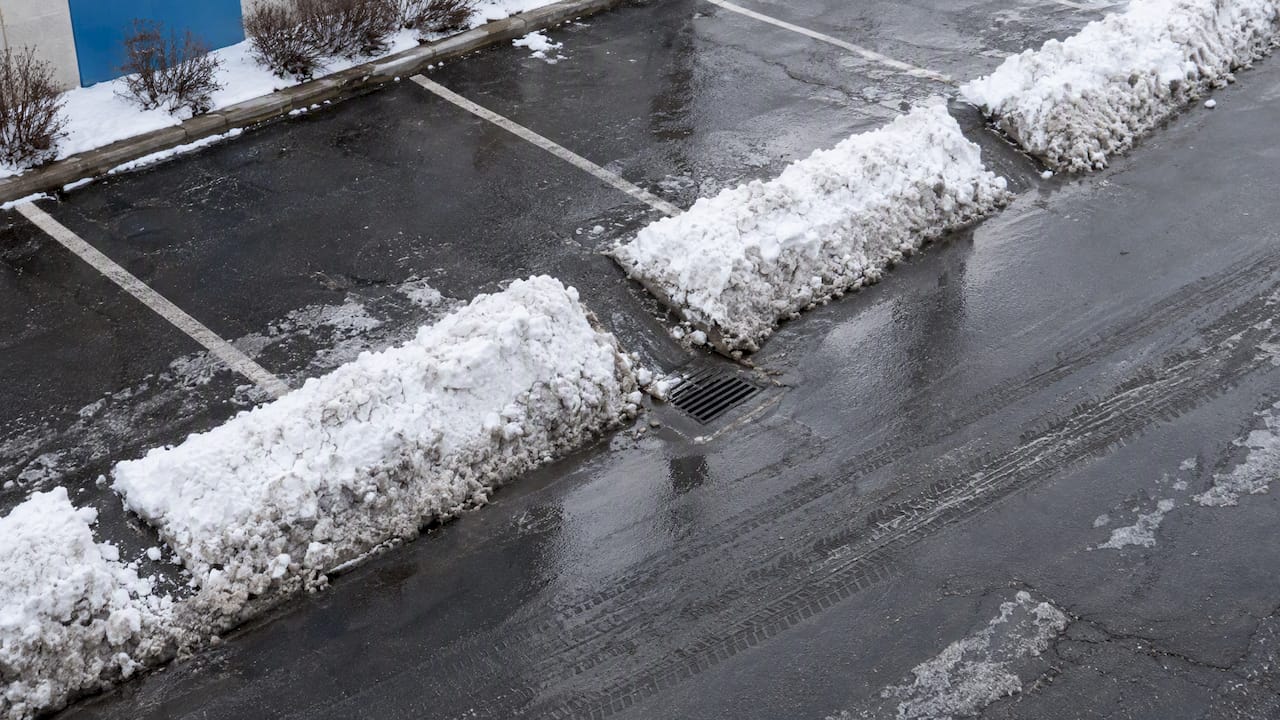
A windrow is the long ridge a plow leaves at the end of a pass. On a slope, a windrow across the grade acts like a dam. Water pools behind it, then freezes. Where possible, set windrows parallel to the slope, not across it, and leave gaps or openings so meltwater reaches a drain instead of a walkway.
Clear in manageable depth
Deep, wet snow on a grade is heavy. Plowing during the storm, in several passes, keeps each push lighter and prevents the compacted layer that turns to ice under tires. Compacted snow is the hardest thing to remove from a slope, because a plow blade skims over it rather than lifting it.
Do not slam piles
Drivers should lift the blade and drop snow at the pile, rather than ramming it. On a slope, hitting a pile at speed can push the truck sideways or leave it sliding toward a vehicle or curb.
Finish the edges by hand or with compact equipment
The steepest corners and tight areas near buildings are often too awkward for a full-size truck. Compact machines, such as a skid steer with a pusher, handle these better, and crews shovel and treat building entries last.
Ice control on a slope: anti-ice first, de-ice second
Plowing removes the snow. Ice control decides whether people can walk and drive on what is left. On a slope, timing matters more than quantity.
Anti-icing before the storm. Applying a liquid treatment ahead of snowfall keeps snow from bonding to pavement, so the plow lifts more and leaves less pack behind. Our guides on commercial anti-icing and ice prevention explain how this works for Denver conditions.
De-icing after the plow. Granular or liquid de-icers go down after plowing, concentrated at the low point, ramps, and pedestrian crossings. If you want to understand product choices, we cover which ice melt belongs where and give a full commercial de-icing playbook.
Return visits. Denver’s sun-then-freeze cycle means a lot that looked clear at 2 p.m. can be glazed by 6 a.m. A slope needs a check or re-treatment after daytime melt, not just after snowfall.
When traction is a design problem
If a ramp or drive lane keeps icing no matter how well it is treated, the issue may be the pavement itself. The Federal Highway Administration describes High Friction Surface Treatment, where a polish-resistant aggregate is bonded to the surface, as a way to add friction where demand exceeds what the surface provides. It is a roadway safety tool, but the principle applies to a persistent trouble spot: ask a paving professional whether the surface or the drainage can be improved.
Where the snow can and cannot go
On a sloped lot, the tempting solution is to push everything to the downhill edge, which is often the street. Don’t. Colorado Department of Transportation says it is against the law for property owners, renters and private snow-removal operators to deposit snow on or next to a public highway. Denver’s own snow and ice build-up fact sheet stresses that pushing or blowing snow into streets creates drainage obstructions, sight-line problems and more ice, and that owners must keep snow within their own property.
That leaves three options on a lot with little room:
- Stack in a designated area on the property, away from drains and exits.
- Use compact equipment to build taller, tighter piles.
- Haul the snow off site. This costs more per visit, but it is the only option once storage is full.
A good contract spells out which applies and who decides when hauling is triggered.
Sidewalks, deadlines and liability
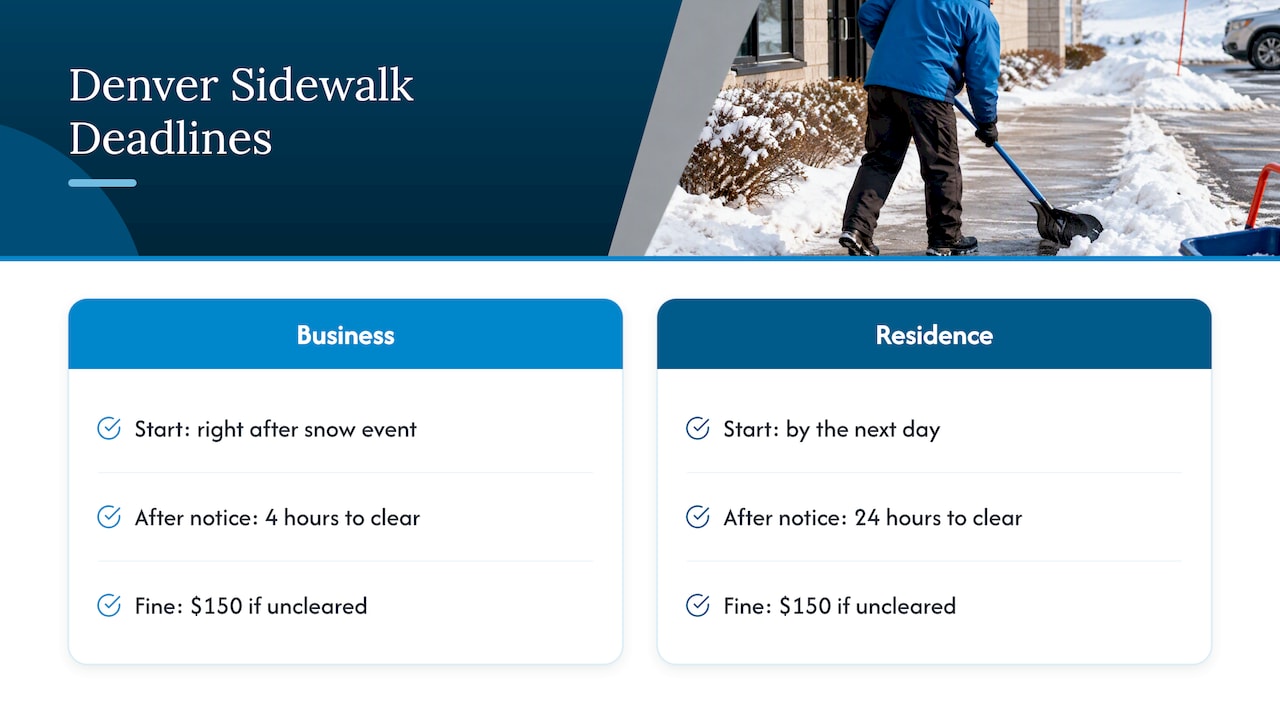
A slope outside your door raises your exposure. In Denver, business owners must begin clearing sidewalks right after a snow event ends, while residents have until the next day. After a time-stamped notice, a $150 fine can follow if the walk is not cleared in 4 hours for a business or 24 hours for a residence.
The fine is the small risk. A fall on an icy ramp is the large one. Documented service visits, with times, areas treated and materials applied, are your best record that you acted reasonably. For the rules in detail, see our guides on who clears what in Denver and the Denver snow alert checklist. If you manage an apartment community, our list of snow removal contract essentials covers liability terms, and HOA boards can review contract terms they should not skip.
If you own an ordinary home with a steep driveway, the same logic applies at smaller scale: plow or shovel downhill when possible, keep snow out of the street, and treat the bottom of the slope first.
Our perspective: what we watch on a sloped lot
After more than 44 years working Denver properties, we have learned that the slope tells us where the problems will be before the storm arrives. We look at three things on the first visit.
First, the low point. If water collects there, ice will too, so it gets pre-treatment and a return visit. Second, the pile locations. A pile in the wrong place becomes next week’s ice sheet. Third, the route a driver takes. A lot we can clear in one pass with commercial-grade equipment is safer and faster than one where the truck has to back up a grade repeatedly.
We also document visits, because on a slope, proof of timing matters if a slip-and-fall claim ever comes up. And we quote after seeing the property, because two lots of the same square footage can need very different work if one has a ramp and the other does not. Our crew is available around the clock, so a midnight storm and a morning freeze do not have to catch you waiting for a Monday callback.
— Jesse
What to ask a contractor about your slope
Send these questions to any provider before signing, and judge them on how specific the answers are:
| Question | What a good answer sounds like |
|---|---|
| Have you walked the lot? | Yes, including the steepest point and the low point, with notes. |
| Where will you put the snow? | A named storage area, plus a trigger for hauling. |
| Do you pre-treat? | Yes, with anti-icing ahead of forecast storms on ramps and low spots. |
| What equipment handles the grade? | Trucks suited to the slope plus compact machines for tight areas. |
| Do you return after daytime melt? | Yes, with a stated re-check policy. |
| What do you record? | Time on site, areas cleared, materials applied. |
| Is the slope priced in? | Yes, written into the contract, not discovered mid-season. |
It also helps to understand the contract model. Our comparison of seasonal versus per-push contracts shows when each makes sense. A sloped lot with frequent refreeze often benefits from a seasonal agreement because ice control is ongoing, not a one-off.
Sloped lots in the Denver area
Denver’s foothills and creek corridors mean plenty of lots sit on real grades, and the climate makes it worse: bright sun, cold nights and fast storms. The City’s snow crews focus on main streets, so your private lot, entrance apron and sidewalks are your responsibility, not the city’s. Whether it is a downtown garage ramp, a mixed-use property, or a retail center, the planning steps are the same. For local detail, see our guides for downtown parking lot planning and mixed-use lots.
Work with us on your lot
We plow and de-ice commercial, industrial, HOA and residential properties across Denver, with 24/7 emergency dispatch, seasonal contracts from September to May, anti-icing pre-treatment, sidewalk de-icing and snow hauling. Residential driveway and walkway clearing starts from $41.25 per visit. Estimates are free, and we will walk your slope with you before quoting. See our parking lot plowing and ice management services or call 303-591-2089.
FAQ
What is an acceptable slope for a parking lot?
Engineering guidance for asphalt lots, including university facility standards, generally recommends 1% to 5%. Steeper than 5% makes snow removal harder and calls for specialized equipment and more friction control. If your lot exceeds that, tell your contractor before the season starts.
What is the best way to clear snow from a steep driveway?
Clear it early and often, working downhill so you are not pushing a heavy load up the grade. Treat the bottom first, where meltwater collects, and keep the snow on your own property. If the slope is too steep or icy to handle safely, hire a pro.
Can I push snow from my lot into the street?
No. Colorado law prohibits depositing snow on or next to a public highway, and Denver’s rules say snow must stay within your property. Plan on-site storage or hauling.
Do sloped lots cost more to plow?
Often, yes, because the work takes more time, more careful equipment choices, extra ice control and sometimes hauling. Prices depend on the property, so we quote after seeing the lot. Ask for the slope to be written into the contract.
Sources
- Snow Removal, City and County of Denver
- Snow & Ice Build-Up Fact Sheet, Denver City Council
- Colorado’s Snow Removal Law, CDOT
- Division 32 Exterior Improvements: Parking Lots, Utah State University
- FAQ: High Friction Surface Treatment, FHWA
- Step by Step: How to effectively plow a parking lot, Landscape Management