
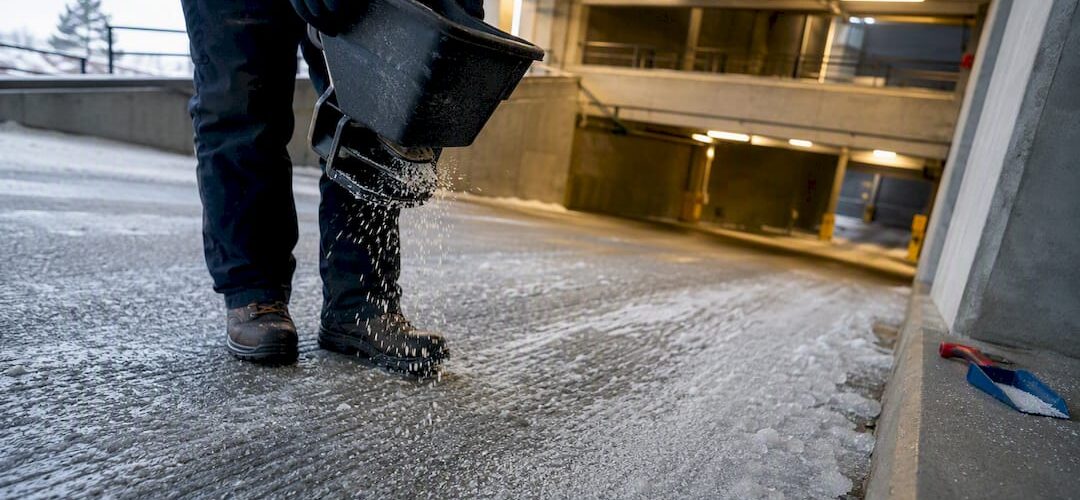
Use garage-safe acetate deicers, such as calcium magnesium acetate or 97% anhydrous sodium acetate (link), for any parking structure. Never apply sodium chloride, calcium chloride, ammonium salts, or urea on a deck; these accelerate reinforcing-steel corrosion and concrete spalling. Protect drains before the storm hits, use rubber-edged equipment instead of steel plow blades, and reserve sand for temperatures where no chemical will work.
TL;DR:
- Acetate deicers like calcium magnesium acetate and sodium acetate provide safer options for garages but cost more than rock salt, with rates tied to temperature and storm type.
- Chloride-based salts and urea cause internal steel corrosion and concrete deterioration by migrating underground, making non-chloride acetates crucial for long-term structure preservation.
- Applying anti-icing solutions before storms reduces chemical use and bond strength, especially in enclosed ramps, but switches to granular products once ice forms.
- Using softer equipment with rubber or polyurethane edges and setting plow height prevents damage to decks, with snow hauling and pile management essential on upper levels.
- Sand only becomes necessary in extreme cold when chemicals lose effectiveness, requiring careful application and cleanup to avoid drain clogging and pavement damage.
Table of Contents
- What Deicers Are Safe for Parking Garages?
- Why Do Chloride Salts and Urea Damage Parking Structures?
- When Should You Anti-Ice Instead of Deice?
- How Should Crews Plow Garages Without Damaging the Deck?
- When Is Sand the Right Call for Ice Control?
- What Should You Budget for Deicer Costs and Contractor Terms?
- What Does a Practical Winter Deicing Checklist Look Like?
- Author perspective: balancing immediate safety with long-term structure preservation
- How Denver Snow Removal Handles Garage-Safe Deicing
- Sources
- FAQ
What Deicers Are Safe for Parking Garages?
Three chemistries dominate the garage-safe category, and each behaves differently once it hits the deck. Calcium magnesium acetate (CMA) is the gentlest option on concrete and steel, though it melts more slowly than aggressive salts. Ninety-seven percent anhydrous sodium acetate (NAAC) works down to about 0°F, making it the workhorse for most Denver winter events. Potassium acetate liquids round out the group and are the standard choice for anti-icing applications before a storm arrives.
- CMA: granular or pelletized, slower melt, lowest corrosion risk
- NAAC: granular, effective to roughly 0°F, strong balance of speed and safety
- Potassium acetate liquid: sprayed pre-storm, ideal for ramps and traffic lanes
Pro Tip: Always pull the safety data sheet and the manufacturer’s technical bulletin before buying in bulk. Acetate products vary by formulation, and application rates on the label rarely match what a contractor actually needs for an enclosed deck.
Expect to pay more per pound than rock salt. That premium is the price of not paying for spalled concrete later.

Why Do Chloride Salts and Urea Damage Parking Structures?
Chloride ions do not just sit on the surface. They migrate through the concrete pore structure, reach the embedded reinforcing steel, and set off an electrochemical reaction that expands as it corrodes, cracking the concrete from the inside out. Urea and ammonium-based deicers cause a related problem: they attack the cement matrix directly, weakening the surface even without the chloride mechanism.
Non-chloride acetate deicers are recommended for garage use specifically because they avoid the chloride-driven corrosion pathway that damages reinforcing steel and accelerates concrete deterioration.
Concrete age matters here too. Chemicals applied within two years of installation can interfere with curing and may void warranty coverage outright. If your deck is new, call your contractor before applying anything.
When Should You Anti-Ice Instead of Deice?
Anti-icing means applying a liquid brine or acetate solution before precipitation starts, so ice never bonds to the deck. Deicing means treating ice that has already formed. Garages benefit disproportionately from anti-icing because enclosed ramps trap moisture and refreeze it overnight, long after an open lot would have dried.
- Forecast shows precipitation within 12 hours: apply potassium acetate liquid with a calibrated low-volume sprayer, targeting ramps and shaded bays first.
- Ice has already formed on the deck: switch to granular CMA or NAAC, applied at the manufacturer’s stated rate, never by eye.
- Temperatures fall below the deicer’s working range: stop chemical application and switch to sand for traction only.
Targeted pre-storm liquid application also reduces how hard ice bonds to the deck, which cuts down on how much chemical you need for cleanup afterward. Keep spreaders calibrated and away from drain inlets to limit runoff.
How Should Crews Plow Garages Without Damaging the Deck?
Most parking structures were never engineered for a full-size plow truck, and treating a garage deck like an open lot is one of the most common and expensive mistakes an operator can make. Live-load limits, membrane coatings, and expansion joints all demand lighter equipment and a different technique.
- Use skid steers or walk-behind units fitted with rubber or polyurethane cutting edges, never bare steel.
- Set plow height to skim the surface rather than scrape it, especially over expansion joints and coated areas.
- Push snow toward designated collection points, not against curbs or drain grates.
- Haul snow off the structure between storms rather than letting piles accumulate on upper decks.
Pro Tip: If your facility has more than one level, assign a specific pile location on the ground floor or an exterior lot. A single overloaded pile on an upper deck can approach the structure’s live-load limits faster than most managers expect.
When Is Sand the Right Call for Ice Control?
Sand earns its place only when temperatures drop below what any chemical deicer can handle. No deicing agent works reliably in extremely cold conditions, so sand becomes a traction fallback rather than a melting solution. It does not dissolve ice; it just gives tires something to grip.
- Apply sand only on active drive lanes and ramps, not across the entire deck.
- Sweep or vacuum sand within a few days of a thaw, before it works into drain grates and joint sealant.
- Budget for cleanup labor. Sand costs less upfront than a full acetate program, but neglected sand clogs drains and grinds into pavement markings, both of which cost more to fix than the material saved.
What Should You Budget for Deicer Costs and Contractor Terms?
Acetate deicers cost more per bag than rock salt, and that gap is the entire point. Switching to non-chloride deicers alongside preventive tactics reduces the corrosion-driven repair bills that dwarf the material cost difference over a structure’s lifespan.
Before signing with a vendor or contractor, ask for:
- A current SDS and technical bulletin for every product they intend to use on your deck
- Documented application rates tied to temperature and storm type
- Contract language specifying non-chloride materials and equipment restrictions (no steel blades)
- Reference to corrosion or concrete-compatibility testing behind their product choice
Put these terms in writing. A verbal promise to “use the safe stuff” is not enforceable when spalling shows up two winters later.
What Does a Practical Winter Deicing Checklist Look Like?
Forty-four years of clearing Denver garages and lots teaches you that the plan matters more than the product. A written pre-storm and post-storm routine keeps crews consistent, even when a storm hits at 2 a.m.
Pre-storm:
- Confirm drain inlets are clear and unobstructed
- Stage skid steers with rubber or polyurethane edges, not steel
- Confirm approved deicer inventory (CMA, NAAC, potassium acetate) on hand
Post-storm:
- Sweep residual sand or granular deicer away from drains
- Inspect deck surface, joints, and coatings for new damage
- Log application rates and locations for warranty and budget records
| Checklist item | Why it matters |
|---|---|
| Drain inspection | Prevents ponding and refreeze on lower levels |
| Non-steel equipment | Protects membrane coatings and joint sealant |
| Approved deicer list | Avoids accidental chloride application by crew |
| Post-storm sweep | Reduces drain clogs and marking wear |
Request a site assessment if your facility has never had a formal winter maintenance plan drawn up. A short walkthrough catches drainage and joint issues before they become chemical damage.
Author perspective: balancing immediate safety with long-term structure preservation
Property managers under pressure want ice gone in minutes, and acetate deicers simply don’t work that fast. The honest answer for stakeholders is that slower melt is the tradeoff for a deck that doesn’t need $200,000 in concrete restoration in five years. Frame it as repair-cost avoidance, not inconvenience.
Call a structural or corrosion engineer whenever you see rust staining, cracking near joints, or spalling that exposes rebar. That is not a maintenance problem anymore; it is a structural evaluation issue. Facilities that treat deicing as a one-off product swap keep repeating the same damage cycle. The ones that build a documented, temperature-triggered winter program stop guessing every storm and start protecting the asset year over year.
— Jesse
How Denver Snow Removal Handles Garage-Safe Deicing
Denversnowremovals is the direct alternative to piecing together your own deicer purchases and hoping your maintenance crew applies them correctly. Our teams already carry garage-appropriate acetate materials and calibrated spreaders, so you are not stuck sourcing SDS sheets and training staff on application rates yourself.
We run parking garage snow removal programs across the Denver Metro area with skid-steer equipment and rubber cutting edges built for deck surfaces, not open lots. Seasonal contracts lock in your approved deicer list and application schedule before the first storm, and our 24/7 crews respond the same night snow starts falling rather than waiting for a callback the next morning. If your garage also has ramp-specific icing problems, our ramp de-icing guide covers that separately.
Request a free site assessment and get a snow plowing quote before the next system moves through Denver.
Sources
- Smart Snow Removal Practices for Parking Garages – International Parking & Mobility Institute
- Are You Using the Right Deicers for Your Parking Facility? – Cryotech Deicing Technology
- Clearing parking garages – SIMA professional guide
- Plowing and Deicing Strategies for Parking Garages – FacilitiesNet
FAQ
Are Parking Garages Safe in Severe Weather?
Parking garages are generally safe in severe weather when drains stay clear and snow piles are managed within live-load limits, but ice buildup on ramps and upper decks raises fall and vehicle-slip risk if left untreated.
How Much Does It Cost to Have a Parking Lot Plowed?
Costs vary by property size, contract type, and storm frequency; seasonal contracts typically offer more predictable pricing than per-push billing, and a site assessment gives an accurate quote for your specific structure.
Can Ice Be a Liability Issue in Private Parking Lots?
Yes. Property owners and managers can face liability for slip-and-fall injuries on private lots and garages if ice was not reasonably addressed, which is why documented pre-storm and post-storm procedures matter.
What Dissolves Ice Quickly on a Parking Deck?
Granular NAAC and CMA dissolve ice effectively on garage surfaces without the corrosion risk of rock salt, though acetate products generally melt more slowly than aggressive chloride deicers, which is the tradeoff for protecting the concrete and rebar underneath.